
Wednesday, March 25, 2026
Home Blog Page 96

It’s those Damned Drums

Or was it ‘cursed’?  Imagine a night in a tent near the jungle far away from civilization, hearing native drums, possibly heralding an attack! Was it a quotation from Rider Haggard or Rudyard Kipling? During the war we were urged to collect waste paper and take it to school. I collected from our neighbours and if they donated books which I had not read, I held them back, to take them in a small wheel barrow to school after reading. This was how I came to be acquainted with Rider Haggard’s books, such as ‘She’.
I think those ‘damned drums’ were parodied in subsequent comedy programmes, but it refers to drums beating out a message, not music. Another non musical use of an instrument we noted when at Stonehenge for the Midsummer Sunrise some years ago, as we heard the modern day Druids blow long horns to the four quarters of the horizon, to celebrate the movements of the sun and moon. But when was music introduced?
My maternal Grandfather, the gardener, produced his sharp knife and cut a corn stalk, notched it and formed a whistle, or hooter. He also showed me how to hold a blade of grass between my palms and blow, to whistle.
No doubt early man found this out too. He probably found he enjoyed hitting one stick against another and then blowing on animal horns. Once the Bronze Age arrived, cymbals followed and a variety of drinking vessels could be bell like. Perhaps the Iron Age introduced the Anvil Chorus! (We have been told that the Blue Stones of Stonehenge can ring like a bell, so maybe in a circle they could produce a peal?).
The Bible records a variety of early instruments, the flute, lyre, harp and trumpet. Some of these were found in the ashes of Pompeii. Later Chaucer and Shakespeare wrote of other musical instruments and dancing. When Oliver Cromwell and the Commonwealth took power anything frivolous, one might say happy, like dancing and singing, was banned, except for the military drum beat and bugle. Even the Maypole was outlawed!
Other early instruments included Shawms, Sackbuts, Gemshorns, Cornetto, Crumhorns, Viols, Rebec, Tabour, Curtal, Lute and Serpent. These are nowadays eclipsed by Keyboards, guitars and drums, well amplified! Recently I heard a group with a male and female vocalists and thought they sing pleasantly, if only the bass beat was not so loud. This may be my age!
Thomas Hardy, in ‘Under the Greenwood Tree’, has Spinks say ‘Dancing is a most strengthening, livening and courting movement, ‘specially with a little beverage added’!’ Later ‘the fiddlers’ chairs have been ‘wriggled by the frantic bowing of their occupiers, …about two feet’. This was at the ‘Tranter’s Party’, when also the bass-viol was played and the cider barrel lubricated the country dancers.
A little more demure, ‘for all her bouncing handsome womanliness …. her freshness’ but to others ‘a fine and picturesque country girl’, was Tess. Then ‘a bevy of girls dancing without male partners … white-frocked maids’, a country dance in a field around midday, from ‘Tess of the Durbervilles’. One of Hardy’s poems, ‘Seen by the Waits’ has echoes of this, when ‘We went to play a tune, To the lonely manor-lady, by the light of the Christmas moon. …. We violed till, upward glancing, To where a mirror leaned, It showed her airily dancing, Deeming her movements screened; …
Dancing alone in the room there, Thin-draped in her robe of night; Her postures, glassed in the gloom there, Were a strange phantasmal sight’.
Hardy loved the ladies, as most of us do! William Barnes has a dialect poem, ‘Bob the Fiddler’, with some lines :
‘Oh! Bob the fiddler is the pride, O’ chaps an’ maidens vur an’ wide –
He’ll zing a zong, or tell a story, But if you’d zee en in his glory, Jist let en have a fiddle. At Maypolen, or feast or feaeir, His eaerm wull zet off twenty peaeir, An meaeke em dance the groun’ dirt-beaere.’
To move briefly into Wiltshire, its dialect poet, Edward Slow, describes ‘Tha Carter’s Winter Zong’, with a chorus – ‘Vor roun tha blazin Kitchen vire, We drink an smoke away, We tell ower tales, an zing ower zongs, An kiss tha maidens gay.’ Of course fewer smoke than when those lines were penned. A little game for those who have read up to this point – how many of the foregoing words were underlined by the computer Spellchecker and how many were not understood? One surprising village instrument which I saw as a child, but our local poets did not mention was the Carpenter’s saw, played with a bow, like a fiddle, the saw being flexed for more effect.
We hope we don’t have jungle drums for our AGM, but we do anticipate some local songs and tales afterwards from ‘Chris and Friends’ on Oct 11th, 2.30pm in Bridport United Church Main Hall, East Street. All welcome, non members £2. More details from 01308 488034.

Cecil Amor, Chairman, Bridport History Society. Tel: 01038 456876.

Humphrey Walwyn 10/11

So, I’m sitting here at my computer with a cup of coffee and a bag of sweeties by my side. My hands are raised over the keyboard and I’m about to start typing but… I’ve now completely forgotten what I’m supposed to be doing. Am I writing an email to our plumber about the dripping tap or a thankyou letter to Cousin Catherine for my nice new pair of blue socks (wrong size, but it’s the thought that counts). No? Well then, I’m sure I’ve been asked by a local councillor at a party to pen a poem in praise of the new Dorchester-Weymouth Olympic dual carriageway. Er… I don’t think that’s needed today. I’m still racking my brain but nothing clicks in my head—this is getting ridiculous. Perhaps I’ll concentrate better if I thoughtfully nibble a pink marshmallow…
Ah, of course—that’s it! Marshmallow immediately reminds me of the Marshwood Vale magazine and I now recall it’s time to write my article for October! How could I forget such a thing?
Perhaps this happens to you too. Do you sometimes go upstairs and then have no idea what you’re doing up there? You even have to go back downstairs again to try and remember what it was you wanted to do. Or do you occasionally open the larder door, look at a shelf or two and then close it again because you can’t remember what you were looking for? Yes, I thought so. You see, we’re all doing it!
Part of this forgetfulness is possibly due to my advancing years, but I think I’ve always been a bit absent minded. I remember completely forgetting the time of my train when going back to school for the new term which resulted in a firm ticking off from the Headmaster. I lost school books, my tennis shorts and rugby boots with predictable regularity (sometimes willingly I have to admit). Later on in my twenties I remember being in a complete panic when I lost my car keys—not just once but nearly every week. It became an embarrassing habit and I tried everything such as tying them round my wrist with a bit of string or hanging them up on a large red hook right in front of my nose by the front door, but nothing worked—they still went AWOL. I swear they moved by themselves secretly at night just to annoy me. I eventually bought a special radio remote key ring so I could press my bleeper and the keys would whistle in reply wherever they were hiding. Of course, I then lost the bleeper which rendered the entire exercise useless. It got so bad over the years that for a time I stopped driving anywhere—not because I couldn’t find the keys when setting out, but in the certain fear that I’d lose them when I reached my destination and be forced to take an expensive taxi home. Like from Yorkshire back to Dorset…
I have over the years discerned several theories on forgetting things. One is that ladies lose more things around the house than men. Yes, girls it’s true, but read this whole paragraph for a more balanced view. Perhaps it’s because men have the advantage of shoving everything into their pockets (which then empty their contents all over the floor when we hang up our trousers resulting in complete loss of coins, cufflinks and credit cards). However, before any angry ladies swipe me over the head, I definitely believe that girls are much better at finding things than boys. Females retrace their steps carefully and work out logically where the lost item must be while men lose their patience and their cool, stamp their feet impatiently and go out and buy a new ‘whatever it is’.
And then there are people’s names at parties, on the phone or—and this one’s particularly awkward—those little chance encounters in the street. It is most embarrassing… I know the face, I recognise the voice and the accent. I might even recall instantly the name of his dog and their awful spotty child, but I have no idea who he is. Did I meet him on holiday in Cornwall ten years ago or was it only a fortnight ago at a drinks’ party in Devon? Of course he knows exactly who I am, but I can’t let on that I don’t know him from Adam. Whoever Adam might be…
All I can do is just smile a lot and utter well meaning pleasantries in the desperate hope that some sort of clue will arise during the conversation. I venture forth into unknown territory:
“And so how is…” I pause.
“Dorothy?”, he interrupts. “Oh, she’s very well, thanks”.
Bother! This doesn’t help me one little bit. The only ‘Dorothy’ I know starred in the Wizard of Oz and this guy (whoever he is) is much too young to be married to Judy Garland.
Of course much of this forgetfulness can be selective. I can choose not to remember many things because I don’t really want to know about them. These include dental appointments, boring town hall meetings, writing to my bank manager or having tea with my aged Aunt to discuss her cat’s sciatica. However, don’t be fooled. I can recall instantly the facts that really matter such as the dates of every battle fought by Napoleon or the number of soldiers and elephants who crossed the Alps with Hannibal. I’m also good at local knowledge like the locations and permissible dates of all dog friendly beaches in Dorset and Devon and the number of lamp posts at Crewkerne station. I missed a train there once and spent two hours counting them. I could possibly make a lot of money by joining a local pub quiz team and helping them win every national trophy by correctly answering all questions featuring my specialised subjects. These include such diverse topics as military history, fishing, history of computers, horror movies from 1955 to 1995, the geography of Malta and lists of ingredients used in Thai cooking. So, I really know what’s important in life! If only I could find my car keys, I could drive to the BBC Mastermind auditions in Bristol…

Jim Potts

“I was born in Bristol but when I was eight we moved to Castle Cary. I’ve always thought of myself as a South Somerset man. We used to go to Yeovil to see the optician or to go to the cinema. On rare occasions we’d go back to Bristol or cross the county line to Sherborne, in Dorset, to buy school uniforms. I went to school at Hazlegrove House in Sparkford and then to Kings School, Bruton. I felt just as much at home in Dorset as in Somerset, as we’d often go on day trips and outings to Weymouth or West Bay.

It seems I did quite well at school and it seemed logical to try to get into university. There was one particular English teacher who saw potential in me, although I don’t think I realised that potential until after A Levels. After university I went to London. I wasn’t quite sure what I wanted to do. I was interested in filmmaking but it was very difficult to get into the industry in those days. I thought of joining the BBC or the British Council (because I wanted to travel), but instead I went to Greece and taught English for a year in Corfu, where I met my wife, Maria. I then returned to study filmmaking at Bristol University. In August 1969 I got married and was employed by the British Council, where I was given additional training in educational television and film production.

My first posting was to Ethiopia, as a producer of television programmes, a British aid and technical assistance project. It was widely believed that the media could make up for the shortage of teachers, not just to teach the children, but that you could, in the process, actually train many hundreds of teachers. I also shot some film of the famine at that time, and when it was shown on schools TV in Addis, children and parents were asking ‘what are we going to do about it’. It was only later when Jonathan Dimbleby made his documentary, The Unknown Famine, that the rest of the world saw what was going on. So I was there at the beginning of the revolution, when Emperor Haile Selassie was overthrown and we had the Derg ― the provisional military government. It quickly became difficult to operate. The Ethiopians suffered what was called the White Terror and Red Terror. People started killing each other on the streets, settling old scores. I spent five years there and then I went to Nairobi and did a similar job, seconded to the Voice of Kenya and the Institute of Mass Communication. We made 16mm films about modern methods of teaching science and other subjects, and training new Kenyan staff at the same time.

After Nairobi I went back to London as a media consultant and editor of a journal called ‘Educational Broadcasting International’. I travelled to places like Ghana and Singapore, running courses in filmmaking for development purposes. In 1980 I was offered the job of British Council Regional Director for Northern Greece. We had a large cultural and English teaching institute in Thessaloniki. The role involved a mixture of cultural relations work, arts and staff management. One evening our building was bombed. We were actually showing Death on the Nile. Somebody must have put a bomb in the dustbin outside the library. Luckily nobody was killed. It was never clear who did it. We must have seemed a soft British target. Two years later one of my friends was assassinated in Athens. He was the Deputy Director; he was going home at lunchtime, and he’d given a lift to one of the Greek librarians. He was shot through the head when stopped at a traffic light and the bullet killed the librarian too. For many months my wife, children and I were given police escorts armed with machine-guns.

For a while, life seemed as insecure as it had been in Africa, where we had barred windows, to deter thieves from breaking in. During the early days of the Ethiopian Revolution we woke up to the sound of volleys of rocks being hurled onto our tin roof ― very disorientating with a young baby in the house.

In 1986 I went to Czechoslovakia as Director of the British Council/ Cultural Attaché. There, the Secret Police ― the StB ― took a much greater interest than I appreciated. Almost every place I went they were recording and following me. Some days, I was to learn, as many as 27 different cars and agents followed me, swapping over every ten minutes. Many years later, after the fall of Communism, I was given access to the StB files and there were about 1400 pages of reports on me. What a waste of effort! I was just a very straightforward British Council cultural relations worker. I’ve written a book about it but it’s not been published yet. It’s provisionally called The Secret Journals of the Poets’ Revolution. Unfortunately I missed much of the Velvet Revolution as my posting came to an end and I was on a three-month research trip around Eastern Europe when it all started unravelling. I was back in Prague for some key events, and I did watch the Berlin wall come down in November ’89, from my East German hotel room.

I was touring Yugoslavia when things were beginning to heat up there; I interviewed people who were predicting violence. Back in London, I became Head of the East and Central Europe Department and Deputy Head of Europe Division. For nearly three years I had various HQ policy roles, which, at a time when it seemed as if there was a revolution happening every five minutes, with many new building projects, it was a highly pressured, very busy job – and in the days before we even had computers and email. I went to Moscow, Ukraine, Georgia and many parts of the region. It was interesting to be at the centre of it all when these changes and revolutions were happening or just stirring. I went to Albania before we had diplomatic relations with Tirana.

Every posting was like a totally different life. I then spent seven years in Australia and had a leading role in developing and managing the British Government’s first big international campaign ‘newIMAGES’ – which set out to try and modernise the whole bilateral relationship across the board, between Britain and Australia. After that I was posted to Sweden ― so from Sydney to Stockholm ― both beautiful cities by the water, but they couldn’t be more different.

Throughout my career I’ve helped promote the arts, theatre, literature, classical orchestras etc. I’m quite eclectic in my tastes, but I think I always loved rock and roll from the early days of Little Richard and Chuck Berry. I remember buying an early 78 of Elvis’ Blue Suede Shoes in a shop in Bristol where they had these little listening booths. I was absolutely hooked from about the age of twelve. At Hazlegrove we even formed a trio called the ‘Hazlegrove Hepcats.’ By the time I went to Oxford I’d already started collecting blues records by John Lee Hooker, Lightnin’ Hopkins and Howlin’ Wolf. I did some backstage interviews for ISIS, the university magazine, at the American Blues Festivals. I met Howlin’ Wolf and Sleepy John Estes and then, when I made a film in 1964, I managed to interest John Lee Hooker in recording the blues soundtrack I’d written for the film. I’m not a trained musician. I do play some raw, basic blues. It would be generous to say that ‘the lad’s got the soul, if not much technique!’ I’m better on the blues-harp.

I did record my own CD at the Sun Studios in Memphis. The studio wasn’t exactly as it had been in the ‘50s, but it still makes recordings. I recorded there on the 50th anniversary of what many consider the true birth of rock ‘n’ roll, exactly 50 years to the day since Elvis had made That’s Alright, Mama in that same studio. I felt that the spirits that had been there at that historic moment were in there with me. I included my version on the disc and all the songs were a tribute to all the old blues singers who’d recorded for Sam Phillips before he discovered Elvis, Jerry Lee, and Johnny Cash. It was a heartfelt tribute to rockabilly blues, and, for me, it had a very meaningful sense of musical history. Another kind of revolution.

The poet Michael Rosen once played a track from the CD (On the Memphis Road!) on the BBC’s Home Truths in 2005. On the same programme, a week earlier, he’d made the comment about me (as a student at Oxford), that ‘at the touch of a plectrum Jim could transform himself into a Mississippi Delta blues-singer’. Perhaps we’re all capable of many types of self-transformation.

I still keep pretty busy. We’re at the shortlisting stage of a Dorset poetry, prose and photography book project, Dorset Voices, due to be published in 2012 by Roving Press. I recently performed in a blues and gospel-blues concert, part of a music and arts festival hosted by the Anglican Church in Corfu. My wife Maria’s novel, The Cat of Portovecchio, Corfu Tales has recently been published in Greek translation. My most recent publication, The Ionian Islands and Epirus, A Cultural History (Signal Books) was the outcome of years of research. We are both currently engaged in research for new books.”

Rick Stein

Rick Stein talks to Fergus Byrne

Rick Stein is horrified when I tell him that, according to the website Wikipedia, he now lives in Australia. “So that’s why people keep coming up to me in Padstow and saying ‘Oh, are you here for long?’” he exclaims. “That’s baloney, I live here!” For a brief moment I fear I may have inadvertently unleashed a powerful storm but instead he is the height of charm and warmth, and as I write this I see the Wikipedia piece has been changed to point out that, although he lives in Padstow for part of the year, he also has a house in Sydney as well as a restaurant in Mollymook, New South Wales.

He is currently roaming the countryside promoting his new book and television series, Rick Stein’s Spain. As powerful, hearty and rugged as the food it promotes, the book is a weighty hardback containing 140 new recipes. It was inspired by his journey off the beaten track of a country that first caught his imagination as an eight-year-old. He remembers how the poverty, the grey uniform of the Guardia Civil and the galloping statue of El Cid helped form a ‘slightly grim but romantic view of Spain’, that he simply couldn’t shake off.

I share those romantic and enduring memories, though sometimes tinged with a mixture of adventure and awe. Rick remembers first trying cuttlefish cooked in its own ink to show off to his parents on his first trip there, and being impressed that it didn’t really taste very fishy. My first taste of the famous inky stew came after a morning dodging rubber bullets in the old square in San Sebastian. As a rather naive young teen, I shared the dark, somewhat forbidding dish later that evening with a group of what I discovered many years later were ETA supporters – it was only a small relief to find that it wasn’t actually me that was the real target of those bullets.

However, if cuttlefish in its own ink conjures up memories of a darker Spain for me, Rick’s book is filled with the colour and warmth of the Spain that has kept millions of us coming back year after year. One of the things that inspired him to actually write the book was the fact that many friends, who were either Spanish or cooked Spanish food, produced dishes that were so much better than those he had often had in Spain. “So I thought it would be really good to do something like an off the beaten track trip through Spain,” he says. “And of course that works very well in television terms too. Funnily enough, one of the things that for a long time David Pritchard, the Director and I have been toying with, is the idea of going to somewhere like Benidorm or Torremolinos and pointing out that just a quarter of a mile from where I’m standing here, with all the sort of English breakfasts and pints of beer, you can get fabulous Spanish food.” He says the idea was born in Spain when he was filming in Magaluf in Majorca a few years ago. “We were going around asking all these poor British kids what they thought of the local food. And of course, their response was, ‘well we’re not here for the food, sorry’”.

Rick Stein’s Spain is a journey through the very different regions of a country that encompasses many influences: from Galicia with its Celtic feel and the evergreen Basque country in the north, through Rioja, Catalonia, Valencia and Andalucía. Not forgetting the huge expanses of central Spain where the sheer vastness of the country is often breathtaking. Few of the millions of visitors to the Mediterranean beaches over the years will have been aware of the diverse nature of a country that includes Galicians, Basques, Catalans and Castilians, all – in theory – under one flag. I was interested to hear Rick’s view of what, in culinary terms, holds it all together. “Well I think more than anything really it’s the ingredients that hold it together,” he says. “Because although in somewhere like Galicia or Cantabria the type of dishes are quite different from what you’d get in Andalucía, the fact is that they all use olive oil, they all use pimento, they always use tomatoes and lots of garlic; so there is a sort unity in the flavour of the food. It’s the dishes that are a bit different but the ingredients draw it together.”

That diversity of dishes could be said to mirror the character of the people: at times dark and moody with undercurrents of anger, whilst more often than not, warm, friendly and remarkably hospitable. On a recent trip to Cordoba, I visited Bodegas Campos to try their house speciality Rabo de Toro, a bull’s tail stew that they serve off the bone. It’s a remarkably dark and powerful dish which, when Rick ate it in Pamplona, he said must be ‘the butchest dish I have ever had’. He offers his own take on the recipe in the book, Oxtail and Red Wine Stew from Pamplona. Although it may be best eaten surrounded by photographs and prints of bulls and bullfighters and washed down with a glass or two of Navarra wine, there’s no reason why it shouldn’t make a hearty meal for an English winter.

Which is part of what makes Rick Stein’s Spain so palatable. Unlike many books with recipes from Spain, this is Rick’s own take on the foods he encountered, and although imbued with the character of the people, the climate and the countryside, it is still comfortingly very Rick Stein. Comforting too is his never-ending enthusiasm for his food. Pointing out that, foods such as Pimentón, Saffron, Jamón and Chorizo are important elements of Spanish cuisine, he says his latest enthusiasm is for Picada: a mixture of nuts, fried bread, garlic, olive oil and sometimes herbs that are pounded together and introduced to a dish at the end as a thickener. It is used to great effect in his recipe for Clams with a Garlic and Nut Picada.

The book also has a section devoted to Spanish desserts and Rick is quick to point out that, unlike the fare generally offered in most Spanish restaurants, the country offers fabulous dessert dishes that can be made at home. His theory is that puddings in Spain have developed a level of sophistication because of eight hundred years of Moorish rule, ‘the love of sweet, nutty and spicy mouthfuls is very apparent’. In the pretty Andalucian town of Nerja recently I tasted desserts that included delicious Malaga raisins bursting with flavour. Rick has included a recipe for Malaga Raisin Ice Cream with Pedro Ximenez Sherry that is rich, sweet and memorable. Powerful flavours that are a fitting end to one of the better cookbooks to be published this year.

Kate Geraghty

“I can remember wartime as a very small child, seeing my mother in a tin hat going off on her bike to do ARP work. My father worked in the War Ministry reinstating the gas lighting in places that had been bombed, like Coventry. At night I watched Very lights and tracer bullets on the nearby firing range; the front garden was dug up to grow vegetables. I used to be in Sunday School Nativity plays, progressing from being a white angel to a pink one, which meant you could be part of the Shining Throng, although I never got to be the gold angel, Gabriel. I think the dramatic setting of those plays, the darkened church with the tableau magically illuminated, and the inevitable hilarious moments, was probably the beginning of my love of theatre.


We lived in a small village in Bedfordshire, in John Bunyan country, and my father would take us, my brother and sister and me, looking for orchids on the chalk downs of the Chilterns, the kind of experience which I think is at the heart of my love of the countryside. The only way I excelled myself at school was in drama, and once had to perform a piece in front of the whole school; my horrible maths teacher, who invariably made at least one girl cry every day in class, said sarcastically ‘I had no idea we had such talent in our midst’. I still panic with numbers.


Although I wanted to pursue an acting career, my father sent me to a technical college to do combined sciences, because he thought I should become a vet. I was completely out of my depth and finally rebelled. My mother convinced my father that I’d resent him for ever if I didn’t get the chance to try for an acting career, and I was allowed to audition for RADA, but failed to get in and was advised to ‘get more life experience’. I worked on a smallholding for a year, tending pigs and chickens, exercising a point-to-pointer and milking a cow.


I auditioned again at the Central School of Speech and Drama, and was accepted. There, I was told I needed a professional name, so I chose my mother’s family name, Lansbury; her grandfather was the Christian Socialist politician and pacifist George Lansbury. Another granddaughter is Angela Lansbury. Many of my contemporaries at Drama School are still working actors, the most well known being Julie Christie. My first job was with the Royal Court Theatre, in a play starring Rex Harrison; Donald Sutherland had a small part in it as a reporter. I had my 21st birthday when we went on tour to the Edinburgh Festival which was brilliant. Afterwards, I took over a part in The Kitchen, by Arnold Wesker. Amongst the cast were Jeremy Brett, James Bolam, Edward Fox and Glenda Jackson. Then I joined the 1962 Keswick Summer Season weekly rep, with the Blue Box Theatre, which was a truly portable theatre, complete with tip-up seats, a box office, foyer, stage and dressing rooms. We lived in caravans and there was a mobile dining room and bathroom, but you had to light a fire to heat the water when you wanted a bath.

Having met my husband to be, I came back to London and started working in TV including a ‘Monitor’ documentary about D.H. Lawrence. When my boys were toddlers, I appeared with them in Z Cars. I have been in several detective series: a P.D. James, Morse, two Ruth Rendells, Bergerac, The Chief, and Sherlock Holmes. I have only been in two films. Blink and you’ll miss me as the magistrate in A Fish Called Wanda, but you can’t miss me in Ever After as I am there throughout in a quaint, mediaeval hat. The film starred Drew Barrymore and Angelica Houston.


In ’65 I was in the opening season of the Yvonne Arnaud Theatre in Guildford, and played Katya in A Month in the Country, with Ingrid Bergman and Sir Michael Redgrave, which later transferred to the West End. From there I joined the National Theatre Company at the Old Vic led by Sir Laurence Olivier. Many young actors in my group are now stars; Anthony Hopkins, Michael Gambon, Derek Jacobi amongst others. I had only a tiny part in A Dance of Death, with Laurence Olivier and Geraldine McEwan, but the rehearsals were really electrifying, watching the play develop through highly experienced players.


After I left the National I was cast as Charlotte Lucas in a BBC production of Pride and Prejudice. Then I became seriously ill and had a 3 month run appearing in an operating theatre. My wonderful parents looked after my two boys and helped me to recover. Fortunately, more TV followed and I came to Dorset for the first time, on location at Melbury House, Evershot in another BBC Classic Daniel Deronda. As Catherine Arrowpoint, I had to be trained by the Beaminster Bowmen to compete in an archery contest.


I was unhappy being away from my children so often, so I changed career, trained as a teacher, and taught in a Primary school for three years. My concerns for what was happening to the countryside were growing, with wildlife and their habitats disappearing. I reintroduced nature walks, but with health and safety issues they became impossible.


We had come to Seatown on holiday every year since the filming so I came to Dorset for a fresh start after my marriage failed. I started as a supply teacher, but had more offers of TV work, including parts in I Claudius and the Duchess of Duke Street. Eventually the acting had to give way to a permanent teaching commitment. I was asked to teach drama to the older pupils, some of whom found it a bit strange, ‘all that ponceing around on the stage, Miss’, but they were very forgiving and did try to understand the purpose of Drama lessons.


Ann Jellicoe’s first community play opened at Woodroffe School where my boys were, and I thought it completely marvellous. I met Ann and we worked together on the Axe Vale play, a joyful piece called The Tide. Ann asked me to join her on a permanent basis producing The Poor Man’s Friend at Bridport, and that enabled me to leave teaching and gave me a re-entry into the acting profession.


In 1985, after 2 years with an excellent Theatre in Education company in Nottingham, an actress I knew from Somerset wanted to start a theatre company. We co-founded and ran the Somerset and Dorset Theatre Company for 7 years. We were a professional company inviting established actors to join us, our aim being to take theatre to places other companies didn’t visit and performed in theatres, Arts Centres, village halls, hotels, stately homes, schools, a prison, playgroups, and on a steam train.


To me, the two most important things in life are children and the environment, because without a sustainable environment, our children have no future. I’ve been a speaker for Save the Children and support Greenpeace and Friends of the Earth. In ‘82 I joined with others to save some ancient trees on Lambert’s Castle, and later, we formed the West Dorset Safe Energy Campaign and held two exhibitions demonstrating alternative sources of energy such as wind and wave power. We fought the proposal to build a nuclear power station at Langton Herring. Hard to believe now, but there would have been a view from the top of Abbotsbury Hill, past St Catherine’s chapel, to a nuclear power station beside the Fleet had it succeeded. We held a huge picnic there and released balloons to show how far any fallout would drift – the winning balloon reached Southern Germany. People forget or ignore the fact that nuclear waste has a half life of 48,000 years. I’ve always campaigned against nuclear weapons, joined the early Aldermaston marches, and in 1981, helped to form Bridport and West Dorset CND, after showing the banned film The War Game to a packed Bridport Arts Centre. We took coach loads of local supporters to national demonstrations and at Greenham Common we were some of the first campaigners to enter the air base, dressed as waiters and waitresses offering Peace Pies to the guards.


I still try to ‘do my bit’ for the community and have been a Parish Councillor since 1993. I was a founder member of the Chideock Society and in 2000, with my partner, Anthony Broad, compiled A Wander Through Chideock, an illustrated history of the village. Eight years ago I helped start and run The Bopper Bus, a leisure bus for children in and around the Marshwood Vale, which is still going strong.


Recently, I have had some very scary health problems which have clipped my wings and made me take stock of my life. I am extremely fortunate to have enjoyed both my chosen careers, to live in the most beautiful place I know, to have a wonderful partner, two talented musician sons, 6 beautiful grandchildren, 4 gorgeous great grandchildren, loyal friends and a dog who makes me laugh every day. Ha! Ha! Ha!”

Up Front 09/11

For many years in my youth I spent a lot of time enjoying live music. There was obviously no internet in those days and seeing bands often meant trips down the M4 to wait in long queues at places like the Hammersmith Odeon, the Palais, the Roundhouse or a range of other concert venues. At least two or three time a week there was the option to pay a relatively small admission fee to watch good music at local pubs, and with a bit of careful organising, a trip to a summer festival such as Reading or Knebworth was a highlight. For someone on a trainee salary it was an expensive business but as a single person with no responsibilities it was an adventure, socially interactive and undoubtedly socially educational also. A few weeks ago I went to Camp Bestival in Lulworth and along with thousands of other parents watched my children enjoy a huge range of live music during a weekend festival. It looked like a very successful weekend for the organisers and seemed to prove that there is a healthy appetite for live music in the Dorset area. However that appetite doesn’t necessarily filter down to the musicians and local music venues, where young – and not so young – musicians spend many hours playing to a largely unpaying audience. According to a new report, ‘Scene and Heard’: Dorset’s Music Industry, commissioned by Creative Dorset; live music locally is largely funded by the pubs and the musicians themselves. The report points out that, of the more than 400 venues offering live music, there is rarely a cover charge and consequently many musicians are earning an estimated £25 for up to 6 hours work, and that doesn’t include rehearsal time, use of PA or transport. From the venue’s point of view, experience has told them that an admission fee is not an option, and many offer music as an investment in retaining customers. The report points out that this hardly suggests an industry in good health and recommends that Dorset’s music industry should not be left out of future funding plans. With promos already starting for this winter’s X-Factor it’s worth remembering that real music is a million miles away from the TV glitz and needs as much support as we can give it.

Up Front 08/11

At a wedding I attended in Ireland recently there was much talk about austerity. The bride and groom, although already a couple for many years, were embarking on a new life together and I suspect many us older guests envisioned a life for them that would be similar to our own: lots of children with all the joy, emotion and tribulations that accompany them. Attending a christening last weekend I couldn’t help wondering how different my own children’s lives might be as the western world tightens it’s belt, and opportunities that have been available to some generations may not be available to others. Although the average family size in the UK is shrinking, there is growing pressure on the planet’s natural resources and with the world’s population due to hit 9 billion by 2050, organisations like the Optimum Population Trust and individuals like David Attenborough are calling for debate on how to curb population growth. The good new for both of them is that the current austerity measures being introduced in countries throughout Europe, may already be changing habits. A research study, ‘Changing Lives and Times’, funded by the Economic and Social Research Council (ESRC) at Cardiff University has explored the impact of the financial crisis on the daily lives and future plans of new fathers, finding that several men were making significant life changes. Following men through their partner’s pregnancy and over the first year of fatherhood, the study found that men appeared to be particularly anxious about money. One new Dad described how he and his wife decided to stick with one child rather than have the three children they originally planned for, because they could not afford to do so in the current financial climate. Good news for those that complain that parents of large families are irresponsible, as some claimed when Mr & Mrs David Beckham announced the birth their fourth child, Harper Seven, recently. Although I suspect there was more of an outcry about the child’s name than the size of the family.

Michael Feasey

“I was born in Portsmouth, a navy brat. But we never had exotic postings, we always ended up in places like Plymouth and Faslane in Scotland. I did spend a lot of time in Weymouth as a youngster. I remember Weymouth very distinctly as a summer place with peeling paint and windswept sand blown streets My mother was German born, married my father after the war, he was a Yorkshire man. And in deference to her continental background, he would let her keep the rural Germanic traditions in the house. We celebrated Christmas Eve, for instance. Food wise, my dad had grown up with a very austere Yorkshire kind of diet. He quite welcomed the flamboyant variety of food that he was not used to. So I grew up taking a lunch box to school with things like rye bread with cream cheese and salami and a gherkin, which got a lot of strange looks from people who had a jam sandwich and a cold sausage.

After that I went to Scotland. My dad helped build Dreadnought, England’s first nuclear sub. We lived in a small cottage where we ate very much the Scottish traditions of sausage and soda farls and all these other delicacies. But my greatest food memory, certainly from that era, was when my dad was doing torpedo trials. We lived with a Scottish lady who would always give us venison and that was my first taste of venison. I suspect it was poached because a man came to the door with a brown paper parcel under each arm and I think a sixpence or a shilling, passed between them. And my father asked the lady after a while, what was in the other parcel. She eventually admitted it was salmon and when my father asked if we could have some she said, “Commander, fish is not fit food for man.” And that shocked me because we’d always regarded fish as absolutely acceptable. When I was about 10 she gave me a shotgun. This was at an age when I wasn’t even allowed an air rifle by my parents. She told me to go and hunt for rabbit up the glen at the back. And I just thought I was in heaven. She was a widow woman and she thought it was a man’s job to bring home the rabbit for the pot.

I remember good food on board ship, I had my first fillet of beef carved at a function. And although forces cooking has always got the billycan reputation, the officer’s mess was pretty damn good. It was the era of sherry and canasta. I remember the sea being frozen over and the postmen bringing the mail over on a sledge, those were very innocent days of growing up.

And then it was boarding school in Wiltshire. I belonged with the crowd that had a good time and partied, and I was actually expelled from there. I was never academically brilliant, I scraped by. In the ‘50s, I remember my father went to Trinidad on a trip and he sent us back a crate of fresh grapefruit, which I’d never had. I think it was one of my earlier taste epiphanies, a fresh grapefruit. And he brought back Calypso music and a whole waft of exotica, and suddenly at the parties, there was still sherry, but also cocktails. Suddenly there was limbo dancing – my mother’s friends in slacks and beehive hairstyles doing limbo.

I suppose the food influence was always there, because my mother came from very much a peasant background. They believed that if you didn’t have art on the walls or silver on the table, even if you were of quite poor means you could demonstrate hospitality by the stiffness of the drink and the size of the portion on your plate. So there was always this philosophy in our house that all was well if your fridge was full. I learnt a lot of my early cooking hints from my German grandmother. I had oxtail and neck of lamb years before it ever became, in modern British terms, fashionable.

I had kids very young and went to Oxford and worked on a rose growing plantation. With my first born on the way I decided that I had to do something settled and sensible. I had a vision of going to work in publishing. In the ‘vision’ I would be sitting in a tweed suit with a bow tie flicking through the odd manuscript, sipping cognac, smoking cigars and occasionally going out for very long lunches. But I worked for Robert Maxwell, so it was anything but. It was a sausage factory of production. Maxwell, as we know, was quite an entrepreneurial character. He had a lot of agendas that we didn’t know about at the time. But we did regard him as a rather charismatic figure. I was involved with the NUJ at the time and came across him, as it were, head to head at the negotiating table, and he was a man who was not to be trusted – which we found out in much later years was par for the course.

Then I went to work on one of Richard Desmond’s music magazines and I went from moving typography around a page at the desk one day, to sitting at Monterey Jazz Festival the next day drinking beer in the sunshine and thinking, “This is it.” Because I’d always been a music fan. So suddenly I was having supper at a table with Peter Tosh, Rory Gallagher from Taste and all my kind of childhood heroes. I then moved to the advertising side which didn’t sit well with me because I had to wear a suit. I went from one extreme to the other.

After that I helped start an outside catering company. We worked on a few feature films. I remember doing the War Requiem particularly. The young German soldier was an unknown called Sean Bean. The nurse was Tilda Swinton, she was quite mesmerising. The old soldier was played by Lawrence Olivier. My infamous part in it all was that after a late shoot in Kent, we were in some chalk pit which was made to mimic part of the First World War trenches, we had a late break where I cooked something, I think it was a shepherd’s pie. It was a typical paper plate and plastic fork kind of job, and he died that night and all the crew teased me mercilessly saying that I’d killed England’s best actor of the 20th century.

Around then I teamed up with a chap I had worked on a commercial with and we became the Cooking Duo. That was the Nosh Brothers. The idea was that we were going to try and create a stir in an industry that had become a little bit above itself. We regarded the world of food as rather over embellished. We’d just come into a recession where we couldn’t afford to eat out how we’d like to.

Marco Pierre White was the new enfant terrible. People were still speaking French in kitchens and as non-trained chefs, but what we call good eaters, we couldn’t understand why this was. We started the restaurant, in ’92, ’93, in Fulham and had an influx of chefs who came from New Zealand and Australia. We had to close in ’96 because I had a bad car accident so it was impossible for me to continue in the kitchen. And we realised that, rather than get other people in who would not follow our style, we would rather close and go elsewhere. So we opened up in All Saint’s Road after that.

And the whole Nosh philosophy was all about robust cooking and getting away from the needless frills that we paid through the nose for. We had a very mixed bunch. There were a lot of rock ‘n rollers, a lot of actors. And minor royalty. We had engagement dinners with Viscount Linley and would tease him to see if he could sort our chairs out. I used to feed lunch to Laurie Lee who wrote Cider with Rosie. It wasn’t quite Chelsea Arts Club, and it wasn’t quite some of the nightclubs but it was a strange mix. We had a lot of fun. One day we were arrested by the Special Branch for trying to depose the King of Tonga. That was the sort of mad thing we used to do. He was losing weight and planning to democratise the island so we wrote a letter to him saying, “Obviously becoming thinner, as your girth diminishes you are losing the grip on your kingdom. So because we have more massive girth than you, we would ask you to desist, cease and abdicate in favour of us. If girth is a mark of nobility, then we would like to take over.” Special Branch swooped in to check us out. We ceased the partnership around the millennium as I had become ill with diabetes. So I decided I had to click down a gear which is how I came back to the country. After writing the Eat Dorset book I cooked at The Fox Inn at Corscombe and would have stayed there if I hadn’t become ill. I think I mourn for my lost cooking activity, but then I’ve done a hell of a lot. So it’s not like I’m clamouring to get back. It’s a hot sticky old environment, the kitchen. I am nearer 60 then 50 these days so I’m allowed to slow down. As I put on my Facebook page: ‘People always remembered me as the short cropped haired chef, now I am the slightly sort of eccentric furniture restorer.’ But I don’t want to lose touch with food and people, because that is where my passion is”.

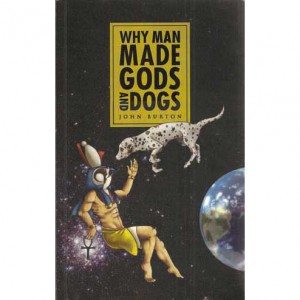
John Burton – Man, Gods and friendly animals

As a youngster he was always taught to avoid discussing religion and politics in the pub. So, over a cup of tea, Fergus Byrne talked to John Burton who has written a book making a case for science.

John Burton, a retired medical scientist living in Somerset, makes a striking impression on many levels. His six foot four frame fills the doorway as he welcomes me to his home. Whilst admiring his garden, adorned with what turns out to be his own sculpture, he points out that he doesn’t do much gardening these days – it’s a long way to the ground and bending down isn’t quite as easy as it once was. In his spare time, as well as sculpting he also paints, although his real hobby is book binding. With a very successful career in medical science behind him, three children and assorted grandchildren, as well as a successful writing career, it’s hard not to wonder how he has had time to paint, sculpt and bind books. Harder still to understand where he got the time to write, contribute to, and edit a range of medical textbooks and journals, including a translation of Lazare Riviere’s 17th century book on the diseases of women.

However it is yet another of his literary achievements that has led me to come to meet him. Last year he also found the time to write and publish his first non medical book entitled, Why Man made Gods and Dogs. It is an intriguing, lucid and thought provoking book, providing an overview of modern science as it relates to religion.

Although his life long interest and knowledge of science has naturally led him to question theological thinking over many years, he says that a recent review of science as it relates to religion has led him to the conclusion that man’s belief in God has arisen as a result of evolution of the human brain, and that man made God as a psychological construction here on earth, rather than God having made man as a physical construction some time ago. In his book he tries to give a simple account of the scientific facts that led to this conclusion, as well as including comments from his own personal experiences. The book is laid out as a series of questions that he has tried to answer or at least offer a view on. They cover a range of topics from Multiverse, the theory that there may be many Universes, to the question of whether evolution can produce moral behaviour. He tackles subjects such as physics and spirituality, life on earth, and commonality of religious beliefs across cultures, as well as questions as diverse as ‘Do animals have gods?’ and ‘Who is the Flying Spaghetti Monster?’ A man with a great grasp of the value of humour, he originally conceived the book as a helpful overview of scientific thinking to allow teenagers the opportunity of seeing alternative views. However he admits that the book got a little more advanced and now believes it may well be more relevant to those of university age and beyond.

Based on his background, many might not have expected such high life achievements for John Burton. He explained that neither he nor his pathologist wife Pat had family that had attended university. “We were from that lucky generation of grammar school people” he says. “My father left school at thirteen and he went to work down the coal mine, as did his father. I think his first job was leading pit ponies up and down. He was a bright chap. As soon as he got old enough he left the mining and went to join the army. He was quite big and strong and became a Grenadier Guards boxing champion.” John’s parents impressed on him the need to pass the eleven plus and ‘get on in life’ at a time when the height of ambition would have been to get an apprenticeship at Rolls Royce in Derby. Although initially interested in English and Art it was pointed out to him that without ‘connections’ he could never get a job with an English degree and ‘nobody could make a living with Art!’ He subsequently followed advice to do science because ‘you could get on in science’. And although maths wasn’t his strong point and neither were chemistry and physics, he did like biology. “And then I realised that you could be a doctor” he says. “For previous generations it was actually quite difficult if you’d not got the right family background”. He managed his university years on a maintenance grant and bemoans the fact that grammar schools have since been more or less abolished and the future of free university is in jeopardy. He recalls that there were only two boys that did biology in his sixth form class and both became professors. One became a professor in zoology and John became a professor in dermatology. “And you know both of us were from ordinary homes in pokey little mining towns.” he says. “I don’t think that opportunity exists in the same way now”.
Although Why Man made Gods and Dogs is self published, John Burton’s introduction to writing and publishing was from an era when publishers enjoyed long lunches with potential writers. He remembers how, when he had an idea for a medical text book, he rang Churchill Livingstone in Edinburgh saying “You won’t know me but I’m Dr Burton. I’m a lecturer in medicine and I’d like to write a book for you.” One of the directors took him out to lunch, liked his idea and decided to publish it. As John remembers, “It sold like hot cakes, went into six editions and was translated into many languages.” As a result he was able to buy a car. “Prior to that I was on a bicycle” he says. “I was able to buy a Citroen Dianne on the royalties.”

Times have moved on and John has no expectations of buying a new car on the royalties from his latest book. As the son of a devout Christian mother and an atheist father I was interested in what initially sparked his decision to write the book. He explained that, as two of his children had each married a partner with a strongly religious mother, he felt uncomfortable with the fire and brimstone doctrine that held that his grandchildren had God always watching them, and that they should live in fear of going to hell if they didn’t conform to religious dictates. “I didn’t really entirely agree with this” he says. “And I thought it’s only right that these kids should, as they grow up, learn the other side of the story and learn some science at the same time. So this was an attempt originally to be aimed at teenagers who I hoped would start to think for themselves. It was an effort to update them about modern science and to teach them you can think about things without going to hell, and that you can still be a moral person. Then the more I thought about this I thought, why is it that Richard Dawkins and the Archbishop of Canterbury could never agree? The evidence is the same, they’re both educated well meaning people – how is it they just can’t seem to agree? And then I began to think that it’s quite likely that humans, as they evolved from the apes and got intelligent enough to ask scientific questions which they couldn’t answer, would have to impute some supernatural power, which in other words is a sort of god. And over the thousands of years obviously there have been many different gods, the ancient Greeks, the Egyptians, the Romans and there’s still thousands of different religions, and they can’t all be right. It’s obvious they can’t all be right. And it’s purely a question of this need for a father figure and an afterlife and an explanation of things we don’t understand. And which particular god you choose is what you’re taught by your particular culture. It’s usually your parents but it could be your school or your friends and so on.”
John’s other motivation was also grounded in the realities of modern living. He was concerned about how some religious interpretation can inflame hatred and violence. He says “The Koran does inflame a lot of these young suicide bombers and they do believe in paradise and the virgins.” He feels that if young people were given the opportunity to question their regimented indoctrination they may not blindly follow teachings that lead to needless destruction of lives.

He doesn’t hold out much hope that elderly religious people will be influenced by his book in any way and has found many friends and neighbours happy to engage in friendly debate. He even agreed to a debate with the local vicar in his village hall. “Loads of people came” he says. “And both of us were very happy with the outcome. It was a very civilised debate and the audience all joined in, there were humanists and devout religious people and they all made their point in a very nice, pleasant way without shouting at each other. I’ve got nothing against the benign Church of England who, by and large, do nothing but good. What is practised around this area is totally admirable.”

In the introduction to Why Man made Gods and Dogs John Burton points out that, although an atheist for many years, he once attended an Alpha course organised by the Church of England and there met two religious people that surprised him and gave him pause for thought. One was a Professor of Biochemistry who believed that the technical difficulties are so great that only a supernatural God could have created living cells from inanimate chemicals. The second, a physicist, had become more and more spiritually inclined as he learnt the complexity of the mathematical and physical laws which govern the universe. He had come to believe that a supreme intelligence must have set up and organised the immutable Laws of Physics, so that the Universe could develop and life could form. Following this introduction, John goes on to produce powerful scientific arguments and present a case for atheism. However, as he told me before I left him at his home in the gentle Somerset countryside, “When it comes down to it people will still say ‘Well it’s all very well what you say John, but I still think there’s something…’” And as he admits himself “I can’t argue with that.”


Why Man made Gods and Dogs, ISBN 978-0-9565588-0-0 is published by Perrott Press and copies can be ordered from perrottpress@hotmail.com. Any profits from the sale of the book will be donated to the National Eczema Society.

Up Front 07/11

Reading about Margaret Thatcher recently, I was surprised to note that it was only a little more than twenty years ago when she was still in power. I had thought it was much longer – something about the Thatcher years has always made me think of the dark ages. Much as I appreciate the ‘bigger picture’ and the benefits of strong leadership, I can’t help but remember that there were a lot of very unhappy people living throughout that era. The Iron Lady often trampled over opposition with more testosterone than a South African rugby team. On one level she was massively successful, but could she have been even more successful? Whilst more and more women are assuming roles as managers, a new study has revealed that rather than using what should come more easily to them, like empathy and compassion, many women are increasingly turning to the stereotypically ‘male’ traits, such as aggression, to get results. The study by Professor Paula Nicolson, from the Department of Health and Social Sciences at Royal Holloway, University of London, says that instead of fighting their ‘natural instincts’ women should embrace them, because displaying emotional intelligence is the key to being a better leader. Although Professor Nicolson’s study predominately concentrated on management in the NHS, she says the results can be applied to any leaders whether in politics, banking or even football management. Professor Nicolson said, “It’s almost like women feel that they must ‘act like a man’ and overly develop traits often more associated with power-hungry city traders. This notion drives women away from a healthy assertiveness into emulating more aggressive male models.” Whilst many television programmes actively encourage bullying, underhand techniques and pushiness to gain success, it is a system that has no real long term benefit. Trampling on the little people and talking tough around a boardroom table may make one feel powerful and important, but working for a long term solution for everyone is a far more valuable goal.