
Sunday, March 22, 2026
Home Blog Page 42

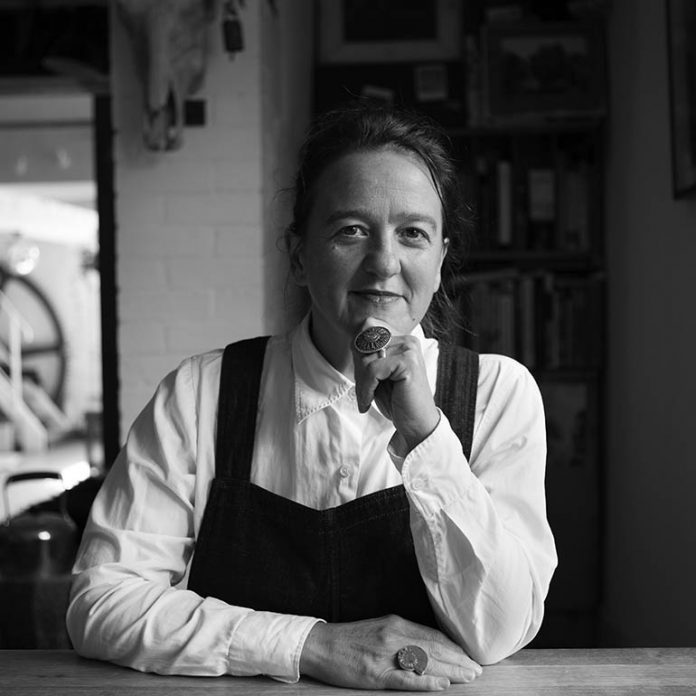
Tania Kovats

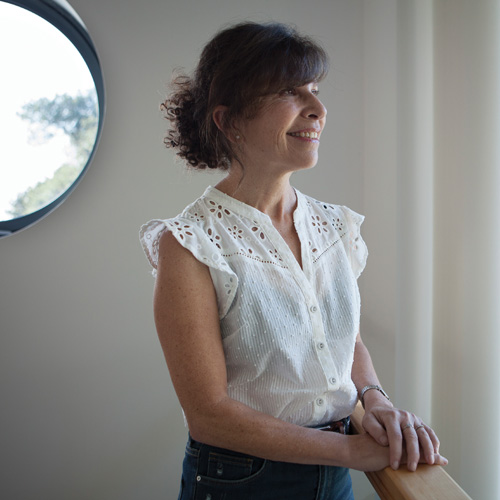
Robin Mills met Tania Kovats at Luppitt, East Devon

‘I was born in Whitehalk in Brighton but spent most of my childhood in Patcham, close to the Sussex Downs. My mother is English, my Dad Hungarian. When war broke out in 1939 his family faced a terrible decision: their oldest son would remain in Hungary, but they would get their youngest out of the country. At the age of nineteen he was moving across war ravaged Europe, sometimes in camps for prisoners of war with other displaced people. He saw nothing of his family for many years, during which time both his parents died. His first trip back wasn’t till the 70s. I was terrified he wouldn’t come back from behind the “Iron Curtain”, which in my imagination was a real metal barrier he needed to pass through. That family decision to send away a son with the possibility of never seeing him again must have been dreadful. I am mindful that many people face such decisions in the world’s current migrant crisis.

My parents met at the engineering factory where they both worked, my Dad 20 years older than my Mum. Within 2 weeks of meeting him she’d broken off her existing engagement, and they married. When I was about five my Dad went to work on the oil rigs in Saudi, well paid years which enabled them to buy their first home. My Mum was now becoming a successful businesswoman sending personnel out to the rigs, and became the main breadwinner of the family. My Nan lived with us and was there for my brother and I—she always held the family together. After my Grandad was discharged out of the merchant navy with ill health, they worked in service; Nan was the housekeeper and he was the butler, but he kept getting the sack for being argumentative. My Nan was resilient and faced the challenges of an itinerant life—two young kids to look after as well as her ailing husband. I have some strong matriarchal roles in my family.

I think I knew from an early age I wanted to be an artist. At the age of 11 I asked to go to boarding school. I loved it, despite it being a slightly freaky all-girl catholic convent school. I had a supportive art teacher, and my time in the art room gave me the solitude I needed to survive living communally. From there I went to an extremely progressive experimental sixth form boarding school. Turns out it was where a lot of creative London intelligentsia sent their kids—their parents were poets, performance artists or produced operas—a completely different cultural and political world. Some sixth formers set up Kids against the Bomb—the youth wing of CND. I went to philosophy lessons with the headmaster who set about convincing me that God didn’t actually exist. I was introduced to great writers like DH Lawrence, Harold Pinter, Jane Austin, Sylvia Plath and TS Eliot, and as a result probably had my head in a book for the next 10 years, finding reading a means of escape to another world, in the same way that as a child I loved the sea’s horizon and the space to imagine what lay beyond.

About this time I first went to galleries, the National and the Tate. Seeing the Rothko room was a significant moment for me, realising that an abstract picture could be profoundly spiritual. The experience gave me even more appetite to discover what art might be. My work had become my home.

I went to art school in Newcastle, which is all smartened up now but then it was a gritty, bleak but beautiful place, with bigger landscapes and steely skies. I loved swimming in the freezing North Sea, the colder the better. From there I went to London, via the Royal College of Art. Whilst I didn’t find the teaching there particularly inspiring, I made some long lasting friendships including Alex, my husband. We met there, and have been together for 27 years—although we only married 3 years ago. The RCA was a very formative time career-wise. From my graduation show in 1990 I was selected to show at the Serpentine Gallery, and won the Barclays Young Artist of the Year Award, which led on to my first gallery quite soon after; I’ve been making and showing my work both here and abroad ever since. There was great appetite for young British artists at that time, despite my tutors questioning why I worked so hard, given I was just going to get married and have children. I teach now; I run the MA Drawing Course at the University of the Arts London, and I can’t ever imagine saying something like that to a student!

Ten years after meeting, Alex and I had our son Frank. When he was quite little we lived in Los Angeles for a couple of years. We had loved previous trips to the States, the amazing landscapes of the desert and mountains, road trips in Utah, hiking the Grand Canyon and the mountains of Colorado, and also loved the city of Los Angeles. So we decided to try living there, but when in time Frank began to pick up an American accent I thought it was time to come home. We lived in Shoreditch for many years, but eventually the area changed from being an artist-friendly, alternative environment to the night-club capital of the world. It didn’t seem right for us any more, with Frank growing up, so we sold up. We needed an adventure so we went travelling in South America, from Buenos Aires to Patagonia, Chile, Peru and Bolivia for 6 months, home-tutoring our eight year old son en route. Just before we were about to head off into the Amazon jungle in Peru I found out I’d won a commission to create a work for a ceiling of the Natural History Museum, for the Darwin Bicentenary. That meant we had to come back.

Some good friends at Uplyme put us up for that summer when we didn’t have a home—or a plan—and during that time we decided not to go back to London. Partly as a result of seeing people with simpler, more rural lives on our trip we started looking for somewhere to live in the West Country. After a lengthy and uncertain period we moved into the Mill here at Luppitt, and much to Frank’s relief he could settle; he got a place at Colyton Grammar School and embraced life here.

I make work and write about how we relate to the natural world, but it’s very different to living in a rural place—there are so many challenges to it, but I am so happy that living here has been a part of my life. I’ve also come to realise how profound the prejudices are in Britain between the urban and the rural—going both ways. I think it’s as significant as the barriers between rich and poor, north and south, and various other cultural or political divides.

Living in the Blackdowns I feel more at home than anywhere I’ve lived before. I went to Transylvania a few years ago for an art project. Out the train window I saw men and women scything meadows in the early dawn light, in a pre-industrialised agricultural landscape a bit like the Blackdown Hills. Turns out my Dad spent his childhood in Transylvania, something I didn’t know till I went there. My Mum’s happiest time as a girl was when they lived at Wrington in Somerset, at Barley Wood. Sometimes I think these things helped me connect personally to the deeply rural landscape I live in now. The Blackdowns are a beautiful, wild, hidden place, full of resilient folk. It’s been a great place for us to live out our time as a family. Frank has finished school now and is going off to university to study medicine, so it’s nearly time for us to think about what’s next.’
Sending Bikes to Africa

As small charities go, the South Somerset-based Prodigal Bikes is pretty special. It works on several different levels.

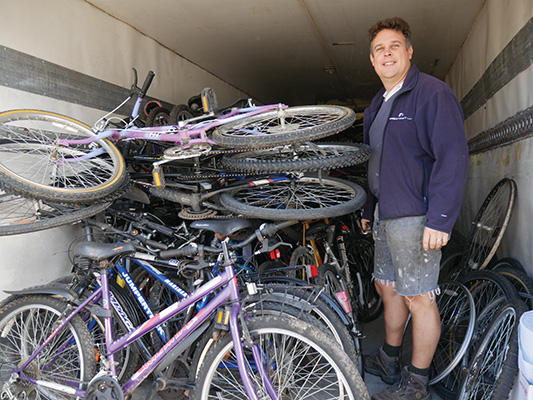
Its goal is to take in unwanted mountain bikes, do them up and send them, along with spares and tools, to rural Africa, enhancing people’s lives through improving access to education, trade and wider communities. Added to that is the twin aim of working together with people in this area, who are on Community Payback programmes or are disengaged, refurbishing the bikes ready to be sent out to Africa.

The charity’s founder Anthony Raybould, 46, said: “We give them a taste of working hands-on in an engineering discipline, with a view to them pursuing education and careers in related professions. There is also the huge boost and sense of fulfilment in knowing their work is benefiting poor people in Africa.”

I meet Anthony in the charity’s tiny nerve centre: his garage in Merriott, near Crewkerne, having been alerted to Prodigal Bikes’ existence by the ‘green token’ collection scheme in the town’s Waitrose. The whole premise seemed such a brilliant idea, I had to find out more. (Incidentally, the Waitrose donation amounted to £414).

When I arrive, Anthony’s tinkering about in his garage with the radio on. It’s a Friday, which means he’s not at Leonardo (formerly Westlands) in Yeovil, where he’s worked as an aircraft engineer since he was eighteen. He’s now there as a contractor and on his days off, he’s hard at work mending bikes.

The charity was formed last year but his interest started back in 2007 when Anthony was a lay reader for the Church of England. He’d taken a service in Lopen and got chatting to a man called Stephen Crane, who was collecting a few bikes for Jole Rider, a charity based in Tetbury that sends bikes to The Gambia.

“I love cycling,” Anthony says. “And I like mending things. As an engineer, I thought I could get involved in this. So Stephen and I initially collected and refurbished 20 bikes for them.”

Bicycles are often bought by people who fully intend to get fit and use them, only to languish in a garage, out of sight and out of mind. In 2014, some 3.6 million bikes were bought in the UK but only one in seven is used regularly.

As soon as people heard about the local collection, Anthony and Stephen were inundated with unwanted bikes The two of them ran beer and bike nights, where friends enjoyed banter while they fixed bikes destined for Africa. They restored a total of one hundred and fifty bikes, which joined the same number again in Hullavington, Wiltshire, stacked up like a game of Tetrus in a container, ready to go off to The Gambia.

Says Anthony: “There are schools there but often no bus for children to get there or it breaks down. Kids have to travel long distances. Africa mostly doesn’t have its own, indigenous bicycle manufacturers and relies on cheap Chinese imports. Western bikes are really appreciated because they’re good quality and supplied by Jole Rider free of charge.”

In 2009/2010, Anthony collected around 350 bikes for Jole Rider, and worked with inmates at Cardiff Prison refurbishing them. “You could see how proud the prisoners were of what they’d done and that the end result was going to Africa. It was then that I thought ‘I’m on to something here’. In the meantime, Ken Clarke was saying some interesting things about a Government scheme called Transforming Rehabilitation. Part of this was helping charities work with people during their time in prisons and following release, with the specific aim of helping ex-offenders towards stable, self-sustaining lives and away from crime. I began to realise how the work I was doing with Jole Rider, and my background as an engineer could fit in with this.

“There is something like a ten to thirteen billion pound cost to the UK economy of people re-offending. But if you put a prisoner in a box with nothing for years on end, it’s no surprise that when they come out, they struggle to get work, and re-offend.”

But then his ideas were put on hold for a while as the married father of two got stuck into a major extension at his home.

“In about 2015, I wanted to get this back on track. I put it to Jole Rider, who said it was a great idea but suggested I do it under my own banner.”

He came up with the name Prodigal Bikes, from the parable of the Prodigal Son (Luke  Ch.15 vs.11-32). Anthony could see parallels in the Bible story of the father prepared to take his lost son back into the family fold and a society prepared to give ex-offenders another chance.

“It was all about society extending that grace,” Anthony says. “And then last year, I was driving to work one morning and I said, ‘let’s do this’. Soon after, I spoke to some graduate trainees at Leonardo and ended up being picked as their charity to support for 12 months, so all of a sudden I had 26 graduates wanting to work with us! We had a bike workshop running at Leonardo and a number of fundraising events were held including a sponsored bike ride and an African Night in Merriott. We got registered charity status in December, too”

Some 150 bikes now look set to be heading for Kenya in January, with around 300 per year planned after that. The workshop working with ex-offenders is planned for early next year, too.

Prodigal Bikes hopes to team up with the Akamba Aid Fund, an independent charitable trust based in South Somerset, which was set up with the aim of enabling the poorest rural communities in Eastern Kenya to have access to the essentials of life that we take for granted.

Registered with the Charity Commission in 2000, Akamba helps hundreds of families with affordable healthcare and education, as well as setting up community self-help groups enabling people to use their own land and resources more effectively. Its trustees regularly travel to Kenya (at their own expense), living with the local communities, to discuss and monitor the various aid programmes Akamba has developed with them, and to ensure that funds donated are used wisely.

Says Anthony: “Getting out to Kenya is difficult for us at Prodigal Bikes, with all we have going on in the UK, so we needed to partner up with another charity with a good track record of operating in Africa. We feel very privileged to work alongside Akamba and hope we can develop this into a substantial aid programme in the coming years.”

Not all bikes received by Prodigal Bikes are sent to Africa. Says Anthony: “Bikes in poor condition are still useful to us as we can take them apart and use the remaining good parts as spares for other bikes. High value bikes are also useful to us, to overhaul and sell, to further help towards the shipping costs.”

How you can help? Prodigal Bikes need bikes that will carry children of 8 years old up to adults off road, such as mountain bikes, hybrids and old ‘sit up and beg’ type bikes, rather than racing bikes or small children’s bikes.

If you live in or close to the South Somerset area, and have a suitable bike you would like to donate, please email Anthony Raybould at aj@prodigalbikes.co.uk with a description of the bike (type of bike, make, model, condition) and your contact details. The charity will be in touch to arrange collection.

Bike donors are invited to also donate £10 per bike towards the cost of shipping to Africa.

It costs Prodigal Bikes around £5,000 to send a 20ft container full of bikes, tools and spares to Africa, so any donations, or proceeds from fund raising events, are gratefully received.

Sasha Mitchell

“It’s all about the breath”, imparts Sasha Mitchell who runs the SW Division of Resonance Voice Training, a company that provides personal impact, voice and presentation skills training. She helps people present themselves better, speak more fully, manage nerves and gain confidence. Sasha runs workshops and also does one-to-one, helping anyone from managers in the workplace who have a difficult meeting or presentation to give, people returning to work after a prolonged absence, those who need to speak in public such as a father-of-the-bride or CEO, to small business owners who want to project themselves more effectively. She has worked with the Foreign Office, female ex-offenders, Chambers of Commerce, corporate businesses, councils and school children. “Everyone,” she says, “can learn to have a healthy voice”.

The daughter of poet and playwright, Adrian Mitchell, Sasha moved round the country with him on tour, using her voice to lull, guile and delight the audience. She read his poetry, sang his lines and loved the way her words had an effect on those listening, as well as the confidence and joy it gave her too. Sasha established a career in acting and started working at the BBC at 16, later achieving cult status as the baddie in the last ever episode of Blake 7 and recognition as DS Karen Malahyde in Ruth Rendell’s Inspector Wexford Mysteries. Now, as well as her local consultancy work, she still travels round the UK, fulfilling her role as a Lead Associate for Resonance Voice Training.

After six years of staying with her partner in Kilmington every other weekend, Sasha finally made the move full time a year ago. She loves the change of pace the countryside provides, giving her time to hide in her writing shed creating stories, work in the allotment and most importantly for Sasha, spend more time reading all she can and developing her client relationships.

Sally Allan

Sally Allan’s first lobster was caught in Jersey waters. She was on holiday, visiting her uncle, when he took her to meet the fishermen and buy direct. He then taught her how to prepare and eat it. It’s been a passion for Sally ever since and now she’s turned her pastime into a business by setting up Sally’s Fish Camp, locally caught seafood hampers delivered to you.

Growing up in Milborne Port, outside Sherborne, Sally often went to the coast with her parents and brother, getting up at the crack of dawn to get to the beach early and set up camp for the day. They spent time together until sundown; crabbing, snorkelling, sand sculpting and rock pooling. This left lasting memories that Sally wanted to recreate with her husband and children. Now living in Abbotsbury, with views of the sea, the family love only being a hop, skip and a jump away from the beach. It’s a regular occurrence for them to set up camp on Chesil beach or Ringstead Bay, roll out the newspaper and get stuck into local seafood, sometimes lighting a fire and staying on into the night.

Sally has spent most of her working life in hospitality, mainly for establishments that serve and specialise in seafood, although she can also make a mean cocktail. The lightbulb moment for the business happened whilst Sally was working at The Three Horseshoes in Burton Bradstock, chatting with punters, talking about how visitors and locals can find it difficult to eat local seafood outside of a restaurant setting. So now Sally collects seafood from Portland in the morning, prepares and delivers it the same day, on ice, in a bespoke wooden crate, or bucket to her customers, who could be in a holiday let or waiting for her on the beach, picnic rug at the ready. Memories come free of charge.

Landscape, Legacy and Loss

“Thames.. Dover.. Wight. Portland. Plymouth. Biscay: South Finistère:
South Westerly gale 8 storm 10 decreasing to 6 gale 8...”


A vicious low pressure on our doorstep took us all by surprise. Deceptive to say the least. It veered north and the rest is history.
James Crowden talked to Tamsin Treverton Jones about her new book Windblown – The Great Storm of 1987


How many of you remember the Great Storm of October 1987? It left most of southern England devastated and millions of trees uprooted on both sides of the English Channel. The storm also left an indelible memory and sense of loss, even bereavement as so many giant oaks were felled in a single night. Thirty years have now past since that devastation and to mark the event the writer and poet Tamsin Treverton Jones has written a book aptly enough called Windblown. She has painstakingly researched and collated a vast range of individual stories most of which have never been heard before. Expertly she weaves the stories into a compelling tale, which unfolds and branches out almost like a novel where the strength of the wind wreaks havoc rather like in the Tempest and the ancient trees are the central tragic characters surrounded by the living, the mourners aghast at the tragedy unfolding.

Even the BBC’s weatherman Michael Fish famously failed to spot the storm’s imminent menace, though in all fairness it was not technically a hurricane. His playing down of the situation lulled the nation into a false sense of security. The weathermen knew it was coming but could not predict its speed and ferocity or indeed where it would hit the coast. Computer predictions did not have the same muscle and clout that they have today. The weathermen also still relied on manned weather ships barometers, wind gauges and weather balloons as well as verbatim reports. Most mariners sniffed the air, used their instinct and very wisely fled for the nearest port and waited for the storm to pass.

On the night of 15th/16th October 1987 the storm sped up from the Bay of Biscay raced through the Western Approaches and very inconveniently devastated the cider orchards of Brittany and Normandy before finally coming ashore in Dorset. The storm took a short cut, turned inland then worked its way relentlessly through the towns and forests of Hampshire, Sussex, Surrey, Middlesex. Kent. Hertfordshire, Essex and East Anglia before leaving these shores. The whole south east corner of England was awash with fallen trees and nowhere was this more lamented that at Kew Gardens where nearly 1,000 mature trees were damaged or uprooted. London and the commuter belt were well and truly hammered.

By writing this book, Tamsin Treverton Jones has followed in the footsteps of another much earlier intrepid storm reporter and raconteur, Daniel Defoe who cut his teeth on the Great Storm of 1703 which devastated Somerset. She has turned reportage into an art form and as well as trailing through newspaper reports, weather records, libraries and record offices she has cleverly used the story of her own family story.

Tamsin has also tracked down and interviewed lighthouse keepers on the Needles, fishermen, farmers, foresters and sailors, sculptors, refugees, as well as orchard growers in Kent and Gloucestershire.

Then what to do with all the wood? Sawmills were inundated. There were some innovative ideas at Kew. Tamsin’s father Terry Thomas designed a stunning 10ft x 5ft wooden mural from pieces extracted from the fallen exotic trees at Kew which depicted Chinese Lions defending Kew against the evil wind. The pieces were then cut and fashioned by Robert Games. John Makepeace OBE, then of Parnham House, Beaminster  was also given some salvaged mulberry wood and American Walnut from Kew which he turned into cabinets and a memorable table shaped like a twelve-foot long leaf. A brace of lute makers also benefited.

Added to all this creativity is the ongoing debate of legacy, loss and natural regeneration, the philosophy and ethics of timber re-growth and management, tree planting, tree roots and the story of nature’s ability to reinvigorate itself after the catastrophic 300 year storm.

Tamsin studied French at Bristol University and is no stranger to Literary Festivals or the Theatre. She was head of Press at the Royal Shakespeare Company, The Royal Court Theatre and Bath Literature festival. She is a real live wire and this promises to be an excellent event.

Laws to Leave Behind

It’s a general truth that the more complex an organization, the more regulations it needs to be able to function. This is particularly true of the EU. Amid all the Brussels sprouting and to-ing and fro-ing, there are loads of bizarre European laws and guidelines sitting on our books which will need to be cleared out. Provided the UK continues to try to leave the EC before we all die of old age, we will as a nation be able to get rid of them after March 2019, but I mention them here as a useful reminder of the absurdity of Euro bureaucracy…

Vacuum Cleaners Suck: Except, following recent European legislation, most now don’t. As from last month, you can’t buy anything over 900 watts which (in extraction terms) is equivalent to an asthmatic wheeze rather than a full-blooded sucking (if you’ll forgive the phrase!). This means that either British floors are dirtier than French or German ones and need more cleaning, or Health & Safety has decided that too many UK hamsters are inhaled by over powerful machines which obviously need to be less dangerous. This same energy saving scheme is also due to be applied to hair dryers, electric kettles and even lawn mowers. The idea is to use less energy and therefore be kinder to the environment, but it also shows that European legislators don’t understand basic Physics. If I want to boil a kettle, I’ll just have to wait a bit longer for my coffee but it’ll still consume the same amount of electricity!

Soapy Yellow Marigolds: There’s a proposed European ‘Personal Protective Equipment Regulation’ that requires makers of rubber washing-up gloves to prove that they can withstand detergent. Of course, if you’re going to try and wash up the dinner plates without using any Fairy Liquid or soap, it doesn’t work very well. You’ll also use up so much more hot water that the energy you’ve saved using your low powered hair dryer (see above) would be cancelled out. That’s Euro progress for you.

Kinky Bananas: Euro regulations dictate that bananas must not be too bendy. A slight angle’s OK, but—according to the Brussels rule book—grade one bananas “…must be free of abnormal curvature.” Yes, seriously! If it’s too kinky, it’s relegated to grade 2 or 3. Also, the same rule was to have applied to cucumbers which should be “practically straight” (i.e. bent by a gradient of no more than 10%) but luckily the cucumber law was repealed in 2008 owing to a rare outbreak of common sense.

So Hungry, I Could Eat a Horse: While Euro laws say it’s quite OK to eat horse meat (no doubt a result of French lobbying), it’s apparently illegal to eat your horse if it’s a pet. I don’t know about you, but I wasn’t aiming to eat a Misty the Mustang steak today, regardless of whether I knew its name. Obviously, it’s inadvisable to pat your meat and talk to it and give it a sugar lump before you put it on your plate and consume it…

Balloon Horror: Children under 8 cannot blow up balloons in the EU without adult supervision. Hopefully this won’t be a problem at our forthcoming kids’ party when I rely entirely on young Billy (aged 7) to blow up my party balloons. I can’t do it because I get all faint and fall over, but Billy’s a champion blower. Perhaps I could hire him to do my hoovering? Worse than that, those squeaky party horns which expel long paper tongues when you blow into them (see picture) have now been classified in Europe as unsafe for all children under 14. This is an extraordinary piece of European Health & Safety rubbish. In Germany and Austria, it’s legally OK to have sex at 14, but you’re not allowed to blow on a whistle!

And there are so many more regulations covering things like jams and marmalades (preserves must contain at least 60% sugar to be officially titled “jam”) and the labelling of light bulbs (100 watt bulbs are banned unless they’re LED because they’re only 16 watts or rather 1600 lumens which is utterly confusing).

My favourite Euro conservation law concerns fossils and the environment. You’re not allowed to remove ammonites from any rock if the little spirally creatures are less than 12 millimetres in diameter. This is to allow time for the smallest fossils to breed and create more baby ammonites which will help conserve stocks for sixty million years from now. Well… OK, I admit it. I made this one up – but all the others are 100% true. I think it’s quite an attractive new law and is easily daft enough to be quietly squeezed under the door as current genuine European legislation. I’m not sure that Brussels would notice the difference…

The Cut

I regularly look at a painting on my wall of a very tranquil watercolour of a canal scene with which I was once very familiar. The centre of the picture is a closed canal lock gate, with its walk way across to the lock keepers cottage. To the left is the towpath with trees away from the waterside and the reed lined water is still, with barely a ripple on the fully closed lock, reflecting the cottage and trees. Looking at the painting is very peaceful.

As a young schoolboy we lived about a mile from the canal, The Kennet and Avon, in Wiltshire, frequently referred to as “The Cut”, because years before it had been cut from the local land.

Sunday, being a day of rest, after bell ringing and choir singing and lunch, my father often proposed a walk if the weather was fine. One of the favourite walks was along the road (not then busy) to the bridge over the canal, down a pathway to the canal tow path, which we then climbed in parallel with the canal.  Father would point out wildlife in the water,  around the reeds near the bank, moorhens, coots, dabchicks (grebe) and occasionally a heron (or crane). Possibly a duck with its family following in line astern. Occasionally a solitary swan proceeded majestically in the middle of the water. At this time the canal was derelict and the only craft was a motorised barge for maintenance.  As this part of the canal contained the famous “staircase” flight of 29 locks at Caen Hill, taking the water up hill, there were 16 “Pounds” or reservoirs at intervals used when locks were opened. The heavy wooden lock gates were operated manually to let water out if a boat was descending or closed to raise the level if ascending. Progress was slow for the barges! When we reached the top of the flight we left the canal side for the road, to another path called Gooseberry Lane, onto Dunkirk Hill and eventually back to our village. I saw no fish, but some said they had a catch so I tried with a hazel rod and bent pin, but went home empty handed. The winters were harder then and the water became sufficiently frozen for skating, or small boys to slide upon. A few years later I discovered the young lady to become my wife lived on the other side of the canal, so it had separated us for some time!

Some years since the canal was rescued and renovated, to be re-opened by the Queen in 1990, so that it now is full of holiday traffic in motorised craft. When it was a working canal, the barges were towed by horses, from the tow path. The lock keepers cottage became a café and ice cream purveyor. In Devon at Tiverton a horse drawn barge provides quiet, picturesque trips for tourists, to give perhaps a flavour of life in bygone days. This is what is left of the Grand Western Canal started by John Rennie in 1810 the year he completed the Kennet and Avon.

Dorset has no canal but once there was a plan to build a Somerset and Dorset Canal with the intention of linking the Bristol and English Channels, between Bristol and Poole. This was first discussed in Wincanton, Somerset in January 1793 and would have saved the sea voyage around Cornwall. It was proposed that the canal would enable transport of coal from the Somerset coalfields to Dorset, also stone and lime and in return timber, slate and wool from Dorset. Another possible cargo was clay from Purbeck to the potteries in Staffordshire. A recent book by Roger Guttridge “Dorset Curious and Surprising” states the original route was from Bath to Frome, with a branch to the Mendip collieries. Then via Wincanton and Henstridge in Somerset and Stalbridge, Sturminster Newton, King’s Stag Bridge, Mappowder, Ansty, Puddletown and Wareham to Poole Harbour in Dorset. However a meeting in Blandford proposed that the route would be better from Sturminster Newton via Blandford to Poole, instead of Wareham. An additional proposal was a 9 mile  extension to a junction with the Kennet and Avon Canal I described near Bradford on Avon in Wiltshire which would thus eventually provide access to London.

Unfortunately some landowners in East Dorset and in particular Lord Rivers objected to the proposal. Lord Rivers would only agree if “the canal did not proceed beyond some point betwixt Sturminster and Blandford, otherwise withholding his consent”. As a result it was decided in 1796 to abandon the southern section, terminating at Gain’s Cross, south of Shillingstone. This would reduce the length of the canal to 48 miles and there would be no route to Poole and the English Channel which had been a considerable selling point. An Act of Parliament had been passed in March 1796 which authorised the company to draw water up to 2,000 yards from the canal and to raise £150,000 in shares. Progress was slow through rocky terrain and the money subscribed was insufficient. Construction ceased in 1803 with only 8 miles completed starting at Cote in Stratton parish for the Mendip colleries branch in Somerset.

I have found a reference to a report by a Joseph Priestly in 1831 from which it appears that locks were to be avoided by the use of a boat lift. A portion of the Nettle Bridge branch was excavated and on a fall of 21 feet at Mells near Frome one of Fussells balance locks was tried with vessels of 10 tons burthen in September and October. Remains of aqueducts, bridges, embankments and lengths of canal can still be found in the western section in Somerset. There are photographs, one of a bridge over probably a farm track with shrubbery growing over the top, another of an excavation site with large stones and possibly remains of an aqueduct. Several river crossings would have been required.

It appears that no work was commenced in Dorset so there is nothing for us to see of the enterprise unfortunately. Had it been completed it may have improved trade and industry here and now either have been an attractive waterway for pleasure craft or a tranquil walk as I remember from my earlier days. Thankfully we have many other walks.


Beavers live Here

Four years ago, a family of wild beavers were spotted on the river Otter in East Devon.  This was the first report of the animal breeding successfully in the wild in England since the species had been hunted to extinction more than 400 years ago.  No one knows how the animals came to be on the river but their prospering population is now the subject of a scientific trial providing a unique opportunity to monitor the re-introduction of a native species, or “rewilding” as it is sometimes called.


I wanted to find out more, so one evening in mid-September, I met Kate Ponting, Countryside Learning Officer for Clinton Devon Estates, at the village green in Otterton.  Kate has been closely involved with the beaver re-introduction trial, taking place as it does on land largely owned by her employer.  We headed to the river, crossed the old stone bridge and walked upstream along the muddy riverside path.  Banks of Himalayan balsam and nettles dominated the river bank while, on the landward side, clover leys spread as far as the low embankment that once carried the railway.  Prominent official signs warned that “Beavers live here” and Kate explained that there had been some local problems with dogs.

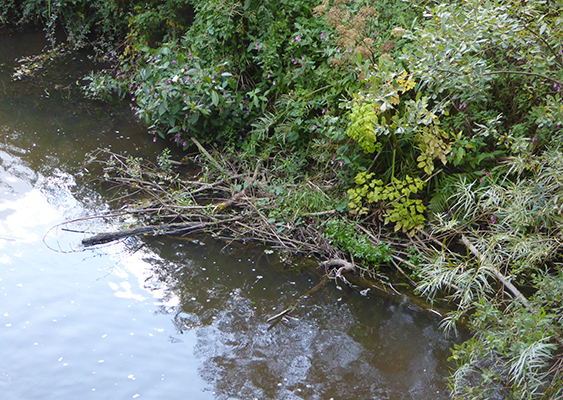
The river was full after recent heavy rain but the scene was tranquil in the low evening sunshine.  We paused on the wooden bridge where Kate pointed out one beaver lodge, a semi-organised jumble of mud, sticks and branches protruding nearly a metre from the river bank and covering the entrance to a burrow where the beavers live.   Further up the river we stopped to watch a second lodge on the far bank.  Kate had warned me that the beavers had become less “reliable” as the autumn progressed and, although a wren flittered about the sticks making up the lodge and a grey wagtail passed through, we saw no beavers. Kate did, however, show me some signs of beaver activity including severed branches and one felled tree.

The beaver is Europe’s largest rodent and until the 16th century was found widely on UK rivers.  They are impressively large animals covered in brown fur, measuring up to 100cm (head and body) and with scaly black tails.  Beavers are strict herbivores with strong teeth allowing feeding on many species of river and bank plant as well as woody vegetation from trees.  They are strong swimmers adapted for life underwater, and skilful aquatic engineers able to regulate water levels by building dams.  When they build dams by felling trees they remodel the wetland landscape creating habitat for many other plants and animals and, for this reason, they are referred to as “keystone” species.

In the past, they were hunted to extinction for their fur, meat and castoreum, a secretion from their scent gland used for medicinal purposes.  Early in the 21st century, however, free-living populations of beavers were re-established in Scotland and there were anecdotal sightings of wild beavers on the river Otter in East Devon.  These reports were confirmed early in 2014 when two adults and one juvenile beaver (kit) were filmed near Ottery St Mary.  This was the first confirmed report of wild beavers breeding in England for 400 years.

At first, DEFRA were concerned that the animals might harbour disease and wanted to remove them but their plan was opposed by wildlife experts and local people.  So, towards the end of 2014, Devon Wildlife Trust applied to Natural England for a licence allowing the beavers to remain on the river as part of a five-year trial to monitor their effects.  The licence was granted on the condition that the beavers were shown to be the native UK species and disease free and in March 2015, nine beavers living in two family groups were returned to the river Otter.  The licence included a management plan for monitoring the health of the beaver population and its effects on the local landscape and ecology; also for making good any damage.  The River Otter Beaver Trial is led by Devon Wildlife Trust working in partnership with the University of Exeter, the Derek Gow Consultancy and Clinton Devon Estates.

Since the trial began, beavers have been seen along almost the entire length of the river Otter.  Breeding has been successful each year but there were concerns that the population might be becoming inbred so in 2016, two additional beavers, unrelated to the existing animals, were released on to the river. By 2017 the population had grown to more than 20 and watching the adult beavers and their kits on a summer’s evening became a popular pastime attracting many visitors to the area.  So far, the presence of these large aquatic animals has caused few difficulties.  Feeding signs have been detected all along the river in terms of severed shoots and felled trees but this was mainly confined to small diameter willow shoots.  Earlier this year, fields near Otterton were flooded when beavers dammed one of the streams feeding the Otter but mitigation measures were put in place.

These are, however, early days and, as the number of beavers continues to rise, their presence in this managed East Devon landscape may cause tensions.  There is good evidence from Bavaria, where the animals were re-introduced 50 years ago, that beavers can have a beneficial influence on rivers.   They support wildlife by opening up the landscape, creating coppice and diversifying the wetland habitat.  Their dams regulate river flows and remove sediment and pollutants. Sometimes, however, they can be a nuisance to those who live and work by rivers, causing flooding, blocking ditches, undermining river banks and felling important trees.   There are now as many as 20,000 beavers on Bavaria’s rivers and their beneficial effects are clearly recognised alongside the need to manage the animals when their activity has a negative impact.   Hopefully, a similar resolution can be reached for the East Devon beavers as their population grows.  Whatever the outcome, the River Otter Beaver Trial will be closely watched by those interested in “rewilding” the landscape.

I should like to thank Kate Ponting of Clinton Devon Estates for giving up her time to show me the beaver lodges and Steve Hussey and Mark Elliott Of Devon Wildlife Trust for providing information and photographs.

Vegetables in November

Does that extra inch matter, I hear you ask? It does! All high performance crops blossom far better with an annual 2” dressing of compost than with only 1”.

We all know the benefits of a layer of compost scattered over the soil surface: bigger yields, healthier plants, moisture retention and weed suppression.

As I had it for free, I used to use cow manure from the farmer next door. His cattle are fed silage, which has no weeds in it, and I could cherry pick well rotted barrowfulls straight from his cattle shed in mid summer.

Now a neighbouring arable farmer cleans out his barns as soon as the cows go out to grass and spreads it on hia arable. This is good, as it fertilises his arable, promotes soil structure, reduces soil erosion and water run-off.

So now we buy recycled green waste, a big 500 litre dumpy bag dropped by a crane lorry just where we want it for just £31—delivered free up to 25 miles from Paulls of Martock. We have been trying it for a while and it is doing us proud. It comes well sieved, stone and weed free and sterilised—so no pests either.

Don’t dig it in. There have been many articles lately decrying the amount of earthworms killed by digging, rotavating and ploughing, together with loss of soil structure. Just chuck it on the surface.

Making your own compost is always best if you can. The bigger the heap, the quicker it rots and the better the heat generated to kill weed seeds. We keep pigs which turn all compostable material into both manure and sausages.

When to put it on? Whenever you can. For us the best time is May onwards to mulch and feed active crops, but do it whenever you canl. The beauty of organic matter is that it is too cold to break down and disappear in the winter, but is actively broken down and used by soil life when it warms up, which is when the plant needs it.

And we were surprised to hear recently that it only rains twice a year in England: August through April and May through July.


What to sow this month

Aquadulce broad beans are the main outdoor crop this month, for harvesting next June. Our feathered and furry friends love them, so protect them with netting or fleece. If your soil is low in organic matter the soil may waterlog and then slugs will eat them.

Indoors we will be sowing lots of Douce Provencale peas for harvesting next April and May.


November in the Garden

As the number of plants in bloom reduces, the further into autumn we travel, the more we notice other, subtler, ways in which plants add colour to the garden. Autumn colour is chief amongst these now, although the equinoctial gales can play havoc with the longed for ‘show’, if the leaves are blasted from the boughs before fully colouring up.

Just now, my own Liquidambar trees are in deep red leaf (well, mostly ‘in leaf’). I have a pair planted next to each other. The straightforward ‘species’ (Liquidambar styraciflua) and the variety ‘Worplesdon’, the latter with supposedly more intense autumn hues (although they look pretty identical most years). I used to have a third variety in the row, it’s identity lost in the mists of time, but it succumbed to a tragic strimming tragedy while still an infant.

On a different tack, statuesque Miscanthus form a backdrop to many of my own planting schemes and large ‘island’ beds. Except for when they’ve been cut to the ground, in early spring, just before bursting back into life, there is hardly a month of the year in which these no-nonsense, giant, grasses are providing some sort of garden interest. During autumn, and into winter, they are at their boldest, crowned with tasselled plumes at their fullest and most dramatic.

In the recent windy weather the stands of Miscanthus in my field were truly magnificent, swaying and dancing to the tune of the gusts. They need some space around them to show off to their best but, as a full stop to a long garden, or as a ‘block’ within a wider one, they can be included even on a domestic garden scale.

I remember buying several different varieties, mostly with German names ‘back in the day’, when I was a Hort. student. Thirty years on, many divisions later, and the true ‘varieties’ have been diluted by spontaneously arriving seedling ‘crosses’. I’m not sure this matters ‘en masse’ but it does mean that, if I have a particularly nicely coloured example, perhaps with deeply coloured tassels, I’ve no idea if it was a named variety, that I bought, or a chance seedling of my own. At the end of the day a ‘good plant’ is a ‘good plant’ I guess.

In complete contrast, to the muted palette of grasses, now’s the time to turn your attention to planting the spring firework display that tulips provide. This should complete your autumn bulb planting—tulips being traditionally planted after all other types of spring flowering bulbs as a means of avoiding the fungal infection know as ‘tulip fire’.

If you moved your tender plants into a sheltered spot last month, now’s the time to make their final move into a frost-free place—such as a greenhouse with a ‘frost-guard’ heater on hand. Fully tender plants need to have some form of supplementary heating readied against the risk of sub-zero temperatures. If you haven’t done it already, thoroughly clean your chosen ‘overwintering’ area, cleaning the glass to maximise the weaker winter light.

Equally, any plants that you bring in should be spruced up by removing any dead, or damaged, bits with a sharp knife. Don’t do any major ‘chopping back’ as the plants are winding down, preparing for winter torpor, so inflicting major surgery on them now could be disastrous. Keep them almost dry, for the winter, because that way they are better able to survive low temperatures; it’s winter wet which is the real killer, rather than cold alone.

You can start planting bare-root plants this month although, in tune with the slowness of the season, there’s no rush with this. Do it when the weather conditions are favourable—for you and the task in hand. To make a proper job of planting takes time, especially if tree stakes, rabbit protection and mulching provisions are involved.

Traditional herbaceous perennials can also be dug up, divided and replanted now. They are slightly more time sensitive, compared to getting bare-root specimens planted, because they cope better if tackled before the really cold weather sets in. If you miss this window of opportunity, before the onset of ‘proper’ winter, then you’ll get another chance to divide them in early spring.

If you chance upon any discounted packets of early-flowering, spring bulbs, they’d be worth risking despite the lateness of planting. If the bulbs are still intact, firm, and not too sprouting, they’ll be fine. Don’t use them in prime positions where an erratic performance would be a source of annoyance. I’d be inclined to plant them thickly in pots of fresh compost, to give them the best chance of surviving, and keep them ‘on standby’ to plant into the garden, or naturalise in rough grass, if they prove viable.

I say ‘rough’ grass because you’ll have to leave the grass uncut, for at least 6 weeks, after flowering, to let the bulbs regenerate. This can make a real mess of a ‘fine’ lawn. Having said that, if you keep the grass short, in the run up to bulb emergence, the rapid bulb growth and flowering will keep ahead of the grass even though you’ll have to stop cutting it.

The tyranny of regular grass cutting is something I am happy to do without. It seems the grass seldom stops growing, these days, even over winter. At least, currently, it’s far too wet to risk cutting my own lawn areas which are, in reality, simply the bits of meadow closest to the house. I tend to design by necessity rather than by contrivance. It seems the most ‘honest’ way to deal with garden space and ‘honesty is always the best policy’!