
Sunday, March 22, 2026
Home Blog Page 46

So you’ve had a stroke

On the evening that Will Davison had his first stroke he put two potatoes into the oven to bake before a neighbour had convinced him to go to the doctor. On learning what was happening to him he packed a bag to take in the ambulance and for some reason got his neighbour to put the baked potatoes in foil, so he could take them with him. ‘Why did I need them?’ he asks in a book that he has since published. As it happened the hospital he was taken to didn’t have a room for him and he was given a temporary bed in a store room. He did eventually see a doctor but by the time he was brought to a ward he was starving and more than thankful for his two baked potatoes. He was to have a similar experience when he had his second stroke in France; the only place the hospital could put him was in the surgery ward. Thankfully he didn’t get wheeled in for surgery but he did get a French breakfast the next morning. This quirky coincidence is one of the stories related in a book that tells the experiences of eleven stroke victims aged from as young as twenty years old.

In So You’ve Had a Stroke: a survivors’ guide to life after Stroke, Will Davison and the other ten people interviewed talk intimately about their stroke experience and their road to recovery from this life threatening condition. And although their stories have as many questions as they have answers, it is an inspiring, heartening and most of all enlightening account of life after a stroke.

One repeating theme that runs through the stories is the need to ‘get back to normal’ as Jo Elliott, a Registrar of Births, Deaths and Marriages explained. She had her stroke aged forty-five and remembered the hardest thing was ‘being so out of control.’ She now lives to look on the positives of each new day rather than dwelling on what she calls the ‘little insignificant things’ that could be negative. ‘It’s a waste of energy asking “why me”’ she says.

Elizabeth Ashmore, who suffered her stroke at the age of twenty, remembered how she didn’t think she could ever be normal again but believes that if you ‘keep thinking positively and keep reminding yourself you’re still alive and with stroke, you can get better’.

Stroke experience isn’t one-dimensional. The outcome, especially paralysis, is very variable. Even a small amount of brain damage affects memory and thus confidence and some lose speech. It’s a devastating result that puts survivors outside a society which thrives on instant repartee and communication. Many feel locked out by their stroke situation, physically less strong and unable to continue with their old lives. But as Will Davison says, one thing he has learned from the interviews conducted for his book is that ‘everybody who has had a stroke has had to face the loss of their old self: the running, jumping version of themselves, and face up to a newly emerged reality. It can be painful but the new you is the real you. And you are alive. It is just so vital to make the most of the life you’ve got.’

According to the World Heart Federation, 15 million people a year worldwide suffer a stroke, and of those that survive five million are left permanently disabled. For anyone directly affected or close to someone who has had a stroke, Will Davison’s book offers an insight and therefore a better understanding of the life-changing consequences of a cruel and indiscriminate illness.


For more information or to order a copy of the book visit www.willdavison.info
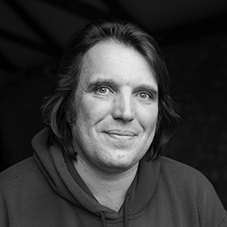
Phil Verden

With his nose pressed up as close to the oven door as he dares, a young Phil Verden watches his mother’s Yorkshire Puddings rise higher and higher, wondering just how she manages it. Today, Phil attends to his own batches of bread, Yorkshires and soufflés as they expand in his oven at the multi award-winning Lord Poulett Arms Pub in Hinton St. George, where he is Head Chef.

Advised to do A-levels following a great set of exam results, Phil ignored everyone, instead choosing to pursue his dream of becoming a chef. Straight off to catering college, he managed to cram twice the amount of courses into one year, qualifying early. Then he wrote to every hotel advertising in a catering magazine asking for a job, with only one response; from The St Andrew’s Golf Course in Scotland. Undeterred, he undertook the 12-hour train journey for his interview, fortunately getting the job. His 18th birthday was spent peeling potatoes, no time to party and no cards as there was a postal strike. But Phil didn’t care, he was learning the French Classics from the best.

Moving on, Phil has worked for some of the best country house hotels in the country. Working his way up through the kitchen ranks he settled at Summer Lodge in Evershot for 10 years as Head Chef then brought his extensive culinary knowledge to Lord Poulett. Still very much a local’s drinking pub there are also elegantly furnished rooms to stay in. Phil is passionate about his food being more accessible, focussing on local English produce.

When he does have a day off, he looks after his sons, Kitt; two and Fynn; five years old. Soon, when both boys are occupied during term time, he aspires to go on a pottery course so he can create some earthenware-style platters on which to present his celebrated food.

Nathan Tuck

“I grew up in Dorchester, went to school there, but didn’t behave myself all the time. There was a new fire station being built, so I laboured there for a while. That’s when I first found out I wasn’t very good working with my hands. So then I worked as an electrical apprentice and discovered I really wasn’t very good with my hands. The tiles and flooring work that came afterwards showed me I definitely wasn’t good with my hands, so went to work in an Off License”, reminisces Nathan Tuck, owner of Wyvern Fireplaces in Dorchester.

It was working in the Off License that Nathan found his true calling in Sales. He was so good he caught the eye of the owner of the fireplace manufacture workshop nearby and was offered a job selling fireplaces. As time progressed and Nathan’s obvious flair for sales was let loose, he was given the opportunity to buy into the business and really set his mark. Later still, Nathan bought the original owner out when he retired. He has retained most of the original staff from decades ago who work in the manufacturing plant behind the scenes. Now Wyvern Fireplaces is also in Yeovil and has a plethora of customers, with the growth of the business mostly down to word of mouth and Nathan’s cheeky banter.

In the run up to winter and through to Christmas, Nathan works long hours, six or seven days a week, finding it difficult to turn business down. But when the summer hits, Nathan will often pick his daughter Olivia up from school and shoot straight down to the beach. He loves the sea and coastal paths, finding it calms him after a stressful day. Having his daughter and wife Grace makes Nathan realise what he’s working so hard for, “if there’s no-one to spend it on what’s the point” he grins.


Giles Aspinall

‘I was brought up in the West Midlands, just north of Telford, so I’m not a local boy. Telford’s maybe not the best address but is in fact steeped in history, with the Ironbridge Gorge nearby. I was lucky to have a very nice upbringing, and we lived quite deep in the countryside. However we were surrounded mainly by intensively farmed monoculture so I didn’t really learn a lot about nature as a child, but later in life in my twenties I became fascinated. My parents were very into self-sufficiency when I was young, growing and freezing huge amounts of fruit and veg, and heating the house with logs that were stacked in an enormous shed. They both had jobs and worked in the town, and although at first sight they didn’t seem like self-sufficiency types, I think they just enjoyed the life.

After school in Telford, and later Southampton, I stumbled into a place at the University of Derby studying creative writing, which seemed like a good idea at the time. As a student I became rather an armchair conservationist, convinced that there was nothing right with the world, and everything was being destroyed. It only occurred to me when I was about 22 that in fact there was a lot that could be done practically. As part of my course I was studying Spanish, so there was a requirement to work in Spain, which is of course by far the best way to hone one’s language skills. I didn’t want to work in an office, and bar work wasn’t considered a good language learning environment, so I was lucky to discover a project in the Canary Islands, where there is a non-migratory population of whales and dolphins. At that time it was entertaining for the paying tourists but was sometimes rather distressing to the whales, especially the mothers and their calves. I worked there for a season, and the following year went back to run the project, my fluency in Spanish a much more useful factor than my very limited knowledge of cetaceans.

A year or so later I went for an interview with a large conservation charity, the British Trust for Conservation Volunteers (BTCV), who were just starting to develop their work with young people, and my experiences in the Canaries helped me blag my way into a job. A year later, involved with recruitment, I was turning down people with far more experience than myself so it was indeed a very lucky break for me. I worked for them for 10 years, first in Wiltshire, then including Somerset and Dorset. During that time I actually had 6 different jobs, which kept the work interesting, and eventually I was covering the whole of the South West. As a national conservation charity their whole purpose was linking people with environmental work, and at one time they were the go-to organisation linking groups like Afro-Caribbean, Asian, or LBGT communities, or any marginalised people, with conservation work, which made my work inspiring and exciting, in fact right up my street. Those days were actually a golden age for conservation charities; we often complained about lack of funding, but with hindsight, under New Labour money was way more available than it is today. BTCV was funded through many different agencies, but a great deal of the money could be traced back to government and local authorities, so when the credit crunch came, they became a victim of austerity. I left shortly before that happened—I think we could all see it coming.

That was 7 years ago, and my next job was here at Magdalen. Rather by accident I came here for a meeting, about a year before there was a job. The meeting had been relocated from Castle Cary, and involved my having to drive an extra 30 miles, so I arrived a bit cross about the whole thing. But once here, I looked round the farm and the facilities, and was immediately smitten with the ethos, the peace, and the natural beauty of the place. Back home I thought nothing more would come of the visit, but a year later the job of chief exec was advertised, and had I not seen the place a year previously I would not have applied. So I struck lucky yet again. Back then Magdalen Farm had a very strong school trips programme, and they were just starting to develop care farming. Visiting school parties came from all over the south of England, and would typically stay for a week. However, these days with less funding available to schools, and parental contributions under pressure, parties normally stay for 3 days, and we’ve had to try and double the number of customer schools to maintain the same throughput. The other big change recently is that the care farming has finally blossomed, which is great; last year we had 4200 visitors through the farm gate, of whom 1000 were significantly disadvantaged, disabled, or vulnerable in some way. They are of all ages, but are predominantly children and young people. We also get a lot of families, with one or more disabled children accompanied by their parents, coming here for respite breaks.

Most visitors are here for basic environmental education. A lot of the children have very limited understanding of the countryside, and we get asked some absolute gems of questions, like “at what age does a sheep become a cow?” So we’re trying to set them straight with whatever questions they have, but really our main aim is to get them to fall in love with nature. If children grow up without knowing the answers to fundamental questions about the countryside that’s a shame, but in the end that’s probably not disastrous; crucially however if they go through life never appreciating the wonder of nature, then their behaviour will reflect that, and they won’t care about their environment or for the future of their planet.

Of those who come here with significant disadvantages, there are many with autism or other learning disabilities; there are young people and children who are refugees, without parents; there are children who are carers for others in their families—as young as 4, believe it or not—and there are young people who are unemployed or have other barriers to success. Our purpose for them is to use the environment and the natural world to help them with their difficulties, to move on. There is an inherent therapeutic value for them in being somewhere green and nice, especially if you’ve had a traumatic time. Young refugees will usually arrive all full of beans and excited, and then sometimes they will have spells of deep sadness. This is a reflection period, and may be the first time they’ve felt able to weep; it shows the value of coming somewhere quiet and green, where there are animals and birdsong. They feel a sense of release.

We have a team of 16 people working here, either directly with the visitors or cooking, cleaning and looking after people overnight. We also have a number of local volunteers helping out with the horticulture, as much of our food is home-grown. Their valuable work is not only motivated by the environmental contribution; it’s also a social one, as so many of the visitors are desperately poor and marginalised. One young refugee from North Korea, aged about 17, told me that one day whilst walking to school she noticed that the river which divided her country from China was frozen. Seeing an opportunity to escape to a new life, she decided to walk across, and kept going, leaving behind her family. How she survived until she reached England I don’t know, it probably doesn’t bear scrutiny; her suffering from the guilt of what she’d done, being unable to return, and with no means of contacting her family, was acute. But coming here helped.’


Filling the Funding Gap

Local Children’s Charity, Family Counselling Trust, has seen demand for its services double in the past year. Founder, Robert Montagu, explained some of the reasons for the increase to Fergus Byrne.


Whilst many households have seen an increase in family stress levels due to exam pressure recently, a Dorset based children’s mental health charity, that has seen demand for its services double in the past year, has highlighted many other reasons for an increase in the difficulties faced by young people. Robert Montagu, Chair and founder of Family Counselling Trust said that a rapidly increasing number of troubled children suffering from the pressures of modern life was one of the reasons for the unprecedented demand for their services.

The Trust now has up to 50 referrals a month from GPs, schools and social services to get help for problems including acute anxiety, depression, bereavement, family breakdown and self-harming behaviour. Robert also pointed out that mental health pressures on children are increasing rapidly and are now attacking them at primary school age as well as secondary school. He added that this is due to numerous factors including social media demands—many children are spending almost all their free time on mobiles, the internet, TV and computer games.

He also cited increased parental separation as a factor, explaining that this is ‘quoted in 70% of our referrals.’ Domestic violence and fears of many kinds are also a factor. For example, fear of break-ins, fires, road traffic accidents and heart trouble, all of which are amplified by constant news reports sitcoms and dramas according to Robert.

Another reason for the increase in demand for the Trust’s services is pressure on the NHS. ‘The NHS have been recommending more and more GPs and schools to come to our service rather than trying to enter theirs’ said Robert. ‘Thresholds have risen so much in recent years in the NHS Children and Adolescent Mental Health Services (CAMHS) teams, that they are now only taking cases where there is a diagnosable mental health problem, eg personality disorder, severe eating disorders, life-threatening self-harming behaviour, etc’.

Family Counselling Trust is one of many small charities around the country that are pulling up the slack in government-backed services. They offer counselling assistance to children and young people at a time when they need it most. However, the increase in need has produced a huge strain on resources and with no government help, Robert is concerned that they will not be able to offer the help needed. ‘If demand continues at this rate the charity risks having to suspend services as funds are limited’ he explained. Without statutory authority funding of any kind at all Robert believes charities like his will not be able to help prevent further family stress and alleviate social pressure. In the current run-up to an election the subject of mental health is definitely on the agenda but with so may other issues to deal with it is likely to be left to organisations like Family Counselling Trust to step in and help. ‘The last conservative government was very much to blame for stopping the ring-fencing that protected children’s services’ said Robert. ‘According to a recent radio interview with a spokesman for the Royal College of Psychiatry, councils are now routinely raiding mental health services to repair holes in their physical health budgets, where they have a statutory obligation to provide service—whereas in mental health they haven’t. So much for what we care about our children nationwide compared to other countries where children’s services continue to be well provided for!’

Family Counselling Trust is determined not to let the children and young people of Dorset down by closing or restricting their service, yet as Robert says ‘we may have no choice if more funding and donations are not found. We currently receive no funding from Dorset County Council or Dorset NHS despite almost all out referrals coming from GPs, schools, and social workers.’

FCT has helped over 800 Dorset children, young people and their families since it began in 2006. It is now a vital and well-respected provider of help in the region and research has shown a definite improvement from their counselling in 95% of cases without the need for further help for the following year.

Anyone wishing to support their work can find details on how to donate at their website www.familycounsellingtrust.org  or may send donations to FCT-Dorset c/o Robert Montagu, Nethergrove House, Portesham, Dorset DT3 4ES.

Dorset & Quirky … a winning combination

Margery Hookings catches up with an old friend to find out more about his ‘Dorset’s Legacy’ book series and the successful business he started from scratch, which is now a niche firm supplying branded items to top football clubs


IMG_8865 for web

I’d bumped into Michael Wood at the Melplash Show late last summer. I hadn’t seen him in ages.

It was a lovely surprise to meet him there in the Kitson & Trotman hospitality tent. I knew him years ago when he ran Mikkimugs, an enamelware business in Uploders, near Bridport.

We chatted about this and that and then he told me about the new book he was planning to bring out.

I knew he’d written a number of books, and the subjects were all to do with quirky things in Dorset, which, to me, is a winning combination.

“I’ll let you know when it’s published,” he said. Some months later, true to his word, I received an email to tell me about his latest book in the Dorset’s Legacy series, which he writes under his full name of Michael Russell Wood.

“I went to do a talk in Dorchester once and I’m pretty sure they were expecting Michael Wood, the historian and broadcaster. I think they were terribly disappointed,” he tells me when I visit him at his house.

Michael has lived in Dorset since 1955, and is well versed in local tradition and countryside. He was born in Hertfordshire where his father had a mixed arable and dairy farm.

He went to Harrow and did his National Service in the Intelligence Corps before going to Cambridge where he studied for a degree in agriculture.

“In 1955, my father bought the Ashley Chase estate, where he worked to reclaim much of the farmland there. I worked with him for a time before starting my own agricultural engineering business—Bredy Supplies, specialising in milking machines and grain handling equipment.”

He sold the business to his partners and went into landscape contracting, working along the M4 corridor on the Trust House motels.

“Then I bought sixteen tons of nuts and bolts from BSA motorcycles when they closed down and retailed them in smaller amounts to motorcycle enthusiasts. At the time, I was living in North Dorset and there we started on the idea of decorating enamelware. We started with a tiny kiln, doing one mug at a time and that became quite a successful little business.”

He moved to Uploders in 1976 after the death of his father and built up the business—Mikkimugs—and then moved into plastic plates, mugs and high quality tableware, many of which are destined for Premier League clubs. Mikkimugs is now run by his son, Sam.

Michael has been writing the Dorset’s Legacy books since 2011. All of them have been about things many of us take for granted—such as bridges, corrugated iron buildings, inscriptions and bus shelters.

It’s a labour of love for Michael, 83, who has great affection for the Dorset countryside and ‘all these quirky little things that people pass by without generally looking at—they have all got so much to say.’

He used to go around on his motorbike, photographing the subjects for his book, but now explores in his car.

“The first book I did was about plaques and signs, the kind of thing everyone ignores and doesn’t even think about.

“And then I did one on corrugated iron buildings. Having previously been involved in farming, these had an attraction for me and I knew where a lot of them were. There is so much history in them.

“The little chapel at Dottery in Dorset features in my book, as well as the Baptist Chapel in Sherborne which was bought by a local philanthropist and donated to the Amateur Players of Sherborne.”

The more he searched, the more he discovered, and it’s been the same with all his books.

The latest, Dorset’s Legacy in Public Statues, features some well-known figures, such as Thomas Hardy in Dorchester and George III in Weymouth, alongside lesser-known pieces including a skateboarder by the sculptor Greta Berlin in the garden of Wimborne Library and Eric Gill’s obelisk in Briantspuddle.

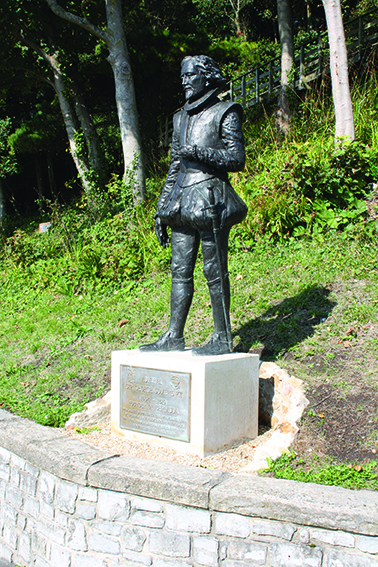
He was inspired to write it after seeing the statue of Sir George Somers in Langmoor Gardens in Lyme Regis.

Somers was the founder of Bermuda and the statue by Ron Mole was unveiled in July 2016 to mark the twinning of Lyme Regis with St Georges, Bermuda.

The book illustrates statues in public view in the county as well as some oddities, telling their stories and the myths surrounding some of them.

For example, the obelisk by Eric Gill, known for his typeface design (including Gill Sans), is reputed to have been brought to Dorset on a horse and cart from his studio in the south east, with the sculptor subsisting on ham, bread and cider.

The Martyrs memorial at the eastern end of South Walks, Dorchester, is by Dame Elizabeth Frink. It marks the spot where the gallows once stood and shows two of the martyrs in front of the hangman. It symbolises the hundreds of people who were persecuted for their religious beliefs during the late 16th and early 17th centuries.

St Aldhelm’s statue sits in a niche on the front of The Digby Memorial Church Hall in Sherborne, which was built in 1910. At the time, a master of Sherborne School described the statue ‘as one of the very worst specimens of cheap modern Gothic extant’.

St Aldhelm, who died in AD 709, was a scholar who built churches and schools. He was also famous as a writer and one of his noted works was De Virgintate (About Virginity) written for the Abbess and nuns of Barking. The author tells us that when Aldhelm was Abbot of Malmesbury ‘he would often stand in the icy waters of the nearby stream in order to subdue the desires of the flesh’.

The chapter on animal statues includes the real story of the five-legged deer on a disused entrance arch to Charborough Park, the home of the Drax family for over 400 years.


Beyond Parnham

The Rolling Stones considered it for a recording studio; the Liberal Party wanted it as a South West headquarters; the Goodies allowed a giant dog to burst through its walls and thousands came to tramp through its grounds during Open Days. But it is as a unique educational establishment that Parnham House will be remembered by many.  At this year’s Beaminster Festival John Makepeace will be talking about some of his memories of Parnham House. He talked to Fergus Byrne.


For anyone not already aware of recent events, an internet search on Parnham House will result in many pages of details and photographs about the recent fire that shocked so many local residents: it was a jolt that spread far beyond the local community. Parnham House meant many things to many people but beyond the impact and personal devastation for the family that called it home,  the house also provides a legacy for hundreds of people that stayed there throughout the late seventies, eighties and nineties: designers and furniture makers that are now spread across the globe.

April 2017 marked the anniversary of the launch of what was then called the School for Craftsmen in Wood, a school for furniture makers based at Parnham House. The project, initiated and run by John Makepeace, was announced by a full-page article in The Times written by Prudence Glyn, as well as a smaller feature in the Daily Telegraph. The publicity resulted in enquiries from enough potential students to fill the first year’s intake. Ironically, exactly forty years later to the month, the same newspapers carried a much sadder story about the fire; made even more poignant because it happened exactly a week after a reunion that had seen 120 past students of the furniture college gather together for the first time since they had left.

It is therefore fortunate that, through one of those quirky coincidences that history will thank us for, John and Jennie Makepeace had been working since the middle of last year on a book about the history of what eventually became Parnham College and it is to be published in July. It is a project that John has wanted to pursue for decades. Speaking from his home in Beaminster he explained: ‘I was always quite keen on a book because it’s never been recorded and books are really important in the history of things.’

Entitled Beyond Parnham, in the introduction Sir Christopher Frayling, who was rector of the Royal College of Art for thirteen years, defines the role of the college as ‘a place where the hand, the head and the heart could be brought together through the making and designing of craft furniture’. He also describes it as ‘an impossibly romantic setting—a sort of Manderley for makers.’

For John Makepeace the school itself was a result of his belief that there was a need for somewhere that furniture makers could learn, not just their craft, but also how to make a living from that craft. He explained: ‘I had concluded that there ought to be somewhere that people could go and learn to design, to make and to run a business.’  The idea had been triggered by his involvement with the Royal College and many of the craft organisations, as well as with the Oxford business school. As a designer and maker, he was already building a reputation for himself but felt that in the education system, ‘the disciplines of making, design and management were poles apart’. He believed that the three disciplines each considered their own sphere to be independent and ‘almost superior’. Feeling that these attitudes resulted in an anti-entrepreneurial approach, he set out to develop an educational environment that could offer students an all-round experience that would help them to, not only grow their talents, but also grow their businesses, or at least their understanding of commercial skills.

The School for Craftsmen in Wood offered a two-year course attracting people from a wide range of backgrounds. From Royal connections to the son of a coffin maker, the varied intake eventually created a diversity of output that saw past Parnham students going on to design for industry, retail, and manufacturing, as well as helping create luxury yachts, palatial homes and civic buildings… and of course, spectacular furniture.

Viscount Lindley, who began his course in September 1980 remembered the passion that drew such different people to the course: ‘Our group of students ranged from eighteen years old to second-careerists of a certain age, from diverse backgrounds but all drawn together determined to be master craftsmen.’ He remembered his time at Parnham with great affection saying: ‘I owe my subsequent career to the many people whom John Makepeace brought together to revitalise the modern Arts & Crafts movement.’

Juliane Trummer, who studied at Parnham in the eighties said that when she finished her course she felt ‘empowered and full of plans for the future.’ She went on to spend nine years as part of the multidisciplinary team who worked on the 787 Dreamliner interior design development. She was involved in early research, strategy definition, conceptualisation and implementation. ‘Working on the 787’ she said ‘felt like a “once in a designer’s lifetime” opportunity. My work experience also provided me with the co-ownership on eighteen US patents, one for IBM and seventeen for Boeing.’

Sarah Kay, who graduated in 1996 and now lives between London and the foothills of the French Pyrenees where she has a workshop, continues to offer consultancy to organisations like Heal’s and SCP whilst still working on bespoke design and making. She also recalled the beauty of the house that drew so many people together. ‘The first impression of Parnham College was of this beautiful Tudor manor house’ she said. ‘It was romantic and idyllic and helped make the whole experience totally immersive. The magic never wore off – there were bluebells in the spring, beautiful walks whatever the weather (especially across the fields to the Eight Bells in Beaminster), the Jurassic coast a short drive away … Sometimes I have wished that I’d gone to Parnham earlier, but to go back to college when you are thirty and KNOW what you want to do was the most liberating and exciting experience.’

Guy Martin, a Design Tutor at Parnham College was one of the sculpture winners of the Marshwood Arts Awards in 2013. He described Parnham as a ‘place of transition, even a rite of passage for some’. He recalled that the working budget enabled him to invite a diverse range of practicing professionals to contribute to each project, enriching the experience. The varied levels that were offered to help enrich that experience even included presentation as John Makepeace recalled: ‘One of the interesting things we put into the course was having a week with a couple of actors. It was to try to get people to express themselves and be able to tell their story, to help with confidence and the ability to sell themselves. It’s easy for people who make things to think that’s the end of it.’

John’s memories of first moving in include some of the trials that come with taking on such a huge challenge. ‘We had forty buckets in the attics collecting rain’ he recalled. The house was ‘leaking like a sieve’. The boilers were ‘ancient’ and ‘some of the early students told stories of how the water in their glass would freeze overnight’. But for John and also for the 210 students that went through the doors ‘it was part of an adventure.’

That adventure was re-lived when so many past students gathered the week before Parnham House burned down. ‘There was this fabulous celebration of people coming together’ said John ’with huge passion and friendship and delight for coming together. And the poignancy of that set against the horror of a fire a week later… There were thousands of people who loved Parnham. Not just the students but the public and everybody who was involved. Within days we had had messages from Australia, South Africa, America—friends and friend of friends, it was quite extraordinary.’

Remembering her time at Parnham House, Alice Robin, who now lives in Nelson, New Zealand, perhaps summed up what many others also felt when she described its effect on her:  ‘The course was a unique coming together of hand, eye, mind and heart—in a nourishing atmosphere of shared workshops, great friendships, passionate production and creativity that saw us raring to go in the workshops at 8am. … and still there at 10pm. It changed my life.’

There will be an inevitable element of poignancy to John Makepeace’s talk at this year’s Beaminster Festival on June 26th. However it will also be an opportunity to celebrate some of the huge achievements of those that passed through the college. The book, Beyond Parnham, described by arts writer Emma Crichton-Miller as ‘an appropriate tribute to a visionary enterprise’ and ‘indispensable for anyone with an interest in Britain’s creative past and future’ is available to pre-order now and pre-ordered copies will be distributed in July.


Up Front 06/17

In the aftermath of tragic events like the recent bombing in Manchester, newspapers, television and websites are filled with stories of horror and pain, as well as messages of hope, care and sympathy. Readers are drawn to words, photographs and video in an effort to try to better understand what happened, and most of all to comprehend why. In The Guardian, columnist George Monbiot described the attack as ‘a blow to the heart: an atrocity whose purpose was to kill and maim as many children and teenagers as possible.’ He called on readers to defy terrorism by showing our empathy and cited an article in the journal, Frontiers in Psychology, pointing out that humans are the only species ‘able to imagine the emotional state of people we cannot talk to, or even see.’ In The Times, Daniel Finkelstein also asked why would anyone carry out atrocities like Manchester or mow down tourists or destroy a nightclub and the people in it. However, he takes a different tack on empathy, concerned that too much soul-searching might take our minds off the only line of defence. ‘Resistance and defiance’ he says, are all that we have until terrorism stops. Another Times columnist, Alice Thompson, stood up for the generation of children that seem to be the latest target of terrorist attacks, suggesting that there is a strength and resilience in today’s youth that is often overlooked when people complain about their ‘pampered and soft’ lives. She highlighted a story of a couple from Croydon who stood on Westminster Bridge the day after the Manchester bombing and posed for a wedding photograph. One was a Muslim and the other a Christian. ‘We wanted to make a point,’ the bride said. ‘It’s all of us against a handful of them.’ Perhaps this is part of the empathy that George Monbiot alludes to, but it may be a mistake to suggest that every member of our species has an understanding of empathy. Whilst, in a sense, there may only be a ‘handful’ of psychopaths, there are many who can only understand empathy when it is explained to them, and even then it makes no sense to their view of the world. There is no cut and dry answer to how to follow an attack like Manchester. A combination of understanding and resistance, along with a better awareness of how those around us think, may be our best response. But whether the party that wins the June 8th election can offer that balance is anyone’s guess.

Ally Pally

Broadchurch has finished now on TV and the large number of viewers claimed has been amazing. We have noticed the increased number of cars and visitors, and with good weather, shops and kiosks have had plenty of trade, and no doubt hotels and bed and breakfast establishments have also. I am sure the local Tourist Information is pleased. Chris Chibnall the writer of  Broadchurch is to be congratulated. The magnificent views of cliffs, beaches and terrain all added to the experience.

Recently I saw a programme on BBC4, repeated from last November which told the story of Television’s Opening Night: How the Box was Born. It told the story of the first live TV broadcast on 2nd November 1936. No recording exists of this historic event, so the programme attempted to re-create it, with actors playing the parts of the original engineers and artists. The BBC transmitted the original programmes from Alexandra Palace, hence my title. I have written about this before, but thought it was worth another mention as we have just passed the 80th anniversary of television, so it is 80 years plus 7 or 8 months from that first broadcast. Without what came to be known as “Ally – Pally” we should not have been able to enjoy Broadchurch and so much more. After the early trial broadcasts, transmissions ceased during the war and  engineers were diverted to the war effort. Television was of course closely allied to radar.

The story of the development of  television is similar to that of radio, which preceded it, the drive of one man being responsible. In the case of TV that man was John Logie Baird. He was born in Glasgow in 1888, a son of the manse, but Baird started training with the Clyde Valley Electrical Power Co. In his early days he apparently tried to get rich quickly by making artificial diamonds using Clyde Valley power and so lost his job. He then tried to earn a living in 1918 by selling a variety of goods, like inflatable boot soles, then jam and chutney and thermal socks, the latter being moderately successful. He moved to the south of England for health reasons and in 1923 he first demonstrated “Seeing by Wireless” in Hastings, producing an image of a plus sign “+”, but his landlady became tired of his apparatus everywhere. He moved to 22 Frith Street, Soho and continued development.

Baird’s system was both mechanical and electrical and required the image to be transmitted to be highly illuminated and in bold contrast. The reflected light was scanned by a spinning perforated disc, previously invented by Nipkoff to operate a photocell. This produced a variable electric current which could be transmitted by radio to illuminate a light source to be scanned by another perforated disc, synchronised with the first, to produce the final image.

In 1925 Baird televised an image of a ventriloquist’s dummy “Stooky Bill” from one room to another. The picture of his “Televisor” was half the size of a postcard, with an orange and black image of only 30 lines. In 1927 Baird’s Chief Engineer was also a “Radio Ham” (amateur) and transmitted live TV pictures across the Atlantic to the home of a fellow “Ham” near New York. Yet I have heard Americans say that California was where TV was invented.

During my time in engineering I had the coincidence of working consecutively with two engineers in two separate companies who had both worked with Baird. They knew each other and both independently spoke very highly of him as an inventor and thought he had been badly treated by history. One colleague has written some of his reminiscences and spoken about them on BBC Radio 4. This colleague coincidentally holidayed at Charmouth for many years.

Baird showed the BBC his ideas and discussed setting up a TV broadcast service but was ignored for some time. Eventually a trial was proposed between the Baird system and an electronic system produced by Marconi – EMI, probably better funded, for 6 months commencing in November 1936, using 405 lines originally. EMI engineers McGee and Lubszynski  had worked on a cathode ray tube to display images, ready just in time. The electronic system eventually prevailed and was capable of much more development than the Baird system. In both cases, like so many developments, they were both based on a number of earlier inventions by others. The components used by both systems had been developed over many years by other inventors/engineers, for example the photocell by Carey in 1875, the Nipkoff (or Nipkow) disc in 1885, the basic cathode ray tube by Rosing in 1911 and radio transmission/reception by Marconi from 1896.

Both the Baird company and Marconi – EMI were heavily engaged in the war effort, but once peace was restored they could reconsider their position in various markets. It was some time before the TV network was able to reach the whole of the UK. Happy viewing!

Vegetables in June

‘Rain in June keeps all in tune’ is true up to a point. Last year heavy June rain produced huge crops of potatoes and broad beans. My father’s comment that ‘we need rain, but only in some fields’ came true again: good for potatoes but not enough sunshine and warmth for other crops like runner beans and courgettes. This year has been pretty good—so far.

As so often we transplanted our French and runner beans as early as we dared, hoping they can grow strongly away from slug attack. Fleecing over until they badly need canes to grow up helps establish them.

Our early outdoor sowings of carrots and broad beans failed this year under sheer pressure of predators combined with the cold, whereas my early May sowing of carrots came up in a fortnight, helped by constant watering of the top soil layer when dry.

Nip out broad bean tops as soon as you see the first blackfly, dib leeks at the end of the month, and put lots of compost around established plants to both mulch and feed them.

As gaps appear, sow or transplant beetroot, French beans, carrots, lettuce, winter brassicas such as swede, winter cabbage, sprouts, cauliflower, calabrese and broccoli and, after the solstice, bulb Florence fennel, radicchio and endives. This year Real Seeds have sold me mixed packet of spring cauliflower seed, this may help spread the harvest period next spring.

Red sky at night, shepherds delight. Red sky in a mist, shepherds pissed.


Dowding June 17


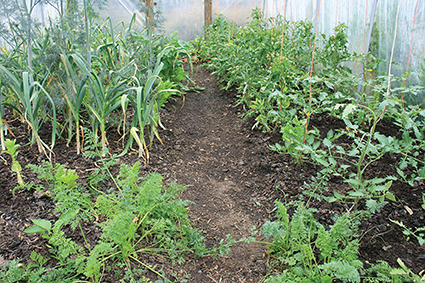
A busy hoop house in mid May. In the left bed:  peppers sown mid-Feb, still small and normally under fleece, transplanted after pulling a crop of peas sown November that produced pods right through April. Garlic was planted early December between rows of salad to deter slugs—it helped a bit(!)—between rows of now-tall overwintered salad lettuce, spinach and dill—some still being picked, and which will be kept for seed. The garlic will be ready to harvest by the end of May. Between the garlic are some cucumber and melon plants just transplanted. A self-sown parsnip has been left to see how big it grows, with French beans beyond that should be ready to eat through June. The right bed is mainly tomatoes sown mid-Feb. Between them some beetroot sown mid-Feb now being picked, and radish also a good size only 6 weeks after sowing. In the foreground a few last carrots (Autumn King) sown October and now a good size. All this intercropping seems to work well even if a bit chaotic, definitely more productive. I will be planting squash under the tomatoes in June, which makes for added but irresistible chaos, last year this produced 40kg butternut off 3 plants.