Sunday, March 22, 2026
Home Blog Page 45

Vegetables in August

This month there is a long list of sowings to keep your soil busy and productive.  For most of these crops, sowing early in the month is best for outdoor autumn picking, later in the month for indoor winter harvests.

Turnips are quick and easy to grow, tender when picked young and will stand the winter outdoors as they grow bigger, a sweet addition to winter stews.

Bulb fennel is a really tricky crop needing lots of space, fertility and moisture, and will go to seed if it gets half a chance, yet worth it for its exotic taste.  We usually grow a few in our hoop house for Christmas.

Our autumn lettuce often succumb to root aphid so we grow lots of radicchio, variety Palla Rossa.  Growing it is easy, give it 13” spacings for big hearts.  Endive Scarola is productive, best to regularly pick young leaves.  True spinach will stand the winter outdoors, the best variety for overwintering is Medania.

There are lots of other ideas, depending if you like spicy leaves in your salad or stir fry.   Rocket, oriental leaves such as red frills mustard and mizuna, coriander and chervil.  If your rocket goes to seed, you can cut it off at root level and it should re-establish.

On existing crops, jobs include pinching out the tops of cordon tomatoes, and reducing the number of trusses if blight is a worry.  Hopefully you have already taken off the lower leaves to help air circulate, as blight establishes in stagnant air.

Pick carrots only when windy, raining or at twilight when root fly are not on the wing, and carefully draw soil up round the root tops to stop flies laying eggs there, and prevent root tops browning.

Thin celeriac plants to 15” apart if you wish for decent sized roots, and keep them well watered.  Water courgettes too, to keep them setting fruit and reduce mildew

August is a dread month for most brassicas as caterpillars hatch out.  We grow our cabbages under Enviromesh, but you may prefer asking your children to pick eggs and caterpillars off by hand, or squirting twice with Bacillus bacteria.  And how do fleas travel?  They itch-hike.

Vegetables in July

Watering becomes an issue at this time of year, although writing about it usually makes it rain—good both ways! Almost all crops except perhaps parsnips and cabbage need help when young.

It’s not a question of your veg plants ‘just about managing’—they must flourish exuberantly and bear huge and heavy yields for their owner. If sowing a crop of carrots, then keeping the soil at seed level and below may need watering every other day, depending on wind and warmth. Compost rich topsoil holds more water.

For other crops, growing in seed trays or modules uses less water and gives a strong start. Transplant them before they get too big and pot bound, and water well around the root ball. After one more good soaking try to encourage them to root downwards.

The leaves going pale probably means the plant was pot bound, and has not yet linked up with mycorrhizae after the luxuriance of compost rich in soluble nutrients.

If dry, water beans and courgettes when flowering to encourage fruit set. Salad leaves need regular watering, and the weekly watering of carrots in clay soil avoids split roots when it rains. Try not to tread on the leaves, and lift your crop only at dusk or the root fly will smell them. Earth up around your carrots so there is no exposed root for egg laying.

Many people with allotments have no access to water—try giving the ground a thick compost mulch, which feeds plants, helps suppress weeds and conserves moisture, at least 50% of which evaporates upwards.

Constant, moderate watering is the key for tomatoes—too little and the plant is under stress, too much suddenly and fruits split and side shoots everywhere, especially on Gardeners Delight. From now on water the soil only to avoid blight establishing on wet leaves. Good air circulation at base helps, so take off the bottom set of leaves after a ‘Smith’ period of 48 hours of high humidity. Blight on tomatoes should not be too much of a problem until they are ripening their fruit—always a time of maximum stress.

Have you seen my wife’s photos on instagram at dowdinglouise? It’s why we all need bifocals, we’re all looking at two screens at the same time.


What to sow in July

July is a big month for second sowings as space becomes available. Transplant or sow French beans, bulb fennel, beetroot, carrots, chard and salads such as lettuce, radicchio, endive, parsley, dill, coriander. Also brassica such as late calabrese, winter cabbage, spring cauliflower, kale, purple sprouting, swede and Pak Choi for hearting. Growing in seed trays or modules gains you an extra month of growing time.

Up Front 07/17

In one of his TED talks, author and speaker on education, Sir Ken Robinson, quotes philosopher Jeremy Bentham saying, ‘There are two types of people in this world: those who divide the world into two types and those who do not.’ Robinson was using the quote to amuse his audience before suggesting that another two groups in the world are those that enjoy what they do in life, and those that don’t. He believes that failings in the education system mean that many people never use their natural talents: often they are pushed into their work through a lack of opportunity to explore their real potential. He makes the case for a radical shift from standardized schools to personalized learning. Instead of pushing square pegs into round holes we should be creating conditions where kids’ natural talents can flourish. It’s a common-sense philosophy that is hard to fault. I mentioned the Bentham quote to someone recently who had his own version. ‘There are two types of people in this world’ he said. ‘Those with high levels of empathy and those with none.’ He went on to explain that we could be forgiven for feeling that recent political upheaval appears to show towering opposites pitted against each other, with little middle ground: Remain v Leave; Democrat v Republican; Labour v Tory. It seems polar opposites have become ever more pronounced—to the point where useful discourse can become impossible. His feeling was that in each of these huge divides there were those that had high levels of empathy and those that believed selfish aims would be more fruitful. Like Sir Ken Robinson he suggested that a change in the focus of some aspects of education may help. If it were possible to teach people to look at the world through other people’s eyes, he suggested, we could transform personal relationships, which eventually could have a knock-on effect on communities and therefore even affect global changes. Echoing Robinson’s call for a revolution in education, he explained that trying to educate people to be more empathetic was a very long-term plan that must be put in place at an early age, but that it could produce results if we started now. There is one stumbling block—there are many who believe that empathy cannot be taught, that it can only be inherent in our DNA. They might be right, but in the interests of progress, perhaps just this once they could try to see it from another perspective.

Richard Mabb

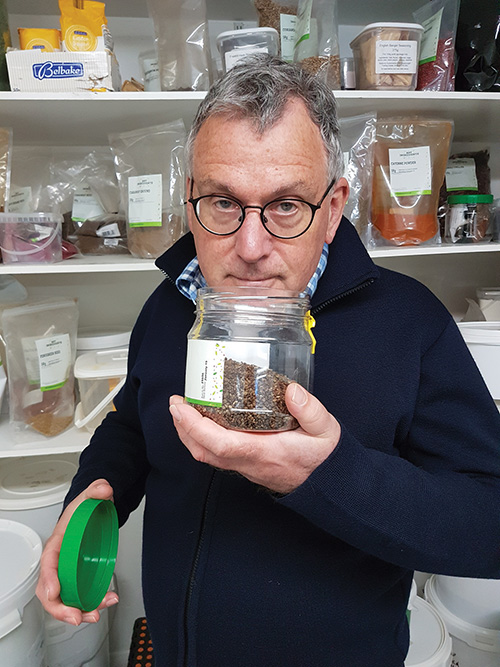
The Dorset Spice Shed is more than just a shed. It’s Richard Mabb’s working-week home where he’s building on a love-affair with herbs and spices that started in childhood. Now based at Bridport’s Dreadnought Trading Estate, the business, which also makes The Seasonist meal-kits started from Richard’s shed in Askerswell.

Moving back to the house that he’d grown up in Richard stepped through the door and smelt ‘home’ emanating from the old spice rack in the kitchen. Richard’s mother, born and raised in China, had always used a diverse rich variety of herbs and spices. He has warm childhood memories of delicious ginger-fragrant Chinese dumplings being cooked by his grandparents, mother, uncles and aunts in West Bay. So, after moving back to Dorset and deciding which direction to pool his passion and entrepreneurial energy into next, he followed his heart and chose spices.

As The Seasonist Richard makes quick-to-prepare risottos, rice puddings and couscous, all expertly seasoned for flavour. The Dorset Spice Shed has all varieties of flavoured salts, individual herbs and spices and signature blends to season everyday cooking. He asserts: “There’s nothing you can eat or drink which can’t be improved by the right seasoning”. This Autumn his blends can be used to make pickles and preserves and for Christmas, the Dorset Spice Shed’s gin and vodka infusers.

After leaving university Richard headed for London where he was a stockbroker for a short spell, worked for an academic publishing company, then became Book Marketing Manager for WHSmith at their head office. From there he set up his own marketing agency in London before finally escaping in 2001 and returning to his childhood home. And that’s when the spices pulled at his heartstrings once more, guiding him to where he is now. Richard’s passion is infectious, drawing his customers back time and again for more adventurous spicing in their lives.

Sue England

Sue England’s father was an apprentice at Smith & Smith Gentlemen’s Outfitters in Bridport. When Mr Smith and Mr Smith died within a year of each other Sue’s family bought the shop, which she now owns with her sister and mother. Sue’s father continued to work in the shop for many years alongside her mother, with Sue helping out on Saturdays. However, after eschewing a career in nursing, Sue now runs the shop on a daily basis, with her team of trusted staff.

Sue’s mantra is to always “sell excellent, good quality stock, with a preference for British makes where possible”. The established outfitters in West Street is a cornucopia of clothes, cufflinks, socks, boxers shorts, day wear, night wear and hats. The men’s section dominates the ground floor, but tardis-like the shop extends up and back to provide a full selection of clothing, hats and underwear for women too.

Many of Sue’s customers have been visiting the shop for years and are greeted warmly by name. Those who venture to the back of the shop can find a map showing all international sales, as the website has meant new global custom; men’s vests dispatched to Canada and Barbour Jackets to Japan. Sue enjoys sourcing clothes for the shop and regularly visits MODA, a trade show in Birmingham to find new producers.

When not in the shop, Sue spends time with her elderly mother, usually enjoying a weekly cup of tea together at Washingpool Farm Shop. And she bakes. Fruit cakes are her signature dish, various tried and tested recipes she makes from memory now. Sue also loves to knit and crochet, proof of which is her wedding dress which she crocheted 40 years ago. Living in Bothenhampton for 35 years, she and her husband enjoy their lovely house as they do living in Bridport, where Sue was born and bred.

Monmouth Lyme Regis

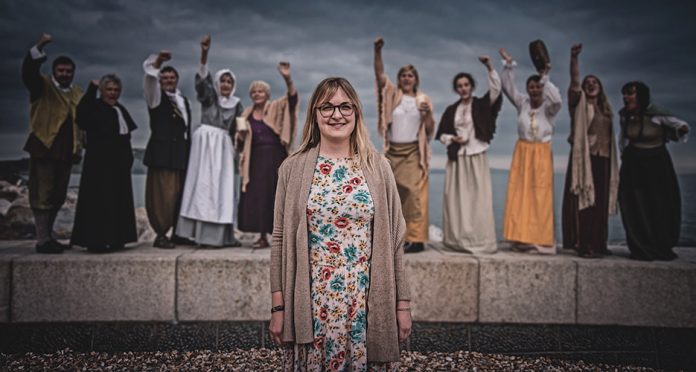
Three hundred years ago in 1685, the Duke of Monmouth landed on the beach at Lyme Regis to raise a rebel uprising against King James II. It was a bold, Protestant rebellion fuelled by the discontent amongst all classes of people who risked everything to join him against the Catholic King. They marched across the South West in a ragtag army, attracting thousands of ordinary men to join the cause. Margery Hookings, who is directly descended from one of the rebels, takes a sneak peek at Monmouth, Lyme Regis’s new community play, written by Andrew Rattenbury and directed by Clemmie Reynolds. It’s being performed at The Marine Theatre in early July.

The last battle on English soil was fought at Sedgemoor, Somerset, on 6 July 1685.

It’s a scenario that sends a shudder through me, and always has, ever since I visited the battlefield many years ago as a teenager in the 1970s.

It became something of an obsession. Back in the early 1980s, I was lucky enough to interview the late W McDonald Wigfield at his home in Ilminster when I worked as a cub reporter for The Sunday Independent.

He was putting together a ‘roll call’ of rebels for a book, which was later published as The Monmouth Rebels.

“The popular uprising in the West Country know as the Monmouth Rebellion must be one of the best documented of all similar events in English history,” he states in the introduction.

“Between 11 June 1685, when the Duke of Monmouth landed at Lyme in Dorset with a party of just over eighty men, and the defeat of his arm at Sedgemoor, in the heart of Somerset, on 6 July, a significant proportion of the population of West Dorset, East Devon and Somerset rose up in arms against the government of James II.

“Exactly how many took part will never be known: estimates of those who fought for Monmouth at Sedgemoor by those present vary between 3,200 and 7,000.”

Wigfield’s research for The Monmouth Rebels was meticulously staggering, detailing as it does nearly 4,000 names of those on the side of the hapless Duke of Monmouth, the illegitimate and enigmatic first son of Charles II, where they came from and what happened to them. Some were hanged, some escaped and others were transported to the West Indies as slaves to service British plantations.

In Donyatt, near Ilminster, where I was born, eighteen men are listed as being in the rebellion. In the West Dorset village where I live now, seven men were caught up in it. At Bridport, twenty four men, and from Chard, more than one hundred. In Lyme Regis, again more than a hundred.

And the surnames of the rebels can still be found in these towns and villages today.

There are incredible tales of tragedy, romance and bravery behind the bare facts. For me, it’s one of the greatest West Country stories that has never really been told, apart from in the history books.

Years ago, I came up with the idea for an HTV programme about some of the Rebels’ descendants in the Caribbean. I was paid for the suggestion and desperately keen to be involved in making the documentary but it passed me by. I found out later that it had been made and aired and fronted by a prominent local historian.

Subsequently, I discovered that my 7 x great-grandfather on my mother’s side, William Crabb, was a Rebel, listed in McDonald Wigfield’s roll call as ‘a gentleman of Ashill’. Some accounts say he died at Ilchester ‘hung, drawn etc’ and others say he died in gaol.

I’ve yet to find out more about my father’s side of the family, the Herrings from Pitminster, near Taunton, who were involved in the Rebellion. Five of them are listed in the roll call and appear to have suffered various fates.

Clearly, I have unfinished business with the Monmouth Rebellion, so I was hooked when I learned that Lyme Regis was putting on Monmouth as its community play. But I lacked the confidence to audition for the production and, besides, I was away during May for rehearsals. However, when I saw a plea for people to step forward to do a play reading for the public, I jumped at the chance.

And so I found myself in St Michael’s Church Hall along with a handful of others who were there to do the same. Most, I think, would have then gone on to audition but me, I was just interested in the words and the story. And what a story it is. If you don’t have any tickets yet, get them while you still can.


Maddy Irvine

‘I had a wonderful childhood, born and brought up in Virginia Water in Surrey, which seemed at that time to be like a real village. My dad was a baker, and his shop, Wentworth Patisserie, was one in a parade of shops that also included a butcher, chemist, ironmonger and greengrocer. My young life revolved around my horse and my donkey, Pip and Misty, and that meant that I spent most of my time outdoors. Whatever the weather we’d ride our bikes to see to the horses, maybe go for a ride, or swim in the river, all brilliant fun. My sister is 6 years older than me, so when I inherited her horse I was aged 10, the horse was 15 hands, and unable to tighten the girth sufficiently I’d slowly topple sideways as the saddle slipped round. Determined and headstrong, it was one of the ways I learned how to sort things out for myself.

There were big transitions taking place at that time in the ’80’s, and a supermarket opened nearby which changed our parade of traditional shops into estate agents and nail bars, and as a family we became very disenchanted with the area. My Dad’s business finished, which had also employed my Mum, sister, brother-in-law, aunty, and cousin. As the smallest, it was my Saturday job to clean the inside of the oven. It was a very difficult time for them when they finally sold up and moved to Sidmouth in Devon, where there’d been many happy holidays, and I went to university in London having been advised to do “Media”, a newish subject then. I wasn’t the most committed student—but in the second year got a work placement in a film PR agency in Soho and found myself, aged 21, flying around international film festivals, in a hilarious, ridiculous, but completely bonkers world. After 3 years I loathed it. I made some lovely friends, but many of the people were to say the least unreal, and some decidedly warped. A few years on, one job led to another, and I found myself in the press department at MTV Networks, beginning to wonder what on earth I was doing with my life, writing endless press releases about Kylie’s bottom.

In a fit of generosity MTV gave me a sabbatical, and I went to the Amazon on a jaguar tracking project. There’s no other way to say it, but it was amazing, and transformative, and made me determined to do something with my life that I was proud of. I soon realised that there were many sides to the story of the threat to jaguar survival; it wasn’t just evil people killing them. The abject poverty brought about by deforestation and environmental destruction meant for some people they could earn more from a jaguar skin than in a whole year of farming.  I also met local people, poorer than we westerners can imagine, who were as excited as we were to find a paw print of this creature which has such spiritual significance for them. I knew then how lucky I was to have this experience, and when I got home I gave in my notice, got a job with an environmental charity called Earthwatch in Oxford as a communications officer, and started studying towards a Natural Sciences degree. I was married at the time, but sadly it only lasted a year—a lovely guy, just not the right guy—and then moved back to London to work at a youth charity and be nearer my pals. Vic and I got together a year or so later, having known each other since school, and always been in the same crowd. Our son Arch arrived very soon after that. Having a baby, as it does with everyone, completely changed my whole horizon. I still wanted to save the planet, wanted to wake everyone up to how wonderful nature is, but now I needed to make this little person’s life as amazing as possible too.

An ambition grew to buy a piece of woodland and bring people to it, to camp in beautiful surroundings and experience nature close up. Then my sister introduced me to John Blaney who was pioneering the concept of forest schools, inspired by what he’d seen in Denmark. He had observed their five to seven-year-olds, outside all day in woodland, exploring freely, which seemed to be such a breath of fresh air, so different to the UK where we wrap our children in cotton wool. I realized this was a model for what I’d always wanted to do, and so headed off to the Peak District, when I was five months pregnant with my daughter Amabelle, to do my forest school training.

At that time Vic and I were living in Sunningdale. For a long time I’d wanted to live in the West Country, and leave the Home Counties behind. On a return trip from a friend’s wedding in Dartmoor, we came through Cerne Abbas where Vic had spent time on holiday as a child. It was love at first sight. In 2008 we bought the Mill House at auction, a truly terrifying but ultimately fortunate process. Having landed here I thought I’d find a job in a local forest school. There didn’t seem to be any in Dorset, but joining my local Forest Education Network introduced me to an inspiring group of women including Helen Day, Deb Millar and Hannah Aitkin, who mentored me through the process of translating the training into becoming a practitioner.

At Forest School the children range from pre-school to teens, and now my partner Jill Hooper is working with adults with dementia, which is going fantastically well. The ethos is to get people holistically involved with nature by introducing a range of activities and challenges to find that individual spark of engagement—which can be beneficial for all people, not just children. In an environment which is risk aware, not risk averse, we set small achievable tasks with the same group, in the same bit of woodland, over a period of time. We set a safe foundation first, with boundary games, learning how to light fires and cook on them properly, and use tools safely; we model how to behave towards each other when playing outdoors, and how to care for the woods. Watching individuals’ confidence grow, interest deepen, and resilience build is pure joy. It’s like sowing seeds of interest and watching them blossom. Some of it is as basic as learning how to be comfortable outside; wearing appropriate clothing so that you’re warm and dry, feeling sufficiently fuelled with good food, and thirsts quenched, all contribute to feeling safe and enjoying the outdoors. Some parents have to learn those things too—wellies with thin socks in winter is torturous!  Once we’ve started a forest school programme, we observe improved attendance and attitude to learning, and as well as instilling an affinity with nature, children’s communication skills have been seen to develop due to the multi-sensory nature of a woodland.

Working with the education system has changed massively since we started because we now have to find our own funding. The South Dorset Ridgeway Landscape Partnership with the Dorset AONB has been instrumental in enabling us, by the end of 2018, to work with 35 schools in the area, and I’m very proud to be part of that.  I appreciate it’s hard for schools to find time to fit Forest School in their busy timetables—however, I have seen where there is a will, a way is found. My dream is to set up a full-time, free-access nature school which has a Forest School ethos, which has core curriculum subjects, but has dedicated time for experiential learning and developing manual skills like basic building, animal care, pottery and woodwork; literacy and numeracy can be easily woven subliminally into practical tasks. And it would allow time and space for children to be explorers and adventurers. We need to balance their screen-time with tree-climbs.’


July in the Garden

If June was ‘flaming’ then there’s every chance that July could be ‘scorching’. Hot and dry weather brings with it the hassle of having to keep everything watered. With increased concern, about using this precious resource, it makes sense to install as many water butts and storage containers as possible. Watering from butts can be problematical, if the tap only runs at a trickle, or if the butt is a long way from your thirsty plants. Small, electrical, pumps, specially designed for the job, may be the answer and they certainly make utilising stored water less of a chore.

I read somewhere that greenhouse crops, specifically tomatoes, yield more if watered with water at the ambient temperature of the greenhouse, rather than water straight out of the tap which is comparatively cold. Grand old Victorian glasshouses often incorporated large water tanks, even cisterns, which neatly stored rainwater and, if only as a bonus, would have automatically supplied water at the same temperature as the plants grown inside. When I get around to it, I intend to move a reservoir inside the greenhouse, linked to the rainwater butt on the outside, to see if this theory, literally, ‘holds water’.

Now that we have passed the longest day of the year many plants enter a different growth mode. Vegetative growth, which was rapid up to now, may slow down and begin to ‘harden off’. Early summer flowerers will concentrate on setting seed, preparing to die down, while late summer flowering plants will stop growing and start blooming. None of this happens overnight, plants respond by means of growth regulating ‘promoters’ and ‘inhibitors’, unlike our ‘instant’ nervous system, but the subtle switch means that now is a good time to undertake a certain amount of plant ‘refereeing’.

The classic example is shortening the long, whippy, growths on wisteria—if you’ve got a wisteria you’ll be more than aware that these need tackling! Climbing and rambling roses should also be assessed. Proper ‘climbers’ are pruned in the winter months but the nice extension growths, which seem to have shot up out of nowhere, need to be loosely tied in before they lose their flexibility. On the other hand, ‘ramblers’ which have had their single flush of flowers, can be fully tackled now. Remove the flowered shoots, keeping the strong new shoots arising from low down, and tie-in these vigorous shoots to replace the spent ones you’ve excised.

Continue with the summer pruning of shrubs which have finished flowering, so that any new wood, initiated by your cutting back, has time to harden off well before winter. Experiment with taking semi-ripe cuttings from shrubs (pencil thick; cut cleanly below a leaf node; remove all but a couple of leaves; insert into free draining soil in an out of the way place; cover with a cloche or propagator lid; water in; leave alone for months). Cuttings can also be taken from any semi-tender perennial specimens, such as those in bedding schemes or containers, which should root rapidly now, giving you small, rooted, cuttings to overwinter, under cover, ready for next year.

Some border perennials which flowered in June can be cut back, fed and watered, to see if you can get a second flush of flowers. Delphiniums often respond well to this treatment. Also, it’s worth tidying up Mediterranean type sub-shrubs and herbs (lavender, thyme, origanum, Convolvulus cneorum etc.) to remove faded flowers and to maintain their compactness. Topiary specimens should be carefully reshaped, using secateurs for large leaved types, such as bay, so that they get a chance to reclothe before the ravages of autumn and winter weather.

General maintenance carries on with, perhaps, even more to keep on top of. Lots of deadheading, watering, feeding plants in containers, grass mowing, weed removing, pest controlling – you know the score. The good thing is that there are still weeks and weeks to go before the slide into autumn, although you need to start thinking about ordering spring flowering bulbs.

While you’re leafing through the catalogues you’ll come across plenty of autumn flowering bulbs too, colchicums and the like, which you can bung in now for a cheerful display to supplement your late flowering perennials. Don’t forget that you can always plant these in pots, if you’ve run out of room in the garden, or if your soil isn’t suitable.

Recently I revisited a nursery in Kent, ‘Madrona Nursery’, that I hadn’t been to since I wrote a magazine article about them, many moons ago. It reminded me how much fun a bit of ‘impulse’ buying can be. It’s not the best time to buy plants, the spring rush is long gone, but at least it helps you to identify which plants are coming into their own now—in what can be a ‘hungry gap’ between early summer and late summer colour.

I couldn’t resist Salvia ‘Love and Wishes’, just getting into its stride with masses of pinky-mauve blooms. It also has a rather heart-warming ‘back story’. This Salvia, raised in Australia, is just one from the “Wish Collection” (‘Wendy’s Wish’, ‘Ember’s Wish’ and ‘Love and Wishes’). A portion of the sales of which benefits the Australian ‘Make-a-Wish Foundation’; this was an impulse buy that benefits more than just my garden.

Another unplanned acquisition was Alstroemeria ‘Rock and Roll’, which has the most striking, bright white and pale green, variegated foliage. The ‘taste police’ must hate it, but they are not my concern. It, together with its green-leaved, brethren, are another useful, mid-summer blooming, group of plants which seem strangely overlooked in current gardens. Apparently, they dislike disturbance so getting them established may be the reason for their scarcity—perseverance is the key.

With that in mind, I’ll end with the sage words of Vita Sackville-West, taken from the July chapter of her Garden Book :-

“Gardening is largely a question of mixing one sort of plant with another sort of plant, and of seeing how they marry happily together; and if you see that they don’t marry happily, then you must hoick one of them out and be quite ruthless about it. That is the only way to garden. The true gardener must be brutal, and imaginative for the future.”


Quite right, Vita, old fruit!

 

Hay Meadows of Golden Cap

For hundreds of years, colourful, flower-rich hay meadows were a defining feature of the British countryside and its way of life. The 20th century saw a tidal wave of agricultural intensification sweep through the countryside accompanied by increased use of herbicides and pesticides. The flower-rich hay meadows were a major casualty of this change and 97% of those present in the 1930s disappeared. Dorset still has some traditionally managed meadows and, at the beginning of May, I went to Westhay Farm below Stonebarrow Hill on the Golden Cap Estate in west Dorset where the National Trust maintains this age-old agricultural system.

I followed the narrow lane as it rose steeply between houses and through woodland along the course of the old ridgeway road towards Stonebarrow Hill.  Red campion, cow parsley, stitchwort and bluebells grew thickly along the grassy verges and bright sunlight filtered through the trees giving an unexpected transparency to overhanging leaves. Emerging from the tree cover, the lane levelled out and, to the right, the land fell away steeply in a patchwork of fields, hedges and trees towards a calm sea with just a light surface stippling.

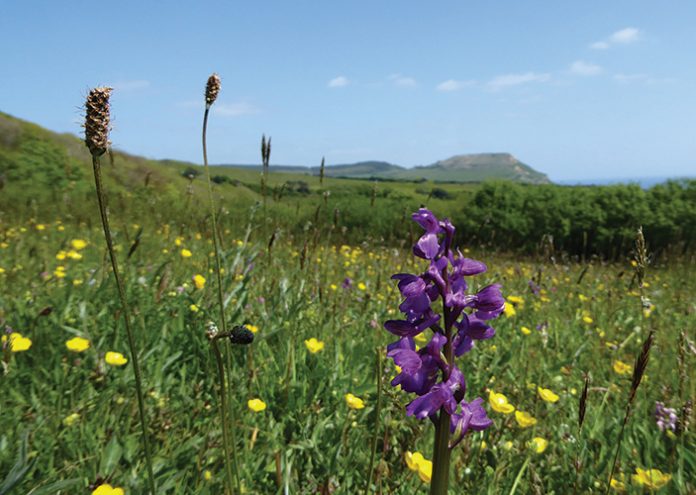
Hidden away in this landscape is Westhay Farm, with its long, mellow-stone farmhouse set in a lush garden and surrounded by hay meadows.  At this time of year, the meadows are richly carpeted with knee-high, yellow buttercups and tall, rough grass with prominent flaky seed heads.  When breezes meander across the valley towards the meadows, the grasses and flowers respond, moving together in waves, like the swell on the sea below.

Partly concealed within the rough grass were tight clusters of lemon yellow flowers above thick reddish green stems.  This is yellow rattle, a traditional meadowland plant, with its tubular flowers open at one end where the upper petal widens to a smooth, cowl-like structure above protruding purple stamens.  A black and yellow-striped bumblebee systematically visited each flower pushing the two petals apart so that its long tongue could reach the nectar at the base.  When it left with its sugary reward it also took away a dusting of pollen from the overhanging stamens to pass on to the next flower.

Yellow rattle is a hemi-parasite; although it can use sunlight energy itself by the process of photosynthesis, it does better when it also establishes physical connections to the roots of other plants in the meadow such as grasses.  The yellow rattle siphons off nutrients from the grasses, suppressing their vigour and creating space for other plants to thrive.  This is very important for establishing a meadow with a wide range of species.

Some of the meadows contained drifts of the glittering, brightly coloured flowers of green-winged orchids, standing defiantly in the grass on thick green stems. Many of the orchids were purple, some were magenta, some violet and a few were white or pink, lending a mosaic of contrasting colour to the meadow. Each flower was composed of several florets arranged around the stem like jewels on a bracelet.  The most visible and exquisite part of each orchid floret was the broad, apron-like, lower petal with its central white stripe contained within a coloured halo.  This white region was decorated with a pattern of eight or more irregular darker spots, the pattern unique to each floret and perhaps decoded by visiting pollinators. Green-winged orchids are a speciality of these meadows and their name refers to the green-veined sepals that protect each developing floret, now thrown back like wings.

The Westhay meadows were a fine sight in early May with their colourful flowers and seemingly unfettered growth.  As the seasons progress, the meadows will mature, the yellow rattle and orchids will disappear, their place taken by other flowers. By July the grasses will be dry and cheerful newcomers such as purple knapweed and buttery-yellow bird’s foot trefoil will bring their colours to the mosaic. In late July, the hay will be cut, this joyous, abundant growth converted into winter animal feed.

Flower-rich hay meadows such as these were a feature of the British countryside in the spring and summer for centuries.  Cultivation followed the rhythm of the seasons.  Grasses and flowers grew in the warmth and wet of spring and early summer and a unique species-rich environment developed. Hay was cut in late summer and removed for winter animal feed, after the flowers had set seed.  Animals grazed the fields in autumn taking advantage of the late-summer grass growth, the aftermath. No chemicals were used and the only fertiliser came from the autumn-grazing animals. The following spring, plants grew, seeds germinated and the cycle began again.  This was a carefully managed land cultivation system, in tune with the seasons and their weather.

Haymaking was an important part of the rural calendar, a natural part of each year’s cycle, celebrated in literature and art.  Here is part of William Barnes’ poem Haymeaken depicting a 19th century rural Dorset scene:


‘Tis merry ov a zummer’s day,

Where vo’k be out a-meaken hay ;

Where men an’ women, in a string,

Do ted or turn the grass, an’ zing,

Wi’ cheemen vaices, merry zongs,

A-tossen o’ their sheenen prongs

Wi’ earms a-zwangen left an’ right,

In colour’d gowns an’ shirtsleeves white


All this was set to change in the 20th century.  Fears for food security during the two world wars led to agricultural intensification and an increased dependence on artificial fertilisers.  Flower-rich hay meadows all but disappeared, a way of life evaporated and the look of the countryside changed.

It wasn’t just the look that changed.  Adoption of new methods coupled with increased use of herbicides and pesticides significantly affected wildlife in the countryside.  Loss of farmland birds and pollinating insects such as bees, butterflies, wasps, moths, flies and beetles has been severe.


July 1st is National Meadows Day and the National Trust is organising tours of the meadows at Cogden near Burton Bradstock.  Contact sarah.kennedy@nationaltrust.org.uk or 01297 489481 for more details.


The title comes from William Barnes’ poem Praise O’ Do’set.


Philip Strange is Emeritus Professor of Pharmacology at the University of Reading.  He writes about science and about nature with a particular focus on how science fits in to society.  His work may be read at http://philipstrange.wordpress.com/


A House of Mystery

On the west side of South Street in Bridport is the Parish Church of St Mary. About 200 yards beyond is a building of mystery, The Chantry, the oldest secular building in the town. It is stone built and on a dull day looks sombre and mysterious, set back a little and detached from the more recent adjacent buildings.  Newman and Pevsner in The Buildings of Britain suggest The Chantry dates from the 14th or 15th centuries, and was a semi fortified tower house, but written information from The Vivat Trust who looked after it for some years suggest the late 13th or early 14th. Constructed 50 yards outside the then town boundary as a two storey square tower, its original purpose is uncertain. It was originally known as “Dungeness”, a prison on a headland, and was on a ness, or promontary adjacent to the River Brit. It has long been thought that its use was to aid local river transport, loading and unloading, as the river was navigable up into the town. It could have been a toll house for travellers by road from the south, and for small boats coming upriver to unload goods. Stones projecting from the south wall suggest a flaming torch or cresset could have been fixed there, to form an early light house. In its early days there would have been no buildings to the south, so it would have been clearly visible. Gordon Le Pard has produced some interesting work showing that the light could have been seen at sea and assisted shipping coming into West Bay harbour to avoid rocks off shore.  A document of 1390 describes the building as “extra ostium”, i.e. outside the entrance to the town. The Chantry has also been called the Castle and the adjacent area to the south has been named Castle Square.

Records show that in 1362 The Chantry was leased to Robert Bemynstre, a lawyer and MP, as accommodation for a chantry priest, Richard Stratton, also known as Richard Farthynge, to sing masses for the souls of  Bemynstre’s family. Initially the mass was to be sung at the altar of St Leonard in St Mary’s church. An additional floor containing a pigeon loft, or columbarium, was erected, and in 1369 Stratton and Bemynstre agreed to share the income from the pigeons, sold for food or eaten themselves. The document confirming this was sealed with two catherine wheels and a heart, symbols of St Katherine and Mary the Virgin, to whom The Chantry was dedicated, according to Luke Over in Bridport—The Evolution of a Town. The building became known as St Leonard’s Chantry. Some years ago we were conducted around the building and saw the pigeon loft still in existence, but not in use, with rows of “Pigeon holes” similar to those in an hotel reception.

In 1376 it was agreed to extend The Chantry to the west, with a hall and chamber near the kitchen, doubling the size of  the building. The additional hall had a central newel stair, and was used for masses, with an altar and a piscina, or basin, used to rinse the chalice. Pevsner describes the area around the piscina as an ogee-headed recess (architectural curve) with a drain. A contemporary fireplace and garderobe (latrine) suggest the room was also a solar or sitting room. On the first floor the chaplain’s bedroom was believed to have been at the front, with an oriel window, another piscina, fireplace and garderobe. The western wall of the ground floor had traces of  wall painting and a large open fireplace with unusual splayed capping. The fireplace surround on the north wall probably dates from the early 16th century.

It is likely that the eastern front is relatively unchanged since the 14th century, although the windows probably had stone tracery. Above the porch projection there may have been a statue, since there are traces of damaged stonework. Possibly a religious work could have been removed by Protestant reformation.

The Chantry continued to be used as a priests house, and an inventory of 1387 names Walter Sherard as chaplain. Another inventory in 1474 indicates John Edwards had taken over.  Chantries were dissolved by Edward VI in 1547-53.

A local legend tells of a hidden passage connecting The Chantry and St Mary’s Church.

After the dissolution of the Catholic Church, The Chantry became a private residence and was leased to a Thomas Watson and William Adeys. In 1695 The Chantry was leased to a Dr James Westly and remained with his family until it was sub-let to the Chilcott family in the 18th century.

Some modernisation took place about 1870 when the front garden walls were built. The west window was enlarged and wooden framed windows inserted. The ground floor was subdivided into three rooms and a new staircase built. Ground and first floor rooms were panelled in pine, with brown varnish finish. The building was reroofed in the 1950s, otherwise little work was carried out until the West Dorset District Council leased it to the Vivat Trust in 1986. The Trust repaired the stone floors and window surrounds, installed main services and converted the first and second floors into holiday accommodation in 1988. Additional repairs to the stonework and windows took place in 1997.

Now the Vivat Trust have ended their lease and the future of The Chantry is in doubt. We hope that it will remain and its history be little changed.