
Sunday, March 22, 2026
Home Blog Page 44

Well Hidden

There is a small road, off the A35 on the outskirts of Bridport to Walditch which passes a gem of a mansion almost hidden by surrounding mature trees. This is building is The Hyde which might be described as Victorian Gothic, built by Joseph Gundry in 1853 and grafted onto the front of a tudor house. In 1864 the historian Hutchins wrote that Joseph Gundry “was the largest owner of soil” in the Parish of Walditch. Gundry used local stone and a slate roof and added stables and coach houses with grooms quarters in 1884, followed in 1885 by a Real Tennis Court a short distance away.

Joseph Gundry had played Real Tennis at Oxford University and knew that the Prince of Wales was interested in Real Tennis and hoped to invite him to play a game in his new court. Unfortunately Joseph was killed in a riding accident in 1891 with the Cattistock Hunt.

The house is now Grade II listed with its Victorian front section including iron window frames in stone mullions, and the JG monogram proudly displayed over the double front doors. Wood is used extensively for internal panelling, cedar, oak and pine and the entrance hall has an eighteenth century carved oak fireplace and over mantel.

On the left of the hall is the dining or Russian Room, which has gold embossed leather wall covering believed to have been brought from a Russian monastery, above carved wooden panelling. The ceiling is of cedar wood, and the fireplace is carved with a male figure on the left and female on the right, each with a child standing in front. The main window is framed by carvings of grape vines and a large dresser to the right of the door has lion head carvings. With a little imagination one can see Harry Potter in Hogwarts waiting for the owl post.

Immediately right from the entrance is the Adam Room, or lounge, with an intricate plaster work ceiling and a fireplace bearing attractive blue lozenges. Further right is the present Library with another interesting marble fireplace and Dutch inlaid tiles.

A fire in 1922 severely damaged some of the earlier rear parts of the building but one room still carries a Tudor Rose ceiling.

The Hyde name has an early origin in the Subsidy Rolls of 1327 which show Thomas atte Hyde and Robert atte Hyde in Walditch. Then in the reign of Henry VIII a John Hyde is recorded as holding a “capital messuage and 60 acres of land in Walditch of Katherine Queen of England, by knight’s service”. The land continued in the Hyde family until the time of Charles II when a daughter of Thomas Hyde married Peregrine, Lord Dunblane. The land passed on to Thomas, Earl of Danby in 1688 and eventually to a Joseph Hardy, who had  daughters, one of whom married Rev Dr Sherive, Rector of Bridport who then owned The Hyde in 1790. Shortly after it belonged to John Eames Downe who sold it to Joseph Pearkes Fox Gundry in 1849.

The first Gundry recorded in the Bridport area was Samuel, a felt maker in 1665, a Dissenter and Unitarian who was appointed to Bridport Corporation or Council in 1695. Soon the family were known as brewers and tallow chandlers. Then the family became middle men in twine and net making, buying in raw material and employing cottagers to work on it. By 1763 a John Gundry was able to leave two houses in West Street, Bridport to his nephew Joseph Gundry, born 1811. One house was known as “Holland’s Court” used in the netting business, this became known as “The Court”, occupied by Joseph Gundry. In 1791 Joseph Gundry and partners Samuel Downe, Joseph Pike and James Kenway opened the first bank in Bridport.

Joseph Pearkes Fox Gundry was born in 1812/1813 and in 1836 became a partner in Joseph Gundry and Company and in 1849 became the “JG” of The Hyde. In 1855 he became Chairman of the Directors of Bridport Railway and “turned the first sod” for the line at Loders. Joseph P F Gundry was one of the founders of St Mary’s Lodge of Freemasons in 1857 in Bridport and Grand Master about 1866. He became a J.P. and as mentioned died in 1891.

Next in line was another Joseph, born 1868, also a J.P. and a Major in the Yeomanry. He became High Sheriff of Dorset in 1921 and Deputy Lieutenant in 1933 but died in 1939. His successor was Squadron Leader Joseph Charles Fitzherbert Gundry, J.P., born 1905. He was Chairman of Gundry and Co. and on amalgamation to form Bridport-Gundry he became Vice Chairman. JCF Gundry sold The Hyde in 1987 and moved to The Hyde Farmhouse.

The Hyde has since become a Bupa Care Home.

During the last war in 1943 American servicemen of the 1st Infantry Division (called The Big Red One) were billeted in The Hyde, officers in the house and other ranks in tents in the grounds. It has been said that Generals Montgomery, Eisenhower and Bradley all visited separately. The Americans left in May 1944 for D-Day, but are still commemorated by a troupe of re-enactors who return to camp in the grounds and attend Church service. There is otherwise little sign of their time here, except that they removed the end wall of the Tennis Court to garage vehicles.

Until 1990 The Hyde had its own private water supply from a reservoir in the copse, but this became insufficient and mains water was supplied. At one time there were six gardeners, but now one keeps the gardens looking beautiful, some earlier features having been allowed to return to their natural state.


 

Up Front 9/17

School days are mostly a distant memory for me but just like recollections of adolescence, there are still moments that come back to either haunt or amuse me. For example—although I enjoyed it—I can remember rugby training on rock-solid, frozen or snowy ground in the winter being more than a little uncomfortable. And running ten times around the pitch in belting heavy rain on deeply mucky ground was no barrel of laughs either. During that training we learnt a technique for kicking successful penalties or conversions. Our coach would make us focus on seeing the ball going straight through the posts before we took the kick. We had to project an image from our mind onto the sky above the uprights and see clearly how the ball would sail straight through. (The crowd would rise to their feet and pummel the air shouting my name, and after a dozen laps of honour I would be carried to the dressing room on burly shoulders whilst hundreds of fans scrambled and jostled to pat me on the back…) Anyway, the focusing system worked, to an extent—though mostly for people that didn’t let their imaginations run away with them. The technique of focusing on success, however, is nothing new and today it is often used in life-skills training. So it was amusing to see research published recently about how to help students deal with the stress caused by exams. The research, from Royal Holloway, University of London, suggested that adopting a ‘this too shall pass’ attitude and mentally projecting themselves into the future could help teenagers deal with stressful situations. ‘With results day looming’ said the report ‘stressed teens should imagine themselves several years in the future’. The theory is that such mental projection could help teens deal with stress, reminding them that no matter what happens, their current situation is only temporary. ‘Much like an adult in a traffic jam, or being forced to sit through a meeting they’d rather not be in, imagining a point after the situation is over can be an effective stress reliever,’ explained Dr Catherine Sebastian. By the time this is in print most people’s exam results will be out and hopefully there will be somewhat reduced levels of stress in many households. Then we can relax, breathe a sigh of relief and revert to more mundane worries about the present, or even the future, in the happy knowledge that the current situation is only temporary.


Jenny Halling Barnard

Robin Mills met Jenny Halling Barnard at the Dorset History Centre, Dorchester

‘My Mum and Dad met in Botswana where they were both teaching. Dad’s Danish and Mum’s a Bristolian. They both have itchy feet and love travelling, and I think some of that has rubbed off on me. They returned to Denmark where they had my sister, and then a year later to Bristol where I arrived. When I was 9 we left Bristol for Chard, and I haven’t lived anywhere longer than four years since then.

At 12 we moved to Weymouth, where Dad taught Design and Technology and Mum Business Studies. I’ve inherited my Dad’s abysmal memory and I tend to look back on events with rose-tinted glasses, but I remember my childhood being wonderful. Dorset was a constant throughout our moves as my Grandma had a caravan in Charmouth, where we spent glorious, sunny holidays with the extended family and friends. Even now going to the Saturday market in Bridport is nostalgic, reminiscent of childhood holidays.

From Weymouth we moved to Hong Kong, which I remember being amazing and awful in equal measure. I wasn’t prepared for the massive culture shock; there was no internet in those days to research our new home, and at the time I didn’t fully appreciate the amazing opportunities that would be open to me. We arrived in 1996, just before the hand-over to China. I remember an exodus of British residents and the People’s Liberation Army moving their tanks to the border, and wondering what my parents were thinking bringing us here! Hong Kong is dynamic, full of life, but is also quite claustrophobic, so we travelled most holidays, visiting amazing countries and meeting fascinating people. After a year my sister left for university, which was heart-breaking at the time—she was my constant through all the moving—but a year later I followed her to the UK, to study Ancient History and Archaeology.

I have always loved history; there was a fantastic history teacher at school, who encouraged my interest. I have fond memories of watching Indiana Jones films when I was really young, my imagination fired by the mysteries of the ancient world and its artefacts. So at university I was in my element and had a wonderful three years in Liverpool, which was such a welcoming, friendly city. Unfortunately when I left, like many of my peers, I couldn’t get a steady paid job in archaeology. After a year of temping, I did a Master’s degree in Care of Collections at Cardiff, specialising in preventative conservation, and began volunteering with the National Trust at Tyntesfield House, near Bristol. This was a new acquisition then, a massive restoration project not yet open to the public.  It’s a vast Victorian Gothic Revival mansion, and whilst I don’t normally believe in the supernatural, working alone in the nursery filled with Victorian dolls and rocking horses which was slightly reminiscent of a classic horror movie set, was a little unnerving; especially when I was required to stay over one night. Despite that sleepless experience, I applied for a paid job there, and although unsuccessful, the Trust offered me a post at Montacute House in Somerset as a conservation assistant. My role was the preventative conservation of Montacute and the Trust’s other South Somerset properties including Tintinhull and Lytes Carey. As a book lover my favourite job was cleaning the books in the library. One day Caroline Bendix, book conservation specialist for the Trust, came to Montacute. I was fascinated with everything about her work and whilst I loved my job, longed for a more hands-on approach to books. She offered me work experience and for two weeks that summer I carried out cleaning and minor paper and leather repairs to beautiful volumes at Codrington Library at All Souls College in Oxford, which was a fantastic experience. I enrolled at a book-binding course in Wellington with an inspirational tutor, and Caroline suggested I applied to do a two-year course in book conservation at West Dean College near Chichester.

West Dean offers some amazing courses—expensive, but the college is good at finding help with funding—such as conservation of metals and ceramics, and making of clocks and musical instruments. It was an inspiring environment to learn in; all the 60 students were there because they were passionate about their specialism and were absorbed in developing their skills and knowledge. The workshops were open from 7am to 11pm and we were catered for, so didn’t have to worry about household chores—although everyone put on about two stone in their first term because the food was so good. Whilst sometimes a little insular it was great to be surrounded by people who were like-minded about conservation and craft, and to be able to collaborate across the specialisms, for example the metals department would advise on treatments if we had a corroded book clasp. I also met my future husband Daniel there, who was on the musical instrument course, making the viola de gamba.

Through the Institute of Conservation I was offered an internship at North Yorkshire County Record Office, on a project partnered with Whitby Museum. In the course of building repairs at the Merchant Seamen’s Hospital in Whitby, bundles of papers, later discovered to be muster rolls, were found in the attic. The rolls recorded the crew of each ship that sailed from Whitby from 1747 to the 1800s. The records included names, ages, where the individuals lived, and previous ships they’d served on; there was a really poignant column for those who fell ill or died on board ship. We thought there were about 4000 documents all bundled up, but there turned out to be over 8000, so it became a production line conservation job, with help from a team of volunteers, who we trained in cleaning and paper repairs. From the muster rolls we were able to trace the naval career of James Cook, from his first voyage as an apprentice to that of master, before embarking on his world-famous career. In some cases we used a technique called leaf-casting, which is taking very fine paper pulp and filling in areas lost through mould damage, to make the document more stable. The rolls were digitised, and a team of volunteers are still transcribing them.

Whilst living in Yorkshire, Daniel and I were married at the Guildhall in Lyme Regis, on a beautiful day, with the ceremony followed by pasties on the beach. We longed to move to the south west, but conservator jobs are few and far between and when my internship ended I was offered a job in Durham. We had been there for over two years, when the post of Archive Conservator came up at the Dorset History Centre in Dorchester, which holds the written history of the county dating from 965. Although not a full-time post, and I had loved working in Durham, we felt this might be our only opportunity to move south. Fortunately I was successful; I work three days a week for the History Centre, and have to externally fund the other two days. On the up side I receive a wonderful variety of external work, including individual’s family bibles, beautiful estate maps from Lord Shaftesbury, and fascinating Admiralty maps from the Hydrographic Office in Taunton.

My work encompasses so many aspects I’ve always loved; understanding the science behind the composition of materials I’m working with, their processes of deterioration over time and how to arrest them; the history that is evidenced by the documents; and the craft skills required to work with intricate and delicate documents. It’s a joy and a privilege to conserve a historic object and think about the skills of the craftsperson who made it, and to play a part in preserving it for future generations.

We love living in Dorset, and now that we’re in the south west Daniel has made me promise that we won’t move again for at least five years. Fortunately I definitely don’t have itchy feet yet.’


Gideon Hitchin

When your most vivid memory of childhood is licking an olive, or taking a tentative bite out of a slice of salami, it’s no surprise that making food becomes your career. Which is what Gideon Hitchin has done, to great acclaim. Gideon is owner and chef at The Giant Club in Axminster, a restaurant that caters for those in the know, those in the Dorset and Devon food scene and those who enjoy elevated, excellent cooking that will send the taste buds soaring. Open for just over a year, The Giant Club offers six courses for a very reasonable £30, from a set menu every Friday and Saturday night.

Growing up at Symondsbury Manor, Gideon was no stranger to meeting new people on a regular basis, as the building was a college with students that came and went. However, in Gideon’s early twenties Brighton and then London beckoned, along with their excellent party scenes, inducing Gideon to hone his chef skills at various establishments as well as generally enjoying life. That is until a phone call from Bridport drew him homeward bound to work for River Cottage, which proved to be an influential and pivotal time to be working there. He combined this with helping to open and establish The Electric Palace in Bridport for his father, cooking and greeting guests whilst enjoying the interaction and association with the arts.

Gideon then set up his own successful event catering company, however, this didn’t have the personal cooking element that he relishes, and so, The Giant Club was born. The space is adorned with eclectic artwork that Gideon, his girlfriend Charlotte and his father have created. But it is in his food that Gideon’s talents take centre stage. He likes to surprise, loves to please and is sure to have tried and tested everything he produces to make sure it is a sublime mouthful by the time it gets onto the diner’s fork.


Luke Hayter

Leaping out of bed, the first thing Luke Hayter does in the morning is yoga, limbering up for a full day of activity at the Fitness Hub. This ball of fitness energy left Bridport Leisure Centre over a year ago to set up his own fitness enterprise, which has been a roaring success. Based at the Bridport Football club house, Luke’s core business started with the provision of Cardiac Rehab, in partnership with the NHS, getting people moving again after heart health problems. From there he got going with evening fitness classes and has also introduced a mother and baby class where mums can exercise while their baby is in a separate minded area.

Exploding onto Bridport’s social media networks Luke can easily be found, offering up fitness tips online as well as promoting himself through free fitness classes held sporadically on a Saturday morning. All this activity has created a buzz around this self-motivated fitness trainer, and with justifiable results and increasing followers, it seems Luke’s vision of his own studio one day is not too far away.

Living in Bothenhampton, Luke has a cockapoo called Murphy, who enjoys going on holiday with his sister Missy, owned by Luke’s parents. Saving his weekends for time off work, Luke enjoys going down the gym on Saturday afternoons, working with weights and chatting with friends. Sundays are reserved for adventure; activities like Air Hop, Paint Balling, Go-Karting, rock climbing—Luke is not a fan of sitting still, so it’s lucky his girlfriend isn’t either.

Cooking for himself most evenings when he gets home, Luke is effusive about healthy eating …and fajitas and burritos. Such is his devotion, Luke has arranged for Mexican street food specialists, A Fist Full of Tacos,  to deliver pre-ordered burritos to his last class on a Tuesday and Thursday evening. What further encouragement do we need to attend?

Experiencing Egdon Heath

Mistaken marriages, passionate affairs, tragic deaths, richly interwoven with folklore and superstition. This is the complex concoction contained in The Return of the Native, one of Thomas Hardy’s great novels. Hardy set his narrative on the semi-fictional Egdon Heath, a “vast tract of unenclosed wild” that assumes a claustrophobic, controlling influence on his characters. Hardy’s Egdon Heath has many of the features of the heath landscape that once filled the space between Dorchester and Bournemouth. I wanted to experience Egdon so, on a warm, humid day towards the end of July, I went to Winfrith Heath one of the surviving fragments of this Dorset heathland.

I followed a sandy soil track on to the heath, descending gradually between borders of gorse and low trees. As I gained distance from the road, long views opened up across the gently undulating terrain surrounding me and an eerie quiet descended, broken only by trains passing on the heath-edge line. Apart from the occasional stunted tree and a few drifts of pale green bracken much of this part of the heath appeared featureless and barren.

Closer inspection, however, revealed some of the heath’s special wildlife. Near the path edge, the cheerful purples, pinks and violets of the three common species of heather showed well. These heathers flourish across the heath alongside rough grasses and gorse, and their bright pastel-coloured flowers lend a purple-pink tinge to long views at this time of year, the colour augmented by sunshine but lost in a mass of dull browns and greens when cloud covers. Large, metallic blue and green emperor dragon flies, the size of small birds, were attracted to the ponds scattered across the heath. They swept back and forth across the water making repeated, aerial, hairpin turns in a constant search for insect food. Heather spikes dipped momentarily when yellow-striped bumblebees moved among the flower-bells collecting pollen and nectar.

The sandy path levelled out. Heathland now spread extensively on both sides and, together with the grey cloud cover, created a claustrophobic feeling. Ahead of me was a band of trees with a gate and standing water. The trees mark a drainage ditch feeding into the Tadnoll Brook, a chalk-stream tributary of the River Frome. I crossed the ditch on a very solid brick bridge, and was transported to a different world, one of damp meadows and thick rushy grass. The wet meadow, soggy underfoot, was dominated by untidy stands of shoulder-high marsh thistles with multiple, prolific, spiny stems. Each stem was topped by a starburst of flower heads, a mixture of shaggy purple flowers and brown and white fluffy seed heads. Between the thistles, the lemon-yellow cushion flowers of bird’s foot trefoil scrambled through the undergrowth and, as I walked, pale brown grasshoppers soared in long arcs from the rough grass, seeking safety away from me.

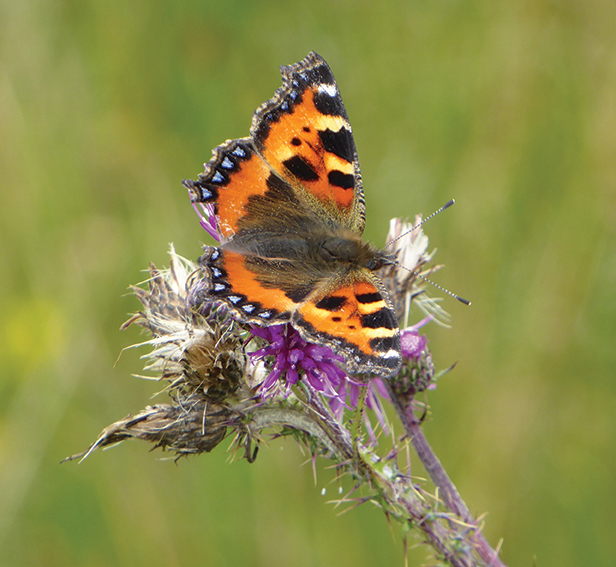
Butterflies danced around the unruly thistle flowers like confetti caught in the breeze, pausing occasionally to take nectar.  Small tortoiseshell, marbled white and peacock resembled colourful modernist stained glass and a pair of gatekeepers performed an airborne ballet. This enclosed wetland felt like a land of plenty, a land of unconstrained, fulsome growth. Even in high summer, however, the meadow was wet and marshy so that after winter rain the area will become boggy and treacherous. A group of cows lurked in a corner of the meadow watching me; they help to control growth of vegetation but create further hazards for the unwary walker.

These two very different habitats, the larger lowland heath and the smaller wet meadow make up the majority of the Winfrith reserve as we see it today but the area hasn’t always looked like this. Until the Bronze Age, this land was covered with forest (birch, pine, hazel, elm, oak) but 3-4000 years ago trees began to be felled exposing the underlying soil. Nutrients were gradually washed away from freely draining soils leaving behind a relatively acidic surface where heathers and gorse flourished, eventually creating the heath we see today. This landscape was maintained and scrub encroachment prevented through a combination of grazing by cattle and ponies and by heathland practices such as furze, turf and peat cutting.

Heathland once stretched from Dorchester in the west to the Avon Valley in the east but much has been lost following changes in agricultural practices or through building; a large part of Winfrith Heath was swallowed up when the nuclear research facility was built in the 1950s and still lies behind forbidding fences. Today, only 15% of the original heath is left but what remains is a very important and rare landscape and part of Dorset’s history. Its importance as a special habitat supporting rare species such as the Dartford warbler and the nightjar is recognised by its designation as a Site of Special Scientific Interest but the heathland is still threatened directly or indirectly by development.

But did I get any sense of what Hardy’s Egdon Heath was like from my visit? Even on a small area like Winfrith, there was a definite sense of isolation in the central part of the heath, and that feeling was only partially lifted when the sun shone and the heath took on some colour. So, if it’s solitude you are after, then it’s a perfect place. One person’s solitude is, however, another person’s loneliness and it’s not difficult to see how Egdon might have depressed some of Hardy’s characters. Neither is the heath a benign environment; care is required in all seasons but in winter, it is bleak, brown and very windy with boggy areas dangerous especially after wet weather. Having said all that, the heath does have an undeniable grandeur but its very rarity as a landscape nowadays means that we may not know how to react to it. Perhaps like Hardy’s “survivors” we should simply accept and embrace the heath for what it is, foibles and all.

Winfrith Heath lies to the west of Gatemore Road in Winfrith Newburgh and a Dorset Wildlife Trust information board marks the entrance. 


Ban Everything

Well, if they’re all talking about custom tariffs, foreign imports and border controls, then so can we. There are lots of things that should clearly be prohibited. Some of these are obvious like illegal drugs and the odd nuclear weapon or two, plus goods such as rhino horns, crocodile handbags and elephant ivory. In fact, any products derived from rare and exotic animals should be universally banned as they’re much better left attached to the real animals themselves—preferably when they’re still alive!

Likewise, if something is harmful to our Planet or the wildlife upon it, then it’s a good idea to stop it coming into the country. For example, just because shampoo is apparently more effective in cleaning hair if it contains millions of tiny plastic microbeads, it doesn’t follow that it’s OK to fill our oceans with the stuff. What seems like an initial good idea in small doses often becomes a global horror story if left unchecked and the fact that a large part of our oceans is already suffused with plastic rubbish is deeply depressing. When I eat my cod and chips, I don’t need the extra nutritious benefit of polyethylene (even if the taste can be smothered with tomato ketchup), so I would favour a ban on all plastic microbeads. And while we’re about it, let’s ban plastic bags and plastic bottles and synthetic milk cartons and polystyrene packaging…

Similarly, you can make an argument to stop imports of everything that’s bad for us as human beings. This means a complete ban on tobacco and cigarettes on health grounds. Since we spend a lot of time trying to make the stuff look unattractive by covering the packs with ghastly pictures of blackened lungs, we might as well save everybody a lot of bother by banning them completely.

I suppose the same goes for alcohol. Given the current crusading path of Health & Safety, they’ll probably soon be covering bottles of vodka and whisky with nasty images of dead people to try and put us off drinking the stuff. But it won’t make much difference—hardened addicts drink with their eyes closed. And if the Health police want to exclude everything that’s bad for us, we have to also ban all sugary fizzy drinks. The nation would be much healthier and our teeth would smile prettier if all such liquids could be stopped at the border. We might as well ban the import and sale of sugar itself. This would cause a national identity crisis, as the UK is well known globally for its manufacture and consumption of sweeties. What? No more Smarties, no more chocolate, mint imperials, fruit gums or toffees! How would I survive without my daily sugar hit? After that, the next step will be to ban everything that brings pleasure. We might as well revert to being strict puritans and ban music, dance, fun and the Arts. The import of laughter and foreign jokes would be strictly controlled.

In revenge, I have my own list of products I’d like to see restricted. Personally, I’d like to ban aubergines because they’re all purple and slimy and are my least favourite vegetable. This means that moussaka is a banned substance in our house. Other proscribed goods at home include ratatouille (the tomato stew, not the film) and chickpeas which I loathe—particularly when they’re mushed up and made into hummus or sesame seed tahina. And a bottle of Retsina is better used as floor disinfectant rather than masquerading as wine. So there! That’s my personal list with which you may or may not agree. You can add your own catalogue of suggestions for a domestic embargo. Can you also please add the banning of mobile phones from the dinner table and any mention of Donald Trump before breakfast.

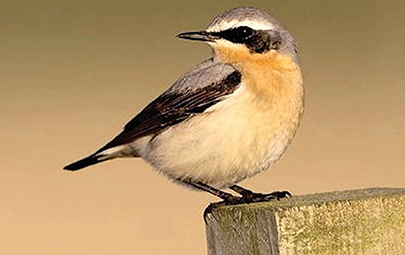
And why stop at a national level? There are a few things made in the Southwest that I believe are better kept within county limits and not let loose on the whole world. I may love local delicacies like Devon clotted cream, Somerset scrumpy and Plymouth gin but I’m afraid to admit (being local and all) that I really don’t like Damask Cream. I know it’s a Bath and Somerset speciality and is filled with exotic stuff like cinnamon, mace and rosewater, but the recent version I tried was so sweet it caused my teeth to squeak and my lips to bleed. In similar regional vein, the worst meal I’ve ever had in my life was Devonshire Mullet Pie served to me by a bored waitress with halitosis in an Exeter pub about 20 years ago. A dish so full of bones that it was like eating mild barbed wire, the awful memory has lingered with me for the remainder of my natural life. Both of these regional items should be removed from menus and proscribed as ‘dangerous substances’. I should also give a brief mention to another local dish that is fortunately no longer available: Portland Snalters—a griddled collection of freshly shot wheatears (see picture) that became King George III’s favourite meal whenever he visited Weymouth. But by then, George had already lost the plot and lost the American colonies. Being declared completely mad was OK if you were royalty in the 18th century. It also meant that—being the King—he couldn’t be banned.


A Walk through History

Margery Hookings calls in on Beaminster Museum and is fascinated by what she finds. The museum is wholly volunteer-based and has been going for 25 years.


It’s a Friday morning and Beaminster Museum is absolutely buzzing with volunteers.

I first came here some years ago. I feel rather guilty that I haven’t been here more recently, because it’s a treasure trove of information, with permanent and temporary exhibitions on so many facets of West Dorset life.

The place is a wonderful resource and full of lots of interesting things—not just about the town but also surrounding villages.

Housed in the old Congregational Chapel in Whitcombe Road, its exhibitions are over two floors—the ground floor and the gallery. It has a shop, which sells gifts, souvenirs and new and second hand books about the area’s history. And it has a reference section of books, maps and other resources. There’s also a meeting room and a kitchen, both of which are available for hire.

But the museum is running out of space. Plans are being formulated to extend the premises out into the back yard. Proposals will be put before the committee and planning consent sought from West Dorset District Council.

The chapel was built in 1749 and enlarged in 1825. It’s a charming Grade II listed building, whose supporters included leading townsfolk such as the families of James Daniel, who fought for Monmouth at the Battle of Sedgemoor of 1685, and Richard Hine, who published his History of Beaminster in 1914.

You can still see the memorial stone on the wall to James Daniel, who had a miraculous escape from Sedgemoor and its bloody aftermath and lived to be 100.

The chapel’s nineteenth century organ still works and there’s a button you can press to hear it play.

Beaminster Museum Trust, a registered charity, acquired the chapel in 1990.

Brian Earl, who’s been voluntary curator since 2013, says: “The trust existed before the museum and was desperate for a building. Richard Hine wanted it to be in the Public Hall but that was overtaken by World War I.”

Volunteers are at the heart of the museum’s success. It is fortunate to have around 70 people helping out—including 50 stewards—who give various amounts of time and energy to make the place what it is today.

But there is always room for more helpers, says Brian, whose own story about becoming a volunteer will ring bells with others who become involved in the goings on of their own communities.

Not interested in history at school and with a degree in modern languages and a background in IT, Brian says: “Someone I played cricket with said they had problems with their computers, so I came along, sorted it out and then got sucked into it.”

The museum has a strong focus on local history, with a main exhibition for the year supported by two, smaller exhibitions. In the winter, the museum runs a series of interesting and successful talks, while the volunteers work on the displays for the coming year.

Currently, there’s a fascinating exhibition called Wood You Know, which runs until the end of October and explores the local history of woodlands, wood and woodworkers. This was supplemented this year by Forty Years of Twinning, photography by Beaminster School students and Three Hundred Years of Freemasonry, the latter being available to see until 29 October when the museum closes for the season. The Beaminster Lodge, which is right opposite the museum, was formed in 1872 and you can read the minutes of its inaugural meeting.

“Exhibitions are planned roughly about two years in advance,” says the museum’s publicity officer, Doug Beazer.

Next year’s main exhibition is going to be called Hatch, Match and Despatch. It’s about birth, marriages and deaths.

Taking me around the Wood You Know exhibition, which includes a wooden rocking horse for children to ride, Doug says: “We like to provide a combination of things for people to read, look at and pick up in our displays. We’re very conscious that we want to involve the generations.”

An insight into school life through the ages can be found in the school room, which is dedicated to the history of education in Beaminster, where Frances Tucker founded a school in the seventeenth century, and surrounding villages.

The museum also organises educational visits to schools and has a loan boxes scheme, in which artefacts relating to many different topics are lent to schools in the area. These range from fossil boxes to items from the 1950s and 60s.

There’s also a dressing up area for children to try on clothes from days gone by and have their photographs taken.

The area’s long history with flax and hemp is examined in an exhibition in the gallery, Hanging By A Thread. The area’s agricultural heritage is on show, along with information and displays about World War I and World War II.

A magnet for children is the corner devoted to the story of Horn Park Quarry, a National Nature Reserve on a privately-owned industrial estate between Beaminster and Broadwindsor. Youngsters can pick up fossils and put a dinosaur jigsaw together.

The museum can organise visits to this reserve, which is the smallest in Britain. According to Natural England, the reserve is important because it contains the most complete Aalenian ammonite succession known to date in England, with all four Aalenian ammonite zones being present. It is an internationally important site for the study and correlation of Aalenian rocks throughout Britain and across Europe.

The limestones contain an extremely diverse and well preserved fossil fauna dominated by ammonites and bivalves. One of the most spectacular features is the ‘fossil bed’—a layer packed with ammonites, bivalves, brachiopods, sponges and fossil wood which lies sandwiched between other, less fossiliferous strata.

This part of Dorset has a rich history, dating back millions of years. And Beaminster Museum is as good a place as any to delve into the various bits of it. Having felt guilty for leaving it so long, I’ll be back.

September in the Garden

Last year we had some of the hottest ‘summer’ weather in September, although, seasonally speaking, we have now entered ‘autumn’. September keeps you guessing as so much depends on the weather and how benign it turns out to be.

It is popular to start muttering about an ‘Indian Summer’ whenever it turns particularly warm at this stage of the year. When I hear this term I automatically see images of our lost Empire, colonial types luxuriating in the ‘last days of the Raj’ and generally ‘It Ain’t Half Hot Mum’ scenes of khaki and elephants.

Aside from being potentially ‘Non-PC’, these images are most likely to be entirely misplaced. Apparently, the term was first used by our North American cousins, notably on a completely different continent, and the ‘Indians’ referred to are actually the, ‘PC rectified’, original inhabitants of that colonised land mass—‘Native Americans’ (although I may be out of date with that term too; I find it hard to keep up these days!).

Anyway, back on safer ground, in the ‘cutting garden’ rows of dahlias, available in every shape, colour, form and stature, provide reliable blooms and vibrant hues to suit every room of the house. There’s so much shrub foliage around, at this pre-leafdrop stage, that a simple vase of leafy exuberance, teamed with dazzling dahlia heads, is all that’s required. If only dahlias were scented (bring on some much-needed genetic modification) then they’d truly ‘have it all’.

For scented cut flowers, a succession of summer flowering bulbs, such as Acidanthera murielae, may be planted over the spring / summer, even up to a late planting in June. Also, experiment with late planting scented lily bulbs and you could be rewarded with these, typically ‘summer’, blooms managing to hold on into September. Plunging pots at different soil depths, or against the ‘cold’ side of walls, may also delay flowering long enough to ensure scented florist’s lilies well into September.

Whatever the weather, autumn flowering bulbs can invigorate areas of the garden which might otherwise appear dull; you can’t beat sheets of ivy leaved cyclamen (Cyclamen hederifolium). Their pretty white / pink flowers emerge well before the marbled foliage which, in turn, persists after herbaceous plants have died down. It’s cool, wet, weather, after the ‘heat’ of summer, which encourages autumn cyclamen to flower. Therefore, in most years, individuals will bloom well before now but it’s the ‘dramatic sheets’ of colour which I hold out for.

What else is coming into its own now? The late flowering, ‘orange peel’, clematis, such as ‘Bill MacKenzie’, is a joy. Jaunty little nodding flowers, like pixie bells, smother an established plant and stay blooming for many weeks. Being a ‘late flowering’ clematis (one which flowers after midsummer’s day) pruning is a cinch as they can be chopped right back, to just a framework of stems, in spring. They flower on the shoots which grow during the current year—so even a drastic chop back will not stop them from flowering. For this reason they are great planted where they can scramble through a big old shrub, festooning it with flowers when otherwise the space would be dead.

For soils with that rare combination of constant moisture and full sun we return to the realm of bulbs and, in this case, corms, in the guise of Hesperantha coccinea (formerly Schizostylis coccinea). ‘Kaffir Lilies’ come in many named forms with colours from deepest red, palest pink through to pure white. Stunning when they are given the conditions they enjoy (see above) but ‘all leaves and no flowers’ when they are either too shady or too dry. Looking for recommended ‘newer’ introductions I came across ‘Sunrise’ (pale pink flowers of increased size) but, to add to the already confusing ‘updated’ Latin nomenclature, this offering is synonymous with the variety ‘Sunset’!!!

Bringing it back to bulbs reminds me that it’s now that I really should be starting to plant spring flowering bulbs. Start planting them in the order that they flower in the spring so that the earliest flowering ones, early crocus come to mind, have enough time to get some roots down before producing the flower stems. Tulips are famously planted late, in November, to reduce the likelihood of ‘tulip fire’ (a debilitating infection) so don’t worry about those yet.

Moist, warm, soil means that it is a good time to move evergreens and conifers which need to be able to produce new roots and recover from the shock of transplanting before the ground is so cold that it stops growth. By the same token, it’s a good time to prepare new areas of ground for future planting or to clean up an area that has become weed-infested. To clear it using a non-persistent, ‘glyphosate’, weed-killer, September is the last month in which chemical herbicides reliably work. If you’re clearing it manually then this needs to be done in good time so that any weed regrowth can be removed before it dies down completely over the winter.

Areas that have been cleared of weeds are best covered up again to suppress further weed growth because even the most thorough ‘clean up’ will only remove the visible miscreants, there will still be thousands of weed seeds, or viable sections of established weed, waiting to sprout again. A physical mulch, such as ‘weed suppressing fabric’, is ideal for larger areas, requiring long term control, but this is a bit too ‘industrial’ for the average garden.

A thick application of sterile, bagged, ‘mulch and mix’ type compost is easier to handle and less likely to introduce new weeds than your typical ‘farmyard manure’ alternative. The ‘belt and braces’ approach is to use weed suppressing fabric with a layer of organic mulch (finely graded bark chippings look acceptable) on top. Of course, if you’ve applied a fabric type mulch future planting will be more problematical as cutting holes in the sheeting to plant through is a bit of a chore. For this reason physical weed barriers work best for planting schemes which are predominantly shrubs or trees. Daintier herbaceous perennials and their ilk are better suited to mulching with organic substrates alone.

I think I’ll end on the positive note of making plans and looking forward to new areas of planting. After all, autumn is historically the real beginning of the gardening year.


Vegetables in September

Hopefully after a wet August we will have an Indian summer. The hot spell in June fired up all our summer crops, with the result that most have continued yielding well in the damp weather.

A high point has been over 100 cucumbers off one plant, variety Passandra, with no signs of it slowing down as fruits grow on all the side shoots trained above our peppers. Tomato blight is worse than usual this year, so we have cut off quite a few fruit trusses, and left the vents open to increase air circulation. Some outdoor Gardeners Delight, although producing less fruit, are extremely tasty.

Slugs have been loving the wet and its proving tricky to sow new crops outdoors.  Carrots and celeriac are growing well, but a first bite on quick-growing skin by a slug will soon be followed by other wildlife like woodlice. Most field-scale carrots are lifted now and meticulously stored at 0-3 degrees C and 98% humidity, so we just put up with increasingly nibbled carrots dug fresh from the soil. We have dug most of our potatoes now as both slugs and blight were beginning to afflict the tubers.

One crop you can still sow outdoors is Rocket, which we sow thinly on the soil surface. We sow Wild or Salad, but it’s such a popular crop now that there are many varieties to choose from. You can pick leaves right though winter and when it rises to flower, try cutting it off at ground level and it should sprout again. Sowing oriental leaf mixes now can provide leaves early next spring, together with leaf beet, land cress, coriander and chervil.

Winter salads grown indoors are most productive, best from an August sowing but not too late even now, and we have many modules of spinach, Little Gem lettuce and a few favoured orientals and mustards to transplant under our tomatoes before we cut them down.

As our summer crops slowly fade, it is great to see winter ones like parsnips growing bigger and stronger. Under Enviromesh the cabbage and leeks seem to double in size every week.

And now there is a new technical term for a warm sunny day after two wet ones. It’s called Monday.