
Christmas might be a time of good will, but it also has its fair share of strange tradition and quite wacky customs. One that always draws a smile is a custom in Caracas, Venezuela. On going to bed on Christmas Eve, young children would tie a piece of string to one of their toes and hang the other end out of the window. In the morning, people roller skating to Christmas services would tug on the strings that hung out of the windows. Another tradition, practised in Catalonia, involves a character called Caga Tió or Tió de Nadal. A small hollowed out log is given little stick legs and a face is painted on one end. The log sits on a table and is fed with fruit, nuts and sweets from December 8th. Then, on Christmas Eve, the poor log is beaten until the goodies pop out. To give little Tió encouragement to release its bounty of fruit and nuts, a song about ‘pooping’ is sung during the process. ‘If you don’t poop well, I’ll hit you with a stick—poop log’, is one translation. Decorating a Christmas tree is a traditional activity for many of us here in the UK, but how many people hide a pickle in the tree? Although it is also said to be a tradition in Germany, many US households will adorn their Christmas trees with pickles after a custom they claim began in the American Civil War. A private, taken prisoner over the Christmas period, begged his guard for some food. The guard gave him a pickle, which the prisoner later claimed saved him from dying of starvation. Afterwards, he always hid a pickle in his Christmas tree, thus starting a new tradition. Another wacky Christmas tradition is from a little closer to home. In Wales there is a ritual known as Mari Lwyd. A villager parades around the streets hidden inside a white sheet carrying a horse’s skull on a pole that sticks out of the top. Along with friends, he stops at houses and local pubs to engage in song and banter with other locals. Often the skull’s jaw is engineered to allow it to snap at those around it. The Czech Republic has a useful system for unmarried women to help them plan for the year ahead. They have to stand at the door and throw a shoe over their shoulder. If the toe lands pointing toward the door, they will be married in the coming year. It is said that the London Underground warning ‘Stand clear of the doors’ was originally announced by a Czech gentleman with a stiletto lodged in his forehead… Sorry, couldn’t resist that. Merry Christmas.
The only way is Wessex

Folk sensations Show of Hands will be returning to their roots this month when they play in Bridport as part of the town’s second Winter Solstice Festival. Margery Hookings catches up with one half of the duo, Steve Knightley, who reveals a big soft spot for the Vale and surrounding countryside.
When Show of Hands play at Bridport Electric Palace on Friday 22 December, it will be like coming home for Steve Knightley and Phil Beer.
Steve’s title for the gig is the rather tongue-in-cheek The Only Way Is Wessex.
Featuring many of the locally-based songs that are their trademark, the concert for the Bridport Winter Solstice Festival will recall the duo’s early days when they first performed in West Dorset more than 25 years ago. They recorded their first CD live at the Bull Hotel.
“Twenty five years ago, our ambition was to play at Bridport Arts Centre,” Steve reveals. Since then, Show of Hands have gone on to fill the Royal Albert Hall five times and have won numerous plaudits, including three BBC Folk Awards. Both Steve and Phil are recipients of honorary doctorates in music from the University of Plymouth.
Peter Gabriel describes them as ‘one of the great English bands’; The Scotsman observed that Phil can’ play nearly every stringed instrument known to man’ and broadcaster Mike Harding rates Steve as ‘one of England’s greatest singer songwriters’. The BBC’s Mark Radcliffe says Show of Hands are now ‘at the top of their game’.
Steve and Phil are two of the most popular ambassadors for acoustic music and have taken it all over the world, from Australia to India, Germany to Canada, the Netherlands to Hong Kong plus key festival appearances including Glastonbury, WOMAD, Cambridge and Celtic Connections.
But this part of the country, and Dorset in particular, is in Steve’s DNA. During the war, his mother was evacuated from Southampton to Bettiscombe. Brought up in Exmouth and now living in Topsham, he’s still clearly drawn to this area. It’s yielded a rich seam of subjects for the band’s songs.
“West Dorset is my favourite place, particularly the Vale. I love the way it’s enclosed.”
In 1986, he moved to Corscombe from London before finding Church Cottage in Whitchurch Canonicorum, where he lived for ten years until 2000.
For six years, he worked part-time at Beaminster School, teaching music, media studies and history.
“John Pugsley was the head at the time – he was such a lovely man. He was quite relaxed and knew I could bring my musical connections to the school.”
Steve had left London at the age of thirty two after trying, unsuccessfully, to make his mark in rock music.
On his return to the West Country, his folk epiphany began when he crossed paths again with Phil Beer, an old friend he had known since they were sixteen. The pair of them had lived on opposite sides of the River Exe, with Steve in Exmouth and Phil in Exminster.
“I was returning to the sort of music I was playing in my teens, traditional West Country songs,” he says. “Phil said he could get us some folk club gigs and we needed to start writing. So I started using local people and local stories. When we were out and about, people engaged with them. The audience weren’t just sitting down in respectful silence.”
In the early 1990s there was a thriving folk scene in the Bridport area.
“We progressed on to the festival circuit with the help of Peter Wilson who was our agent.”
From those days, Show of Hands, with Miranda Sykes performing with them since 2004, have never looked back. Fervently loyal to their West Country roots, they jumped at the chance of playing at the Bridport Winter Solstice Festival, which is curated by Grammy-nominated musician Simon Emmerson, a record producer and founder of Afro Celt Sound System and The Imagined Village.
“We knew we were free and I trust Simon,” Steve says. “The reason he lives here is because I was talking to him at the BBC Folk Awards and he said he wanted to move to the West Country and asked me where should he go.”
Steve had no hesitation in recommending his beloved West Dorset, where Simon has lived now for more than ten years.
Show of Hands are looking forward to coming back to Bridport and playing some of the old songs. “It’s a great line-up and a lovely venue,” Steve says.
Show of Hands play at Bridport Electric Palace on Friday 22 December. For full details please visit electricpalace.org.uk
December in the Garden
Looking at photos I took of autumn colour last year, compared to the same scene this year, I think that it’s got colder sooner, to lower temperatures, this year compared to last. There are also more berries on my hollies, never the heaviest cropping specimens, than in other years which, traditionally, signifies that a ‘hard winter’ is in prospect. Well, time will tell, but my masochistic side rather looks forward to a properly freezing winter—if only to ‘cleanse’ the garden of some of the overwintering pests and diseases.
Having said that, a very cold snap would not please me at the moment because, perversely, the striking, glaucous, toothed leaves of Melianthus major (the plant that smells of peanut butter if you bruise the leaves) come into their own around now. Being South African in origin it is, like the various bulbous species hailing from that part of the globe, programmed to time its growth spurt and flowering during our autumn and into winter.
Melianthus major is a bit late to that party, compared to the autumn flowering of its bulbous compatriots, such as Nerines and Crinums. Established plants produce their weird, mahogany hued, inflorescences only around now. Given that they are mostly grown for their architectural leaves, the flowers are a bonus especially because they look impossibly tropical to be appearing at this particular time of year.
They need to be planted in a sheltered spot, less because of the cold, they seem almost hardy in this part of the country, but more due to how annoying it is to have their grey-green foliage shredded by strong winds or ‘burnt’ by an icy blast. On the question of hardiness; there have been years when my established plants seem to have practically disappeared – only for a buried stem, often where it’s forced itself into a crack or crevice, to burst back into life and send up new growth where none was apparent before.
Also, they are adept at ‘layering’ themselves, so that new plants can often be started where old stems spontaneously root as they rest on the soil surface. The old woody stems can spread-eagle to the point where the plant’s architectural value is diluted by too much louche sprawling. To reinvigorate an ancient specimen, it’s a simple case of cutting off the oldest stems, especially those that flowered in the winter, to promote the production of new growth with lovely, fresh, toothy leaves.
Evergreen plants are an important part of the garden and winter is when they come into their own. To ring the changes why not include some variegated evergreens which will really shine during the dull winter months? It’s popular, but rather obtuse, to frown upon variegation. “Variety is the spice of life”, and all that, so to exclude variegation, from your gardening palette, is cutting off your nose to spite your face.
I suppose, during the flower filled months of the year, you might not want too much fancy foliage competing with the blooms. However, in the winter months, the relative dearth of pretty flowers means that the novelty of variegated leaves makes up for the paucity of blooms and can therefore be ‘forgiven’. I have a small-leaved, green and white, variegated ivy which began life as an escapee from a winter bedding scheme. I hardly notice it in the summer but, now its bedfellows are denuded, it’s a very welcome alternative to having bare soil. In fact, evergreen groundcover plants are a must in the winter as without them a lot more soil would be exposed to the harsh glare of scrutiny.
To get even more value out of evergreens, in the winter garden, you can clip them into all sorts of intriguing shapes—‘topiary’. In its simplest form, it could be argued that a hedge is really just a very practical form of topiary. You are, after all, clipping and trimming a tree or shrub so that it stays in a particular shape—which is anything but natural. The fact that it also performs a function (boundary, windbreak, backdrop etc.) creates a ‘hedge’ rather than a ‘topiary specimen’.
More abstract shapes, or single specimens specifically shaped, are what we generally regard as topiary. My old favourite, yew, lends itself superbly to all types of ‘topiarising’ due to its dense growth habit, small evergreen ‘needles’ and the ability to sprout afresh even from the oldest wood.
A garden, full to bursting with herbaceous plants in the summer, can have a second life in the winter if the beds and borders contain cones, pyramids, balls, or any other shape, of clipped evergreens. Repeating the same shape, at regular intervals, lends a formal ‘backbone’ to the garden.
Ready made topiary specimens are readily available from garden centres, those big D-I-Y chain stores and various ‘online’ suppliers. They can be quite pricey, due to the time it takes to grow them to a decent size, so, if you’re looking to buy a gardener a generous Christmas present, maybe some instant topiary would fit the bill?
For me it’s impossible to think about topiary without thinking of how obsessive the Japanese are about this gardening Art. By pure chance, I honestly didn’t plan this, this also links nicely back to how I started the article…
Years ago, I invested in a lot of plants, Melianthus major being one of them, from a nursery called ‘Architectural Plants’. Recently, while attending a garden talk, I learnt that a certain Jake Hobson worked there at around the same time.
The link is; he went on to set up a company, on the Dorset / Wiltshire border, that has become the byword for all things Japanese, precision gardening tools and topiary maintenance : ‘Niwaki’.
What a small world this funny business we call horticulture is!
Compliments of the season to you, Dear Reader.
Lloyd Brown

Lloyd Brown, MD of Grey Bear Bar Company grew up in Alton Pancreas, a hamlet nestled in the Piddle Valley. He went straight from school into his first job at The Victoria Hotel, Dorchester, knowing then that he wanted to work in hospitality. He put his head down and started to learn the ropes.
After a few years Lloyd moved to Reading, where he could really start to focus on learning how to make cocktails, the area he wanted to specialise in. He worked along the riverside where there were lots of bars and restaurants, learning different skills and deepening his understanding, trying to get as much experience as possible. During that time he also started freelancing at cocktail parties in London, exposing him to a whole new level of mixology.
But this Dorset boy got homesick and so googled one day for a ‘bar job Dorset’. Up popped one entry; The Venner Bar, The Bull Hotel, Bridport. Lloyd jumped at the chance as it involved a complete blank canvas. The bar was redecorated, re branded and he hired new staff. It was a complete success; winning the accolade of Best Bar in the South at The Observer for four years in a row, no small feat. When the business changed hands, Lloyd decided it was time to move on. Supported by his wife Vix and the locals he had served over the years he was persuaded to set up Grey Bear.
Now Lloyd advises local pubs, restaurants, drinks companies and hotels on cocktails. Creating them, pairing them, devising menus and training staff to make them. He also has a bespoke portable bar; the Fat Bear, a converted horse box, which he takes to venues. As father of a newborn, he may be burning the candle at both ends, but is thriving on having created his own perfect mix in life.
Bring on the Angels

My first stage appearance was at the age of six—not exactly a starring role but a solid and supportive member of the cast. Supportive because my job was to lean on the cardboard stable door to stop it falling over and covering the manger in our local school Nativity play. Apart from this vital physical act of propping, my dramatic responsibility was limited to masquerading as a sheep dog supposedly keeping watch over the half dozen stage sheep and goats. The sheep were all liberally smothered in yards of cotton wool and one of them named Sam (aged five) developed a wooly allergy and sneezed so hard his entire cotton fleece flew off his back and landed on the plastic Baby Jesus. I realise now this was a fortunate extra safety measure to protect the manger and all surrounding it (that meant us animals plus a rather worried looking Mary and Joseph) in case my leaning support gave way and the stable door knocked everything over. This might have resulted in some local headlines (‘Away With A Manger Shock’) and mild unpleasantness which would have been sorted out between parents with a glass of sherry.
I got to wear rather natty pointed doggy ears and I also remember I was covered in an old and very stinky black and white Afghan rug belonging to my mother. I may not have looked much like a sheepdog, but I certainly smelt like one. And we were all kneeling around the crib with front feet and hooves (or in my case paws) obediently folded in front of us as we worshipped the little baby Jesus (in pink plastic with ‘real’ opening and closing eyes from Woolworth at £2 and 5 shillings).
If I recall correctly (it was quite a long time ago), there were also some lowing (or blowing) cattle, a donkey with large floppy ears and a few rather bored shepherds with glued moustaches and beards plus an Angel Gabriel with asthma and a runny nose (played by Sarah from the year above because she was more grown up and taller than any of us six-year-olds). For some reason that has long since hopped away and vanished from my brain, we also rather strangely had a moth-eaten kangaroo kneeling next to one of the cattle. I didn’t think that kangaroos were mentioned in the Bible, but I reckon Ms Grimshaw who organized the Winnie-the-Pooh pantomime for the senior school wanted to re-use her Kanga costume because she had made it and everyone agreed it was a Very Fine Piece of Costumerie which definitely needed to be seen more than once in the school year.
One of the worst forms of medieval torture for small children is compulsory kneeling. It’s pretty uncomfortable for grown-ups, but for small children it’s unbearable. After a very long half an hour, the wise men finally stumbled into view with their bendy cardboard camel, but by then the sheep and I were all fidgeting and squabbling and longing for relief. One of the goats couldn’t wait any longer and decided to relieve himself rather too literally. The resulting shriek from one of the shepherds caused a rapid stage redeployment which was further compounded when Mary dropped the Baby Jesus in it. The parents of course all fell about laughing, but I remember that no child spoke to Gary (the offending incontinent goat) for months afterwards. He was teased so badly I think he left school the following term. Children can be so cruel…
Apart from an onstage accident or two, I hope that your local traditional school Nativity play continues to flourish complete with fake beards and wise men dressed in tin foil and glitter. Even if your 2017 Star in the East is now a battery powered LED (£15 from Amazon) and Santa Claus might be a drone flying high over Pilsdon Pen, the old-fashioned power of Christmas can still light up the sky in an analogue fashion. Christmas is perfectly real and the Christmas message doesn’t have to be virtual to be meaningful. We certainly need even more wise men and women than we had last year. And a few Angels might come in very useful in solving some intractable global issues. Actually, Angels are very useful and very small—according to medieval theology, an infinite number of them can apparently dance on the head of a pin, so they could get into really tiny places to look for lateral solutions. And if you’re stuck on stage near the back, just keep propping up the stable door because you never know what might happen…
The Spirit of Jack Daniels
During the festive season we have the solstice and then on the 24th we may think of a roaring log fire, a half-eaten carrot and glass of sherry on the hearth, perhaps with a smattering of snow marked by reindeer footprints. Then with the curtains drawn we might think of local ghost stories, as people did years ago. The ghost story recounted here is macabre and disturbing.
This ghost story is not about an American whisky, but about a boy with a similar name, John Daniel, who was nearly 14 years old in 1728, living in Beaminster. The story is not for the faint hearted, being a ghost story with more detail than is often the case.
John was not in good health and lived with his stepmother Elizabeth and his ten year-old half-brother Isaac in Hogshill Street. John was sent by his stepmother to look after her cows around midday, near to midsummer, but did not return that evening and apparently she did nothing about his absence. Early next morning his body was found lying on a small island in one of the local streams about a furlong from his home. A written description states that he was “lying in a very odd posture…with several black or blue spots round his neck and on his breast and belly, which tokens of violence…” Despite the unusual circumstances there was no evidence that his death was unnatural and he was buried on Saturday 1st June in Beaminster churchyard.
In those days boys up to about fourteen years of age were schooled in the parish church gallery by the schoolmaster John Guppy on Saturday mornings. On the 22nd June he dismissed the class just before midday and about a dozen went out to play ball in the churchyard whilst three or four remained to sweep the gallery. They heard a noise like a small bell being rung, gradually coming nearer. The boys ran from the gallery and down the stairs to tell their friends in the churchyard that they thought someone was hiding in the schoolroom to frighten them. One boy fell on the stairs and bruised himself. The boys returned to the gallery but found nothing untoward, so most returned to play in the churchyard. Those remaining in the gallery heard noises which were confused in their subsequent descriptions, such as the minister preaching, a congregation singing psalms or someone in boots on the stairs. One boy who returned to the schoolroom to collect his book saw what appeared to be a white coffin with brass nails standing on a desk at the far end of the gallery. From the churchyard near the door, which opened inwards at the foot of the stairs, it was possible to look up to the gallery and the coffin was seen by four or five boys at the doorway. They saw a piece of tape hanging from one handle of the coffin and the apparition of John Daniel in his school clothes sitting at his desk next it. He had a hat partially over his face and one hand bound up with linen cloth as on the morning prior to his death. Some boys only saw part of the apparition and others, curious, returned to see it, until Isaac cried “there sits our John…I’ll throw a stone at him” as he did so he shouted “there Johnnie, take it”. Immediately the whole church became dark although it was a clear day. After a few minutes the darkness lifted but the apparition had disappeared. The terrified boys ran from the churchyard, some falling over a low wall, alarming other people nearby.
The event made people even more suspicious that John might have been murdered and they went to Colonel Brodrepp of Mapperton Manor, JP for Beaminster. He saw all involved including eight of the schoolboys, interviewed separately. Each boy told a similar story, including a new boy who had never known John and he described the apparition in detail, his clothes and the white rag on his hand etc.
The body was exhumed and an inquest was held two weeks after the apparition, at the Kings Arms, probably on Saturday 6th July, including at least 38 witnesses. The coroner was George Filliter, Wareham Town Clerk, attorney and solicitor. Two boys were overheard saying “there is the gartering we saw on the coffin handle when it lay on the writing desk” but the sexton and others present at the funeral could not remember anything tied on the handle. Two women who had seen the corpse two days after it was found had discovered a strip of black cloth around the throat. A surgeon could not confirm any dislocation of the neck. The verdict of the jury was strangulation. Was it murder ? No one was accused.
One possible suspect was John’s stepmother, Elizabeth Daniel, who was described in a contemporary document as “before this accident was very gay, singing and merry, has since by the affected to sing but it is observed by the neighbourhood that she pined away. Her lips wale, and in this time in an infirm way”.
Some six weeks after the apparition of John Daniel a second appeared, again in the church during school. A girl of about 14 saw a woman in a dark gown with a flowered neckerchief and straw hat push open the door and look up. The girl immediately told the schoolmaster, believing the woman wished to speak to him. As he descended the steps the door slammed and when he went outside there was no one to be seen. The minister also heard the door slam and they questioned the girl who described the woman as slim, “rosier with the pox” and a pale face. On hearing the description neighbours said it must be the ghost of John Daniel’s own mother who had died about the time of the girl’s birth. Following this event there were no more apparitions in the church.
Elizabeth Daniel married again to Henry Gould a year or two after the death of her stepson John. The Daniel family continued to prosper, but the name ended in Beaminster some twenty years ago.
This story is based on a booklet The Death and Times of John Daniel by Marie de G. Eedle and Raymond E. Paul published in 1987 and still available from Beaminster Museum. I knew both authors via our mutual interests in family history before they went to join John Daniel.
I hope this story will not put you off your Christmas dinner or disturb your sleep. And I wish you a very happy and peaceful Christmas.
Cecil Amor, Hon. President, Bridport History Society.
Alan Brown
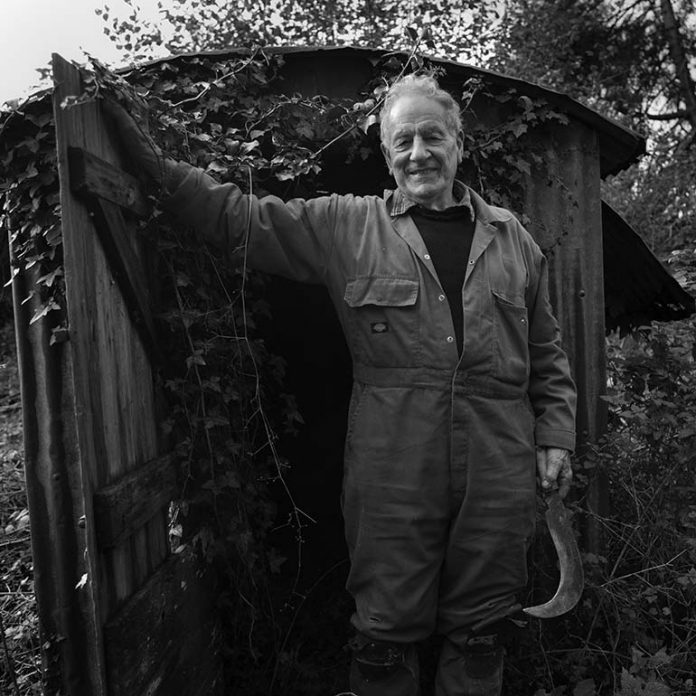
‘My family’s from Wool; I was born and brought up in the village, and still live there. I’m now the sixth generation of hurdle-makers, a trade we can trace back to the 19th century in our family. Right from when we were quite young we went to work in the wood for Father, who was spar-making for thatchers. He’d trained as a hurdle-maker, and then the First World War came along and he never went back to it. He wanted a house, so went to work on the railway, but he carried on spar-making part time for the rest of his life. So we were always in the wood as youngsters; my brothers are all gone now bar one, who’s in a home, but it was my eldest brother that taught me hurdle-making.
I went to school locally, worked on the farm, and then did my National Service in the Army with the Dorset Regiment. I was a lorry driver for a bit, and then we got married, so I needed some extra money and went back to the woods part time. That was 50-odd years ago now. About 40 years ago I met Don Davis, who was hurdle-making here; he was heading towards retirement, was good enough to let me have some of his woods, and little by little I’ve built it up from there. I use about four acres of hazel coppice a year on a seven year cycle, so I’m looking for about 28 acres in all.
When I started it was a lot of sheep hurdles. Melplash Show had some most years, as did Frome Cheese Show, although when we joined Europe that stopped—they weren’t allowed to use wood apparently. But a lot of farmers were still using them for lambing pens, and would buy a few dozen every year. And now it’s pretty much all garden hurdles of various sizes. It’s gone from a century or so ago when every village, where there were sheep, would have had several hurdle-makers (in 1885 in Wool alone there were 11 recorded), to now when it’s just me making garden hurdles and trying to compete with the imports from Eastern Europe. In the days when sheep were folded every night across the arable ground, and grazed on root crops in the winter, it took 15 dozen hurdles to pen them in the one acre fold. Every morning the shepherds would have to move three-quarters of those hurdles to make the next night’s fold. That’s why there’s what we call a twilly hole near the top of the hurdle to allow the shepherd to put a bar through 3 or 4 hurdles at a time and carry them all on his back. One of the oldest country crafts, the wattle hurdle was also used for building walls, so called wattle and daub, often found in mediaeval buildings, and one was found buried in the peat on the Somerset levels, laid flat as a walkway over wet ground, and thought to be 5,000 years old.
Rotational hazel coppicing every seven years has huge environmental benefits for a piece of woodland. On the areas I’ve recently cut, the wildflowers that come through in the spring have to be seen to be believed. Dorset Environmental Group recently surveyed one of my copses and found 47 plant species thriving. This morning, a butterfly settled on the white side of a hurdle with the sun on it, and that’s not bad for late October. However, if the hazel’s not cut for 10 years, or less now it seems to be growing faster, it becomes overstood, and useless for hurdle making. Nor is it ideal for firewood; it gets so tangled in the top branches, it’s very hard work to cut, and will warm you up four or five times before you get to burn it. So it will be a great loss if the hazel’s not coppiced, but no one seems to care. Now we’ve got Ash Dieback disease through imported saplings from coming in from Poland via Holland, and I think that happened because nobody, especially the authorities, cared about the consequences. Although, we sent some hurdles to the USA, and they burnt them on the dockside because they hadn’t been treated.
My working day in the woods starts at about 7.30am, rain or shine. One day a week I’ll just cut rods for a few hours, and leave them to pitch for a few days so they’re not too sappy to work, and I’ve always got a few strings to work with that I cut previously. I’ll work in one curf, about half an acre, which will last me a few weeks. I start with the flake, usually a nice bit of ash pole, cut in half lengthways, with nine holes in it for a garden hurdle, into which the uprights or zales are fitted. The flake has a slight bend in it so that when the new hurdles are stacked they’ll tighten up as they dry out and straighten. The two end zales are round, and the seven through the middle are split. Then I’ll start weaving in the twillies, the smaller round rods at the bottom, which are bound in so the hurdle doesn’t fall to bits. The larger rods through the middle of the hurdle, or rixon, are all split, and we’ll cleave enough to make the hurdle. That’s done using a hook that’s never been sharpened, which, once started into the rod, can be worked all the way along its length by a combination of pulling and twisting the hook, splitting the wood as it goes. It looks a bit dangerous, as you’re working towards the hand you’re holding the rod with, but I don’t push it. It’s easy when you’ve done one before. Once upon a time you’d reckon to make 8 sheep hurdles a day, but that’s going some, and hurdles didn’t need to be as tidy as they do today. These days if I make two and a half six-foot hurdles that’s a good day’s work, and it’s a lot of wood to shift. In the summer, when the sun’s out it does get very warm, but the wood works nicely. In the winter, if the wood’s frozen I’ll light a fire and lean the rods on a frame over it just to take the frost out of it.
I’m doing exactly the same as my father and grandfather did all those years ago, nothing’s changed. I’ve never bought a tool in my life. The hooks I use, that one was my father’s, that one Don Davis’s, and that one Frank Churchill’s, and they are sharp. I put my own handles in, using a bit of withy. What has changed of course is partly because sheep farmers have little need for wattle hurdles now, and partly down to competition from Eastern Europe. My son Steve was working with me after training as a quantity surveyor—he’s a good hurdle-maker. But 10 or 12 years ago the cheap imported hurdles started flooding in, nailed together and cut with a band saw, so they don’t last. We lost business from seven companies in three months, and these were lorry loads of hurdles. It’s the same with spar-makers. They’re struggling now for the same reasons, which is a great shame.
Steve, with a mortgage to pay, had to go back to quantity surveying, but he hopes to come back to hurdle-making if times get better. So I’m carrying on with that in mind. I go to most of the shows to promote my work, and the variety of customers I supply makes it more interesting. I supplied some hurdles for the recent film Far from the Madding Crowd, and the New Hardy Players in their production of The Woodlanders. It’s a way of life Thomas Hardy must have appreciated.’
Toby Horne

If it hadn’t been for Toby’s mum he wouldn’t be Operations Director at Beehive Self Storage and Beehive Toy Factory. Nine years ago, Richard Stone, the owner of Beehive received a phone call from a very persistent lady, who had seen an advert for a job vacancy at his company in the local paper. She would not let him put the phone down until he had agreed to see her son. Since then Toby has proved himself to be invaluable, working his way up from answering the phones to Director this year.
Toby is in charge of the day to day running of Beehive Storage Solutions. There are three sites across Dorset and Somerset, with the head office at Lopen. This is where Toby is based, managing staff, helping with enquiries on site or from the other two locations, looking after marketing, advertising and general operations.
However, this year Toby has also been instrumental in helping set up a toy business; the Beehive Toy Factory. He was given the task of thinking of a business that could run alongside the storage facility, something the staff could help with during quieter moments during the day when the storage business was not so demanding of their time. Toby thought of an online shop, which he could design and manage. Richard had always wanted to get into the toy business and so the green light was given.
Now Toby has travelled a couple of times to China to make contacts and source toys, using staff in Lopen to hand pack and send the orders out. They are continuously expanding their stock, selling high quality wooden toys, baby toys, soft toys and baby bikes, all proving very popular. Toby is determined to make the next chapter in his career working for Beehive a success, still grateful to his mum for that initial phone call.
Vegetables in December
Christmas is a good time to reflect on what you eat, or over-eat. Every week scientists reveal ways of changing our diet and extend our lives by another few years, so the good news is that we will all live to the age of 250.
The saying “a little of what you fancy does you good” is so true, and gives us a pleasurable sense of guilt every time we finish a box of chocolates in one go.
But the pleasure of picking your own greens over the 7 month winter is immense, both the placebo effect and the actual amount of stuff in it which your body both needs and recognises, including the millions of particles of dirt and benign bacteria which the scientists have also suddenly decided are good for us.
If you haven’t grown before, or are thinking of expanding your veg empire, now is the time to put down a shallow cardboard box on top of grass or over the site of a lately deceased shrub, and fill the box with fully rotted compost. If this works well for you, then you can put planks of timber around and fasten at the corners with a stake to make a longer lasting raised bed. Then in the spring you can sow whatever you want, and there should be few soil pests or weeds.
Leaf crops are the most productive per square inch for a small area, perhaps salads, then rocket and mustards in the winter. As you gain confidence and enthusiasm, you can take in more areas.
We have been annexing parts of our over-large chicken run with great results this year, planted with Sarpo Mirta blight free potatoes, the heaviest of which weighed 913 grams in late October. More large cardboard boxes are ready to be put down in the new year, with chicken wire around it held in place with bamboo.
Time now to wish all readers a rich and fertile Christmas, why does Santa go down the chimney? Because it soots him.
Up Front 11/17
Interviewed by Chris Anderson for a Ted Talk, the journalist and broadcaster, Christiane Amanpour, recalled her first reaction to the ‘internet superhighway’. She had hoped that the advent of a new and widely available method of communication might make the world a more open and honest place. She had thought that the proliferation of platforms on which we could get our information would mean that there might be ‘a proliferation of truth and transparency and depth and accuracy’ and that we would have access to ‘more democracy, more information, less bias’. She has since concluded that this is not the case. In fact, many would say that the world has lurched in the opposite direction, and that fake news and the growth of populist and selfish agendas are winning the battle for hearts, minds and votes—well, minds and votes at least. One reporter recently pointed out that the populist has four main tactics: tell big lies, no matter how verifiable the reality; repeat the lies over and over and over again; promise everything, no matter how impossible or contradictory, and make the story about the individual—‘vote for me, only I can fix it’. It is a tactic that has been successful for manipulative people since man first discovered the value of misrepresentation, a very long time ago. The difficulty today is that methods used to proliferate lies are far reaching and immediate, and once implanted into the consciousness of a large enough group of people, they become the shared memory. In November, the current US President will celebrate the anniversary of his election and probably continue his efforts to brand many traditional media outlets as peddlers of ‘fake news’. However, honest journalism was born out of a belief that lies should be constantly challenged. So CNN launched an advert recently to battle the President’s attempt to brand them as fake news. A voice-over, sounding not unlike the US President, speaks over an image of an apple. ‘This is an apple,’ says the voice-over. ‘Some people may try and tell you that it’s a banana. They might scream “banana, banana, banana” over and over and over again. They might put “BANANA” in all caps. You might even start to believe that this is a banana, but it’s not. This is an apple.’ Incredibly, the trolls were out in force immediately claiming the ad was condescending, and spoof versions proliferated at speed. However, we can learn from this—it turns out that the truth, for some people, can only be a banana.