Friday, March 20, 2026
Home Blog Page 40

Vegetables in January

Pruning fruit trees is a perfect health remedy for humans suffering daylight deficiency in the dead of winter, and makes the tree healthier and more productive too.

The main aim with all fruit trees and soft bush fruit is to let air circulate between branches and allow each one as much daylight as possible.  Cut out weak, wispy shoots and branches that ‘cross over’ each other.  By the time you have finished, you should be able to see through the tree and be left with a small number of strong branches.

On a freestanding tree aim for three or four strong side branches and a ‘leader’ – the leading strong and upright branch.  This is easier said than done, as different varieties have different game plans, but try and give the tree as much light and air as possible, whatever its shape.

In our orchard rooks tend to perch as high as they can, usually on the precious leader, and snap it off. Once the leader has been broken, you rarely get a single successor, and end up with a shrubbier tree than before.  To protect the leader on a new tree, we often tie a bamboo protruding above the top to stop this happening.

Fruit trees set bud in the autumn, so prune healthy shoots to about 6”, which leaves a number of next year’s fruit bearing  nodes on each.

When cutting out an unwanted shoot, cut it back to its ‘shoulder’, proud of where it joins the main branch, not flush with it.  This allows the cut to heal and keep canker out.  Often you get upright and quick-growing water shoots around a former prune, these never bear fruit and should be removed.

If a tree has been left unpruned for decades, and has a great thicket of branches, prune it drastically, all the time with an eye to keeping just a few strong branches.  The tree will soon revive itself.

The tree can be shaped however you want if you are feeling creative and lust for a particular shape.  Most fruit trees are grown on numbered rootstocks, which dictate how big the tree can grow.  Cordons are grown on dwarfing  rootstocks such as M7 or M9, full size trees on M25.  Soil and climate also affect growth rate, and the subject then gets quite complicated.  If you prune an M25 hard, it will simply grow back with a vengeance, and vice versa.

Most professionals prune in the winter, if you have time then pruning in the summer can help keep the tree growing just as you want.  And what do you get when you cross an apple with a Christmas tree?  A pineapple.

Slavery

Have you ever heard the phrase ‘I have been working like a slave’? The abolition of the Slave Trade Act was passed in 1807 in the UK and USA, although it was overlooked for some years in some places. For some time there was little sympathy for the memory of slavery.  For example some public houses retained the name ‘The Black Boy’ and a road in Bristol, a port prominent in the slave trade, was called ‘Black Boy Hill’.

It is uncertain when local involvement in slavery commenced, but Sir George Somers who was born in Lyme Regis founded the colony of Bermuda in 1609. It may be that soon after this the trade grew. In the early days slavery was regarded as just another trade and members of all religious denominations were involved. William Penn, the Quaker founder of Pennsylvania owned slaves in the 1690s. Before long slaves were brought to England as servants and the Uplyme Churchwardens accounts for 1649/50 show that a ‘Blackamoor’ was paid for cleaning the churchyard. King William III had a favourite black slave and a sculpture of him was displayed at Hampton Court.

Several local families were prominent in the slave trade, notably the Hallett, Burridge, Way and the Lyme Regis Gundry families and the Pinney’s of Bettiscombe.

Colonel John Hallett, a sugar planter, owned 220 acres and 84 slaves in 1680 and a marble floor in St Michael’s Cathedral, Bridgetown, Barbados is inscribed to him and his family. In his will he left his wife Mary six of his ‘house negroes’, his coach and four horses in Barbados and £400 from his Barbados estate. He also left his grandson Martin Bently £1,000 of Barbados money and to daughters Christian Farmer £1,500 and Katherine Farmer £100 to be ‘laid out’ in negroes for her, plus £60 of Barbados money. His kinswoman Judith Alford received £10 per annum and John Burridge also of Lyme £10. Axmouth church has a monument to Richard Hallett of Stedcombe, John Hallett of Bridgetown, Barbados, Southcott Hallett and Rich. Hothersall Hallett. In a will of 1691 a Richard Hallett gave his brother John and nephew Richard the right to sell his lands in Barbados and shares in ships and negroes. It has also been suggested that Raymond Hallett returned from Barbados to Lyme in 1699 with black servants and his wife Meliora brought one or two black maidservants. John Hallet of Stedcombe gave freedom to ‘my boy Virgil’ on his deathbed. Lyme Regis Court Sessions for 1702 record that ‘a black Negro servant of Mr Richard Halletts called “Ando” was accused of being riotously assembled in Broad Street’.

The Burridge family owned a boat Africa employed in the tobacco trade between London, Lyme and Virginia. John Burridge gave donations to a Lyme charity in 1703 and contributed to the upkeep of the Cobb. So those involved in the ‘triangular trade’ were often charitable at home. In 1705 the Burridge brothers and Benjamin Way sent a vessel Friendship to Jamaica, returning with sugar and two negroes. In 1706 they took part in two slaving ventures, with the London and the Dorset Brigantine, ships owned by Joseph Way of Bristol. John Burridge invested in the frigate Martha in 1709, captained by William Courtenay, son of Samuel, Mayor of Lyme in 1702. This delivered 160 slaves to Jamaica in 1710 and returned with sugar, cotton, wood, lime juice and ivory from the Guinea Coast. Also in 1710 the John & Robert owned by the Burridge family took 130 slaves to Virginia. John Burridge senior stepped down as Member of Parliament in 1710, to be succeeded by John junior until 1728, who was also Mayor of Lyme in 1726. At this time being engaged in slavery was no problem in reaching high office! John Burridge junior sent the Mary & Elizabeth to Virginia in 1712 with 113 slaves who were sold for £20 to £25 each. The ship returning to Lyme in 1713 with 10 cwt of ivory and 50 tons of tobacco for John senior, Robert Burridge and Nathaniel Gundry of Bridport. From 1713 all Burridge ships to the Guinea Coast started from Lyme. The Burridge family collected signatures in Lyme for a petition that the ‘trade of this port…depends…on Plantations…chiefly raised by Negroes from Africa’. A Samuel Courtenay provided 25 slaves at £18 each for John Burridge and 21 other merchants, with a surgeon hired for the voyage for £2-10s to care for them. In 1714 the Burridge ship John went to Guinea for 91 slaves, 82 of whom were sold to William Cogan for £1,719. Major Cogan of Barbados had been born in Lyme and shipped local rum in exchange for slaves. A cargo of rum was worth £1,909 in 1709. From 1718 Robert Burridge III handled all the family business and became a dealer in tobacco and freight to Virginia until 1740 when the business in Lyme as a port reduced. He paid interest at 5% on £33 to the poor of Lyme Regis and at his death interest on his investment of £100 was left in the same way.

Nathaniel Gundry also became Mayor of Lyme Regis, but as a tobacco merchant had sent 15 slaves from Barbados to Potomac in the Martha under John Wallis.

In 1718 the crew of a ship from Maryland were paid off at Lyme after delivering tobacco worth £1200. One crew member was ‘Harry’ a Negro owned by John Pitts, a Lyme merchant with shares in Burridge enterprises. John Burridge spent 10s 8d on sheepskins, spirits and tobacco for Harry. It has been suggested that Harry may have been employed as night watchman in port. Harry then went on a trip to Gambia and Maryland, with John Pitts paid a salary of £6-5s for him and over £4 for ‘Diet of Negro and servants’.

Much of this information has been drawn from The Forgotten Trade by Nigel Tattersfield and The Slave Trade by Hugh Thomas.

Finally the abolition act was passed in 1807 and the House of Commons voted compensation of twenty million pounds (estimated at £37-10s per slave) to slave owners, but for many years there were complaints that this was insufficient. The attitudes of the country were very different to the present day. Unfortunately even Dissenters, who were later at the forefront for abolition, believed that trade and business were almost God given and that slaves were lower beings and could only be elevated by Christian baptism, but not of course to the level of businessmen. As late as 1867 Elias Cox, a leading local Non Conformist built a lighter for Mr. Briggs, the Harbour Master at Bridport Harbour. It was painted black and named The Black Slave, its purpose being to clean mud from the harbour.

Reach for the Stars

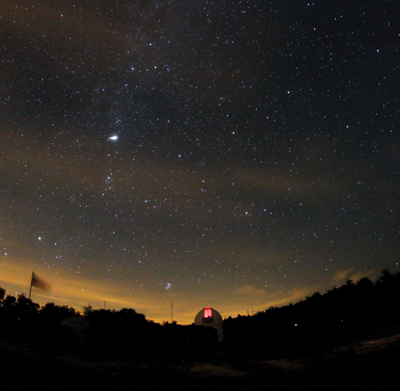
A starstruck Margery Hookings enjoys a surprise visit to the Norman Lockyer Observatory near Sidmouth. The evening was not quite as she expected but a return visit is on the cards.


It’s my birthday and my husband has organised a mystery trip for the evening.

‘You’ll like it,’ he says. ‘I know you will.’

It’s dark when we set off. We head west and hit the A35, just past the turning at Hunter’s Lodge to Lyme Regis and then down the lane towards River Cottage HQ.

I get a little bit excited, having bought my two children and their partners vouchers for meals at Hugh Fearnley-Whittingstall’s place last Christmas. I even bought Mr Hookings a Build and Bake course the year before. At last, the imbalance is going to be redressed. It looks like I’m going to experience the River Cottage treatment for myself.

But we drive on past the signs and I feel a little downhearted. It reminds me of when we took the children on holiday and didn’t tell them we were going to be spending a week on a canal barge. They saw the signs to Alton Towers and were made up, only to be crestfallen when we carried on and ended up at the water’s edge. Mystery trips are all very well but it pays not to dwell too much on the possible destination. You could end up disappointed.

We’re heading towards Sidmouth now and it suddenly dawns on me where we might be going. This time last year I picked up a leaflet for the Norman Lockyer Observatory and remarked how interesting it sounded. I love the night sky—not that I know much about the stars or astrophysics but I’m enchanted by the literal other-worldliness of the constellations and the romantic stories behind their mythical names.

I don’t tell my husband that’s where I think I’m going until we get there, and then wish I’d worn something slightly warmer on this cold night.

We pull up in the car park, along with a number of others and, as we assemble in the warm foyer, it’s clear that none of us really knows what to expect.

The foyer is full of bits of memorabilia connected to the observatory, including a 19 century orrery, which was donated by Howard Anderson, a member of the British Sundial Society, and restored by observatory members. It’s a mechanical model of the solar system, showing the Sun, Earth, Moon, planets and major asteroids.

We’re ushered into a lecture hall where a woman gives us a talk and slideshow about pulsating stars. Excuse the pun, but it all goes slightly over my head. I understand it while the talk is underway but forget everything seconds later.

Then we are split up into three groups for a tour of this strange and wonderful place and are told we’ll meet up later. A cluster of domes sits in the field, connected to the main building by radiating paths.

We’re taken to see the oldest telescope first but, unfortunately, the night sky is clouded over so we can’t see anything through it. The Lockyer telescope was built in 1871 for Norman Lockyer, and he used it to make his discoveries about the composition of the Sun in 1868.

The next oldest telescope, the Kensington, is housed in another dome. It was built in 1881 for the Solar Physics Observatory in London, where Norman Lockyer was a director, and was installed at the observatory near Sidmouth when it was first established in 1912. The third telescope is the McClean Telescope, which was donated by Francis McClean in 1912.

It’s a bit chilly in the domes and walking by torchlight from telescope to telescope so we’re pleased by the warmth in the Lockyer Technology Centre which, along with the Connaught Dome, was opened by rock star and astrophysicist Brian May in 2012.

Inside this dome, it feels like being on the set of a disaster movie—this would be the location for the scene where a small outpost raises the alarm after seeing on screen a large meteor hurtling towards Earth.

The technology centre is the hub for a network of Meteor Detection Stations, both within the UK and Europe, utilising back-scattered radio signals emitted by the GRAVES Satellite Radar Station in Dijon, France. The observatory’s Radio Astronomy Group is located in the Lockyer Technology Centre where data is collected 24/7. Activities include meteor detection and, although it’s cloudy outside, we can see on screen the odd shooting star firing off as we’re given a run-down of what’s happening here on the ground.

At the end of our tour, the three groups reassemble and sit down in the 60-seater Planetarium, the centrepiece of the observatory’s public work. The elaborate instrument used to display the stars and planets was given to the observatory in 2005 by the Royal Observatory, Greenwich. Here we are treated to a brilliant presentation about the night sky, which becomes slightly surreal when the heavens are wound back to recap on something we missed earlier.

We all leave the Norman Lockyer Observatory open-mouthed, not quite believing what we’ve just experienced.

And Mr Hookings is right.

I liked it. I liked it very much. River Cottage can wait for another day.


About the Norman Lockyer Observatory

The Norman Lockyer Observatory was founded in 1912. It is both a historical observatory and home to an active amateur astronomical society. It is a centre for amateur astronomy, meteorology, radio astronomy, and the promotion of science education. It is regularly open to the public and staffed entirely by volunteers.

Lockyer was a Victorian amateur astronomer, who discovered the element Helium in the Sun’s corona in 1868. He was one of the founders of the science journal ‘Nature’ in 1869. He became the director of the Solar Physics Observatory at South Kensington and the first professor of astronomical physics in the Normal School of Science (now the Royal College of Science) in 1887. He was knighted in 1897.

After his retirement to Sidmouth, Lockyer obtained support in 1912 for the building of the Hill Observatory, renamed the Norman Lockyer Observatory following his death in 1920. His son James, a trained astrophysicist and just back from the war, became director. Dr W J S Lockyer died suddenly in 1936. Funds were hard to find and, in 1948, Exeter University took over running the observatory.

The last professional astronomer left in 1962. Following acquisition in 1984 by East Devon District Council, the observatory is now a centre for public science education as well as being the home of the Norman Lockyer Observatory Society.


Admission: Adults £8, children £4, Family (2 adults and 2 children) £20. The programme is approximately 2 hours duration and will usually include a short talk, a planetarium presentation and visits to the historic telescopes and Lockyer Technology Centre.

For more information visit normanlockyer.com

People in Food Paul Wiscombe

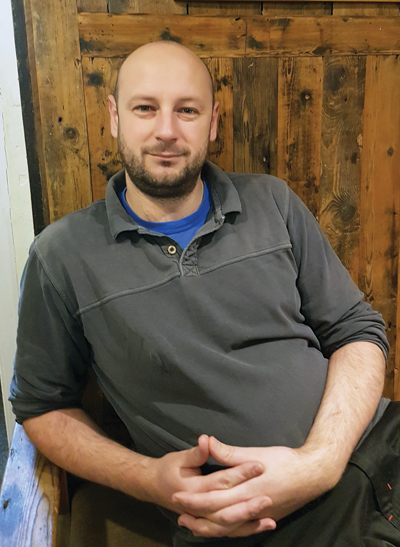
Bang, crash, go the barrels as they are rolled across to the other side of the car park, where the empties are stacked. Paul Wiscombe, Landlord of The Anchor at Seatown’s childhood memories involve helping his parents at the pub they ran; the Ilchester Arms in Symondsbury.

Coming across Paul as he cleans the pipes in the barrel house perched on the steep incline next to the entrance of The Anchor, he explains he lives and breathes pubs, as it’s all he knows. Having run The Anchor for 14 years, since he was 23, he knows his establishment inside out. Especially since the complete refurbishment which Palmers did a couple of years ago, giving the pub a new lease of life and three rooms for B&B. Paul had his own vision to tie in with the transformation, putting his stamp on the menu and how the pub did food and drink. He hired Head Chef Jean Paul De Ronne and his team to create stunning locally sourced dishes, and got David Smith of Hix to design bespoke cocktails, resulting in Paul and his team sweeping up, winning awards left right and centre. The Anchor is now one of the most celebrated pubs in Dorset.

As Paul says, “Everyone used to come down here because it was a beautiful place. But I wanted to make it the whole package, a real destination pub. As the pub received a great level of custom anyway, it was a brave decision to change things, but one that has paid off. I feel bolstered by the confidence the brewery has shown for me.”

Now, Paul doesn’t spend as much time behind the bar. He is busy orchestrating the business from behind the scenes. This is something he has worked hard for, so he can spend time with his young daughters, which he values above all else.

People at Work Romla Ryan

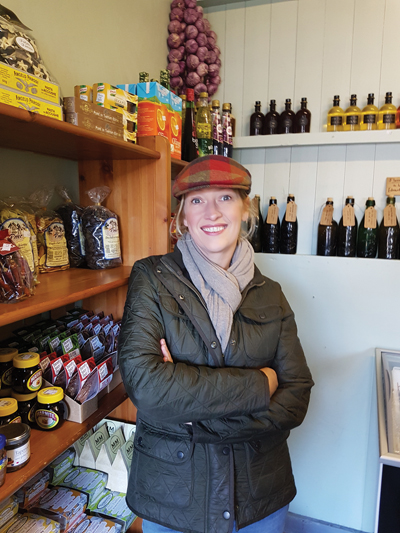
Superglue, baby wipes, multiway phone chargers, strip wax, magnums of champagne, packets of brightly coloured pasta from Italy, coconut cream, every spice combination you could wish for, personally selected red, white and rose wine, locally made mead, original Edwardian bottles filled with flavoured olive oils and vintage shaped bottles housing autumn-tinted contents, homemade on the Manor. The handwritten labels depict deliciously inviting Wild Plum Vodka and Butterscotch Rum to name but two. All this inside a stable block that is now Marshwood Manor Stores, run by Romla Ryan, who lives at the Manor House with her husband, children, and somewhat eclectic pets; two dogs, two cats, a goat and a turkey.

The original idea behind the shop was to provide somewhere that guests staying in the holiday cottages at Marshwood Manor could get provisions they may have forgotten or run out of. A cornucopia of a shop, so compact and well stocked with personally chosen items by Romla, either local, or specifically selected and imported from abroad. In the adjoining stable is a home and gift shop brimming with treasures. Another stable houses logs, buckets and spades, dog bowls and even kites, for fun family adventures.

Romla can often be found perched behind the counter at her laptop. She types away, working on a new piece of writing, now that she has the time again. Once an actress, she moved into screenwriting horror movies when her children were born as it was something she could do from home. When Romla and her husband moved to Marshwood Manor a few years ago they got stuck in with renovating the holiday lets on the estate. Now the Stores are open Romla hopes to also supply locals, and is happy to try to source any specific items they are after. The challenge though, is to find something you need that isn’t already on a shelf.


January in the Garden

Well, Dear Reader, assuming you’ve come through the ‘Festive Season’ relatively unscathed, January is a month more suited to armchair gardening than ‘full on’, outside in the cold, hairy-chested, tasks. If, like me, you are not as young as you used to be, then rushing outside, on a cold day, launching yourself into strenuous exercise is not to be recommended – a sure way of starting 2018 with pulled muscles or a strained back.

Wrapping up in plenty of layers not only keeps you nice and warm but also offers a degree of protection against the cruel barbs of those pesky beauties; roses. There is constant debate on the best time to tackle rose pruning. In these days of global warming, autumn can be too early as it just encourages soft growth which is then wiped out by later frosts. Leaving pruning until March, or April, may be too late as the sap is rising and the pruning cuts can present a feast of opportunities to disease causing pathogens.Best to prune them now while they are in their deepest winter sleep and impervious to the vicious cuts which you are about to subject them to.

There are loads of different rose ‘types’ but the only factor that you really have to worry about is what role the rose in question needs to perform? With constant hybridising (basically ‘cross-breeding’) every named rose variety, as opposed to a ‘Species’, is a mongrel. Resisting the urge for a ‘Dog Rose’ pun, this means that many fall between neat titles like ‘Shrub’ or ‘Climbing’ rose.

The rose seller and breeder ‘David Austin Roses’ has managed something of a marketing coup with their modern ‘English Roses’ aiming, pretty successfully, to provide old-fashioned form and scent with modern disease resistance, vigour and repeat flowering. Many of their introductions perform different roles depending on how you choose to prune and train them. Many of their laxer ‘shrub’ roses can be used very effectively as ‘climbing’ roses just by altering their pruning regime and giving them a framework to attach them to.

That’s why I tend not to worry about what specific variety I am tackling but more what I want to achieve by pruning it. This is especially useful if I’m tackling an old, often shapeless, rose in a client’s garden where the actual variety name has been lost in the mists of time. There is nothing more satisfying, although it is very time consuming (i.e. expensive), to transform a tangled mess of an old rose, full of death and disease, into an elegantly arching, concisely edited, array of healthy stems just waiting to burst into glorious, summer, blooms.

The reverse of this joy is the complete annoyance, with pent-up frustration, of working in a garden surrounded by roses which have been pruned / trained by a ‘keen owner’ who hasn’t the first idea how to artfully prune a climbing rose to make the most of its flowering potential. I guess that old chestnut ‘Ars est celare artem’ is a pearl cast before swine in that situation. Gardening is, after all, an Art which is equally reliant on a good understanding of Science.

I digress, best get back to some pruning waffle…….With any rose the pruning checklist is to start with removing any dead wood, diseased wood and spindly, non-vigorous, shoots. Dead wood is easy to identify because it is brown, diseased wood is generally brown or yellow, with a mottled appearance, while healthy wood is a shade of green, although many roses have a distinct purplish tinge about them.

Once the dead and dying stems have been cleared out then the oldest stems are the next for the chop. These are harder to spot, until you’ve got your eye in, but they tend to be darker coloured than the younger stems. There are, naturally, more old stems towards the base of the plant than at its top.

Before severing the old wood, have a look along its length to make sure that it isn’t carrying new, vigorous, shoots further up which you need to keep. The aim should always be to remove all the oldest wood, whilst keeping the youngest, to leave a balance of the different ages when you have finished pruning.

Another aim is to keep the centre as open as possible with no crossing branches. That is the ‘ideal’, in fact it’s very difficult to have no crossing branches. Cutting stems so that you always leave an outward facing bud, on the bit that remains, is another laudable, but not always possible, aim. Don’t get hung up on these finer points of pruning, just be aware that they are ‘best practice’.

If you’ve removed all the obvious stems, falling into the categories so far, then you should have shifted the balance towards healthy new growth. On a ‘waist high’ type rose shortening everything back is fine and the more brutal you are, the more it tends to bounce back.

On a rose with long, arching, stems the temptation is to decapitate each ‘unruly’ growth. Resist this temptation as shortening the long, new, shoots would destroy the plant’s grace and flowering potential. Better to construct some sort of frame around them, up to about a third or half of their total height, using tree stakes and hoops of wire which the long stems can be arched over and tied onto. The overall effect is to produce a ‘fountain’ of growth.

Working around the bush, you should end up with all the new growth kept intact, and under control, thanks to the supporting structure. It’s a relatively simple task, in subsequent years, to remove the oldest stems and tie in the newest ones – thanks to the framework which you have imposed on them. As with climbing roses, trained on a wall or fence, the point of arching them over is to encourage every bud, on the top of the curved stem, to produce a flowering shoot hence realising its full potential.

Well, for me, 2017 was something of an ‘annus horribilis’, in fact the last decade has been pretty ‘horribilis’, so, surely, 2018 can only be better. I fancy reinvesting time into my own home, and garden, which has been somewhat neglected while I’ve been fighting other battles. Having grown vegetables for other people, for the past few years, it’s about time I started growing them at home again; I’ve found veg growing to be a particularly life-affirming activity—although life is too short to grow peas (at least while ‘Bird’s Eye’ is still in business). Happy New Year.

If we love our seas and beaches, we have to talk about plastic

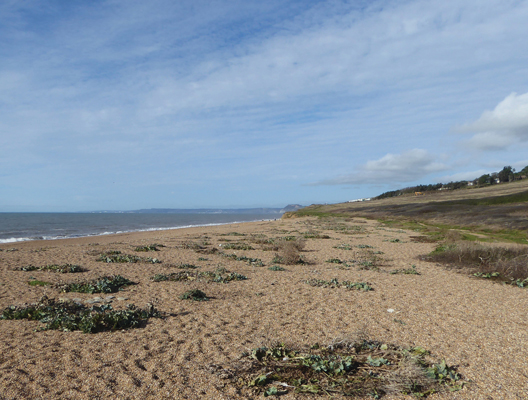
Towards the end of October, I spent a day at Cogden Beach, just east of Burton Bradstock. It’s a beautiful, natural spot, a rich concoction of sea, sky and shingle where wildlife prospers despite the sometimes harsh conditions. It’s becoming increasingly difficult, however, to ignore the scatter of plastic pollution on the beach and the potential effects of this man-made material on marine life.


It felt unseasonably warm as I walked downhill from the car park, more like a late summer’s day, although the blood-red rose hips and smoky-black sloes decorating the leafless scrub spoke of a different season. The vast shingle bank of Chesil Beach dominated the long view, a yellowish-brown convexity edged with white waves sweeping eastwards towards a mistily mysterious Isle of Portland. The sea was calm and a steely grey except where the low sun’s rays highlighted individual wavelets whose reflections merged in to a broad, silvery band of light.

When I reached the shingle bank I found traces of the special beach plants that grow so profusely here in spring and summer.  Well weathered, blue-green and brownish-grey leaves were all that remained of the sea kale that dominates in May whereas, beneath the brown remnants of this season’s vegetation, fresh glaucous leaves were showing from the yellow horned-poppies. Small flocks of starlings skittered about puddles at the back of the beach like children in a school playground and, in a low sandy cliff, I was surprised to find bees busily filling nests.  These were ivy bees, the last of our solitary bees to emerge, the females collecting chrome-yellow pollen from nearby clumps of flowering ivy. To the west, there were spectacular views of Burton Bradstock’s yellow cliffs and the distinctive flat top of Golden Cap.

It seemed like the perfect natural spot. But was it? Almost all the clumps of beach plants contained plastic waste including pieces of plastic wrap, colourful plastic rope or plastic fishing line. On the shingle between the clumps, I saw the occasional plastic drink bottle, some were intact, some in pieces. The prominent strandline about half way up the beach contained dark, dry seaweed and small pieces of wood mixed liberally with shards of plastic as though objects had shattered in their continual buffeting by the sea. Plastic drink bottles or their fragments also appeared at regular intervals along the strandline. This beach is no longer a completely natural, wild place, it has been contaminated by our throwaway plastic culture. Perhaps the most poignant symbol of this tension was a chunk of expanded polystyrene covered with pale grey goose barnacles.

Plastic is, of course, both versatile and cheap. It has transformed our lives but its very ubiquity and ease of use means that we don’t value it enough. Think how much you throw away each week: plastic wrap or bags from supermarket produce, drink containers and lids, plastic trays, pots and so on. We have embraced a “disposable” lifestyle where about half of the plastic we produce is used once and thrown away. Some countries manage to recycle or energy-recover a large proportion of their plastic waste but the UK is not one of them. In this country, more than 60% of plastic waste ends up in landfill where it does not break down and is effectively lost. We are squandering resources and energy on a massive scale, an appalling indictment of our way of life.

But what about the plastic waste I found on Cogden Beach, how does it get there? It comes from the sea and is left behind by the retreating tide. We have turned our oceans into a “plastic soup” composed of plastic bottles and bags, plastic fragments formed by breakdown of these larger items, also microplastics (5 mm or less in size) such as industrial pellets, small fragments and very small fibres from clothing or from car tyres. This is a huge global problem and shows no sign of abating. A staggering 12 million tons of plastic waste enters the oceans each year. All countries contribute but a large proportion comes from several in the Far East with poor waste management systems.

The consequences for marine wildlife are alarming. Consider, for example, the Northern Fulmar, a bird that forages exclusively at sea. A study in the North Atlantic showed that 91% of dead Fulmars found on beaches had plastic in their gut, having mistaken the plastic for food, reducing their ability to feed and sometimes damaging their digestive tract. At the other end of the food chain, zooplankton have been shown to ingest tiny microplastic fragments that may end up in fish and perhaps in humans. Plastic fragments also attract toxic chemicals that may affect the creatures consuming them. Our throwaway lifestyle is disturbing the entire global marine ecosystem. The problem is just as serious as climate change.

What can be done?  First, we must reduce the amount of plastic in circulation by moving away from single-use items such as plastic bottles, takeaway cups, plastic cutlery, plastic wrap and plastic packaging. The introduction of the 5p charge on plastic bags led to an 85% reduction in use, so a levy on single-use takeaway cups and plastic cutlery may also be effective. Second, we need to encourage a “circular economy” where as much plastic as possible is recovered and recycled and none goes to landfill. A deposit return scheme for plastic drink bottles would increase recovery but greater recycling of other plastic containers must also be achieved. It is encouraging that some government ministers are now talking about the problems of plastic waste, but their words must be translated into actions.

Individual decisions can also bring about change. We can refuse to use plastic cutlery. We can choose to drink only from reusable cups. We can use and reuse our own shopping bag. We can recycle all plastic bottles and containers. We can pressurise local businesses to reduce plastic waste. We can participate in beach cleans. If we love our beaches and our seas we must do this.


Philip Strange is Emeritus Professor of Pharmacology at the University of Reading. He writes about science and about nature with a particular focus on how science fits in to society. His work may be read at  http://philipstrange.wordpress.com/

Clare Trenchard

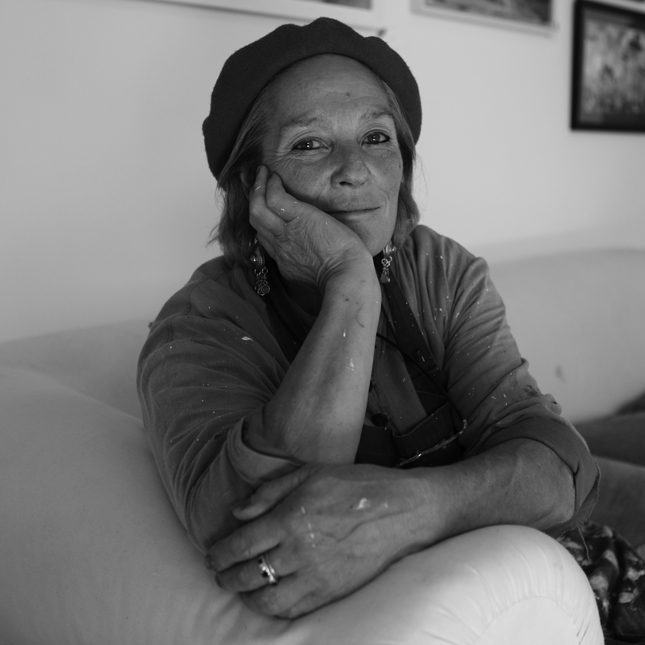
‘My father was in the Army and made the most of the various sporting opportunities which army life offered after the war, riding in point to points in Germany and representing Great Britain as part of the army Pentathlon team in both Switzerland and Sweden. When I was born he was stationed in Colchester and spent much of his time during my childhood hunting the Colchester Garrison Beagles, a pastime which gave all the family a busy rural social life. Money was scarce in those days and we lived in a number of different houses in Essex and Suffolk which my mother would renovate and improve before selling and moving on to do the same to another one. I have an older sister and two younger brothers who we used to bully incessantly until they became bigger than us and the tables were turned. My mother had been a radiographer in a medical practice before she married but now had her hands full with four children, so we were frequently left to entertain ourselves. Our young lives were full of fun and very sociable. We had dogs and ponies and lots of freedom, and would gallop out of control across the countryside, often ending up in trouble with local farmers for straying over their land.

When I was thirteen we moved to Dorset and my sister and I were packed off to Sherborne School for Girls, where we were expected to behave like young ladies. After so much freedom I found it rather hard to adjust to the restrictions of boarding school life and at the age of sixteen, following an incident which resulted in the games mistress being pushed into the swimming pool, it was agreed that it would probably be better for me to leave and go to a crammer in London to sit the necessary exams. There was such fun to be had in London in those days and I met a great bunch of friends, most of whom had also left their schools early for various reasons. While there I decided that I’d like to go on to Art School. My parents weren’t enthusiastic, but I’d always enjoyed drawing and was quite determined and enrolled at the Sir John Cass School of Art in Whitechapel. Halfway through the course I disappeared to Greece with a friend and failed to return in time for the beginning of term, so that was the end of that. By then my parents were living near Colchester again, and suitably chastened I returned home and embarked on another foundation course, this time at Colchester Art School. The only place left was in the sculpture department which was brilliant, and turned out to be quite a turning point. It spurred me on to look for a place on a degree course, and I was accepted by Chelsea School of Art. The sculpture department had some amazing teachers like Nigel Hall and some great technicians who taught me invaluable skills like welding and using angle grinders. Anish Kapoor was there doing an MA and Chelsea had become quite conceptual in its teaching, the last figurative tutor probably being Liz Frink who had left two years before I arrived. There was no life drawing organised and it took me a while to get used to abstract practice, but in the end Chelsea taught me not only the technical skills, but more importantly how to think about my work and question my thinking. Being at art school in London in the early seventies was a fairly hedonistic experience and involved a somewhat anarchistic lifestyle, but I did succeed in getting a degree.

Few people can leave Art School and immediately start to earn a living as an artist, and I was no exception. I joined an agency who sent me to decorate a property in Barnes. In no time word had spread and two other decorating jobs had followed. Around this time I met Johnny and again my life changed. Four years older than me, he had travelled and done many different things and unusual jobs in the UK and elsewhere, but had finally accepted the inevitable and settled down to take up his first office job as a shipbroker in the City. He had a large Yamaha 750 motorcycle and we spent our evenings and weekends careering around town and going on long bike trips to stay with friends in the country or in France. My parents were understandably wary of him in those days, but I ignored their warnings and we were married the following year. I must add that they and he are now the best of friends!

I had recently started a training course which involved teaching teenagers art in the East End but I didn’t enjoy it. Johnny persuaded me to call it a day and concentrate on making a proper business out of the ever increasing number of decorating jobs. The business took off on the back of the property boom of the 1980s and before long I was running two or three teams of builders and decorators installing bathrooms and kitchens and decorating whole houses. Johnny had by now abandoned his attempt to become a shipbroker and took over the admin and much of the organisation. The business flourished for the next five or six years until the arrival of children ushered in a new era in our lives.

By the time Tommy and Emma were both at school I was becoming desperate to return to my art. At the same time we had begun to feel the need to move out of London and find more space for all the family. We were aware that the surge in property prices had made it possible to exchange a small terraced Victorian house in Battersea for a substantial property in the country and started looking for somewhere in Dorset. We ended up at Abbotts Wootton in the depths of the Marshwood Vale not knowing a soul within fifty miles. Despite the beautiful surroundings it was difficult and strange at first, but after a while we acquired a great circle of friends and it proved a magical place for the children to grow up. Now after twenty two years I can’t imagine life anywhere else. Our children have grown up and left home but often return to spend time here. They are both free spirits and have spent much of their adult lives abroad. Tommy is now married and works as a freelance journalist in Africa and the Middle East, and Emma is an artist who has recently travelled to Mongolia and back on a Vespa!

Before we left London I had tentatively returned to working as an artist and had already accepted a few commissions for portrait sculptures and the odd mural. I had also begun to wind up the decorating business and was giving morning art classes to groups of mothers with school age children. When we moved to Dorset I immediately set about trying to establish both the sculpture and some classes in our new home. Gradually by word of mouth two new businesses emerged and developed, and together with Johnny’s business importing ceramic pottery from Sicily, they have formed the basis of our life here ever since.

Apart from my family, my two passions in life are my art and my garden. I regard myself as extremely lucky to have had the chance to satisfy my creative side in so many ways and to have the use of such a spacious studio. It would be impossible without it to produce such large sculptures, or to have all the classes and courses which I now give. Being an artist of any kind can be a solitary and introspective business, but the regular art classes provide company and a refreshing break. It gives me huge pleasure to help people develop their talents and I firmly believe that everyone has within them the ability to sculpt and to draw, but few people have the opportunity or find the time to discover it.’


Up Front 01/18

I gave up sending Christmas cards years ago. At the time I claimed an environmental stance but really it was more to do with cards being one of too many things to do, and besides nobody would notice. I was right, nobody did notice, but not because I hadn’t sent a card, it was more to do with the plethora of new forms of communication that had begun to appear. Businesses started sending festive emails to their clients explaining that they would donate the old postage costs to charity. Early adopter friends discovered electronic greeting cards and those with more to say began sending short (mostly) digital video messages to friends and family. The traditional family photograph began to disappear from the mantelpiece and the amount of brightly coloured Christmas cards coming through the door dropped dramatically. And there was me thinking it was all because I hadn’t faithfully sent cards to everyone. These days, with friends and family spread around the globe, it’s hard to decide which method of communication to use to keep in touch. Is it to be through Facebook, Messenger, Instagram, Snapchat or WhatsApp? Should I be spreading my happy festive season message on Google+, Twitter, Linkedin, Friendster or Bebo? And of course there are all my friends in China on Qzone and my Russian buddies on VK. Perhaps I should just crank up the webcam and say hello on Skype, Facebook Live, YouTube or Bambuser. There are just too many options. So many, that even some of those from the generation that grew up with digital communication are beginning to question the motivation behind the deluge of new communication platforms. A teenager recently admitted to me that she believed that app and content producers were very exploitative, especially of children. She explained that many of her friends were turning away from the pernicious effects of too much time online and believed that major corporations were using manipulation techniques to addict people to their products. The recent turn away from digital photographs, she told me, is an example of people’s need for something more real. There are many apps available now that will make digital photos look a bit more like they were taken with a film camera. However the most amusing, and in many ways ingenious one that she highlighted was an app that not only gave the images a filmy effect, but it would only let you take 24 photos at a time. Best of all, the app wouldn’t let you see the results for three days! Brilliant.

A Place to Dream

One man’s dream and the hearts and hands of many local craftsmen came together to create a magical place in an enchanted woodland. Fergus Byrne has been to visit The Woodsman’s Treehouse. Photographs by Sandy Steele-Perkins.


Once in a while we sleep so soundly and dream so vividly that we just don’t want to wake up. And what better way to enjoy those waking moments than after a night under the stars.

I recently woke to the sounds of the jungle. A chattering spider monkey curled its prehensile tail around a branch and led his family on a merry dance across the treetops. At the same time, what seemed like a hundred hummingbirds vied for nectar, whilst the cacophony from dozens of other brightly feathered creatures heralded the arrival of the morning sun. On a sturdy branch, not more than 20 feet from where I lay, a furry, wide-eyed indri lemur froze as he heard the low rumble of a Jaguar prowling through the undergrowth at the edge of the water below. I watched transfixed. Suddenly, with lightning speed, the huge cat sank its powerful teeth into the skull of a small caiman and calmly dragged it back into the woods. It was breakfast time in the jungle.

As I slowly opened my eyes and made a feeble attempt at stretching, the sound of David Attenborough’s soothing voice gradually faded—as did the wilder animals of my dream. And through a skylight window above my bed amongst the trees, I watched wispy clouds sailing slowly across a powder blue sky. I had woken in a warm, cosy bed and my hazy dream and the sounds of the jungle had given way to the more familiar noises of pigeons and blackbirds shuffling through the autumn leaves below.

It was a crisp, bright morning and I was in a treehouse on the edge of Dorset. However, this was no ordinary treehouse. A 35 square metre structure, lovingly and creatively produced from a mix of local wood, it was the perfect place to dream. The building is perched amongst the top branches of a veteran oak tree; a solid, secure structure that stretches to meet its neighbours—beech, birch, yew and alder—with a majesty that befits its maturity and stature in the middle of this hidden woodland.

In the centre of the room, a rotating wood-burning stove retained a little of the heat from the night before.

I began to remember the magical walk through the woods the previous evening. The treehouse is reached along a series of walkways within a private woodland until you get to a pier-like rope walk taking you to a door with what looks like a submarine window. Inside is a revelation, a glorious circular room cleverly housing a bedroom, bathroom, kitchen and seating area, stunningly created from a range of different woods.

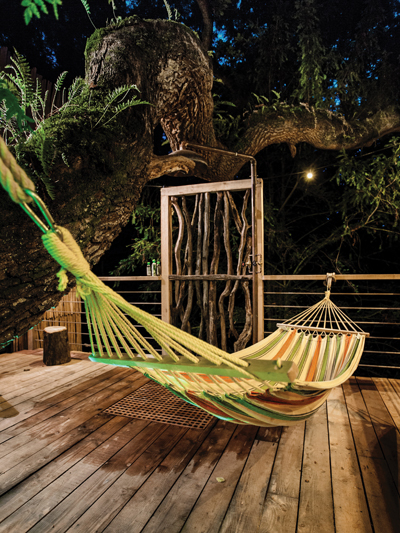
On one side, by a large window overlooking an outside deck with a spectacular view of the ancient oak, a double-ended copper tub beacons and a luxurious steaming bath sets the tone for a gentle day in the woodland.

Recently featured on the list of houses considered for the title RIBA House of the Year 2017 on Channel 4’s Grand Designs, the Woodsman’s Treehouse was conceived by Bridport resident Guy Mallinson. A master craftsman who studied at Parnham Furniture School and the Royal College of Art before setting up a successful furniture design business in London, like many young boys, Guy had spent much of his childhood years making dens in the woods and the opportunity to design and build a proper treehouse was something he had always dreamed of. ‘Who hasn’t’ he exclaimed when I spoke to him after the project had been completed.

He explained how the treehouse had developed organically.

‘I got into the luxury glamping business accidentally’ he said. ‘We were running green woodworking courses in our woods in Holditch when one of our course guests asked whether they could pitch a tent in the woods during a course. Another then asked if we could put one up for them, and then could we put up a smarter tent, with flushing loos and sauna etc.’

In time, Guy responded to further customer requests for electric blankets, heated towel rails, pizza ovens and even Wi-Fi. ‘We were one of the pioneers in the now very popular glamping market’ he laughed. However, the business—known as Crafty Camping—is well beyond just glamping. ‘We still differentiate ourselves by the hand crafted spaces, using our in house design and craft skills, by running, entirely optional, green wood craft courses and by building our little village of handmade spaces in a woodland on boardwalks and decks.’

Being in a woodland involves a lot more work in both building and maintaining as it is perhaps a more harsh environment, but Guy knew that visitors loved the magical atmosphere and enjoyed being immersed in the wildlife and tranquillity that a woodland affords.

In fact, it was the guests asking for a treehouse to supplement the existing yurts, tipi and shepherd’s hut that set a long process of research in motion. A chance meeting and subsequent friendship with architect Keith Brownlie helped Guy’s dream become a reality. ‘I realised that I needed some help from an architect, as my furniture design skills were not enough to design and build a house, let alone one in the middle of nowhere half way up a tree’ explained Guy. ‘The collaboration that resulted was a real pleasure and the design development meetings in Keith’s Bridport office, the woodland field kitchen and of course the pub were great fun. I think the end result very much expresses the fun that we had designing and developing the concept and design.’ A description that Kevin McCloud from Grand Designs echoed, presenting the treehouse as ‘a fantastical creation designed to bring out the playful in all of us.’

When Michelle Ogundehin, a trained architect and editor-at-Large at Elle magazine visited the treehouse for Grand Designs, she described it as ‘like a childhood fantasy come to life’ She loved its ‘elements of richness, escapism, even fantasy’ saying it was ‘quite magical—which is not a word you often use in architecture’.

Made from a wonderful mix of Douglas fir, cedar, larch and oak, set on stilts of sweet chestnut, the building was ingeniously designed around the oak tree, rather than attached to it. Keith Brownlie explained that the ethos was to enhance the environment not to destroy it. It was built ‘in respect of the trees, to look at the trees rather than to stress the trees’ he said.

Joining the list of buildings chosen to compete for the RIBA/Grand Designs House of the Year is one of many accolades bestowed on The Woodsman’s Treehouse and Guy was quick to point out that it took a huge collaborative effort to bring it about. ‘We started building the treehouse in February 2016 with a core team of four woodworkers and builders’ he explained. ‘This team grew through the build as we brought in more specialist and local craftsmen. We were very lucky to know a lot of excellent Bridport and west Dorset based traditional craftsmen through our courses and the green wood craft community, many of whom were involved in the project. By the end we had about twenty of us working on it.’

Guy’s three boys were also very involved during their holidays, and along with some of their friends, were responsible for the sweet chestnut split log walls. ‘Between them they made and assembled about 10,000 logs, which involved draw-knifing off the sapwood in a shaving horse and then cleaving the logs into quarters before carefully assembling them on the outside and the inside of the entrance cube.’

Graham Diment, an old friend of Guy’s, was site foreman, and as Guy put it, ‘had the unenviable task of working out the best method to build this challenging project in the air, in the middle of a boggy wood.’

The list of those involved is too long to include here but between them they brought the project to completion and produced what the RIBA described as ‘a masterly control of form and function, with pinches of references from Borromini, Palladio and Stirling.’

With its wrap around balcony leading to a top deck offering its own sauna and Jacuzzi, The Woodsman’s Treehouse is undoubtedly one of the most unique buildings of our time. Kevin McCloud wasn’t far wrong when he described it as ‘studded with distractions, like a glamorous woodland funfair.’

After a leisurely stroll through the woods, a sauna, a long soak in the Jacuzzi and a pizza from your own personal wood-fired pizza oven, it’s hard to believe anything else exists in the world around you.

A squirrel bounces along nearby branches, a train hoots in the distance, and a little closer, one can hear the lowing of a nearby herd of cattle. On the evening of my visit somewhere in the distance someone was celebrating with fireworks—the view from the within the trees was a spectacular bonus.