
I found myself searching the internet recently to see what cheering things we might look forward to in the coming months. As ever, sporting events were high on many of the lists. The first to feature was the Winter Olympics, which as Humphrey Walwyn points out on page 47 might not be to everyone’s taste—not all of us know the difference between an ‘alley-oop flatspin five’ and a ‘double-cork 1260’. Then there was the football World Cup in Russia in June and July to look forward to, but with England not participating this time, that may be less enticing. We could, of course, look forward to a new Royal baby or a celebrity-style Royal wedding—but that’s not really sport is it? However, one big sports story is the inclusion of eSports in the Asian Games, a Pancontinental multi-sport event in Jakarta in August. Many observers expect this to pave the way for full Olympic inclusion in the future of what most of us know as video-gaming. It makes you wonder what the ancient Greeks might have thought. You may even be wondering whether talk of the inclusion of digital games in the Olympics is true or not. Thankfully, for the sceptics amongst us, a new game has recently been produced by researchers at the University of Cambridge to test players’ ability to spread fake news. Entitled ‘Bad News’, the hope of the researchers is that by using the game players will learn to spot what is true and what is not, therefore in a sense, inoculating themselves from the effects of fake news. The inventors like to describe it as a sort of ‘vaccine’. The game encourages players to stoke anger, mistrust and fear in the public by manipulating digital news and social media within the simulation. Players build audiences for their fake news sites by publishing polarising falsehoods, deploying twitter bots, photo-editing evidence, and inciting conspiracy theories in the wake of public tragedy—all while maintaining a ‘credibility score’ to remain as persuasive as possible. You can guess where this is going. Some might say ‘Bad News’ should have been an Olympic sport years ago but imagine it joining the range of eSports that one day become part of the Olympics. Imagine the crowds flocking to see their fake news heroes pitting their wits against teams from other countries. Imagine the flag-waving and the tears on the podium, the interviews with the proud, emotional parents and the lap of honour holding an iPhone aloft. Or, on the downside, imagine being disqualified for cheating. Now that would be ‘Bad News’.
Vegetables in March
As the spring gap looms, it makes sense to use as much of last year’s labours as you can. Even though the veg garden is now looking a little empty, it often holds more than you think.
Parsnips are heroic the way they sit in the ground unblemished. They start to shoot now, but there’s no loss of flavour. Louise’ flower borders have some growing perennially as the flower heads are so pretty—perfect for taking seed. When thinning them, the taste of these perennial roots is still good, albeit slightly less tender.
Carrots sown in June and dug mid-February taste much sweeter than ones stored in sacks. After all the holes and nibbles are cut away, that is, the advantage of growing large carrots from an April sowing. This year we are going to grow them under unsightly Veggiemesh to reduce root fly after two years of heavy attack, perhaps because they were growing in a central bed where I kept treading on the foliage.
Chard and spinach beet are productive in the spring gap. As they rise to flower, the smaller leaves are equally good, and you can either leave the crop in place until you have other crops for the space, or try keeping them as perennials. This last method is messy and less productive, as they keep trying to flower and bits of stalk often rot away.
The cabbage family are good friends as many of them sprout. Purple sprouting obviously, but also Brussels and curly kale. After the first pick, more and smaller sprouts appear—pick these while still small until May, even though less bulk, still delicious. Any new leaves on these plants can be cooked too.
Late varieties of leek feed you into May, mainly those with bluish leaves such as Bandit. If its dry, keep them well watered to reduce their urge to flower. Boltingh leek are still edible, although eventually, they get woody, even if you cut the rising flower stem. As with many vegetables, there are permaculturists out there who champion leaving many vegetables as perennial plants and cutting the tender but rather small growth each spring. This can be done with the leek but is less productive.
Spring cauliflowers are looking promising, even though most of ours flowered last autumn, so this year I’ll try sowing in July instead of June. Like most cabbage, they need lots of space. More compact brassicas, rocket and turnip, are picking well at the moment but will look to flower by April, by which time we’ll all be picking asparagus. And why was Cinderella thrown off the football team? Because she kept missing the Ball.
What to sow this month
Broad beans, early and 2nd early potatoes, radish and peas. Our peas will be sown indoors to get round our mouse problem. True spinach, lettuce, summer cabbage and beetroot germinate well under fleece or in a greenhouse but are easier to establish in April. If you feel lucky, you can try sowing carrots this month, too.
Two or Three
I recall from my early days two elderly farmers when one said “Ow many vields ‘ast got down to ‘ay?”. The other replied “Tu’ Dree”. “Dree” is still recognised by some as “Three”. This came to mind as I am writing about a number of different subjects, maybe two or three, something of a “rag-bag”.
Rabbits
After an afternoon flying our model aeroplanes, one of our friends invited us back for tea. His father had a garage and several other sidelines, including an old bus used for the school run and known among its passengers as “Alexanders Ragtime Bus”, a play on his name and a well-known song. As we arrived we were confronted by a lorry with a large triangular structure to the rear which was completely covered in dead rabbits. When we enquired of our colleague he said they will soon be off to London, for sale. We were told that his father had the trapping rights for a section of Salisbury Plain. This was before the myxomatosis epidemic decimated the rabbit population. They were a regular sight on country walks, with ample evidence that they had been there.
I once joined a walk over Pilsdon Pen led by a knowledgeable lady archaeologist who told us that the hill may have been an old rabbit warren. She said rabbits were introduced to this country by the Romans who constructed warrens in suitable places, such as on sandy soil and downland. It occurs to me that perhaps Coney’s Castle on the edge of the Marshwood Vale may be so called because it once housed a thriving rabbit colony, coney being another name for rabbit. A few hundred years ago gaming houses called novices “coneys”, perhaps because they might be fleeced!
In the 14th century Lords of the Manor created warrens in their parks or poor downland as a commercial enterprise. By the 15th century, rabbits were sold for 4d or 5d for a couple. One West Country manor received one-third of its revenue from sale of rabbits, more than the proceeds of sales of wool and livestock together. It was said that rabbit meat was favoured by the royal household and by many poor households also, until comparatively recently.
Some years ago the musicians Chas and Dave produced a record called “Rabbit, Rabbit” but I believe this referred to too much chatter!
The Ox House
When I was a youngster we frequently passed a farmhouse with an effigy of what I thought was a cow in front and I was told this was the Ox House. This puzzled me for a long time. An ox is a large bull and very strong and better at ploughing sticky mud than a cart horse. The Oxford English Dictionary states that the ox was a castrated bull, hence more docile, but strong.
The road which passed the Ox House led to the market town of Devizes up the very steep Dunkirk Hill, which must have been almost impassable, in mud, snow and ice before it was tarmacked. One can imagine coach and horses being exchanged for oxen in winter, to better scale the slippery hill.
Cecil N. Cullingford in A History of Dorset shows a photograph from about 1900 of two teams of oxen ploughing at Parsonage Farm, Dewlish, three drawing each plough. Oxen continued in use there until 1914, when no doubt the introduction of tractors reduced the need for oxen. We never see them in fields now and only hear of them at Christmas time when English carols and rhymes refer to them near the crib.
Sheep Dips
Some years ago there were sheep dips or washing pools on many farms to enable sheep to be washed beforehand clipping. This reduced the grease from the fleece on the worker’s hands and made clipping easier. William Barnes wrote a dialect poem The Shepherd o’ the Farm:
“An’ I do goo to washen pool, A – sousen over head an’ ears, The shaggy sheep, to clean their wool,
An’ meake ‘em ready for the shears”.
There was a sheep wash at Symondsbury and another at Bradpole, the latter having been renovated as a Millenium Project. This dip is adjacent to the River Asker in Lee Lane, Bradpole on the downstream side near Whitehouse Farm. It is roughly semi-circular, with a diameter of about three metres and with walls about one metre high. The open diameter faces the bridge wall at a distance of approximately a metre. Presumably, the sheep were driven parallel to the bridge, into the semi-circular enclosure to be pushed under the water. This sheep wash was probably last used in the 1940s and farmers might have obtained 1d per pound weight extra for the wool if it was clean.
Thomas Hardy wrote about a sheep wash in Far from the Madding Crowd saying “The sheep washing pool was a perfectly circular basin of brickwork in the meadows, full of the clearest water… a tributary of the mainstream flowed through the pool basin by an inlet and outlet at opposite points of its diameter….The meek sheep were pushed into the pool… thrust them under as they swam along, with an instrument like a crutch, formed for the purpose and also for assisting the exhausted animals when the wool became saturated and they began to sink. They were let out against the stream and through the upper opening, all impurities flowing away below”. Hardy described five men working, waist deep in water, but he was probably writing about a larger sheep wash than that at Bradpole, which was probably only a two-man job.
Now we wonder about Washing Pool Farm between Bridport and Salway Ash. Has that place name the same origin?
Well, that completes my “Tu’ – Dree”! I am reminded of the Mikado by Gilbert and Sullivan, where the minstrel sings “A Wandering Minstrel I – a thing of shreds and patches, of ballads, songs and snatches and dreaming lullaby”.
Bridport History Society meets on Tuesday March 13th to hear about “Joseph Clark, a popular Victorian artist and his world” from Eric Galvin at 2.30 pm in the United Church, Main Hall, East Street, Bridport. All welcome, visitors entrance £3.
Cecil Amor, Hon. President, Bridport History Society.
The Lyme Regis Museum
A Treasure Trove fit for the 21st Century
The Lyme Regis Museum reopened last year after a major makeover including the addition of a new wing named after Mary Anning, the famous fossil hunter and one of Lyme’s most celebrated citizens. Mary Anning possessed a unique talent for finding, reconstructing and interpreting fossils in the cliffs of west Dorset and her discoveries transformed the field of geology in the 19th century. The new Mary Anning Wing has transformed the Museum into one fit for the 21st century.
I remember visiting the Museum some years ago on a bitterly cold mid-December day. I recall a pretty but rather spartan Victorian building crammed with interesting exhibits but very much a museum in the old style. I returned this January to a completely different experience. The Museum now has a spacious, welcoming entrance area and shop with natural light flooding through plate glass windows giving spectacular views across Lyme Bay and the Jurassic Coast. The important features of the old building such as the beautiful spiral staircase and rotunda are still emphasised but there is a new Fine Foundation Learning Centre and with the installation of a lift, the Museum is accessible to all.
I enjoyed the bright, interesting and well-presented galleries covering the Early History of Lyme, the Cobb and the Sea, the Undercliff, Lyme during the War and the Branch Line Railway. A large display on Literary Lyme features, in particular, the writer John Fowles, who lived in the town and was a great supporter of the Museum acting as Curator for a decade. Fowles’ novel The French Lieutenant’s Woman was famously made into a film putting Lyme on the international map. Jane Austen also features strongly; she spent holidays in the town and set some of her novel “Persuasion” there.
All this alone is worth the price of admission but, in my opinion, the real jewel in the crown is the new interactive Geology Gallery. Here the visitor can see fossils similar to those discovered locally in the 19th century that changed the face of geology forever and made Lyme Regis famous around the world. The Gallery celebrates these discoveries and the people who made them while not forgetting those who continue this quest into the 21st century.
The large, high-ceilinged room is packed with exhibits: many different kinds of fossil, drawings, artefacts and mementoes. There are striking examples of large fossilised creatures on the walls and suspended above are models of these same creatures. The exhibits are so impressive and so well presented that there is a strong “wow factor” but the interactive displays bring the exhibits to life showing what the fossilised bones mean and what these creatures might have looked like. It is a gallery for all ages but there is no dumbing down.
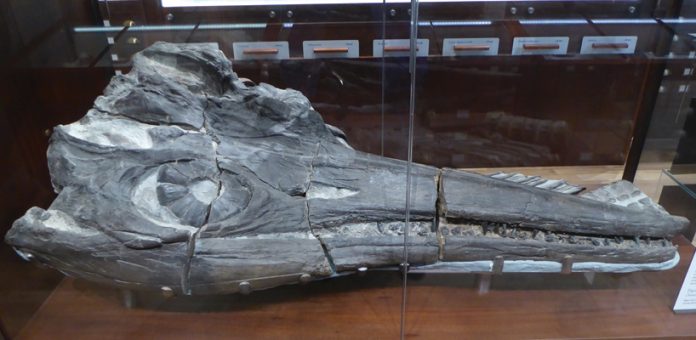
As I looked around the Gallery, I felt that even if she wasn’t actually there by my side, Mary Anning “spoke to me” from almost every exhibit. Her story is outlined in the displays, how she was born in Lyme Regis in 1799 to a very poor family, received no formal education but learned from her father the way to collect fossils from the surrounding cliffs. When she was about 12 years old, she and her brother made their first major fossil discovery, an Ichthyosaur, a now extinct “fish-lizard”. One of the most dramatic objects on display in the Gallery is a partial Ichthyosaur skeleton, about 5 metres long, discovered in 2005 by Paddy Howe, the Museum geologist, similar to the one discovered by Mary Anning. There is also a massive fossilised Ichthyosaur head in one of the cabinets, so we can get a real sense of how exciting it must have been to discover one of these creatures for the first time. Mary went on to become the greatest fossil hunter ever known, possessing a unique skill and persistence in finding and reassembling fossils together with the intelligence to learn about the underlying science. Among her other unique fossil discoveries were two Plesiosaur skeletons, the first ever found and probably her greatest finds. The Plesiosaur was a small-headed marine reptile with a very long neck and the Gallery contains the skeleton of a juvenile Plesiosaur with a model of the creature hanging above the display.
Despite her lack of formal education and her humble origins, Mary came to be well respected by the leading geologists of the time, Henry de la Beche, William Buckland and William Conybeare, all of whom are described in displays. These men sought her out in Lyme and befriended her but despite this friendship, they used the fossils she found to further their own reputations and gave her little or no credit. As a woman in the 19th century, she was never able to assume her rightful place in the scientific hierarchy. After she died in 1847, however, Henry de la Beche read a eulogy to the Geological Society dedicated to Mary Anning and her discoveries. This was an honour usually accorded only to fellows of the Society which did not admit women for another half-century.
The new Gallery tells the story of Mary Anning but I feel that her importance is slightly underplayed, especially in relation to the male scientists of the time. Her discoveries were unique, showing that large reptile-like creatures had existed millions of years ago but were now extinct. These findings challenged existing ideas in geology and questioned contemporary biblical accounts of creation. They also contributed to changes in thinking that led Charles Darwin to propose theories of evolution by natural selection. The importance of Mary Anning should not be underestimated and it is surely significant that in 2010 the Royal Society voted her one of the 10 most influential women in science.
I very much enjoyed my visit to the remodelled Lyme Regis Museum with its new Mary Anning Wing. It is a treasure trove of fascinating displays, a museum fit for the 21st century, and the staff should be congratulated on their achievement. I urge you to visit, you will not be disappointed.
Ten Years On
Like the origins of many great initiatives, the exact details of how Bridport’s film festival, From Page to Screen started are lost in the mists of time. This year, the team that brings together a popular and diverse selection of films, workshops and talks is celebrating ten years as Britain’s only festival of film adaptations, and in April visitors will enjoy twenty-two films shown across multiple venues along with workshops and talks by influential literary and film people such as novelist Ian McEwan and screenwriter Simon Reade.
The festival is now run by a large team of volunteers and an experienced committee ensures its smooth operation, but once upon a time a chat in a pub, a meeting at Bridport Arts Centre and the equivalent of a ‘back of a fag packet’ proposal led to what is now a hugely popular and successful event that draws enthusiastic audiences from near and far. One couple has visited from Brighton for the last eight years. They enjoy a week of Dorset walks and films at the festival, seeing it as the perfect holiday, and even bring their own cushions!
Bridport based film producer, Nic Jeune remembers being approached by newly arrived director of the Arts Centre, Lindsey Brooks, and chair of the Bridport Film Society, Steven Horner, to talk about putting together a selection of films to help broaden Bridport’s already established literary reputation. The Bridport Prize was by this time a highly respected international competition and on the back of the Prize, the Bridport Literary Festival was growing in strength. As Lindsey recalls, ‘Steven suggested he curate a series of monthly films which linked to events (dance, theatre, visual art) happening in the building. This made the films the Arts Centre screened relevant to our wider role and these beginnings led to the creation of a festival linked to the Arts Centre’s other major success story, the Bridport Prize for literature. Steven’s choice of adaptation as a theme was perfect and his ambition for the festival was infectious.’ Soon the ‘back of a fag packet’ idea morphed into a 100-page PowerPoint presentation that still lurks somewhere in the bowels of Steven’s computer.
As with all festivals, the dream was to create something that would bring people together ‘to make film fun and memorable, rather than sitting in front of your DVD player at home’ said Steven. As Nic Jeune recalls, there are many festivals doing this now, ‘Secret Cinema, Nomad Screenings and other festivals over the country—but at the beginning it was Tilda Swinton’s film festival in Scotland, Ballerina Ballroom Cinema of Dreams that was the inspiration.’
In a ballroom in Nairn, Scotland, she held a miniature film festival, deck chairs, bean bags, fish finger sandwiches and home baking. She said they were aiming to ‘reinject some romance into the film festival circuit’ which chimed exactly with how Steven and Nic were thinking in another little town at the opposite end of the British Isles; not just ‘film for films sake’ as Nic says, but the whole experience from food to music to decoration—creating a magical atmosphere.
For From Page to Screen, all these ideas and influences eventually came together along with a collaboration between Bridport’s two venues, the Arts Centre and the newly opened Electric Palace. From batting about the kernel of an idea back in 2007, memories, anecdotes and often heated debate about the role and technique of film adaptation generated a buzz in Bridport. Steven recalled the sell-out showing of A Single Man at the Palace as one of his lasting memories of the festival ‘I sat watching A Single Man, with my boyfriend next to me, on the huge screen of the Electric Palace with hundreds of Dorset folk, ranging from the most arty to the most ‘farmer’ types. Watching this story of a gay man reliving his love for his deceased partner.’
For Nic, the lassoing of Lynn Barber to close the festival with a screening of the film of her autobiography, An Education, was his greatest coup; hearing her talking on a BBC breakfast show, he emailed in an invitation and moments later had the satisfaction of hearing the invitation read out live on air. “That sounds lovely” said Lynn Barber “let’s talk later”. They did talk later and Lynn was secured as a guest at what would go on to be a sell-out screening of this Oscar-winning film.
Lindsey echoed Nic’s satisfaction at that particular coup. ‘We were used to attracting A-listers of the literary world to our tiny town every year to judge the Bridport Prize (“phone them and they will come..”)’ recalled Lindsey ‘but the film industry was another matter. Nic’s story of Lyn Barber agreeing instantly to come along, though, showed us all it could be done. Lyn had a whale of a time. Many of the guest speakers choose not to watch their film being screened and Lyn was no exception. Instead she wanted a meal, preferably a curry. I took her to the Taj Mahal on East Street only to find it full. Inevitably, I recognised some friends who invited a delighted Lyn to join their table for perhaps their (and her) most surprising curry night.’
From the outset it was apparent that many, many films were adaptations of existing works. When screenwriter/adapter Olivia Hetreed pulled out her battered and heavily annotated copy of Girl with a Pearl Earring; suddenly the adaptation process slotted into place for Nic Jeune: ‘Here was that physical copy of the book that this screenwriter had absorbed, broken down… you could see people going OK… book, person, film, the whole process’. That is why it’s a festival with a long life as there is never a final answer to the question ‘what makes a good adaptation?’.
As the festival grew, one of it’s greatest additions was the concept of a Guest Director, something that many literary and film festivals have embraced. Steven had heard Jonathan Coe speaking about They Were Sisters on Francine Stock’s Radio 4 show The Film Programme and invited him to speak at the festival. To Jonathan’s disappointment, he’d been unable to attend ‘I was very regretful about that because it sounded like a wonderful idea for a festival and I did want to be involved, and I assumed, as you do when you turn something down, that they’re never going to ask you again’ he said. So, when Steven later got in touch and asked him to guest direct the whole thing, he was more than happy to oblige. ‘He was probably the best person we could have got to be the first curator’ says Nic. ‘He didn’t see it as a token post but absolutely threw himself into the whole idea of planning a season and having very ambitious ideas which he said probably wouldn’t come off… what was fantastic was that he DID it!’. His ambitious ideas included Kazuo Ishiguro, Bill Forsyth, Nicholas Mosely, and they all came. Since then each year has been built around the curator’s choices of films and guests.
This has the bonus that whilst the festival remains about adaptations, it has the different stamp of each year’s curator. Jon Ronson, journalist and filmmaker, brought an edgy feel in 2014. Drama director Charles Sturridge came in 2016 and Curtis Brown’s Nick Marston sited the importance of From Page to Screen’s role after his week in Bridport in 2017. ‘My time in Bridport as curator of the From Page to Screen Festival was my highlight of last year’ said Nick. ‘The range of films we saw, from sixties revivals to potential contemporary classics, was tremendous. We also welcomed some very special guests, such as the screenwriter Hossein Amini for a showing of Drive and actor Dev Patel to introduce Lion. The writer, the script and the source material are the foundation of everything. So I think it’s brilliant and important that the From Page to Screen Festival continues to flourish. There is no festival like it and Bridport is its perfect home. All power and credit to those who created it and those who continue to nurture it.’
This year film director Garth Jennings brings his love of animation and comedy to the Festival. Director of The Hitchhiker’s Guide to the Galaxy (2005) and writer and director of Son of Rambow (2007) and Sing (2017) Garth is looking forward to his time in Bridport. ‘Working with the team to plot an entire program of films has been a real treat’ he said ‘and I’m really looking forward to watching the films and hearing the people behind them share their secrets. We are not just celebrating some of the finest screen adaptations, but also the sheer delight of the cinema experience.’
The themes of food, music and the magic of cinema have continued over the years. A whole range of local food producers now contribute to the festival. The magic of cinema has spread all around Bridport. The Arts Centre has continued to improve its screening facilities and the Electric Palace now has the screening equipment of a modern cinema. Alternative venues are also a popular addition to the festival, from a sell-out midnight screening of Nosferatu at St Mary’s Church, with live music accompaniment in 2016; a screening of The Shining in the then spookily empty Burton Cliff Hotel, (now the Seaside Boarding House), in 2013; a dog friendly Lassie at the tithe barn in Symondsbury and this year to celebrate 200 years of Mary Shelley’s book there will be a late-night screening of Young Frankenstein at the Unitarian Chapel.
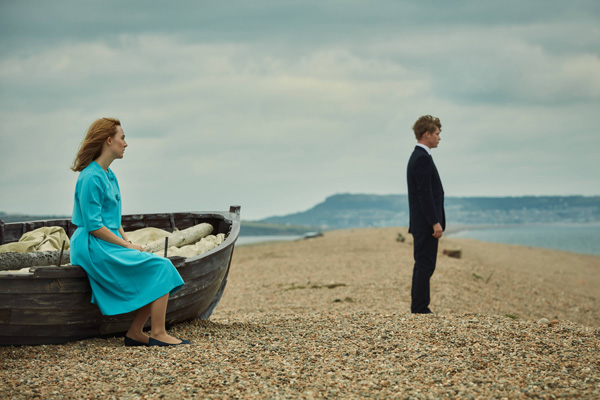
As the festival established its reputation with the film and literary industries, it was able to offer pre-release screenings to its audience and this year is no exception. The gala opening on Wednesday 11th April will be On Chesil Beach and the novelist Ian McEwan will be attending this and the earlier screening of The Comfort of Strangers.
From Page to Screen, along with the many other initiatives developed over the years in Bridport proves that this small seaside town is a popular venue for the big hitters. Lindsey Brooks recalls moments where the box office felt ‘besieged’. Dozens more volunteers were recruited to staff events, hand out delicious food and sell raffle tickets to help balance the books. ‘They all turned out to be as enthusiastic about From Page to Screen as we were’ said Lindsey. ‘Just as well, as we often found ourselves running full tilt down South Street from an Arts Centre event that over-ran to the next screening at the Palace. Has this ever happened at Sundance, Cannes or Venice? Perhaps not, but the small-town story of the festival—the vision and energy of Steven and Nic, the willingness of Bridport Arts Centre to take a leap in the dark, cheered on by enthusiastic local audiences—is the main reason it’s now ten years old and still growing.’
Slippin’ and Slidin’
We all have particular hates in life. My sister hates a messy kitchen, my dog hates getting up in the morning and we all hate going to the dentist. My particular hate concerns skiing – largely because I’m no good at it. I once went up an Italian mountain in my twenties to impress a passing girlfriend. I’d never skied before but it looked so easy-peasy! Obviously taking ski lessons would be a waste of time: you go up a hill and you come back down a hill but with sticks on your feet. No problem.
It’s a boy/man thing… Many of us hate being told how to do anything – particularly when it seems so obvious what to do. That’s why many men never look at the instruction manual: we simply connect up the telly or the computer, turn it on and then work it out. This is the direct approach – suck it and see. Surely that’d be the same with skiing?
Well, no actually. As soon as I hopped off the ski-lift into a swirling blizzard at 6 thousand feet, I discovered that wherever I wanted my legs to go, my skis had other ideas. After several attempts to stand, I ended up spread-eagled like a barbequed giraffe. Having eventually assembled my arms and legs into a fixed crouch position, I managed to squat and slide down the hill straight into a tree because I had no idea how to stop. I realized that perhaps I should have at least skimmed through a ‘quick ski start guide’ before departing up the mountain. I slid down another slope entirely on my bum which wore an embarrassing hole in my natty new blue ski suit. In desperation I ended up taking off the wretched skis and walking down the hill carrying them over my shoulder. It took four hours to walk back down – an embarrassment made even worse by the joyful shouts of glee from small children whooshing past me or through my legs as they showed off their downhill ski skills. That’s why I hate anything to do with skiing. And Italian girlfriends.
This is also why I’ve never been able to get involved with any of the Winter Olympics on TV. I watched a bit of freestyle skiing and skating but I fell asleep while trying to work out the overly complicated points scoring. I almost got into curling but it just looks too silly. And I really wanted to appreciate the ice hockey but the puck is so small and it zooms about so fast, that it’s difficult to see who’s got it and where it is… and then out of nowhere they’re all suddenly cheering and it’s in the goal and I have no idea how it got there. Yes, I know I’m not alone when I say that ice hockey just doesn’t work on TV. You need a bigger screen. Or I need a slow-motion pair of glasses or a go-faster brain.
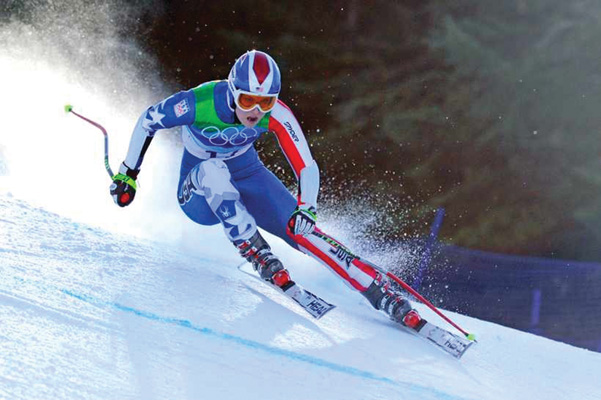
I’ve also tried to get into downhill skiing and ski jumping but they mostly leave me cold. Literally. If you look at the spectators lining the track, you realise that they’re all madly cheering and ringing cow bells because of the cold. They’re just trying to keep themselves warm as they stand about trying to catch an eye blink flash of a skier zooming past at 90 miles per hour.
And before you start to send me pro-ski hate emails or tweets, let me be the first to praise team GB and all our highly skilled competitors. I applaud their triumphs and I share their tears and – sometimes alas – their crashing disappointments. But the wide-eyed wonder that I feel for them is similar to me admiring a seal for balancing a ball on the end of its nose. I can feel deferential to any being if I see it doing something that I would never be able to emulate in a month of Ski Sundays.
And, in addition to the undoubted skill involved, I can bow down in awe to the sheer nerve of slipping down a hill on your back at 100 mph. You surely have to have at least one screw loose to do the Luge. You might just as well slide down a hill on a tea tray with your head two inches above the ice, which is what the Skeleton is all about. Bravery, yes; but a healthy spoonful of lunacy too.
Winter sports all involve different ways of sliding, slipping, skidding or slithering over the ground. I don’t care what anyone says, but this is not a normal method of transport. It seems to me that all the events in winter sports are unnatural because they all require extra bits of something tied on to your body. None of them are possible unless you’ve got skates or skis or snowboards or metal runners under your back. Surely summer Olympics are more environmentally natural. You don’t need anything extra to run a hundred metres, do the high jump or long jump or dive into a swimming pool. But sliding down a mountainside four times faster than a speeding jack rabbit is as mad as a month of March hares. Which I suppose is one of the reasons why they do it… Either that or they’re all trying to get away from their Italian girlfriends and boyfriends.
People in Food
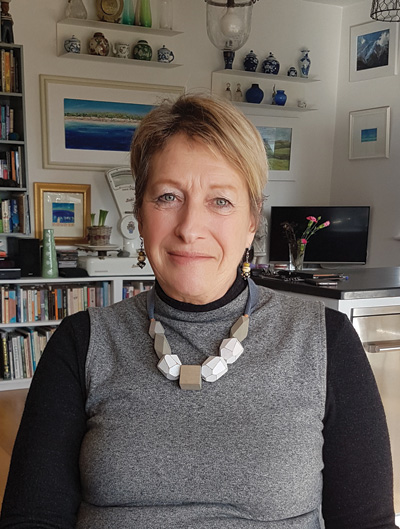
From her large beautifully designed open plan kitchen perched on top of Lyme Regis, Gill Coates provides workshops on how to make chocolates. Chocolate Amour has proved so popular, Gill is now teaching at Ashburton Cookery School. She learnt her skills at Valrhona’s Ecole du Grand Chocolat, near Lyon, while living in France for 20 years, running a hotel with her husband Peter, offering chocolate making workshops to her guests.
Just out of school Gill studied Hotel Catering and French at Brighton Poly, where she befriended someone with a boat. Already bitten by the travelling bug, she boarded the vessel and never looked back. Once in the Med she jumped ship and got a job cooking on a yacht, which led to catering on luxury yachts to the Caribbean as Skipper’s Mate. For 15 years Gill travelled the world, cooking her way from port to port.
Eventually she wanted to get back on dry land, so set up home in Antibes, France, where the boat docked. She renovated an old farmhouse for a friend near Cotignac, then bought her own and transformed it single-handed. Gill then met Peter, an artist, who was living in St. Tropez. They bought another part ruin together, which became their home and a hotel, with Gill cooking and teaching.
After 10 years, Peter wanted to exhibit his art more, so they returned to England. Gill continued offering chocolate workshops from her kitchen, whilst renovating their home in Dalwood and then again with the bungalow in Lyme Regis. Not ones to stay still, the couple rent their home out for the summer and go campervanning around Europe. Gill feeds her passion for art with her business in interior design; Roomshadows. Her years of travelling, refurbishment and teaching now combine, providing a lifestyle doing something she loves, pretty much all the time.
People at Work
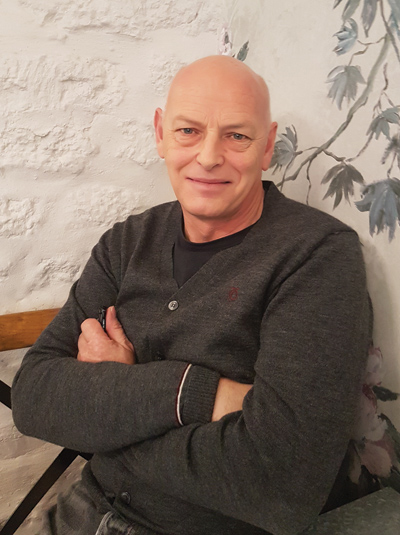
The owners of Cilla & Camilla, Richard Barker and his partner Sally Ann Palmer bought the original shop in Beaminster seven years ago. They kept the name but immediately started looking for new premises, as they were confident what they offered would be popular. Soon after, they did find another location across the square and after time expanded into the space next door as well. With everything a shopper might want, from clothes, cushions, glassware and kitchen accessories to wrapping paper and cards, once in the new location, Richard opened a café out the back, increasing footfall and sales for the business.
Five years ago, the second Cilla & Camilla came to Bridport, with a Cookshop added to the set four years ago in Sherborne. Richard is no stranger to the retail sales business. He was General Manager of Post Office Ltd before buying Cilla and Camilla, and prior to that Sales Director for Waterstones. He also owned a small group of bookshops with Sally Ann and was a book buyer for WHSmith initially. But 25 years of corporate life took its toll so when Sally Ann’s parents moved to Dorset, Richard and his family followed soon after, smitten with the countryside and lifestyle.
Richard enjoys the selling circle; choosing what to stock, unpacking it and putting it on a shelf, then being on the till when it sells is very satisfying. Thankful for a strong workforce, when Richard’s not at a shop, or working above it in the office, he can be located according to the Exeter Chiefs’ rugby fixture list. A season ticket holder, Richard loves watching the rugby, as well as Somerset cricket. Living in West Chinnock, with Sally Ann and his twin teenage daughters Richard spends a significant about of time “being a taxi” but also enjoys the local eateries too, as he loves dining out.
March in the Garden
Carrying on this month where I left off last one : “Let Battle Commence!”
March is well named as it’s this month when ‘Mother Nature’ begins hitching up her skirts, stepping up from a slow amble, towards a more forceful ‘march’. In the garden spring bulbs will be popping up everywhere and, even though the weather can still be horribly wintry, the positive beauty on display does a lot to fight off even the most unjust things that life can throw at you.
There is plenty to cheer the heart, not just the blooming bulbs but also many star performers amongst the trees and shrubs to marvel at. Magnolias, camellias and Japanese quinces come to mind and even the indestructibly yellow forsythia is, in my opinion, not an unwelcome sight.
I expect the ‘wicked’ forsythia that I rescued in the garden I left last year, reinvigorating it as a trained specimen on a wire fence, has been unceremoniously ripped out by now… what was it that Dorothy Parker said about ‘whores’ and ‘culture’?!!!
When you’ve finished admiring the good things in your garden, it’s time to get on with a few essential tasks at this critical time of year. The traditional ‘winter’ jobs must be completed this month. These include things like planting bare-rooted hedging, rose pruning, mulching of beds and borders, winter digging, wholesale clearance work and anything which involves too much disturbance of bird nesting sites.
There are some plants which really need to be sown now if they haven’t been already; sweet peas are chief amongst these but so are any bedding plants which are relatively slow to reach flowering size (salvia, lobelia, impatiens, antirrhinums inter alia).
In fact getting on with sowing annuals under glass is a great positive step towards filling your garden with colour later in the year. Any gaps in your borders can have a few filler annuals allotted to them now. Similarly, if you are planning to fill a new area with herbaceous perennials, you can dig up and divide older specimens now, using the divisions to extend your garden free of charge. The ‘expansion gaps’, between the perennials, can be plugged with more annuals which will crowd out the weeds and provide an extra fillip to the border.
Towards the end of the month, especially if there’s a settled, mild, spell, hardy annuals can be sown where they are to flower. Compared to buying plants in pots, even the tiniest of pots, packets of seeds are ridiculously cheap so a generous sprinkling, amongst beds and borders, can yield fabulous results with just a little diligence to weeding out ‘competing’ plants plus some attention to pest control (this means a prophylactic scattering of slug pellets—there really is no avoiding chemical control if you want at least some seedlings to survive to flowering size).
I can’t see how anyone, even the most control-freak sort of gardener, could not welcome a little random flower power when it comes in the form of hardy annuals such as ‘Love-in-a-Mist’, pot marigolds, Californian poppies, cornflowers etc. I’ve not yet tried it myself, maybe this year I shall, but I rather like the idea of the hardy annual ‘Greater Quaking Grass’ (Briza maxima) as a foil to the more traditional ‘blooming’ annuals. I have a strong memory of being fascinated by it as a child—although I can’t for the life of me remember how I would have encountered it at such an early age. It definitely was not growing in our own family garden.
The weather can still throw a spanner into the works this month, especially regarding vicious overnight frosts. Be ready to protect newly planted areas with horticultural fleece, pinned down with whatever comes to hand. I like to fashion hoops out of galvanised wire for this purpose; push the ‘u’ shaped pin through the fleece and into the ground below.
It’s too early to plant out tender plants, which you’ve been keeping under cover, but potting them into new compost is a good idea if they are coming into growth and you don’t want to check their growth. Keep a close eye on watering in greenhouse situations as plants don’t want to be droughted, as they are starting to make new growth, but a drop in temperature could induce rotting if they are kept too wet.
If that’s all a bit depressing, just as things were ‘looking up’, then I suggest you flick through one of those hugely colourful seed company catalogues (that seem ubiquitous despite it all being available on the paperless internet) and order up some jolly ‘plug plants’. I’m a little tempted to see if ‘Crazytunia Ultra Violet’ can possibly live up to its billing and, even if it doesn’t, having plants ‘on order’ to replace any losses amongst my own raised seedlings, is not a bad plan.
Any excuse to give in to temptation, just as a new gardening season is getting into its stride.
Alice Allan
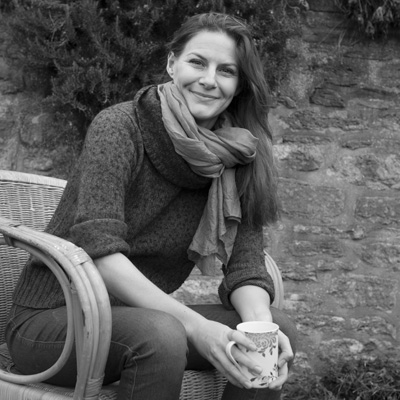
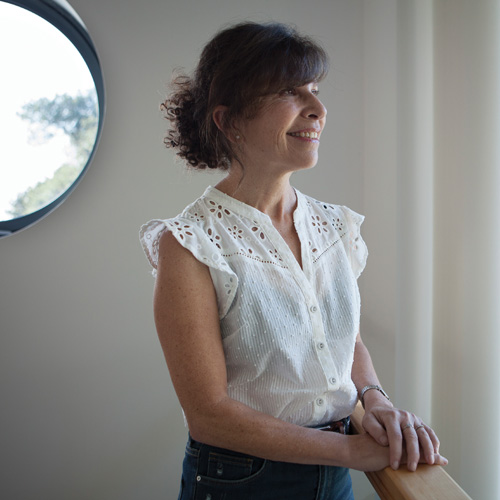
‘When my husband Chris got taken on by the Foreign and Commonwealth, I was given some advice by a fearsome ex-ambassador’s wife: “Get an English teaching certificate so that you have something to keep you occupied while the children are at boarding school.” It sounded very far from the life I knew, or any kind of future I’d imagined for myself. At the time, I felt sick at the prospect of so utterly giving up my identity, but ultimately, I think she did us a favour. She galvinised us to focus on what was important to us. We’ve both worked hard to make sure the bleak vision of diplomatic life she painted has not come to pass, that I’ve got the most out of life abroad, and we’ve kept our kids with us while we travel.
I was born in London, but grew up in East Devon, near Stockland, on a beautiful small-holding owned by my mum, an art therapist, and dad, a writer, social worker and journalist. My younger brother and I had free run of the fields and we grew up with sheep, geese, chickens, dogs, cats and even, for a couple of years, a shaggy pony with whom I roamed the lanes. I always felt a bit of a hippy-outsider at primary school, where pretty much everyone else seemed to be related to each other, but at Honiton Community College I discovered music, literature, languages and the yearly, yearned-for school play. I set my heart on being an actress.
When I got into Cambridge to read English a few years later, I realised my ambition of joining Footlights. I wrote and performed comedy for Footlights’ ‘smokers’ (which often took place in smoky, mouldering basements), and played roles in Shakespeare productions in America and Korea. After graduating, I dreamed of the RSC, but touring in small scale theatre, acting in low budget films and a lot of waitressing was more the size of it. When I met my husband, it was time for a change; I jacked in acting and worked as a corporate trainer, teaching voice and presentation skills.
Our first diplomatic post was Japan. It was very far from home and very foreign—I couldn’t even recognise the vegetables! I was homesick, that first year, living in a tiny seaside town while we learnt Japanese. My Japanese tutor kept trying to turn me into an erito rady (elite lady), by teaching me how to make tea and arrange flowers, but it just wasn’t me. With some relief, we moved to a tiny 10th floor apartment that overlooked the bright lights of Tokyo. Tokyo is a crazy city, a place that never sleeps and is constantly reinventing itself-we had a lot of fun and I don’t remember sleeping much myself. I went back to acting, mostly in commercials. In Japan, only villains have British accents, so all my roles as cute blonde foreigner (I went bottle-blonde for the Japanese market) involved faking an American accent; one involved being a mermaid being caught on the end of a fisherman’s pot-noodle-baited line. I also played Greta Garbo in a cult Japanese movie franchise. I was killed off after 10 minutes by being pushed from a moving train and got to scream loudly while leaping out onto an inflatable mat. All very ‘Lost in Translation’!
I became pregnant in my last year in Tokyo. Japanese women are expected to give birth very demurely, with no shouting and no pain relief. I moo-ed like a cow and tried to punch the obstetrician, but safely delivered my daughter Cara.
I inevitably learned that acting doesn’t easily combine with motherhood, so when we moved back to the UK, I re-trained as a breastfeeding peer supporter; the UK has the lowest breastfeeding rates in the world, and not nearly enough support for new mums. I’d loved breastfeeding, so I felt it was something I could help others with. When our second daughter Sylvie was a year-old I started work in a hospital and did home visits to new mums, which for the first time helped me feel really connected with London. I qualified as a lactation consultant so I could work on our next posting, to Addis Ababa, Ethiopia.
It’s an incredible privilege to represent Britain abroad, and to really get to know other countries, but as a diplomatic spouse, I’m a bit of a liability. I have never really believed in ironing, have no interest in table plans and a tendency to talk about nipples at polite functions.
One day, one of the giant tortoises on the British embassy compound in Addis had an infected leg and was being eaten alive by ants, so I called the vet. When a man arrived, I rushed him into the back garden and made him examine the tortoise. He wasn’t very forthcoming, so eventually I asked, “Well, what do you think?” He apologised, and said, “I’m sorry, I don’t know anything about tortoises. I’m the New Zealand ambassador!” He’d come for a meeting with my husband. The vet turned up 10 minutes later.
On another occasion, Chris was having a meeting in our living room with the very grand ‘Sultan of Afar’ who wore fine robes and a turban. I had been bathing the kids and had turned my back to get their pyjamas. I returned to find them, both stark naked, outside the door of the meeting room. The youngest was perched on top of a toy van, which her sister was revving, telling her, “OK, I’m going to open the door and push you in. 1…2…” I just managed to avert an embarrassing incident.
In Ethiopia I found volunteer work at a big public hospital on their neonatal intensive care ward. The hospital served the poorest, high-risk mums in the community; a bed for the night there cost about £1. I’d often come home in tears at the unfairness of life for these women and babies. The experience inspired my novel, Open My Eyes, That I May See Marvellous Things, which tells the story of a midwife who falls in love with an abandoned newborn. It deals with attachment, loss and the power of touch to remind us what it is to be human.
We’re currently posted in Uzbekistan. I’m writing and doing a MSc in Public Health. Fortunately, nowadays, ambassadors’ wives aren’t obliged to be the hostess with the most-ess (a good thing, since my inquisitive Ethiopian street-dog Frank has a habit of sticking his nose up people’s skirts at functions). My parents have just moved to friendly Bridport. Wherever I’ve lived in the world, the West-Country is a much-needed anchor. I return home as often as I can to the green hills of Devon and Dorset. They’re where I find most peace.’