Thursday, March 19, 2026
Home Blog Page 37

Vegetables in April

How many ways of getting it wrong are there? Every year of sowing my seeds seems to discover a new way of getting it wrong. But all newly sown seed need is warmth, moisture, nutrients and light, so it must be easy. End of article!

Let’s look at warmth. Most seeds germinate best in warm soil. If you take your trousers down in April and park yourself on the soil, you will find it is still not warm. Like all other months, April has warm moments and cold ones. So germination is better indoors in a greenhouse or on a window sill.

Once a seed has germinated, it will grow on in cooler conditions. But a seedling in cold soil often becomes slug food, so we prefer to grow in seed trays or modules in the greenhouse until a strong plantlet can be dibbed into the great outdoors in warmer soil a month later.

But then there is the carrot. This more or less has to be soil sown, unless you have the forensic dexterity to germinate hundreds of seeds in a paper towel or cornflour gel, and then transplant into soil without causing them to fang.

Looking back, the best carrot germination is in a fairly dry April, something to do with dry soil warming up faster, and slugs. Germinating seed need moisture, but not too much. As with all seeds, firm some extra fine soil around the seeds, so that enough moisture is in contact with the tiny seed for the two or more weeks they take to germinate. Catch 22 is that warm and wet soil favours both the carrot and the slug.

How thick to sow your seed? Seed packets typically contain over a thousand seeds, so the temptation is to sow thick. My experience is that either all seeds germinate or none in any given length of seed drill. Thick sowing means a lot of tiny carrots that never grow to a good size, or a painstaking amount of thinning later on, risking the sweet smell attracting the dreaded root fly. So it’s best not to sow too thick, but keep the spare seed for later sowings. And what is the difference between an honest Russia official and a unicorn? Nothing, they are both fictional characters.


What to sow this month

Outdoors: all the English favourites, such as maincrop peas and potatoes, leek, beetroot, calabrese/sprouting, radish, onion sets, lettuce, carrots & parsnips.

Indoors: early in the month celeriac, mid-month: courgettes, basil, sweetcorn and early May: cucumber, French and runner beans. Transplanting any of these outdoors before the weather is seriously warm is risky, so it may be better to sow later than this.

Up Front 04/18

Whenever someone begins a sentence with the words ‘I’m no expert but…’ and then proceeds to hold court on the state of the world, or whatever their chosen subject is, there is a strong chance that they wouldn’t want to listen to an expert anyway. In fact, any opinion outside of their own may not really be to their liking. Expert bashing has often seemed like a national pastime, but today, in our digitally driven world, everyone is an expert. The speed at which comments and ideas can be delivered means that even a meme—an image, video or piece of text carrying an often simplistic message—can quickly become the viewpoint to latch on to. When a meme tickles the imagination of a large audience, it can become the collective social judgement, rapidly masquerading as the ‘expert comment’ on whatever the subject may be. Unfortunately, memes tend to be designed more to amuse or to propagate a political or social agenda, rather than to offer an opportunity for wider and more balanced discussion. But they play such a considerable role on collective consciousness—and more recently in the ‘divide and conquer’ game of manipulating people’s opinions—that real expert knowledge is often drowned out. So what is an expert? Most dictionary definitions go for something along the lines of ‘someone who is very knowledgeable about a particular subject or skilful in a particular area’. I see a doctor about illness because he or she knows so much more than I do about what might cause my ailment. I see a mechanic about fixing my car for the same reason and I read the thoughts of a well-educated historian or scientist because he or she will have learned things that I haven’t had an opportunity to learn. In theory, the analysis offered by any of these will supply useful insights, and more often than not they will be able to offer valid and useful advice. The issue of expertise is not one of whether expert opinion is of value or not—of course it is—a problem only occurs when the expert comment doesn’t fit into our own agenda or suit our current prejudice or political bias. In our increasingly polarized world we need expertise and wisdom, and an ability to dissect and analyze, more than ever. Especially the expertise from those involved in ‘information warfare’ who bragg about how easy it is to manipulate emotions using social media, as in the case of executives from Cambridge Analytica when filmed undercover recently. Whether or not this is just braggadocio or sales spiel, these are also experts that it might be best to take note of—if only to avoid the polarization caused by their manipulative activities.

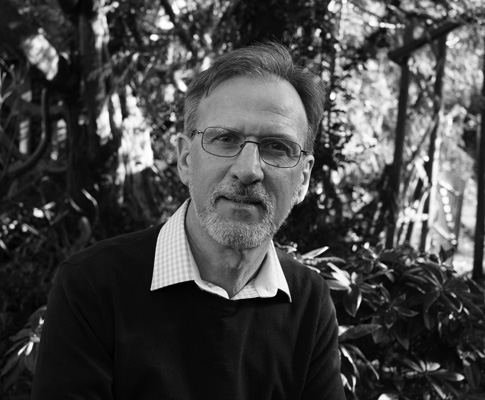
Richard Lane

‘I was born in Hampton, Middlesex, when my dad was away in the Korean War. He was in the Navy until I was about three. We then moved to the edge of Epping Forest with my younger brother and sister and dad, like his father, joined the Police Force. I was passionately interested in natural history from a very young age and often went off on my own exploring nature. My parents were incredibly tolerant of all the strange things I kept around the house. I was particularly fascinated by insects, it seemed they came from another world. It was a challenge growing up with your dad as a local bobby, you had to do what you were told. Conforming isn’t my strong point but that’s what research is all about, everywhere I went I was always pushing the boundaries.

When I was 12 we emigrated to Australia where the wildlife was fantastic. We lived near Perth and I loved exploring the bush finding spiders and snakes without a worry in the world. After three years we returned to live in West Sussex and I went to a secondary school in Cuckfield. I decided I wanted to be an entomologist but the teachers told me that no-one does that for a job. A lot of people told me what I couldn’t do. I left school as soon as I could and went to the Technical College in Brighton—great fun in the late 60s! I was 16 when my dad saw an advert in the newspaper for junior staff at the Natural History Museum so I applied, and went to work there when I was just 17, in June 1968, fifty years ago in fact. I started work at the museum as the lowest form of life whilst I did my A Levels at evening classes including doing Chemistry A Level in just six months. The then Scientific Civil Service ran a competition to sponsor people to go to university.  I asked my head of department if I could enter this competition and was told no-one had ever done that before. I went ahead and won an award. By this time, I’d met Maureen who also worked in the Museum as a scientific illustrator. We got married in 1972, whilst I was still a student, in a little church on Harrow on the Hill.

Studying at Imperial College, London was just fantastic. At last I found people who just ‘knew stuff’ and all the staff were leading authorities in their field. I got a first-class honours degree and suddenly there seemed to be no barrier to achieving things. I did my doctorate (PhD) whilst working back at the Museum on what was to be my main career, insects that transmit diseases. Soon after, I moved to the London School of Hygiene and Tropical Medicine; another world class institution. I had a research team from India, Pakistan, Israel, Somalia, Jordan, Colombia, all over. I was also travelling for the World Health Organisation, often involving missions to insecure areas. I was in western Pakistan, between Iran and Afghanistan, when streams of lorries passed us; it turned out to be the Taliban invading Afghanistan. I’ve been very lucky not to catch anything too serious considering the number of times we set ourselves up as mosquito bait for scientific research. You can’t do that anymore they reckon it’s too dangerous. I once came back from living with Gurkhas in the jungle with strange maggots in my back. I thought this was really interesting, so I kept them for several weeks to see what they did. Eventually, Maureen said ‘enough is enough I’m not sleeping with a man with maggots in his back anymore’ she thought the experiment had gone on long enough. So, I went to see a dermatologist friend of mine to have them removed. We filmed it of course with students watching and wrote a scientific paper. Another time we were using a high containment lab to experiment on parasites and the blood-sucking flies that transmit a fatal disease. There were no vaccines and the drugs available were very toxic so we had to be careful. One of my friends had an idea of making a vaccine for this disease by using a parasite from a desert rodent and injecting them into ourselves to give us protection against the more dangerous form. We got fantastic levels of immunity so then used the real one – it didn’t work and I ended up with a huge tropical ulcer on my arm. I kept the infection and did lots of experiments on it until Maureen said ‘I’m not sleeping with a bloke with a tropical ulcer anymore.’ So, off I went to see a friend who was experimenting with a new drug for treating this disease, which eventually worked.

We had three children by this time, Lucy, Roly and Nicholas. I travelled a lot to remote areas where communications were very poor. By the time they got a postcard from me I was usually somewhere else. I’ve always said you need a long-suffering wife to work in a job like mine.

After seven years at the Tropical School I went back to the Natural History Museum to head the Entomology Department of about a hundred people and that’s when I wrote my first book, people refer to it as “Lane and Crosskey”. It became a standard text for medically important insects and ticks. Roger Crosskey was my boss and then later I became the boss—I learned a lot from him. I’m just writing his obituary, he died in September.

Then I worked for the Wellcome Trust, the world’s largest charity funding medical research and the largest single funder of the human genome programme. Here we could tackle one of the great injustices of the world—at that time 90% of the world’s health expenditure was spent on just 10% of the world’s population. I went to head up tropical medicine and was responsible for spending between 60 and 100 million dollars a year. We had research centres on malaria in Africa, and set up new research institutes in South Africa, Vietnam and Beirut to study HIV and women and child health. Few people here really understand about women’s health in developing countries. Women were 150 times more likely to die in childbirth than in the UK.

After eight years I returned to the Natural History Museum as Director of Science. I had 350 scientific staff and looked after a collection of 70 million items and a library of over a million volumes. There, I was responsible for setting a new scientific direction making sure the science the museum did was relevant to society. We built a new building that the public could walk through enabling them to see labs and collections to explain what the scientists were doing and how they were doing it. Science isn’t something you should hide away from people. Nature is so beautiful, understanding it makes it even more beautiful. The Natural History Museum holds the human remains of 20,000 people. We had a request to return aboriginal group remains to Australia so I became very involved in the ethics of repatriation. It’s about balancing the benefit to science of retaining these remains compared to the harm caused to the communities of having their ancestors’ remains held somewhere else. I retired from the Natural History Museum in 2011, this same year, I was awarded the OBE by the Queen for services to science and museums.

Whilst working we had a cottage in Kilmington for just over eight years and came down every other weekend without fail. It’s such a beautiful place. The boys had gone off to university and we just had Lucy at home with us. I can’t believe how lucky we are to have landed in Kilmington. Six years ago, we bought the house we are in now, we demolished most of it and designed our new home. We have the countryside and good people around us and can’t ask for much more than that really.

Since retiring I do three things; some consultancy work, volunteering and family, friends and leisure time. On the working front I was approached by the Australian government to be an advisor and work with Aboriginal communities and Torres Straits Islanders helping them with the return of their ancestors’ remains. Some have become great friends and we’ve had one of them to stay here with us. One of the nicest things was to be master of ceremonies at the Australian high commission in London to handover remains to aboriginal groups. I am also advising on a major new science Museum in Bangkok.

My volunteering work includes being a trustee of a UK charity called the Against Malaria Foundation. Every single cent of the $150million we have raised is spent on buying bed nets. We’ve been rated number one charity worldwide by three agencies in America that measure the impact and transparency of charities. Monday morning for example I was on a teleconference to Uganda. So, in good old rural Devon I have tentacles out all over the world. More locally I’m a patron of Lyme Regis Museum. I’ve just published another book The Biology of Parasites along with some other guys. I think if you’ve got knowledge you have an obligation to share it; you pass it on for someone else to build on.

Then most importantly there’s my family, friends and leisure time. We’ve got four grandchildren, three girls and a boy which is great. The boys and their families live up in Surrey but we see them quite a lot. There is nature and the garden too. A few friends and I belong to the Devon Fly Group, we go out surveying flies—there are more than 7,000 species in Britain. And, of course we have a very active social life—we thoroughly enjoy contributing to village life. If we don’t make the future who will, I’m not standing by to let others do it, I want to be a part of it.’

People in Food Anita de Greeff

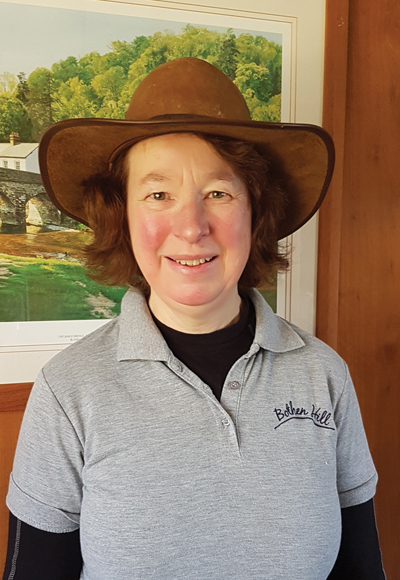
Every April and May, near the traffic lights in Bridport town centre a lady can be spied wearing a large brown hat, stood behind a table brimming with bright green asparagus spears. This is Anita de Greeff, of Bothen Hill in Bothenhampton, who runs an organic vegetable growing business with her husband Chip. They grow a variety of vegetables year-round but have a particular fondness for asparagus, which got them shortlisted for a BOOM (Best of Organic Markets) Fresh Produce award last year. Their secret seems to be down to the care they take, continuing to water the asparagus once cut whilst chilling it to keep fresh.

Passionate about the produce they grow from seed, Anita and Chip pick the crops themselves, with a couple of dedicated part-time staff. During asparagus season, they work from dawn till dusk slicing the spears from the earth, having a nibble of the smallest most tender stalks as they move down the lines. And when they return home, exhausted from their labour, around midnight, when Anita remembers the VAT return is due, they may well tuck into some pan-fried large chunky asparagus spears too. A great family cook, Anita also turns her skills to baking on a Friday morning, holding classes to raise money for Devon Air Ambulance.

Based at the farm, Chip is out in the fields and polytunnels most of the time. Anita does the books and admin, as well as working outside. Her previous 34 years working in a bank has given her a natural head for figures. The couple have two children; Harry and Lucy, although now grown up and on their own career paths, they also help out on the farm whenever they can. When Anita does find some time off she heads out to her beloved Exmoor, where she rides her horse, leaving the farm far behind.

People at Work Gabby Rabbitts

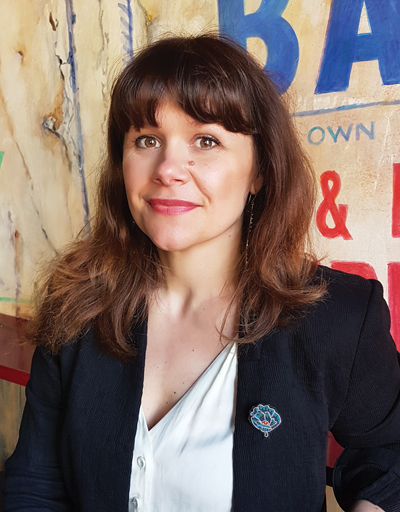
Gabby Rabbitts is the newly appointed Director of the Marine Theatre in Lyme Regis. She means business, and has a tall order to turn the tired venue around, but relishes what’s ahead, determined to transform the historic building into a strong contender on the UK music and theatre circuit year-round.

Gabby grew up in Symondsbury, and went on to college in London. She stayed there 12 years, working firstly for a couple of small independent theatre and film projects and then organised large corporate events. When her father got in touch asking Gabby if she would consider taking over the running of the Electric Palace in Bridport, she jumped at the chance. Now she could combine her passion for theatre and live music with her skills from the corporate sector. Her aim was to make the Electric Palace a quality live independent venue for the South West and to make it financially sustainable.

Gabby spent the next few years putting everything she had into the venue. She had her son, still giving as much time as she could to the place she loved so much. However, when Gabby and her husband Iain’s second child came along, it was time to sell up. Not content to sit around, the couple decided to go travelling around Europe with their little ones during Gabby’s maternity leave; with Iain on sabbatical. Creating amazing memories, they loved waking up in a new town each day, absorbing the different cultures they experienced.

Once back home, Gabby was told about the job at the Marine Theatre. Perfect for her, she applied and was appointed in October 2017. With acts only booked in till December she hit the ground running, and hasn’t stopped since. Passionate about theatres being at the heart and soul of a community, Gabby is a shining light, battling for the Marine Theatre’s future and survival.

Socially Aware Wedding

After many months of ‘will they?’, ‘won’t they?’, my cousin Dahlia has finally decided to get married. For most of our family this is the long-awaited signal for general rejoicing, but for me it’s the time to enter a state of encroaching gloom. Not because of the people involved—he seems a nice enough guy and she’s very happy—but only because of the wedding event itself. I should explain… Over the last 5 years Dahlia has become progressively green and liberally argumentative while he’s the leading blogger for hashtag #PlanetEarth. I believe I can therefore forecast their wedding plans with 100% accuracy…

Let me start with the pre-invitation messages from all of their several hundred Facebook ‘Friends’. I say ‘Friends’ advisedly because she hasn’t met many of them. He probably imported most of them from an anonymous online Russian wedding list as they’re simply fake digital links to boost their ‘Likes’ ratings and approvals. Over months, this will grow into a self-congratulatory Facebook Timeline of ‘Our Wedding’—an avalanche of digital drivel in which both can wallow in a fuzzy warmth of anticipation.

Next, I might receive an actual written invitation—well, not actually hand written of course. It’ll be to ‘Our Dear Uncle’ on recycled brown rice paper using that flaky ‘Blue Romance’ font on iPads, and printed with acid-free ‘be kind to squid’ computer ink. Yes, I’m sure you can tell how I feel about it all…

Dahlia’s dress will no doubt be a gown of organic canvas with natural non-toxic to bee dyes. It would be even more PC if she wore her mother’s old wedding dress (good recycling) but I read on Twitter (#WeddingMum) that it’s got loads of plastic beads on it, so that’s a non-starter! In fact, I can absolutely guarantee one thing about this forthcoming nuptial event: it will be the World’s first 100% Plastic-Free Wedding. This is so important to both of them, it’ll be printed on the invitation and re-Tweeted around their closed digital universe with a degree of smug satisfaction.

Dahlia was never particularly religious but if she does get married in a church, it’ll be to keep her mother happy. That’s about the only thing her mum will be happy about… she certainly won’t like some of the hymns (‘Women Of The World Unite’) which will maybe be listed as ‘Hers’ rather than ‘Hymns’. I’m not sure about the anthem sung by the imported Maori choir which is to be a choral adaptation of “#MeToo”, the musical. If the local vicar allows it, the address from that nice old Buddhist monk the couple met when back-packing in Nepal last year might be OK, although paying for his first-class air ticket and four-star hotel accommodation seems somewhat overly generous. But the last straw will be the appearance of the groom’s hippy-haired older sister, a guitar toting ageing folk singer. She will no doubt ‘sing’ in a quavering sickly flat voice about Dolphins and Freedom in a vomit-inducing musical turn. I am reminded of a similar scene in ‘Four Weddings and a Funeral’…

Hopefully the confetti might be blown bubbles or recycled paper aeroplanes which would be original and fun, but I read it’s going to be organic popcorn. Groan… At least hungry guests can nibble their confetti while they wait for the endless movies, galleries of digital photos, WhatsApp video calls and tweets being recorded on the glowing rows of iPhones—before being despatched electronically worldwide.

During the reception with tasteless vegan tofu canapés and plates made of recyclable bamboo (only 2 years to grow in sustainable forests), the guests can sip their organic kiwi and pumpkin cordial from native pottery mugs (£1 to charity for every fragile mug dropped and smashed). Naturally, the bride and groom will then depart on bicycles to save global energy, at which point guests can thankfully retire to a local bar and have a few real pints of ale instead of the ghastly organic mead (with aftertaste of synthetic cough syrup) which was the only alcohol served at the wedding.

Yes, this is to be social recycling on a grand scale. The cake and food are made from reprocessed soya bean while the clothes and the decor are re-salvaged from second hand shops (which is definitely a Good Thing). All the flowers are potted plants to be taken home and enjoyed later. Everything can hopefully be reused. I hope for her sake, she doesn’t take the reconditioning too far. She could take comfort from the fact that, if the marriage doesn’t work out, she could recycle her entire wedding for another go. She could also try recycling her entire life.

As you will have gathered, this is not an event I’m looking forward to. But it’s OK, because I won’t be going. Since they’re getting married in New Zealand, it’s rather too far to go. And what’s more, that’s sufficiently far away for her not to be able to read this piece in the Marshwood Vale mag.

Invasion and threats of invasion

Over the years there have been occasional concerns about possible acts of aggression wrought across the seas onto our local Dorset shore.

In February we considered the Grand Old Duke of York with King George being prepared for possible invasion at Weymouth around 1800. Earlier, in 1690 an attack almost happened, nearby, when  a galley of the French Fleet approached Lyme and was fired on from the fort there. These galleys were rowed by criminals or slaves and were troop carriers. They had already defeated the English and Dutch at the Battle of Beachy Head under their commander Tourville, for Louis XIV. The French flagship, the “Soleil Royal”, carried an English pilot, a Catholic from Bridport, who had advised his commanders that : “Landing will be easy, with no resistance, no walls or gates. There are two large streets and one Burgess is worth 7 or 8 hundred thousand francs. There are many Catholics in the neighbourhood of the town, near where the Duke of Monmouth landed”. Despite this advice the French only went on to attack Teignmouth, which they sacked and burnt. This was recorded by C.Wanklyn in Notes & Queries, 1930-32.

Returning now to Napoleon’s plans to invade, Rebecca Thompson (nee Stephens) wrote of her parents recollections of the war as “Bridport being on the south coast it was considered necessary to plant cannon on the cliffs and I have often listened to the tales of alarms that the “Fierce French” were near upon landing”. The Stephens family had a drapery shop at 13 East Street.

Another writer to use family recollections of the period was our renowned local author Thomas Hardy. I came across one of his short stories recently in Wessex Tales which was new to me so possibly this volume was issued in various forms. This particular short story is entitled A Tradition of Eighteen Hundred and Four. Remember it is only fiction. It starts with the possibility of an invasion of England through a Channel tunnel, widely discussed later in Victorian times and partly commenced. But this had not begun in 1804 when a number of men were sitting in the chimney corner of an inn and in particular Solomon Selby. His was the only voice, no doubt provided with plenty of lubrication by his friends.

Solomon began his tale with “My father, as you mid know, was a shepherd all his life and lived out by the Cove four miles yonder…Of all the years of my growing up the ones that bide clearest in my mind were eighteen hundred and three, four and five…Bonaparte was scheming his descent upon England…On the other side of the Channel… the French army of a hundred and sixty thousand men and fifteen thousand horses…were drilling every day.. … Bonaparte had  been three years a-making his preparations; and to ferry these soldiers and cannon and horses across he had contrived a couple of  thousand flat-bottomed boats….A good few of ‘em were so made as to have a little stable on board each for the two horses that were to haul the cannon carried at the stern…O ‘twas a curious time !”.

It has been suggested that “the Cove” close to the shepherd’s cottage was Lulworth Cove, now an attractive tourist  area, but it is easy to imagine such events happening. Solomon continued “Every morning Neighbour Boney would muster his multitude of soldiers on the beach…practise ‘em in the manoeuvre of embarking, horses and all….My father drove a flock of ewes up into Sussex that year, and as he went along the drover’s track over the high downs thereabout he could see this drilling actually going on….Where would my gentleman land ?…one of the little bays inside the Isle of Portland—and for choice the three-quarter-round Cove…out by where we lived, and which I’ve climbed up with two tubs of brandy across my shoulders on scores o’ dark nights….I used to help my father, keeping an eye upon the ewes while he was gone home to rest. Every night I was at the fold, about half a mile…from our cottage”.

Solomon’s Uncle Job came to visit and they went together to the fold and settled down in a heap of straw and dropped off to sleep. Then Solomon awoke. “I looked out from the straw, and saw what it was that had aroused me. Two men, in boat-cloaks, cocked hats, and swords, stood by the hurdles about twenty yards off. They spoke in a tongue that was not ours—in French, as I afterward found”. He woke Uncle Job quietly and said “Two French generals…Come to see where to land their army!”

Then suddenly one officer sprung a dark lantern open on a paper, and showed it to be a map. They had a consultation and they pointed here and there. When they rose the light flashed upward …  “What is it – Uncle Job? – Boney!…The Corsican ogre…. Slipped across in the night-time to see how to put his men ashore”….A boat came out from the Cove, and they jumped in”.

Uncle Job was in the army. When he went back to camp he told his officer, and that was the end of the story and Bonaparte did not return. Remember, Hardy wrote fiction!

Some years ago John Bithell gave a talk about the Nothe Fort near Weymouth, which stands on a southern promontory of the Ferry Port. A map of 1539 showed a beacon and blockhouse on the “Nose”. When King George III came to bathe in the sea at Weymouth he was aware of the possible invasion by Napoleon, so a small battery of 3 or 4 guns was installed, followed by six 24 lb. guns in 1803/4. Later the French built “The Glory” a steam propeller and sail warship of wood with iron cladding. Lord Palmerston set up a commission in 1859 to investigate our sea defences, which resulted in the construction of the Nothe Fort . This was completed in 1872, basically circular in plan, with 10ft steel clad walls encircled by a 30ft ditch. Royal Engineers completed the fort with a tier of 24 guns. The Army left the fort in 1956 and now it is a visitor attraction.

Since Napoleon I do not think anyone has seen any aggressive foreign leaders, real or imaginary, on our shores. However a number of supposed sightings of possible spies were noted on the coast signalling to imaginary submarines during the First World War, but without uniforms heavy with medals.

Bridport History Society  meets on Tuesday 10th  April to learn from Mark Forrest of Dorset History  Centre about the “Development of Dorset Harbours in the 15th Century” at 2.30 pm in the Bridport United Church Main Hall, East Street. All welcome, visitors entrance fee £3.

Cecil Amor, Hon. President, Bridport History Society.

April in the Garden

As I write this there is snow laying on the ground and a chill wind blowing. I think I opine every autumn that it “might be nice to have a ‘proper’ winter” due to its cleansing action on the myriad pests overwintering in the garden.

Well, the old “be careful what you wish for” adage is apposite here—having snow in March was not quite what I had in mind. The problem with the white stuff is that it really does get in the way of doing anything in the garden. Having it so comparatively late in the winter / spring will certainly throw a slight spanner in the works.

Having said that, from experience, I know how mercurial the weather can be at this early stage of spring. As soon as the cold spell is over and the temperatures start to rise, in this post-equinoctial period, plants will rapidly burst into growth and the snow will be a distant memory. Nature has a great propensity for making up for lost time so that even though cold weather freezes progress, while it lasts, the season will even itself out in no time at all once it has passed.

This month, more than ever, what you can do in the garden depends greatly on the state of the weather conditions, so any advice I give comes with that caveat. Frosts are still likely in April so if you do manage to get on and plant out young, hardy, plants it’s wise to keep some protective horticultural fleece, cloches, even bubble-wrap, on hand to throw over them if another cold spell is forecast.

Don’t be tempted to plant out your tender beauties, whether they be fresh from the garden centre or lovingly coaxed through the winter in your own greenhouse, until you get that feeling that we’ve had the ‘last frost’. This is, of course, one of those horrible conundrums because it’s impossible to know, with absolute certainty, that any frost is the ‘last frost’ until more time has passed! It’s just a kind of feeling you get, if that makes any sense?

A lot of plants which are described as needing to be sown, with heat, in ‘Feb-Mar’ can still be started off now (but be quick) and should nearly catch up with the earlier sowings by the time summer is upon us. In the case of bedding plants, the early start date is based on the assumption that you want to get them to ‘planting out’ size as soon as possible. This is fine if you can provide loads of supplementary heat, and sometimes light, to counteract the earliness of the season. Leaving it a little later alleviates the need for quite so much artificial stimulation. As I said a little earlier; plants have real knack of catching up from a late start.

If you did get sowing as early as February or March, there will be plenty of ‘pricking out’ and ‘potting on’ to be getting on within the greenhouse / windowsill area. I must admit that I am very lazy at doing this and often have trays of congested seedlings sitting around. If you do leave it too long, at any stage, there will be a check in growth which slows down the seedling development and has a detrimental effect on quality.

Some other gardening tasks to be getting on with; spring flowering bulbs should be allowed to die down naturally although a sprinkling of ‘blood, fish and bone’, gently forked in around them, will help to build up flowering strength for next year.

The lawn should be growing actively now so will require regular mowing. If we have a good, clement, period of weather then raking out the accumulated thatch and moss is beneficial. If this reveals any ‘bald’ patches then a sprinkling of lawn seed, mixed into good loam, can be worked into the damaged area to thicken up the sward.

Although now is, traditionally, a good time to sow lawns, there may be a problem if the ‘April showers’ turn out to be more deluge-like. Torrential rain will wash away a newly sown lawn—using turf avoids this risk but is a lot more expensive.

It’s a good time to plant out containerised trees, shrubs and herbaceous perennials as they are in active growth, which makes establishment easier, and water is in good supply. It’s good practice to water in all new plantings, even in wet weather, because this initial watering in is to ensure an intimate bond between the newly introduced root ball and the surrounding soil. Further watering, in dry spells, remains essential for the whole establishment period at least.

This is the real window of opportunity for planting evergreens which need to be planted after any freezing winter weather has passed and must never be allowed to go short of water. The recent blanket of snow has reminded me just how good clipped evergreens, especially yew, look in wintry splendour. When nothing else in the garden is showing, it is the structure provided by evergreens, trees and hard landscaping that comes to the fore.

While considering the importance of garden ‘structure’, I was very sad to read the other day that the eminent garden designer, John Brookes MBE, had passed away. He was hugely influential, even at the time I was getting into horticulture, although he first came to prominence in the late 1950s. I tend to think of him primarily for designing small, usually enclosed, spaces and he’s the designer who first wrote about the garden as the ‘Room Outside’—combining interior design with the exterior. He was revolutionary then, and is still relevant now, because his ‘grid design’ method of laying out a garden plan is a concept that is simply fundamental to any designed space.

Another garden cue, I took from him, is the importance of trees even in the smallest garden. From memory, he had a signature small tree that he used in many of his town garden schemes—Robinia pseudoacacia ‘Frisia’, I think. Seems to be a bit ‘out of fashion’ these days despite being a good compromise between vigorous growth, airy foliage and manageable size at maturity. I imagine its propensity to sucker may have been its downfall but, like everything else in the garden, it’s just a case of knowledge and timely intervention.

Pushing the Boundaries

Margery Hookings meets a remarkable young man who is bringing Britain’s Disabled Strongman competition to his hometown

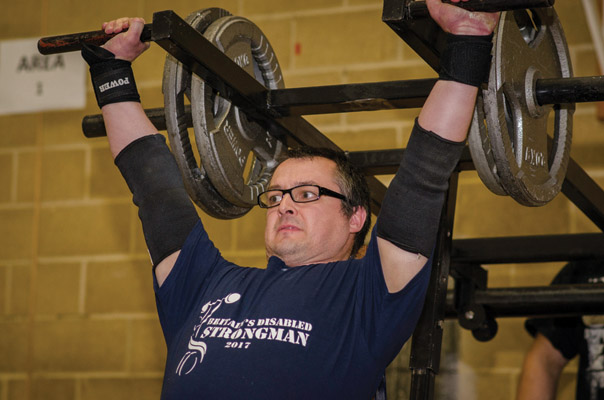
It’s been a labour of love for Somerset’s Gary Clarke, who next month brings the British Disabled Strongman competition to Chard.

Since 2015, it’s been his dream to stage the contest in his hometown after he founded the national event, which was held in Stoke-on-Trent. Similar events had taken place previously in Iceland and USA but never before in the UK.

Gary is Britain’s first disabled strongman and competes against athletes from all over the country.

“I’ve been a Strongman fan since the day I could stand up,” he says. “I’m not sure what appeals so much about Strongman competitions, but I’ve always loved them. I’ve been a fan of Strongman since the days of Geoff Capes and Jón Páll Sigmarsson. I can still hear cries of ‘I am a Viking’ to this day. I remember saying to my grandmother at the time: ‘One day I’ll be doing this.’.”

Gary is a remarkable young man. It’s very humbling to talk to him. He’s already achieved far more than many able-bodied people of a similar age. I last saw him when he was a small child and I took my daughter, exactly a week younger, to his house to play. His mum had been in the next bed to me in the maternity ward.

“I was born three months early,” Gary says. “That’s why I’m blessed with cerebral palsy. But I don’t know any different. In a way, I’m grateful because it’s made me the person I am. I’m 40 now and still have lots more to do.”

When I speak to him, he’s up to his ears and eyes trying to organise the event, which takes place in Chard Guildhall on Saturday 12 May.

The competition is now in its fourth year. In 2017, some 25 athletes took part, including some of the top names in the Strongman sport because it’s the qualifier for the World’s Strongest Disabled Man competition in Norway in September.

The judges at Chard will be four-time World Strongman Magnus Ver Magnusson and Arnar Mar Jonsson—the founder of the Disabled World Strongman competition.

These are big names for Chard. And it’s hugely prestigious that the event is being held in the town. That’s largely down to Gary’s hard work and persistence.

“I’m most grateful for the people of Chard and local businesses for getting behind this unique event. It’s good to be doing something great for the town,” he says. “I am immensely proud to bring it to my home town. I want it to be the best Britain Disabled Strongman event we have had.”

Gary has strong connections to both Chard and Ilminster, including training with Simon Lunn at Phoenix Fitness. He is hoping people from the town will come out to support the event.

As a nod to the county, the event will have a Somerset theme and there will be lots for spectators to see.

“We’ve got five events,” Gary says. “There’s a hay bale pull, an axle press, a seated dead lift, a forward hold and—the housewives’ favourite—the atlas stones.”

Continuing the Somerset theme, the forward hold will involve competitors lifting a large cheese wheel.

Gary’s passion for Strongman competitions goes back to the 1980s. A fan of Geoff Capes and Jon Pall Sigmarmarsson, he then began training with weights when he was seventeen and later became involved in disabled powerlifting.

“I don’t think of myself as being limited, I think of my strengths,” he says. “Strongman epitomises that, really—it’s about going outside your comfort zone and thinking outside the box—especially with the things you do in training.”

Gary is passionate about promoting disability awareness.

“My whole life’s been about banishing negative stereotypes. Strongman is one of the best ways I can think of for putting disability in a positive light. There is definitely an aspect of challenging attitudes to disability. We are doing these competitions to a high standard; there is nothing light about them. It’s about pushing the boundaries of what can be achieved.”


Britain’s Disabled Strongman competition is at Chard Guildhall on Saturday 12 May from 10am.  Admission for spectators is £5.

Prepare to Leave

A reading of Andrew Rutherford’s latest play, Prepare to Leave, will be presented at Bridport Arts Centre on April 21st. He talked to Fergus Byrne about the play’s inspiration and the questions it poses.


Anyone who saw Gary Oldman’s portrayal of Winston Churchill in the film, Darkest Hour, might agree that his performance was worthy of an Oscar, as indeed was the work of his make-up artist, Kazuhiro Tsuji. In the film, we are told that Churchill’s staunch belief that Britain could never survive a truce with Germany, drove him to travel on the London underground in order to hear the public’s view. It was a scene that those in favour of the United Kingdom leaving the European Union might have applauded. The unwavering belief that the UK was capable of fighting and winning a war against what appeared to be an unbeatable adversary, was portrayed in the film as the turning point for Churchill. British pride in the result, and the country’s belief that it was an independent power to be reckoned with, was thus built on a solid foundation.

Then, in January 1973, a Union Jack was raised at the EEC’s Brussels headquarters to mark the UK’s membership of the European Economic Community. It was to be the beginning of a new and hopeful, though at times complicated and often fractious relationship with Europe—a relationship that will officially end on March 29th next year. The vote in 2016, for what was dubbed Brexit, was seen by many as an opportunity to return the UK to a position of independent power—whilst for many others, it is believed to be a step backwards from a union that has brought peace and stability to Europe for decades.

It has undoubtedly been the most divisive issue that European countries have faced since the Second World War, but for UK citizens, torn apart by the whole process, the future of their children and grandchildren’s lives has been decided, and amongst the wave of questions, the one that never recedes is what motivated the country to vote to leave.

According to NatCen, Britain’s largest independent social research agency, ‘Identity Politics’ played a substantial role in the Leave vote. ‘The Leave victory was not about objective demographics alone’ said the report. It suggested that matters of identity were equally, if not more strongly, associated with the vote to leave, particularly feelings of national identity and a sense of change over time. In a recent speech, Sir Vince Cable also claimed that ‘nostalgia for a world where passports were blue, faces were white and the map was coloured imperial pink’ had a significant effect on the exit vote.

This is a theme that is explored in a new play, Prepare to Leave, written by Bridport’s Andrew Rutherford. It is being read at Bridport Arts Centre in April.

The play revolves around the effects of a no-deal decision by the UK Government to crash out of the European Union. It explores the dramatic impact of rapidly developing events before and after Brexit Day on the personal and professional lives of UK and EU nationals, in this case, members of a University history department and their partners. A fund-raiser for Bridport Arts Centre, the reading, which is to be followed by a panel discussion, promises to raise questions and perhaps temperatures as some of the darker sides of human nature are probed and laid bare for the audience.

Andrew wrote the play last summer and admits that at the time, hopeful that Britain might elect for a ‘soft Brexit’ he wasn’t sure whether it would be relevant. However, he now questions whether the UK and Europe can conclude a deal that allows for the free movement of people. ‘It’s looking more and more likely there’ll be no deal’ he said. ‘I’m convinced there’s a small group, fifty or sixty Tory MPs that actually want to crash out. They’re not interested in any sort of deal. It’s not about the economy for them. It’s a sort of romantic, mystical view of control. They want to go back to King Arthur and all of that.’

However, the questions raised by Brexit have led to much soul-searching, at least amongst those that might indulge in such activity. ‘Although it’s about Brexit’ said Andrew, ‘it’s also about a clash of values and ideas about what a University should be. What a country should be.’

The story highlights a divide within a small University history department between the Brexiteer group—who see academic opportunities when all their European colleagues are forced to leave and therefore better jobs for English academics as a result—and those that have fewer material ambitions.

Andrew explained that, in a sense, the play homes in on just one aspect of Brexit. ‘It’s focused on employment status and immigration issues. It touches on the broader issue of these immigration targets that Theresa May basically invented when she was home secretary—this extraordinary target of trying to bring immigration and emigration level when they are hundreds of thousands apart at the moment.’

A main character, Johannes Fleet, played by local furniture designer, Petter Southall, is a Dutch professor who finds himself top of the list of people to be repatriated after Brexit. ‘There are slight shades of what happened in Germany in the 1930s’ said Andrew, ‘where they started to weed out people that were not of the Aryan race.’ The story revolves around the clash between what Fleet stands for and what some of the University bureaucrats believe in. However, there are darker forces at play. ‘We don’t meet him, but the Vice-Chancellor is a sort of intelligent version of Nigel Farage’ explained Andrew. ‘He sees Universities as something that should become instruments of the state. Some of that is taken from authoritarian situations that go back to the 1930s and so on. So, members of staff who see their future saddled to this particular way of thinking—this nationalistic way of thinking about University education—they are more than happy to start rounding up the EU people.’

To further enforce the feeling of state intervention, one of the characters in the play, Paul Mashiter, is seconded by the Home Office from the immigration unit to work inside the university as their resettlement advisor. Supported by Giles Latimer, an English academic played by Bournemouth University lecturer, Chris Huxley, their agenda is not in any doubt.

After spending ten years in the Home Office, Andrew Rutherford’s career in both Britain and America became mostly concerned with problems of criminal justice. His research focused on alternatives to penal institutions, constraints on criminal policy and what he refers to as an ‘over-riding capacity to disregard’. This became central to his work and to working with groups like the Howard League for Penal Reform. Prepare to Leave is his fourth play, all on themes inspired by his career. Counting the Birches is set in a Siberian prison. Blind Spot deals with how the authorities dealt with the death of Dr David Kelly and The Country Team is set within the United States Mission to a South American country ruled by a military dictatorship in the 1970s. His academic background means he is familiar with the setup of a small department in a University, so some of the characters in Prepare to Leave are loosely based on people that he knew.

Andrew hopes that the play will leave the audience asking questions. ‘Given the real uncertainties now as to what might happen in a year or two’ he explained, ‘people, however, they voted, will feel “this really could affect me, I need to know more about this.”’ For him, it’s a matter of encouraging discussion. ‘I hope it also helps to place in context what’s happening vis-a-vis EU citizens for the wider issues of immigration policy.’ He would like to see people think about immigration ‘in a sort of humanistic way rather than being persuaded by the tabloids that it’s a bad thing to have foreigners taking our jobs and all that.’

Prepare to Leave will certainly add to the debate and will no doubt ensure more people engage with what will happen a little less than a year from now. But judging by the debate on the BBCs The Big Questions recently, we are no closer to knowing what Brexit will mean—neither are we any closer to a consensus amongst those that will live with it.


Prepare to Leave is presented at Bridport Arts Centre on Saturday, April 21st at 7.30pm. Tickets can be booked online at www.bridport-arts.com/event/prepare-to-leave or telephone the Box Office on 01308 424204.