
Thursday, March 19, 2026
Home Blog Page 36

West Bay Discovery Centre

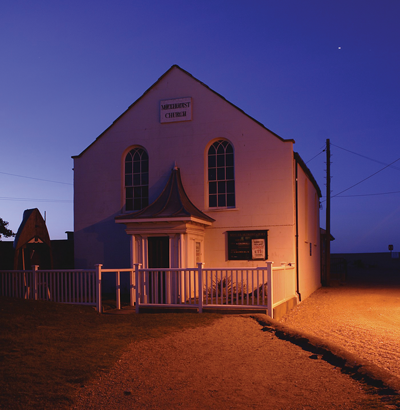
Once a refuge built to convert people away from the evils of drink, The Chapel on the Beach in West Bay is about to take the next step in its proud history.  This summer it will open again to the public and present a treasure trove of West Bay stories and information. Trevor Ware details some of the history of the building.

Of all of the old buildings that survive in West Bay today, the Wesleyan Church, better known as the Chapel on the Beach, is probably the most remarkable. Set to the side of the Bridport Arms Hotel, close to the old Watch House and Belle Vue Coast Guard Station, it is an intriguing part of the conservation area on the eastern side of the harbour. Barely 200 metres from the shoreline and built without substantial foundations directly onto the shingle by the owner of the West Bay Shipyard, Elias Cox, it has withstood the full force of nature for nearly 170 years.

During the middle of the 19th Century, West Bay harbour was a seriously busy place. A large shipyard employed up to 300 men and built quantities of vessels for the Royal Navy, private owners and the Customs and Revenue service. In a period of 100 years from 1769 some 350 ships were constructed and many local fishing vessels crossed over the Atlantic to Newfoundland to fish for cod on the Grand Banks. Fishermen, shipyard workers and sailors alike were more than a little predisposed to enjoy their leisure hours in the drinking houses around the harbour. Drunkenness was common and Cox, a staunch Methodist, decided to build a little Chapel with his own money; the cost was £400, approximately £100,000 in today’s money. He and his fellow Methodists plan was of course, to convert men and women away from the evils of drink. Clearly constructed without any practical building experience, the floor and joists contain many offcuts taken from the shipyard presumably to save money. The shape of the roof inside the Church resembles a barrel and the curved structure is like a ship’s hull. It has a remarkable acoustic, probably deliberately so, as Methodists rejoice in singing hymns, and, extraordinarily, it feels as dry as a bone.

One hundred years later, after government requisition and damage caused by the Army during World War 2, there was a gradual decline in Church attendance. In 2006 the last service was held. The building was handed over to the West Dorset District Council that same year in a poor but not critical state. The Council valiantly tried to find a new use for the Church but without success. Finally they agreed to transfer the property to the Bridport Area Development Trust in 2011 with a grant of £30,000, to enable them to evaluate and develop a set of options for future use. A devoted team including Crystal Johnson, Sylvia Stafford and Charles Wild took up the challenge, assessing a range of different ideas, consulting widely with local residents and visitors to West Bay, and, with very little money at their disposal, keeping the little Church safe from the elements.

Coincidentally as this process continued, the success of Broadchurch on TV became bigger and bigger. Many more visitors came into West Bay in search of specific locations. Their interest reached beyond the mere identification of the crime scenes and victim’s homes, and questions were asked about buildings around the harbour, East Cliff and the Jurassic coast. It became obvious that West Bay had a history people wished to learn about but there was nowhere to tell them the stories.

The Trust decided to develop an imaginative scheme which was to use the little Church as a base for Discovery. This was summed up by one simple statement—‘A treasure trove of West Bay stories and information, as well as a base for exploration and adventure’. The church would neither be a standard visitor centre, nor a kind of mini-museum, but a repository of information on its people, their occupations past and present. It would reflect the many interests of its visitors including the Jurassic Coast, birdwatching, camping, fishing, walking and offer ideas activities and trails.

As the plans developed, more and more content became available. Many unusual stories and facts emerged from all sides, so that a grant application of convincing substance was made to the Coastal Community Fund in 2016. This government fund was created to encourage employment and economic growth in coastal communities. Strongly supported by the Bridport Town Council, Jurassic Coast Trust and the local Coastal Community Partnership, the cost of the converting and equipping the Centre was estimated at £250,000. In mid-2017 the Trust was notified by CCF that the entire sum had been awarded. After six long years the future was secure.

After the usual applications for listed building consent, submission of plans and building regulation approval, work on the refurbishment began in late 2017. Under the expert guidance of the Bridport town surveyor, Daryl Chambers, a large amount of remedial work has been completed, although, from the outside nothing seems to have altered. The most exciting stage is just now beginning with detailed planning of the content and its presentation. So much has come to light that the difficulty has been how to decide and prioritise the wealth of history and other material we already have. This is a very nice problem indeed.

When the Discovery Centre opens this summer, it will be fully equipped and have a separate working space for a Manager, who we will be recruiting shortly, and our volunteers. Entry will be free, like all main museums, but we plan to have a small retail shop and to ask visitors for donations to contribute to our running costs. Our volunteers will be vital in helping with these aspects and ensuring that essential parts of the operation work smoothly. We expect visitors to be full of questions and volunteers will be trained and briefed on the display content and means by which ‘discoveries’ can be made. On those few occasions in the past when we have opened the Church doors, people soon arrived wanting to know more. There were just as many wanting to tell all.

As I said at the beginning this is no ordinary building. It appeals to peoples’ memories of childhood holidays, previous visits to Dorset and West Bay, and a general sense of easier times gone past. We would love to meet people who wish to share this extraordinary building and its treasure trove of information with others by becoming a volunteer even if only for a few hours a week. Please contact John West at info@westbaydiscoverycentre.org.uk

Together we Learn

Hooke Court in Malawi is a small charity making a big difference. It aims to provide opportunities for teachers in the UK and Malawi, Africa, to exchange ideas and learn from each other. It operates from Hooke, near Beaminster. Margery Hookings has been there to find out more.


When I arrive at Hooke Court, children are out playing in glorious surroundings. The sun is shining and the mellow stone of the 14th-century manor house looks even more beautiful than usual.

Hooke Court is an activity centre offering tailor-made educational activity experiences and residential school trips for all ages. It’s also home to a pre-school. It’s an inspiring setting in which to learn about the world around us.

Tucked in a corner of the coach park is a large shipping container. It’s being stuffed with items. Bikes, boxes of books, clothes and toys, it’s all here. It’s destined for Malawi. The container is on its way to provide schools with the raw materials for education. Without the Hooke Court in Malawi charitable trust, many of these schools wouldn’t have exercise books or even intact pencils.

We live in a world full of haves and have-nots and the work of small charities such as Hooke Court in Malawi is essential to help redress the balance, particularly when some bigger, ‘household name’ charities are reported to be falling foul of their duties on the ground, with money swallowed up in admin and expenses and some head offices unaware of what’s happening at the coalface.

A few months ago, I wrote about Prodigal Bikes, a charity in Merriott, near Crewkerne. Set up in 2016, the charity supplies—free of charge—refurbished mountain bikes, spares and tools to poor people in rural Africa. In south Somerset, it works with local, disengaged people who refurbish the bikes before they’re sent to Africa.

As a result of that article in the Marshwood Vale Magazine, the people at Hooke Court in Malawi contacted Prodigal Bikes founder Anthony Raybould to ask if they could have ten bikes to put in their container.

“Some teachers live some way from the schools. The bikes will be loaned to them so they can get into school,” says Mandy Cooper, one of the charity trustees, who set up the field study centre in Hooke with husband Peter almost 25 years ago.

The charity has also recently been supported by LabAid with science equipment, Accor Hotels with laptops and KitAid with sets of England youth football kits. There’s a 100 Club in Hooke village and a number of local schools which support the charity, which has eight trustees, most of whom are highly qualified teachers and head teachers. School in a Bag, another local Somerset-based charity, has also supplied more than 300 school bags filled with basic school equipment which have been distributed to children in all the nine schools.

Hooke Court in Malawi aims to improve standards in education in nine schools in the Bandawe area of Malawi by recruiting volunteers from the UK to share their expertise with the teachers and children from Malawi; providing 100 individual black boards and chalk to each school; working with local education advisors, head teachers and teachers to develop teaching skills and provide training; repairing and decorating classrooms with educational displays to enhance the learning experience of all involved; providing classroom teaching resources including pens, exercise books, text books, reading books and chalk and providing fun programmes for the children that allow them to think creatively and provide solutions to problems.

Back in 2011, money was raised to be spent on essential needs for schools and orphanages that the Cooper family visited on their travels.

“We ended up in a remote village called McAlpine,” Mandy recalls. “The headmaster of the local primary school was at the front of the class with a pencil, breaking it into three pieces to make it go further.”

“Mandy kept going out and then the word spread,” says trustee Fiona Boggis. “A lot of schools come here for residential visits and we offered to take some of the teachers to the schools in Malawi to share their skills and bring back what they learned.”

Since 2014, groups of volunteers have visited the schools to help implement phonics, provide team building activities for the children and carry out minor repairs and maintenance in the classrooms.

As a result of these summer programmes, it was decided in 2015 to set up Hooke Court in Malawi as a charity.

Malawi is one the poorest countries in the world, with only 40-50 percent of children completing primary education and 11 percent completing secondary education. The government made primary school education free for all children a few years ago but did NOT provide the schools with any funding, resources or infrastructure.

With class sizes of 100 to 150 and minimal resources—for example, a blackboard but no chalk—it was clear that the work of Hooke Court in Malawi was very much needed.

“The children had just the basics. Talk and chalk—but often not even the chalk,” Mandy says.

Fiona says: “Our motto is ‘together we learn’. It is very much a two-way process.”

“And we are constantly monitoring,” Mandy says. “Every bit of money we raise goes directly on things there—we don’t hand out money unless it’s for specific things. Volunteers who go out to the schools pay for their own costs.”

Mandy’s son-in-law, Chris McConnell, who is married to her daughter, Sarah, who is the charity’s chairman, went out to visit the schools in January to check on progress and see how things were being used. “We have a close relationship with the teachers in schools and give them the chance to use a range of different teaching methods” he said. “It’s a system children have not grown up with. At first, children don’t know how to even open a book or how to look after it.”


Spring Time

It has been suggested that my recent articles have been full of doom, with invasions and so on. Recently I saw a sundial dated 1767 with the inscription “Let others tell of Storms and Showers—only count Your Sunny Hours”. An inspiration!

Trying to turn over a new leaf, I shall pull on my dancing boots, bells and hat with floral arrangements. I only hope I shall not be hit by those sticks during the dance.

John Symonds Udal in Dorsetshire Folk-Lore, published in 1922 after a long gestation and partial publication, writes that “It was anciently the custom for all ranks of people to go out a-Maying early on the first of May; but I do not think that there exist now in Dorsetshire many traces of the old merry dances and games, such as the Maypole dance, the Morris dancers, the milkmaids, the chimney-sweeps, the maidens’ garland or flower dances and processions, which used to be so prevalent in many parts of England on May Day”.

During the Long Parliament in April 1644 the Puritans under Oliver Cromwell insisted that all maypoles were to be taken down and removed by constables, churchwardens, and other parish officers. There was considerable resistance to this, but the law prevailed until King Charles II came to the throne and maypoles were set up again. Cerne Abbas apparently made a new one each year from a “fir-bole” and raised it up in a night. It was erected in the ring just above the Giant. It was decorated and the villagers went up the hill and danced around the pole on the 1st of May. In some areas the performance took place at Whitsuntime. The origin of the maypole is uncertain, but it is suggested that it started in Germany as a pagan ritual, or may even date back to the Druids. It was certainly recorded in the early 1500s.

We also see Morris Dancers from the spring time, dancing in a circle in open public spaces in their traditional dress of knee breeches, white socks with bells just below the knees, a coloured waistcoat, braces (Baldrics) crossed over the chest and two handkerchiefs tucked into the belt front, all topped by a straw or felt hat, often decorated with flowers. There are usually 3 men per side, 6 in all, but sometimes 8 or 10 maximum. We usually see men dancing the Morris, but there are some female groups too. Music is generally from a concertina or melodian, a fiddle and a small pipe and tabor. The name has been said to be a corruption of Moorish or a French word for a dance, but it was first recorded in Cornwall in 1466. Some have suggested it originates in fertility rites. Morris Dancing was also referred to in Tudor and Elizabethan times. In the 16th century it was called the “Devil Dance” whilst the dancers processed to church. The Puritans banned dancing, but the Morris became popular again under Charles II, especially in villages, when men might walk 20 miles to dance for money, supplementing their wages. It was said that the higher the dancer jumps, the higher the corn will grow. And many dance names include “hay”, so very close to the soil. Shakespeare writes of “capers” as leaping steps and some Morris steps are called “capers”, others called “galleys” and “hook leg”. Some old Morris tunes were collected by Cecil Sharp in the early 1900s and may  have increased their popularity in modern times. The Wessex dances are similar to those of the Cotswolds, but Morris dancing is widespread throughout the country. I have been lucky to see a performance in the north Midlands and it is popular throughout the north of England.

Something which we see less often than the previous items is the old practise of “Beating the Bounds”. Udal says the general custom in olden days was for persons to go round, or perambulate the boundaries or limits of their own particular parish in Rogation Week or to be more precise, on one of the three days before Holy Thursday or Ascension Day. He quotes Brand that “the minister, accompanied by his churchwardens and parishioners…beg a blessing on the fruits of the earth, and preserve the rights and properties of the parish”. He also quotes William Barnes “In order that they may not forget the lines and marks of separation they ‘take pains’ at every turning. For instance, if the boundary be a stream, one of the boys is tossed into it ; if a hedge, a sapling is cut out of it and used in afflicting that part of their bodies upon which they rest in the posture between standing and lying….if the boundary be a sunny bank, they sit down upon it and get a treat of beer and bread and cheese. When these boys grow up to be men, if asked if a particular stream were the boundary of the manor, he would say… ‘Ees, that ‘tis, by the same token that I were tossed into’t.’  If he should be asked whether the aforesaid pleasant bank were a boundary: ‘O, ees it be’, he would say, ‘that’s where we squat down and tucked in a skinvull of vittles and drink’. After that he would declare ‘I won’t be sartin; I got zo muddled up top o’ the banks, that I don’ know where we ambulated arter that’ “.

In 1898 Thomas Wainright transcribed some early Bridport Records and one related to fines levied at a Court held on 30th September in the 36th year of the reign of Queen Elizabeth I, AD 1594, which Wainwright believed resulted from Beating the Bounds “Mr Henry Wade hath forfeited his payne of 30s for not plucking down a wall and setting up a gate in the way of the perambulation upon the muridg near Pink Mead”. So in those days it had a worthwhile effect.

Udal  records an unfortunate occasion in 1891 during Beating of the Bounds in Bridport. A large millpond marked a boundary and needed to be crossed. The Mayor, Borough Surveyor and another man embarked on a large raft to be towed across. Soon after starting off the raft started to sink and the occupants were thrown into the water. The Mayor and the third man managed to swim ashore, but the Surveyor regained the raft to be towed to land, completely drenched. It is not recorded if they went on to complete the event.

The town of Bridport for many years kept up an old flower custom on the first Sunday in May. Udal states that school children assembled at schools in Gundry Lane and marched to the parish church, carrying flowers. Divine service followed and the church bells were rung. In 1788 the children had also processed around the parish boundaries.

Now we have looked at four aspects of early May over several centuries. Think of them this May.

Bridport History Society meets on Tuesday 8th May at 2.30 pm in the United Church Main Hall to learn about the “Magnificent Obsession : Victoria and Albert” from Helen Rappaport. All welcome, visitors entry £3.

Cecil Amor, Hon. President Bridport History Society.

Nurdle Hunting in Charmouth

You may have never knowingly encountered a nurdle but these small plastic pellets are the raw material of the plastics industry and are ferried around the world in their millions. About the size of a small pea, nurdles come in many colours and they’re finding their way on to our beaches, killing wildlife and polluting the environment. I wanted to find out more about these unwelcome intruders, so I joined a nurdle hunt organised by the Charmouth Heritage Coast Centre.


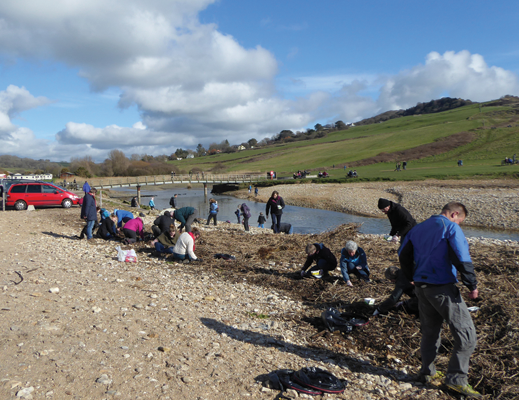
Charmouth beach was surprisingly busy that morning but it was half term and, for mid-February, quite warm in the low sunshine.  Many people were walking by the sea, taking advantage of the mild weather, perhaps hoping to find a fossil, but an expectant crowd had also gathered by the steps to the Heritage Coast Centre. At precisely midday, Sophie Thomas, one of the Centre wardens, walked down the steps together with local volunteer Eden Thomson and gathered us together. Sophie began by explaining what nurdles were and how they washed up on the beach from the sea. She emphasised the dangers these plastic pellets pose to wildlife such as birds and fish who mistake them for food. Each of us was given a pair of disposable gloves, to guard against toxic chemicals contained in the nurdles, and an empty margarine pot for nurdle collecting. Then off we went, about thirty of us, to hunt among debris washed up on the west bank of the river Char between the two beach car parks.

And what a fine sight we were! Young and old, locals and visitors, families and children, sitting or lying on the ground, enthusiastically scouring the debris for the plastic pellets. It was a fascinating event, although we did get some funny looks.  Everyone found pellets in large numbers, not just on the surface but also buried a few centimetres down showing how pervasive they are. Some were smooth, grey and cylindrical and a few were lentil shaped, white, yellow or green. The vast majority, however, were bright blue cylindrical pellets, about 5mm in size, with fine ridges.The grand total for the group was 6650 pellets collected in 90 minutes from this small section of beach, highlighting the extent of the contamination.

What do we know about nurdles and how they get into the sea to wash up on our beaches? These small plastic pellets are made from oil or natural gas to provide an easily transportable raw material for use in plastics factories all around the world. Most of the plastic products that now dominate our lives are made from nurdles and huge numbers of the pellets are transported by ship, so there is always the potential for spills. In October 2017, two containers of nurdles fell from a ship in the port of Durban leading to massive nurdle pollution along more than 1000km of beaches. Closer to home, the storm-damaged container ship, Napoli was beached off Branscombe early in 2007 leading to hundreds of containers breaking free. Two containers were filled with nurdles which washed up along many local beaches.These environmental disasters have been likened to oil spills, only worse as the nurdles do not break down.

Nurdles can also end up in the sea through careless handling at plastics factories. The environmental charity, Surfers Against Sewage, visited several plastics companies in Cornwall and found nurdles littered around the sites.  These will inevitably be blown or washed into drains and into the sea.  Another kind of plastic pellet, wrinkly or ridged, has been found in large numbers on beaches in Cornwall by Rame Peninsula Beach Care. These are biobeads, easily confused with nurdles but with a completely different purpose. Some sewage works use biobeads as part of the wastewater treatment process and the pellets get into the sea through careless handling by water companies.

Why should we be concerned about nurdles and biobeads? They are a totally unnecessary form of pollution in our seas and on our beaches and their presence shows a lack of respect for the environment. They are now found all over the world wherever the sea meets the land: on beaches in industrialised countries or on isolated, sparsely populated islands. Not only do they pollute our beaches, they are eaten by seabirds and fish who mistake them for food. Once consumed, they block the digestive tract, lodge in the windpipe or fill the stomach leading to malnutrition and starvation. For example, analysis of dead puffins on the Isle of May in Scotland, home to one of the UK’s largest breeding populations of these birds, showed they had consumed nurdles alongside their usual diet of sand eels.

Nurdles are also a source of toxic chemicals that may exacerbate their physical effects.  Freshly spilt nurdles may release chemicals such as plasticisers used in their manufacture.  Nurdles that have been in the sea longer attract toxic chemicals such as PCBs and DDTs. These substances may have a toxic effect on seabirds and fish that consume them and have unknown effects on humans who encounter them on beaches.

What can we do about the nurdle problem? Industry needs to improve handling procedures and make sure nurdle spills are cleared completely. Operation Clean Sweep is a plastics industry programme aimed at eliminating pellet losses but, as yet, it is only voluntary. In the longer term, we need to reduce our dependence on plastics, especially single use plastics.

Nurdle hunting can also help by raising awareness and by reducing pellet numbers in the environment. As Sophie Thomas said to me “A nurdle collected is a nurdle out of the sea”. Occasionally, it may be possible to infer the source of pellets based on their appearance and properties. For example, the pellets found at Charmouth are unusual compared to those I have seen on other beaches. Although some at Charmouth are true nurdles, the majority are the bright blue cylindrical type with fine ridges, more typical of a biobead. If these are indeed biobeads, how are they getting on to Charmouth beach?


People in Food Mark Evans

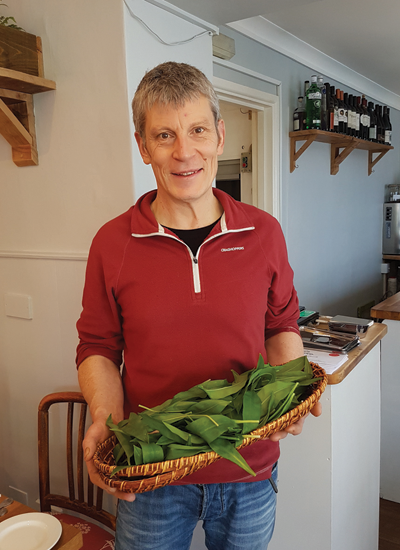
There is a buzz of activity in the kitchen at Tierra restaurant in Lyme Regis. It is the morning of a new seasonal menu change and Mark Evans, owner of the vegetarian restaurant, along with his sous chef, Channing are busy chopping, blending, mixing and macerating vegetables of every kind, working hard to bring out the best in their produce.

Entering its fifth year in Lyme Regis, Tierra is firmly established on Lyme Regis’s restaurant scene. Chef Mark is brilliant at creating dishes full of flavour, driven by the seasons and subsequent produce available. In a way, he says, the menus write themselves. For instance, only the day before he was out walking his elderly Jack Russell, Geaves, and couldn’t resist stopping to collect the first of the wild garlic to make into arancini. Also being crafted are nettle and feta mini filos, while cauliflowers are marinated in the corner, generating mouth-watering aromas.

Mark moved to the area partly because of the freshness of the ingredients and closeness to the sea, but also because he wanted his children to grow up here. Previously in Bristol, his vegetarian restaurant, Café Maitreya, won award after award. However it was time for a change and Lyme Regis attracted Mark as the right spot for his new restaurant. Now, close to hand, samphire and seaweed often feature in his dishes.

Mark has written a couple of cookery books to date, and is about to publish his third; Naked Tierra, bursting with vegan and gluten-free dishes.

Working 60 hour weeks he doesn’t get so much time to himself. What time he does get he spends with his two children, as well as looking after the U11 Lyme Regis football team, which his son plays for. At night, Mark might be found relaxing at home, dreaming up new recipes, with some reggae music bouncing around the walls.

John Hubbard: Remaking Landscapes

At an uplifting event at Roche Court outside Salisbury, to remember and celebrate the life of the artist, John Hubbard, the British Art Historian, Neil MacGregor highlighted John’s combination of ‘voracious, sensational curiosity’, his ‘endless intellectual energy’ and his ‘unshakeable calm.’ It was a fitting description of a man whose engaging character and artistic legacy has left an indelible mark on the history of contemporary art.

John Hubbard not only touched many lives with his expansive paintings and drawings, but his warmth and generosity both inspired and heartened so much of the lives of those who were fortunate enough to have known him. Most recently he was patron of the Marshwood Arts Awards, but in the past, as Neil MacGregor also pointed out, John had given generously of his time to South West Arts, Tate St Ives and many other public institutions, as well as donating work to the British Museum and numerous collections all over the world.

Born in Connecticut in 1931, John was educated at Harvard University before completing his military service based in Japan. After studying at Art Students League, New York City and with Hans Hoffman, he then travelled throughout Europe in a Deux Chevaux, eventually ending up in London where he met his wife Caryl whilst looking for galleries in which to show his work. He and Caryl settled near Bridport and from there John’s career found him painting in locations as diverse as Malaysia and Morocco, Indiana and the Scilly Isles. He won the Jerwood Prize in 1996 and has work in collections from Cornwall to Melbourne, Australia.

In an interview in this magazine in 2004, John told Katherine Locke that art is like telling a story. ‘It has lots of changes of plot and pace’ he said. ‘The work evolves before you—there are good bits and not so good—some happy parts and some sadness.  There is backtracking and interweaving—just like a good novel.’ He also knew that the novel of an artist’s life must come from somewhere very close. In a short film made for an exhibition of his work in Washington DC in 2013 he said: ‘You have to base your work on what you love and what excites you, what draws you out, what inspires you, and what continues to grow inside you.’

Thanks to the work of John’s wife Caryl and his children Kate and Edmund, we now have an opportunity to enjoy a close-up view of how John Hubbard’s work evolved, how the novel of his painting life grew. A new book, first begun by John in the year before he died and lovingly finished by his family, has been published by Unicorn Press.

John Hubbard – Remaking Landscapes offers a fascinating insight into how the artist developed his work and presents a selected timeline of his paintings and drawings from 1958 to 2010. From the majestic mountains and luminous light of mainland Greece, to the splendour of late sun striking a wave in Cornwall, John’s intense engagement with a contained stretch of landscape often led to him being described as a landscape painter. But those that know his work also know of another level to the world around him that John Hubbard strove to portray—a world that, like Narnia from a wardrobe, could only be found within his vision and then his canvas.

There is a quote from Walt Whitman that John liked to read which says much about what he as a gregarious and warm person and as an artist driven to see beyond what was in front of him, sought to find in his life: “Maybe the things I perceive—the animals, plants, men, hills shining and flowing waters, the skies at night, colours, densities, forms—maybe these are only apparitions, and the real something has yet to be known.”

Although Whitman was in no doubt that what surrounds us are just apparitions, John Hubbard never stopped looking for ways to portray his own perception of the world around him. It was something much more than an ethereal vision.

In a long and productive life, he met and got to know a wide circle of other artists and creative people and the book includes notes from his diaries that make fascinating reading. The last word on Remaking Landscapes quite rightly belongs to him. Pointing out that a good deal had been written about his work in reviews, prefaces to exhibition catalogues and journalism he said: ‘I regard this book as an opportunity to interpret various events in my life in my own way; its purpose being to build a sense of intimacy which also has a flexible, entertaining structure. If it provides a brief facsimile profile of my painting and drawing, it will stand as a retrospective exhibition in itself.’


John Hubbard – Remaking Landscapes

is published by Unicorn Press

on April 26th 2018.


The book includes a forward

by Hilary Spurling and an article

The Garden at Chilcombe by Sarah Raven


ISBN: 978-1-910787-83-0. RRP £30.

Helen Carless

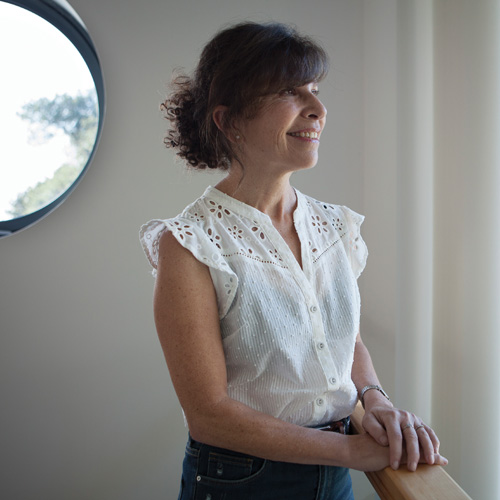
‘My mother and father met in Cyprus, where my father was doing his National Service. He was Welsh, and she Cypriot, sadly both dead now. They were both quite young, perhaps a bit naïve, but terribly romantic, and they returned to the UK so that he could take up a place at Cambridge. His ambition was to join the UN; a PhD was needed for that, so he chose to read Arabic Studies and spent some time in Cairo, from which arose a love affair with Arab people, their culture and language, which lasted the rest of his life. Rather than join the UN, he joined the Foreign Office and became a diplomat, and an Arab specialist.

Geographically Cyprus sits in the Eastern Mediterranean, quite close to Lebanon and Syria, and at the time segregated into Greek and Turkish zones. So the Middle Eastern ambiance of Cyprus, and meeting my mother, probably also had a lot to do with that Arabian love affair. My father’s career took us as a family all over Europe and Arabia. My sister and brother (both younger than me) and I all went to boarding school from about the age of 10, the alternative in those days being home tutoring or a local school, so boarding school it was. My father’s postings were in Saudi Arabia, Bahrain, and the Lebanon, then later in Paris where many Lebanese live. I spent my formative years from the age of about 14 to 18 in Saudi, so of all the places we lived that remains for me the most evocative. The smells, the sights, the tastes, and the heat and humidity, all remain powerful memories. Most of the Arabian Peninsula at that time, the early 80’s, was quite a closed place. You either lived there, were a diplomat or were on business; you wouldn’t go there as a tourist.

Before we went to Saudi, we lived in Bulgaria, which at that time was very deep behind the Iron Curtain. Both Bulgaria and Saudi were fascinatingly similar in that they were closed countries, but obviously different in many other ways. Looking back, I was privileged to experience life in both countries at a time when life was so very different to ours in the West, but as a teenager I remember being resentful at being unable to buy the clothes and other essentials that my friends in the UK could. In both countries the average local person just got on with the only life they knew. This was pre internet and the majority didn’t know any different, but with a low crime rate, a strong cultural heritage and strong family ties many seemed to enjoy a relatively happy life. Living in a diplomatic community, interaction with the local people was limited, especially in Bulgaria, and frankly wasn’t encouraged. There was more socialising in Saudi, but in the 80s simply being a woman meant you couldn’t go out alone, making life pretty restricted. However I did meet many people from all sorts of backgrounds, which I just loved, and still do, because in a diplomatic community socialising isn’t just between the British and the host country, there would be representatives from all over the world.

I think I knew from quite an early age I wanted to go into advertising, and I honestly don’t know why. But I wrote to Saatchi’s and J Walter Thompson, the two big agencies of the day, and they said go to Oxbridge. That wasn’t an option for me, but I found a course at what was then called Thames Polytechnic in international marketing and advertising, after which I joined Saatchi’s on their graduate training scheme.

It was a mad, fun time to be in advertising in the 80’s; there was a lot of money in the business then. It was hard work, but with new ideas, thoughts and mediums making it an exciting time. Among my clients were Castlemaine XXXX—whatever happened to them?—and Blackpool Pleasure Beach. At the end of the graduate scheme at Saatchi’s I joined what was then a boutique agency called White Collins Rutherford and Scott, to help launch the Today newspaper, edited by Eddie Shah. At the time, journalism was run, pretty much from top to bottom, by men. There were those at the very top with large egos, like Murdoch and Maxwell, and Eddie Shah was a strong character too, but he was at all times very fair to me. His priority was whether you could do the job, regardless of whether you were a man or a woman, and even though I wasn’t that senior, he was always interested in what I had to say. His was the first newspaper to be written in central London, but linked to the printers elsewhere via computer, a process which famously necessitated overcoming union opposition.

In the world of advertising you had to move out to move up, so after 2 years with WCRS I went to work for Publicis, now part of one of the biggest networks in the world, on the large Renault account. They were specifically looking for a woman’s view on car advertising, as after all women do in fact buy cars. I got my first company car, the iconic Renault 5, in which I used to cruise around London, pre congestion charge and with an office parking space. Unthinkable now. If you were lucky enough to have a good job, and were young and carefree, then London in the late 1980’s was an exciting place to be. It’s so different for young people today, struggling with crippling rents and job insecurity.

By now I had met my husband Andrew, who had lived in Dorset, and we began to get to know the area. He was in the wine trade in London, and he and his friend Andrew Mangles and I saw an opportunity to set up a “Majestic” style business in Yeovil, supplying wine to wholesale and retail customers. Supermarkets were scarce enough in Dorset, and they certainly weren’t selling much wine, so the business flourished. With his accountancy background, Andrew eventually left the business and joined Symonds and Sampson, where he has been for nearly 25 years.  I was approached by Simon Lawrence, whose family had set up and owned Lawrence Fine art Auctioneers in Crewkerne, to use my experience in advertising to give an overview of the business. We developed the project, and in time, as we got on very well, he asked me to become his general manager, which I accepted. Eventually there was a point at which he offered me the opportunity to lead a buy-out of the business. I remember thinking to myself that in a situation like this, you say yes first, then work it all out afterwards. That was 1992, some 25 years ago; I was a 31year-old woman in a traditional industry in a conservative, rural area with a young son, Henry, so life was not always plain sailing. My daughter Izi was born the following year and we also moved house. A whirlwind 2 years. I am lucky enough to work with some fantastic people and many exceptional specialists who have made Lawrences the huge success it has become. I love the work I do, because rather than being simply about the objects we sell, it’s about people; the staff, the specialists, the sellers of the objects, and the people who become the new owners.

When we moved to Dorset, we first lived in Stoke Abbott, in the house that Andrew was brought up in. Andrew and I knew the owners of our current house in Broadwindsor, and were very fond of it so there was no choice but to try to buy it, even though I was 7 months pregnant at the time, and had just bought Lawrences so the timing wasn’t great. We’ve almost finished doing the things we said we would, nearly 25 years later. Henry and Izi are both in advertising in London, doing well, and we love life in Broadwindsor, a thriving village. We play tennis, and bridge, and walk sections of the South West Coast Path when time allows.  My year as President of the Melplash Show in 2014 introduced me to people, ideas and areas I had never known about before; farms, private gardens, allotments, crafts people, thatchers, volunteers, charities etc. We are so lucky to live in such a vibrant community, and I still pinch myself that I have ended up spending the last 30 years in this wonderful part of the world which I am constantly learning more about.’

People at Work Anthony Bucke

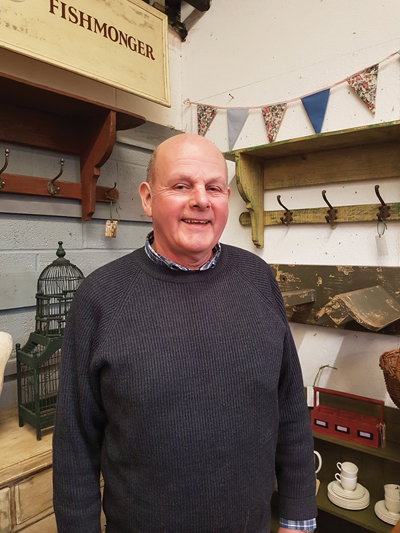
Much like the building that houses Antiques Bazaar, it’s owner Anthony Bucke, also has an interesting story. Prior to being an Aladdin’s cave to all manner of antiques and collectables, the large vaulted building used to be a textile mill. Webbing, fashion belts and saddle girths were made there, as well as the straps for the parachute on the Space Shuttle when it returned to earth.

Anthony was brought up on a smallholding on the top of Hardown Hill, perched above Morcombelake, by parents who made all manner of livings possible from their slice of paradise. Schooled in Chideock and then at Woodroffe, Anthony spent three years as a trainee site engineer, including working on the M5. At the same time, he bought a half share of a smallholding in South Perrott, with established antiques and vintage dealer Julie Wells. During weekends and evenings, he reared bullocks on the land. One day Julie approached Anthony with a proposition; there was a second-hand furniture shop for sale in Crewkerne, did he want to run it with her? And so his love affair with antiques started in 1976, fuelled by Julie’s knowledge, which she was happy to share. A few years on they bought a new site, and when the partnership eventually came to an end Anthony went on to acquire the one-acre site where he is now.

Bursting with independent traders, Anthony manages Antiques Bazaar and all that goes on within it. He’s there before it opens, restocking the on-site café each day. With an excellent team on site, he is then able to turn his attention to other business matters that claim his attention. Anthony produces The Antiques Tourist booklet, a quarterly town guide for Chard and also has a palette recycling business. The ability to find a margin is what drives Anthony and makes him so very good at what he does.

Vegetables in May

May is a critical month for establishing so many crops, and if time is in short supply, don’t rush it, as early plantings need more work than when all is warm.

It is five years since we have had such a cold spring, and the peas, beans, beetroot and lettuce planted out in late March were all looking unhappy, even under fleece, until we had a splash of warmth mid-month.

Slugs? The EU have recently re-invented ancient folklore and called it Integrated Pest Management (IPM). Although their main drive is to try and reduce the amount of pesticides washing into our rivers, the useful message is to look at the bigger picture of soil and plant health, which naturally reduced pest numbers in the first place.

Limiting slug damage is all about keeping plants strong in healthy soil as well as reducing their numbers by denying them weeds to eat over the winter, and nurturing an ecosystem where there are plenty of slug predators, such as the hedgehogs we have in our garden.

Timing is important, too. Unless you have exceptionally green fingers, it is much easier to establish your crops when it is warm. Courgettes are a good example. Our healthy little plants will be transplanted into rich soil in early May, and fleeced over for a month. It is safer to transplant later in the month, but fleecing keeps them warm early on.

Establishing your runner and French bean is the ultimate test of warmth, see below—transplant late or you will have ‘has beans’. In the Spring Gap we are still eating Borlotti French (haricot) beans we grew last year, an excellent dual variety. And what is a Kardashibean? It’s a family of bean-shaped women.


What to sow this month

Most things!

Sow outdoors: carrots, parsnip, beetroot, leeks etc.

Transplant from greenhouse sowings: sweetcorn, courgettes, celery, autumn cauliflower, calabrese, summer cabbage, basil, etc. Late in the month, or even in June, cucumbers, tomatoes, runner and French beans.

May in the Garden

“What a difference a month makes”!!!

Last time I was writing one of these articles, there was snow on the ground and my garden was a quagmire. Now the weather is convincingly summer-like and, about time too, most of the mud has dried. I hope that these extremes balance out, pretty soon, because it would be nice to have some sort of ‘normal’ spring, if only to get the garden back onto an even keel.

One practical consideration is that the large volume of water that has rained / snowed upon the soil, then percolated through, during early spring may have washed away all the nutrients which were thoughtfully added as part of your feeding / mulching operations.

Plants need nutrients to grow healthily and if you don’t supply them then they won’t fulfil their full growing and flowering potential. Also, strong growth is better able to fight off disease and pest attack which is vital in these more enlightened times when chemical control of such ‘nasties’ should only be relied upon as a last resort.

Many problems with established gardens can be put down to a failure to replace lost nutrients on a regular basis. As with many aspects of horticulture, it is the Science behind the Art which I feel is often left out of the ‘formula for the perfect garden’.

I understand that most folk just want to look out of their window, to gaze upon a beautiful ‘outside room’, without having to think back to their schooldays, battling with chemical formulae. For this reason, I’ll return to my mantra of simply ‘tickling in’ a few handfuls of general purpose fertiliser whenever you weed or mulch your borders.

Before continuing on my ‘nutrients’ theme, I shall briefly return to my other ‘hobby horse’ topic : soil compaction. I have banged on before about my theory that many established plants fail to thrive for the simple reason that they are growing in soil that never gets forked or dug over. Just like us, plants require oxygen and it’s not only the leafy, above ground, portions that need it.

The roots also need to have access to air and, especially after waterlogging, if the soil becomes compacted it means that all the gaps in the soil structure, which would otherwise supply air to the living roots, get ‘squashed’ out. It is your job to rectify this by means of forking it over, where space allows, or just inserting the fork tines, as deeply as possible, and levering the fork back to lift the compacted soil. As the soil is physically lifted it will open up the structure, allowing air back in and allowing the plant roots to ‘breathe’.

Keeping off your beds and borders, especially when wet, helps to prevent soil compaction. I was always taught, and any sensitive gardener knows by instinct, that whenever you need to tread on the beds you should always have a border fork with you, to ‘lift out’ your footprints, as you retreat from the border. Whenever I’ve gardened for other people, who profess to caring for their gardens, I simply cannot understand how they can trample all over the beds and never give a thought for all the damage that their heavy-footedness is doing!

OK—back to ‘nutrition’ : all you really need to know is that chemicals containing nitrogen are necessary for the main sort of plant growth; leafy growth. If, like my favoured ‘fish, blood and bone’, you apply a general garden fertiliser, with a relatively low nitrogen content, then the actual application rate does not have to be too precise because, even if you are heavy-handed, it can’t do any harm.

Inorganic, chemical, fertilisers, such as those used widely in agriculture, are a different matter because they may contain high concentrations of nitrogenous compounds and are designed to be applied in precise amounts—hence they need to be applied by machinery which can accurately deliver the correct dosage for the crop / soil in question.

Domestic gardeners cannot easily apply inorganic fertilisers at the precise rate necessary. This is as good a reason as any to choose an ‘organic, balanced, slow-release’ fertiliser. It is the practise of using a nitrogenous fertiliser, as part of your gardening ‘regime’, which is important, rather than maximising the amount of nitrogen added.

If you can afford the extra expense, then utilising a chemical, inorganic, slow-release fertiliser in your beds and borders is the modern way of making sure that your plants are getting a balanced feed over the entire growing season. I tend to use this product in pots and containers, rather than in the ‘open’ soil, because that is where its clever, ‘conditions regulated’, nutrient release system is at its most valuable.

I have a ‘soft spot’ for these products, originally developed as ‘ICI Osmocote’, because I spent a ‘year out’, before my degree in Horticulture, at ‘ADAS Efford’, where the trials on this novel product were originally carried out. I remember acquiring pots and pots of azaleas and camellias, via the ‘staff sale’, which were grown using ‘Osmocote’ as part of the trials. I like to think that some of them, over thirty years later, are still gracing my parents’ then garden—although they would be huge specimens by now!

Now, with rising temperatures, weeds, pests and diseases also increase exponentially. Nip them in the bud so that they don’t get the upper hand. Natural control mechanisms tend to lag behind their pest and disease targets, so your timely intervention to remove them is vital. Weeds, of course, are not controlled by ‘friendly predators’ so physically removing them as soon as they germinate is critical; “one year’s seed is seven years weed” and all that.

Some more positive tasks to get on with include; hardening off tender plants, those that have been overwintered under cover, before moving to their permanent garden sites. More regular lawn mowing, at a shorter length, as conditions allow. Staking and ‘pea-sticking’ herbaceous borders now, if waterlogging kept you off the soil earlier in the year, so that they don’t collapse in a heap later in the year.

Even if you don’t have the luxury (hassle?) of owning your own garden then, at least, May yields a huge bounty of garden openings and flower shows. My days of religiously visiting ‘Chelsea Flower Show’ are, I think, over, but just a few minutes of research on the ‘www.’ yields an abundance of alternative horticultural attractions to visit and get inspired by during this blossoming time of year.