Thursday, March 19, 2026
Home Blog Page 35

Vegetables in June

It’s irresistibly dangerous predicting the weather in a monthly magazine, but after such a cold spring, the wind centred in the northeast may treat us to a flaming June. Even if not, June is a busy month.

We have been putting thick layers of compost mulch between plants after hoeing out any weeds. It boosts strong growth, holds moisture and suppresses weeds. This increases soil life, worms come up to feed on it and the plants absorb the worm casts.

Moisture is key in a hot month, beans and courgettes need moisture to set fruit. If these plants failed on your first attempt, there is still time to start again in pots on a warm windowsill or greenhouse. For best results, when planting them out give them a deep watering, preferably through a thick compost mulch.

Nip out broad bean tops as soon as you see blackfly on them. Last year was the first for a long time when we had no blackfly at all, but keep your eyes open. All broad beans and peas around here have been stunted by hostile spring weather, only a foot tall and yet flowering in mid-May, so it’ll be interesting to see how big a crop we get.


What to sow this month

There really isn’t much you can’t sow in June, the only issue is keeping seeds moist—we will leave modules in a cool and shady spot until they germinate if it’s hot.

As gaps appear after first harvests make sure you fill the space with either transplants or sowings of beetroot, dwarf French beans, swede, cucumber, lettuce, swiss chard and bulb fennel. Sweetcorn sown early June should mature in October.  It’s the perfect month for sowing carrots for winter use, keep the seedbed well watered. In clay soils, it’s best to water carrots weekly or they will split if there is Glastonbury-type rain. As the roots push up out of the soil, earth up over them, or apply a thick mulch between the rows..

Sow winter brassicas, sprouts and kale. Spacing of these dictates size of the plant—24” spacings for large, 15” for small cabbage hearts. Brassicas take a lot of space and will fill your garden with winter fodder.

After midsummer, it’s time to sow radicchio and endives, if you like them, as late summer is tricky for lettuce. Endives are ‘cut and come again’, radicchio hearts will be ready in autumn for a splash of colour.

All this talk of dry weather will surely make it rain cats and dogs if so try not to step in a poodle

Up Front 6/18

After a screening of the film, Eye in the Sky, at the Electric Palace in Bridport a few years ago, one of the less intense questions that arose was whether an insect-sized drone with a camera on board could really exist. In the film, Helen Mirren plays a Colonel tasked with coordinating a drone attack on a group of suicide bombers in Nairobi, Kenya, and one of the surveillance tools available to her is a camera-carrying drone disguised as a fly. Whilst the moral question of using drones as incendiary weapons was hotly debated afterwards, the thought that a drone could be disguised as a fly took some believing. However, that was in 2015, and if we have learned anything in the last ten years, it is that advances in technology come faster than anything we could have imagined. We still fear the intrusion of drone technology on our personal privacy and continue to question its use by both military and law enforcement, but there are beneficial uses too. Firefighters have used drones to see the extent and direction of fires to help control them; search and rescue missions have found them invaluable in helping recover people missing in difficult terrain—the same applies to disaster relief. In fact, the recent footage from a drone that was able to deliver life-saving flotation devices to two swimmers in difficulty highlighted just how many services these devices could help. And of course, there are the many uses in agriculture, construction and other industries. However, the question of how tiny and how easily disguised a drone could become can probably be answered by the recent announcement from a team of scientists at the University of Graz in Austria. They have developed autonomous little robots that interact with bees and are accepted as members of the bee society. Bees and wild pollinators are crucial to ecosystem biodiversity and food security, and the scientists believe that understanding and influencing the bees’ behaviour, from inside the hive, will help to develop new methods to protect the species and hence the environment. Whilst many of these experiments display great ingenuity and may help to alleviate some of the problems facing the world in the future, the long-term thinking of some of the researchers offers a slightly daunting prospect. Some believe that creating mixed societies of animals and robots can be a new way to protect endangered species, as well as the environment. In many ways, the mix of humans and robots has already begun, but who or what might we be having lunch with ten years from now?

People in Food – Joe Baron

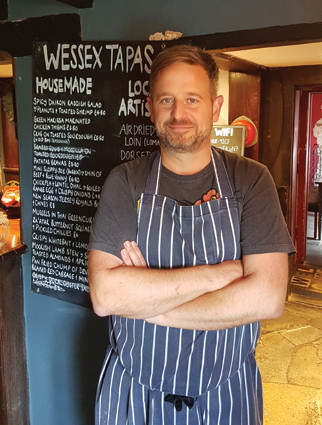
Landlord, Chef and Proprietor of the Shave Cross Inn, Joe Baron is a welcome addition to the echelon of hardworking individuals elevating Dorset’s oldest and celebrated pubs. With a menu that changes daily and a tapas selection to choose from, Joe also serves single meat choice Sunday roasts, putting all the care he can into producing a delicious locally sourced meal, incorporating a combination of cuts in the one dish. Pair this with the soulful chilled voice and guitar of BB Tim and you have a relaxed Sunday lunch difficult to beat.

New to the Marshwood Vale, Joe and his wife Louise moved to Dorset last year to turn around the much-loved Shave Cross Inn. He had previously successfully established himself in Newmarket at The Thai Street Café cooking South East Asian and Thai cuisine. A frequent traveller, Joe picks up many of his cooking influences from abroad, including Spain, where he lived for a while, soaking up all the food knowledge he could.

There are other strings to Joe’s bow though, as he hasn’t always been a chef. He grew up on the Isle of Anglesey, then moving to Suffolk where his parents ran a hotel. More than a music fan, he also had his own record label, producing from his music studio in Brick Lane, London.

After the whirlwind winter turnaround of the pub Joe is now set for the summer. Louise, his florist trained wife is on hand to help with the running of the pub, adding her fresh touch to any jobs that need doing. Currently, she is concentrating on the garden, one of the prettiest and most quintessentially British beer gardens to be found.

Together, they aim to make the Shave Cross a combination of locals’ drinking pub, food lovers’ destination and somewhere in between for everyone to celebrate the weekend in style.

People at Work – Alex Brooks

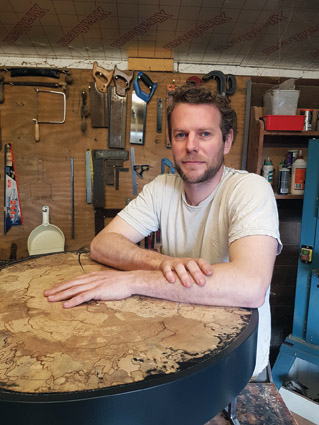
Alex Brooks has been making bespoke wooden garden furniture for years with his brother Ed. Ed is a landscape designer based in London, but also has Ed Brooks Furniture which sells specialist garden furniture, with pieces personally designed for his clients. There is only one person with whom he entrusts his creative drawings, transforming them into reality, and that’s his brother Alex.

In addition to the garden furniture carpentry, Alex is branching out, designing his own interior furniture from the wood he loves so much. Alongside conventional bespoke furniture, Alex strives to capture the beauty of fallen wood, showcasing the end grain detail in his pieces, which are also works of art. Alex uses the sections of a tree that other carpenters often avoid as they are temperamental to work with. But the results are more than worth it.

Each piece is unlike any other, crafted from trees such as sweet chestnut, oak and beech, from his parents’ woodland and surrounding farmland, outside the village of Wootton Fitzpaine, where Alex’s workshop is. Working alongside his father, who helps source the wood, their workplace overlooks pasture fields, making it an idyllic spot. Even in winter when the bitter cold sets in Alex can retreat into the shed where a wood burner sits snuggled in the corner, content in the knowledge that fuel is never an issue.

Alex now lives in Seaton with his wife and young daughter, enjoying the short commute to his rural workshop, down the road from where he grew up and his parents live. Relying on his father to collect any fallen tree that has come down in a storm, Alex appreciates his support and guidance over the years. The work for Ed Brooks Furniture continues, alongside the newer Alex Brooks Furniture enterprise; complimentary businesses that flourish under one family tree.

June in the Garden

It seems almost impossible, given the ‘bad start’ to 2018, that we’ve been blessed with almost a month of good, warm, sunny weather in the period since I last sat down to write one of these articles. It’s certainly made up for most of the atrocious cold, wet and snowy conditions which, for a while, threatened to put a permanent ‘downer’ on this year’s gardening activities.

As ever, I hope that writing that won’t tempt ‘the Fates’ to punish me by turning on the rain taps and turning our summer into a washout; I’m keeping everything crossed!

With the warmer weather, of course, has come exponentially increasing plant growth and exuberance. Unfortunately, it’s not only the ornamental plants that have been growing ‘like Topsy’—the weeds have been at it too. I have reached the stage where I am almost prepared to ‘love my hairy bittercress’ because whatever I do it always seems to be one jump ahead.

This little, annual, weed is very easy to pull out but, thanks to its explosive seed capsules, it is so successful at spreading, far and wide, that keeping it under control is a Herculean task. It often enters a new garden as a ‘stowaway’ in the pot alongside a newly purchased garden plant. It is endemic to many (all?) plant nurseries and, even if the adult plants are weeded out, its seeds may well be hiding in the compost, despite the nursery owner ‘cleaning’ their plants prior to sale.

There is a flipside to these ‘stowaways’; there are also ‘passengers’. That’s what I call the seedlings of ornamental plants which sometimes get carried into a garden alongside plants which you have chosen to introduce purposefully. In my case, I don’t think that I’ve ever bought aquilegias, Linaria or snakes head fritillaries, and yet they have all made their way in to my garden ‘under the radar’. They’ve cost me nothing and, when they pop up in the right places, are useful additions to my garden palette.

Using the adage that a ‘weed is just a plant growing in the wrong place’, I have no compunction in pulling out these self-sown, yet ornamental, chancers whenever they threaten the existence of a more precious, more ornamental, plant. I guess the only difference between these ‘passenger’ introductions and ‘classic’ weeds is that the former I might allow to remain in the garden, whereas the latter I’ll always pull out—no matter what context it is growing in.

As well as weeding, there are other garden tasks which need keeping on top of now that summer is practically upon us. If you notice any faded flowers, on spring flowering shrubs, prune out the boughs that have bloomed and generally tidy up or reshape the specimen. Take a hard look at it and decide whether it’s the optimum size, too large or still has room to fill out. With shrubs just standing still requires that you remove the flowered stems and do some thinning out of the oldest ones each year; if it’s too large then a more brutal chop back, accompanied by a feed and mulch, is in order; shrubs that are still establishing may need light titivating to coax them into a pleasing shape.

Dead-heading of spring bulbs is advisable if you want them to flower again in future years. Also, remove faded flowers from plants in bedding schemes, hanging baskets and the like, to keep them blooming for the longest period. Adding ‘food’ to the water, following the instructions on your chosen brand, will pay dividends but simply ensuring that they never dry out is vital because drought makes them set seed, and stop flowering, sooner than they might otherwise do so.

If you have a pond, June is a good month to perform maintenance tasks such as thinning out water weed or marginal plants. It’s warm enough that the job is not too unpleasant for you, always an important consideration, plus any new plants that you add will get off to a good start. It’s also a good time to introduce new fish, if you want a bit of fishy fun rather than a purely natural experience; ornamental fish will reduce the amount of indigenous water life which your pond will support.

It’s a good time to look at your beds and borders and implement any ‘last minute’ staking, or pea-sticking, wherever it looks as if one plant is threatening to collapse and squash another one. At the same time, any gaps which persist, maybe where early spring bulbs have died down, can be plugged with a generous sowing of hardy annuals; you can’t go far wrong with that cottage garden stalwart—Nigella damascene (‘Love-in-a-Mist’). For more instant ‘plugging’ it’s worth keeping a few pots of filler plants at hand; pelargoniums (tender ‘geraniums’) fit the bill nicely. Failing that, a trip to the garden centre should yield some tender perennial bedding plants to play around with.

I can’t sign off without paying homage to the recently late, great, plantswoman and nursery owner—Beth Chatto. I met her many times, while staying at ‘Great Dixter’, and, I think, it was her influence on me, as a student gardener, which taught me the most important rules which need to be followed in order to make a successful garden. She was the one that first explained to me, then demonstrated in her sublimely beautiful gardens, the importance of choosing plants that are not only aesthetically pleasing, but which are suited to the conditions in which they are expected to grow.

‘Right plant, right place’ is, somehow, too simple a concept. Beth demonstrated that it was more than that. It was her Artistic sensibility, allied to an in-depth understanding of the underlying Science (her husband, Andrew, played his part in that), which made her garden writing essential reading for anyone setting out to make a garden. She was always much more than ‘surface’ when it came to gardening—a quality largely lacking in our image obsessed, ‘Instagram’ crazed, culture today. Her like will not be seen again.


Here for You

Margery Hookings finds out more about the local mental health charity, South Somerset Mind, and its project aimed at supporting young people, farmers in Somerset and North and West Dorset and women struggling with perinatal mental health.

Approximately one in four of us will experience a mental health problem during our lives, according to the mental health charity Mind. It’s a statistic that’s bandied around a lot these days, as the stigma surrounding mental illness lifts and more and more people talk about the condition.

In England, one in six people reports experiencing a common mental health problem, such as anxiety and depression, in any given week. And according to the publicity around last month’s Mental Health Awareness Week, stress is also a key factor.

Employers have a responsibility towards their workforce as the stresses of modern-day life impact on our mental health. Social media has a part to play, particularly in the lives of young people in a fickle world in which the number of Facebook ‘likes’ are interpreted as the measure of one’s popularity.

Mind says that the overall number of people with mental health problems has not changed significantly in recent years. But worries about things like money, jobs and benefits can make it harder for people to cope.

It appears that how people cope with mental illness is getting worse as the number of people who self-harm or have suicidal thoughts is increasing. And whilst the NHS struggles with funding, work by charities such as MIND is more important than ever.

I caught up for a chat with South Somerset Mind’s community fundraising manager, David Fields, who joined the charity after a 36-year career in the Royal Navy.

Although being aware of the good work of Mind for a number of years, I hadn’t appreciated that there are 135 local Minds, about ten of which are in the West Country. They all have to generate their own income through organisations such as Big Lottery, trusts, local councils and their own community fundraising projects—they do not receive an income from national Mind.

“We are affiliated to the national charity Mind, although we receive no specific funding from them,” David said. “Raising money for your local Mind ensures that funding is spent on local needs and projects.”

“Last year, South Somerset Mind provided support and a listening ear to more than 3,000 people. We aim to promote good mental health and wellbeing, encourage greater understanding of mental health issues and provide high standards of care.

“We provide one-to-one support, group training courses to help people better manage their lives and activities in local communities where we ease isolation and where people can meet new friends and share support.”

Each local Mind is unique, understanding the needs of its community and tailoring services to match the local requirement.

“Services include talking therapies, peer support, advocacy, crisis care, employment, housing support and training for local businesses in mental health awareness and wellbeing in the workplace.”

This year, a number of fundraising events are being held for The Hardy Appeal, which was launched in August 2017. One of these is Music for the Mind. Money raised will support young people, mothers and the farming community.

Music for the Mind is a fundraising initiative first conceived in 2008 by Bristol-based businessman Richard Lowe in memory of his brother, James, who took his own life at the age of 30, following a period of mental illness in 1998.

Richard is organising a fundraising concert at the Cedars Hall in Wells on 15 September in support of local Minds. David hopes that other Music for the Mind events might be staged in the region by people keen to support Mind’s mental health services in their own areas.

You can find fundraising packs and more information by visiting http://www.southsomersetmind.co.uk/music-for-the-mind.asp

The Hardy Appeal is a long-term project seeking to raise £296,000 to support the following projects in South Somerset and North and West Dorset:

  • Youth Matters supports 16-25-year-olds with their mental health, through a weekly drop-in session and 1-1 counselling. A new drop-in centre for young people will be opening in Bridport in June. Details will be published on the website soon.
  • Bump in the Road supports women who are struggling with their mental health both during and after pregnancy. Women with young babies or children can find it difficult to leave the home or attend groups, so a support worker coming to their home can be the lifeline needed to help them and their families. Working in partnership with health visitors, this programme would embed into doctors’ surgeries and then be rolled out across the area.
  • Farming Support—in our rural area, farmers are seven times more likely to take their own life than other professionals. One contributing factor is a lack of time to fulfil their work. Groups are therefore not an option. Increasing triggers are financial and linked with bovine TB. Tailored support workers are needed on the farm to help while the farmer goes about their work.
  • Mental Health Community Day and 1-1 Service—this grant would fund South Somerset Mind’s work for service users in Yeovil, Somerset. Their Mental Health Community Day is attended by 72 people each month and runs from 9.30am – 3.30pm every Wednesday. In addition, this group work is complemented by up to 9 private one-to-one sessions with experienced support workers throughout the week. One support worker and four volunteers run this day.

Finally, 30 June will see another big fundraising event in support of South Somerset Mind’s Hardy Appeal—the Driving Challenge at Henstridge Airfield. The event starts at 10 am and finishes at 4 pm. Participants have the opportunity to test their driving skills from a choice of different vehicles ranging from tractors, foragers, forklift trucks, coaches, lorries, off-roading in a 4×4 to driving the brand new Mini. There will also be a barbecue and refreshments. You can sign up at www.southsomersetmind.co.uk/the-driving-challenge.asp


  • For more information about South Somerset Mind visit www.southsomersetmind.co.uk or contact info@southsomersetmind.co.uk

You can access South Somerset Mind’s services by calling 01935 474875. The office is manned between 9 am and 5 pm Monday-Friday and you will always be able to speak to someone or leave a message outside office hours. You can also refer yourself through the form available on South Somerset Mind’s website.

  • If you’re feeling suicidal or concerned about self-harm, visit your local A&E or call 999 at any time of the day for help. And whatever you’re going through, you can call the Samaritans, free any time, from any phone on 116 123. The Samaritans are there round the clock, 24 hours a day, 365 days a year.


Don’t Mention It

There you are, having a nice quiet discussion at a dinner party or at the local, when someone opens up their over-wide mouth and raises one of those ‘do not mention’ burning issues that not only divides opinion but can in extremis split up longstanding friendships and families. Often made worse when fuelled by too much cider or prosecco, some discussion points are particularly divisive and should never be mentioned in polite society for fear of social breakdown or an outbreak of world war three in the village pub. Apart from the ever-red historical favourites of politics, religion, abortion and doctor-assisted suicide, in the 21st century we can now add ‘iPhone versus Android’, McDonalds, Brexit, Online dating, Facebook, Kanye West and ‘Keeping Fit’ as subjects that are best avoided, unless you enjoy long futile unresolved arguments between friends. It’s as Black and White as arguing about Marmite. Or Marzipan (yuk). Pointless discussions like these are also incredibly boring for everyone else to listen to.

Jeremy Clarkson used to be on my taboo topic list because opinions about him were so divided, but he rather dropped off my radar with his move to the ‘Grand Bore’, although he may come back onto it with his rebirth on ‘Millionaire’. Likewise, the other ‘Jeremy’ (née Paxman) has mostly vanished from popular gossip after leaving Newsnight, and we obviously can’t discuss the third ‘Jeremy’ (née Corbyn) since he is filed under ‘politics’ and is consequently an automatic ‘no-go’ discussion area. And don’t forget burning local issues such as new housing in the Blackmore Vale or the Chideock A35 bypass—both of which can cause normally nice citizens to wax furious and walk out of any party.

Other once touchy subjects have now become surprisingly OK to talk about. The subject of Donald Trump is so universally upsetting that he has in his own way become a force for unification. Everybody seems to loathe him so he brings us all closer together in mutual scorn. Likewise (although for a very different reason) the issue of our Royal Family has gained a huge lift after the public triumph of Harry & Meghan’s wedding. Royalty is therefore now off the ‘don’t mention it’ list. It can come back again perhaps when Prince Charles becomes King. In the meantime, if your dinner conversation ever develops to drawn daggers, just change the subject with a brief “Yes, but isn’t Meghan’s smile so wonderful?” This will force any anti-royal supper partner onto the defensive as he/she can’t argue without incurring regal fire and brimstone from the rest of the party.

There is yet another totally divisive subject that splits our house in two… I’m talking about the noble game of Football. Sorry to say, but yes—it’s one of those years again. That one year in four when the normally football-free summer month of June decongests into a global conga party of World Cup footie. Up till now, it’s been kept quite low key mostly because of the frenzied hoopla of the Royal Wedding. But watch out—here it comes… four weeks of bum-numbing TV wall to wall coverage. Apart from the recent FA Cup Final (which was so boring I fell asleep at halftime), it’s about the only time the BBC is contractually able to broadcast any footie on telly, so you can bet your bottom (numb or not) that there’ll be no escape.

I am unashamedly a footie fan when it comes to the World Cup. Not just the sport itself or who wins, but the international glory, pride and stop-watch torture. I watch the crowds in the stands as well as the pitch itself. It is high opera and heart-stopping drama with 32 teams from all over the world—Italian angst, Latin flair and African dash with Germany still winning on penalties! Here are some key June dates for your diary…

June 14th: the opening game—a vain but glorious hope that Saudi Arabia beats Russia (this year’s hosts—Boo, Hiss).

June 22nd: Nigeria takes on Iceland—what a clash of climate, style and culture!

Can Senegal crush Japan on 24th or underdogs Morocco defeat their richer Spanish cousins (25th)?

The more observant of you will have noticed that I didn’t mention England. Sorry if I sound a bit manic, but I’m psyching myself up for another summer of sadness if we—possibly, even probably—get eliminated by Belgium on June 28th? I live in hope…

It’s exactly like another recent festival of huge international importance… the Eurovision Song Contest. Both events have much in common—foreign supporters pursuing their own open agenda and throwing beer cans or voting against rivals. Also, neither the song contest nor the World Cup features the USA which is a good thing. However, both of them feature Australia which doesn’t do much for our understanding of European geography. And the one is hopefully not a forecast for the other, otherwise, we’ll be looking at England… Nul Points.


Cable and Wireless

This is the title of what grew to become a large company working in communications by either means. But it made me think of two unrelated local stories. Technology had to be established first to enable either means of communication to exist.


The Cable part of the story :   

The name Ferranti is known to most of us, but perhaps not that of Alfred Bolton. At Easter 1883 they were both in Bridport, but it is unlikely that they were here on holiday. Bolton was the head of Thomas Bolton & Sons of Birmingham, a company making copper wire for the growing electrical industry. Sebastian Ferranti was not then 20 and about the same age as Alfred’s brother Frank. Ferranti founded the company which made his name a household name which we have all seen on television sets, radios and other electrical apparatus.

So what were these two “bright sparks” doing in Bridport at this time? The answer lies in electric cables with which they were both associated. By 1888 Bolton & Sons were supplying Ferranti with power cables and had also been involved with submarine telegraph cables from 1850 and the Atlantic cable laid by Brunel’s “S.S. Great Eastern” in 1865. Submarine cables had to stand wear from the undersea conditions as they were laid and also from chafing caused by underwater movement. Tarred hemp twine was used to cushion and insulate the copper cables, suggested by Sir Charles Wheatstone about 1840. Bridport was used to handling hemp. Some years ago several of us were shown a small section of cable by Mrs. Frances Sanctuary, which incorporated Bridport hemp, an unusual byproduct of Bridport’s industry.

In 1851 a cable was laid between England and France. The first transatlantic cable was laid in 1858 but failed shortly after. Brunel’s ship “The Great Eastern” was then the largest ship available and carried more than 1,000 km of cable and was in service in 1866 between Valentia, Ireland and Trinity Bay, Newfoundland. An American merchant, Cyrus West Field proposed the scheme and raised the necessary funds. After testing was complete the first official message in 1858 was from Queen Victoria to President James Buchanon. Newfoundland was linked to America. After a short time, the cable failed but was replaced soon after.


Wireless is the second part of this duo:

The name Marconi is also well known now. But in his earlier days, Guglielmo Marconi had a struggle to raise money for his developments. Marconi came to Britain aged 25 and contacted the British Post Office and received help from Sir William Preece, Engineer in Chief, from 1896. He took out British Patent no. 12039 for a system of telegraphy using Hertzian waves, the world’s first. As with many inventions, it came after a number of scientists in several countries, for example, Heinrich Hertz and Sir Oliver Lodge, had published information of their discoveries in the same field, but Marconi was able to bring all the ideas together as a working product. By 1897 Marconi had broadcast across the Bristol Channel. He achieved the first shore to ship communication on Christmas Eve 1898 from South Foreland Lighthouse on the White Cliffs, near Dover to the East Goodwin Lightship about 12 miles out in the English Channel. Marconi also set up the world’s first transmitting station at the Royal Needles Hotel on the Isle of Wight, signals to be received at a station set up in the Haven Hotel at Poole, 18 miles away. The Haven continued as one of Marconi’s experimental stations until 1926. In 1899 signals were sent across the English Channel and in 1901 from Poldhu, Cornwall to St John’s Newfoundland. His early transmitters used a spark discharge, rather like a motorcar ignition and transmitted messages in Morse Code, not the human voice.

Many ships were fitted with Marconi equipment and shore stations were erected. The Post Office took over the service in 1910. The Titanic was fitted with Marconi equipment and sent out distress signals on hitting the iceberg in 1912 which were picked by the “SS Carpathia”. It was the first time that “SOS” had been used, previously “CQD”—“Come Quick Danger” was in use.

You may have noticed a group of buildings on the right-hand side of the A35 road shortly after leaving the roundabout from Dorchester towards Bridport. Most prominent now, and modern, is a building concerned with computer printing, but lurking behind are some earlier, somewhat derelict buildings which were known as the Dorchester Radio Station from 1927. An aerial tower is adjacent but I believe this is modern. The radio station was part of the Imperial Wireless Chain for the British Post Office set up to link countries of the British Empire and apart from two transmitter buildings, it fronted a large number of curtain antenna systems on 460 acres of land. This was a shortwave radio system with directional antennas, known as a Beam Transmitter. These were conceived by the Marconi company, with the first transmitter on Bodmin Moor, Cornwall and a receiver at Bridgewater, Somerset. The Dorchester Station soon followed and another West Country station was at Portishead, Somerset.

An International Wireless Conference was held in Bologna, Italy in 2015 and two Dorset men spoke, as reported in the Bridport News. Both ex-apprentices at the Dorchester Station, Peter Garland who originated in Bridport and Paul Hopkins from Dorchester were able to show photographs of Marconi visiting the Dorchester Station to Princess Elettra, Marconi’s daughter. Princess Elettra gave the keynote address at the conference. They described how Marconi’s experiments with shortwave technology were made between Pohldu, Cornwall and his yacht Elettra, after which his daughter was named. The first transmission using this network was from Bodmin to Yamachichi receiving station. The system was useful when Britain needed an alternative to cables to connect with parts of its distant Empire. The Dorchester Station closed in 1979.

This brings to mind a visit I made to the Rampisham Transmitting Station of the BBC World Service just off the A356 road some years ago arranged by a friend who was employed there when it was still operational. He knew of my interest in all things electrical, especially the power supplies there. Sadly it has since closed and the field which once carried a large number of masts carrying antennae has been the subject of a planning dispute for an array of solar panels or alternatively a wildlife area.

Bridport History Society meets on Tuesday 12th of June at 2.30 pm in the United Church Main Hall, East Street, Bridport. You may be aware of a new film The Guernsey Literary and Potato Peel  Pie Society. The subject of this months talk will be “The occupation of the Channel Islands” by Paul Radford. All welcome, visitors entrance £3.


Cecil Amor, Hon. President Bridport History Society.

Prints Charming

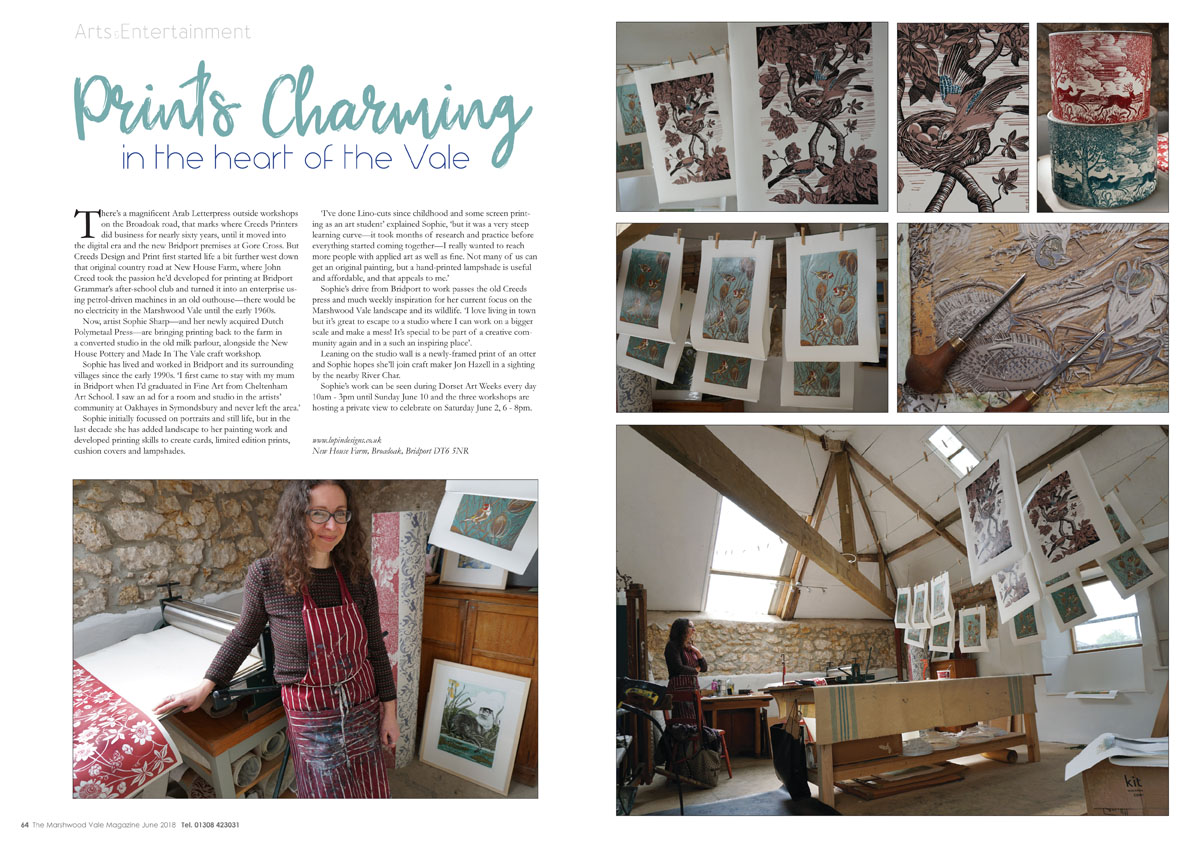
There’s a magnificent Arab Letterpress outside workshops on the Broadoak road, that marks where Creeds Printers did business for nearly sixty years, until it moved into the digital era and the new Bridport premises at Gore Cross. But Creeds Design and Print first started life a bit further west down that original country road at New House Farm, where John Creed took the passion he’d developed for printing at Bridport Grammar’s after-school club and turned it into an enterprise using petrol-driven machines in an old outhouse—there would be no electricity in the Marshwood Vale until the early 1960s.
Now, artist Sophie Sharp—and her newly acquired Dutch Polymetaal Press—are bringing printing back to the farm in a converted studio in the old milk parlour, alongside the New House Pottery and Made In The Vale craft workshop.

Sophie has lived and worked in Bridport and its surrounding villages since the early 1990s. ‘I first came to stay with my mum in Bridport when I’d graduated in Fine Art from Cheltenham Art School. I saw an ad for a room and studio in the artists’ community at Oakhayes in Symondsbury and never left the area.’
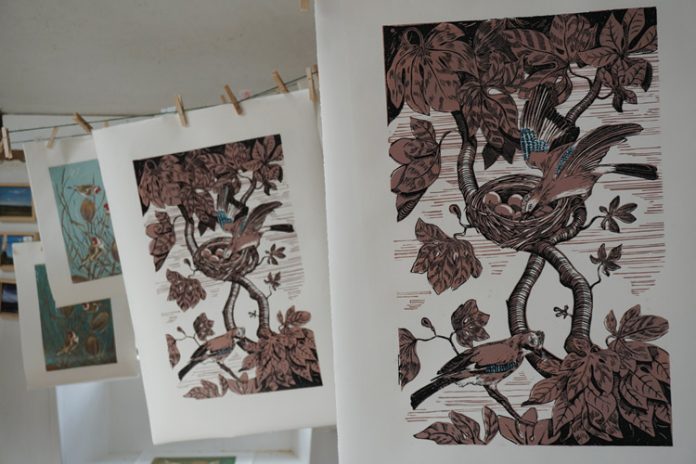
Sophie initially focussed on portraits and still life, but in the last decade she has added landscape to her painting work and developed printing skills to create cards, limited edition prints, cushion covers and lampshades.

Prints Charming in Broadoak
‘I’ve done Lino-cuts since childhood and some screen printing as an art student’ explained Sophie, ‘but it was a very steep learning curve—it took months of research and practice before everything started coming together—I really wanted to reach more people with applied art as well as fine. Not many of us can get an original painting, but a hand-printed lampshade is useful and affordable, and that appeals to me.’
Sophie’s drive from Bridport to work passes the old Creeds press and much weekly inspiration for her current focus on the Marshwood Vale landscape and its wildlife. ‘I love living in town but it’s great to escape to a studio where I can work on a bigger scale and make a mess! It’s special to be part of a creative community again and in a such an inspiring place’.
Leaning on the studio wall is a newly-framed print of an otter and Sophie hopes she’ll join craft maker Jon Hazell in a sighting by the nearby River Char.
Sophie’s work can be seen during Dorset Art Weeks every day 10am – 3pm until Sunday June 10 and the three workshops are hosting a private view to celebrate on Saturday June 2, 6 – 8pm.

www.lupindesigns.co.uk
New House Farm, Broadoak, Bridport DT6 5NR

Up Front 05/18

Last week I was shown a map of trees planted in 2017 in the Heart of England Forest in Warwickshire. The brainchild of the late Felix Dennis, the forest started with a small wood that he planted in 1996. At one point Felix was one of the 100 richest people in England and before he died in 2014, he decided that all his wealth and the profits from his various businesses should go into a trust, with the primary purpose of planting trees for the benefit of the local community—and of course, the planet. By 2013 over 1 million trees had been planted and this year the map shows an area that is now home to over 1.5 million trees. There is a level of pride and excitement in those that have taken on the task of fulfilling his legacy, and its benefit to the area is already very obvious. Thankfully, it’s one of many tree planting projects across the planet. Emmanuel Chibesakunda in Lusaka, Zambia, recently launched an initiative to plant over two billion trees by 2021. He hopes to accelerate and scale up a tree-based economy for socio-economic change in Zambia and mitigate some of the impact of climate change. Last year, volunteers in India planted 66 million trees in twelve hours in a record-breaking environmental drive and there are numerous new programmes currently being launched from South America to Saudi Arabia. Another tree planting exercise, Trees on the Land, is an interesting example of a cross-border initiative. The not-for-profit group is working to establish young native trees across the Republic of Ireland and Northern Ireland. Their goal is to provide valuable resources, beneficial ecosystem services and a lasting legacy for future generations. When it comes to trees, we seem to be able to overcome issues with borders as well as perhaps more tribal differences, and maybe the trees themselves have a lesson for us. European and Chinese scientists have been investigating for ten years how the diversity of tree species in forest ecosystems influences their coexistence and growth performance, and their findings are interesting. The scientists have discovered that trees growing in a species-rich neighbourhood produce more wood than those surrounded by neighbours of the same species. They were particularly impressed by the fact that the interrelationships between a tree and its immediate neighbours also led to a significantly higher productivity of the entire forest. It’s not an outcome that would be particularly popular with those that feel mixed neighbourhoods are to be avoided, but interesting that diversity can have a positive effect.