Monday, December 22, 2025
Home Blog Page 31

October in the Garden

Another month when it’s largely a case of ‘steady as she goes’ and not ‘all hands to the pump’ – as long as the weather behaves itself. The process of putting the garden to bed, which began last month, continues with the completion of tasks such as trimming formal hedges before it gets any cooler.

The risk of sharp frosts, or prolonged periods of cold weather, is still low but it is sufficiently cold, and wet, that all tender perennials and less than hardy exotica should be brought into frost-free winter quarters. Tidying, cleaning and fettling of the greenhouse, or other frost-free place, may be necessary if you’ve been using it for growing tomatoes etc. during the summer. Check that any heating apparatus is in full working order and clean the glass to maximise winter light levels. If you haven’t done it already, scrub off any white-wash which was applied to the exterior of the glass for summer cooling.

I banged on a fair amount about statuesque Miscanthus grasses last month and how they really come into their own at this time of year. In my garden they form the perfect backdrop to another star performer of the late summer / autumn garden: the Asters. I am sufficiently old and set in my ways that I still cannot get my head around the taxonomical changes which have seen a lot of the ‘old favourites’ get new botanical names.

I remember, as a young horticultural student, how easy it was to adapt and change when a taxonomical wind blew a whole set of plant names away in order to replace them with new, more correct, nomenclature. We students used to roll our eyes when the ‘old guard’ of the gardening world complained about any unwanted (presumed ‘unnecessary’?) renaming of gardening favourites. Now I find myself firmly in the Luddite camp and get faintly annoyed with myself for not being able to take on taxonomical renaming as easily as the new, young, horticultural hot-shots.

My Aspergic trait of getting frustrated with inaccuracies and abhorring lies / deceit / manipulation now begins to act against me when trying to write about ‘asters’. The problem with knowing that these days they are not all ‘Aster’ (the italics are important as they denote that I mean Aster as the genus—not the general garden term ‘aster’ which is the common name for these particular perennial plants).

I know that being taxonomically correct is important, so I MUST get it right but, annoyingly, I know that my compulsion to not deceive, or knowingly ignore the confusing changes, is probably of very little significance to the ‘normal’ gardener. I am already beginning to regret going down this route but, especially knowing that recently these traits have landed me in a lot of trouble, it is important to at least try to explain this to you, gentle reader!

What I am trying to say is that the most worthwhile asters, improvements on the mildew-ridden ‘Michaelmas Daisies’ of old, are those with the species name ‘novae-angliae’—the ‘New England’ asters. These are now in the genus Symphyotrichum which is much more of a mouthful than good old Aster. Having said that, I think that using the taxonomically outdated term will still be understood for many years to come. In everyday gardening I doubt that Symphyotrichum novae-angliae will ever totally eclipse ‘New England Aster’ in general horticultural parlance—at least I hope not.

To prove just how set in my ways I am, my favourite ‘Michaelmas Daisy’ remains the reassuringly ‘non user-friendly’ named ‘Andenken an Alma Potschke’. Her shocking popping-pinkness, when first glimpsed during my salad days at Dixter, made such a deep impression on me that I doubt any new introduction will usurp her position as my all-time favourite aster. Having said that, ‘Purple Dome’ is a usefully short New England Aster, carrying a profusion of purple blooms, with good mildew resistance and worthy of a place in any garden.

Returning to pink hues; many of the late summer and autumn flowering bulbs occur naturally in shades of pink, although many of them have been selected over the years to gain colours ranging from pure white right through to the deep reds. They tend to flower over the course of about three months beginning when the cooler, wetter, autumn conditions begin. I am thinking of such stalwarts of the late garden season as; autumn crocus, colchicums, cyclamen and Schizostylis—all helping to keep your garden ‘in the pink’ as the temperatures drop.

To heighten the impact of autumn flowering gems, see above, it helps to remove any decaying herbaceous foliage, in beds and borders, which otherwise could dilute the impact of those border inhabitants which are still looking good. Dahlias will continue blazing, amongst the less exotic border plants, if dead-headed and propped up, until the first frosts. Plant spring flowering bulbs into any gaps which are revealed, marking the spot with a label so that you don’t dig them up by accident before they emerge.

The other weekend I had a lovely day out, with my faithful hound, at ‘Toby’s Gardenfest, Forde Abbey’. It was a great way to see a number of nurseries, bulb firms and sundry suppliers all in one place, at a time when planting things is not only possible but actually advantageous. I did succumb to a few impulse purchases, one of which was a real autumn flowering gem; Nerine sarniensis x bowdenii ‘Afterglow’.

Being a hybrid between the reliably hardy ‘bowdenii’ and the less than hardy ‘sarniensis’ species of Nerine (‘Guernsey Lily’) it needs a sheltered spot in the garden where it won’t be frozen solid, or sat in winter wet, for months on end. I have a gravelly bed, at the foot of a south facing wall, which should suit it impeccably and has proved beneficial to other doubtfully hardy bulbs which I’ve established there in previous years. It’s always a joyous fillip to be able to add a new component to an already established area of the garden. Happy days 😉

Lyme Bay from a Diver’s Perspective by Peter Glanvill

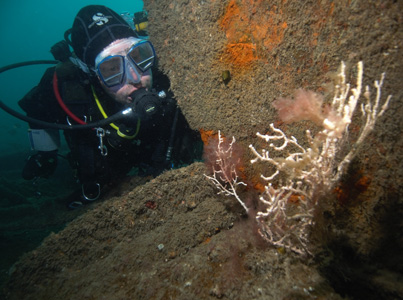
As you gaze out to sea from Lyme Regis Cobb do you ever wonder what lies beneath that constantly moving multihued expanse of sea? Does it resemble the land above with rounded hills and steep-sided valleys or is there a flat featureless plain down there littered with the decaying remains of sunken ships? And how deep is it anyway ‘full fathom five’ or hundreds of metres? I think I can now claim an inkling of knowledge of the seabed after hundreds of dives but ask me to draw a map and I wouldn’t know where to start. During a single dive I might cover 800 metres but even on an exceptional day I will never see more than 10 metres of seabed to either side of me – and usually it is much less. All this in a permanent green-tinged gloom with colours filtered to the point where cut flesh oozes ink-black blood.

The seabed in Lyme Bay is covered in the main by areas of thick undulating mud but it is far from devoid of life even in these grey submarine deserts as there is much, albeit invisible, burrowing life. However, the oases in this realm of Poseidon are the rocky limestone reefs and shipwrecks scattered across the bay. In places these reefs take the form of jagged 2m high ledges rearing from the seabed like fortifications. Sometimes there are plateaux terminating in 6 or 7 metres high precipices.  Depths a couple of miles offshore are in the 25-metre range but of course shallower on the reefs. These reefs are covered in marine organisms—there is no bare rock to see. The pink sea fan, a gorgonian (a sort of colonial soft coral), is the dominant species.  Looking like flattened roseate trees they vibrate gently in the current across which they are aligned so that the individual polyps can feed on the plankton borne by the tide. Between the thousands of fans are colonies of Ross, a bryozoan, that resembles nothing so much as a packet of huge cornflakes glued together in a bowl shape. Ross shelters countless small creatures in its maze-like interstices and is frequently used by rays and catsharks as a surface on which to bind their egg cases.

The most popular dive site in the Lyme Regis area is not a reef but the wreck of the collier Baygitano, sunk in the dying days of the Great War by a U boat and lying 20 metres down about a mile offshore. It is recognisably a wreck and situated on a sandy seabed, it functions as a reef. Now surrounded by thousands of ghostly white sea squirts it is gradually disintegrating. In 1968, aged 17, on my tenth dive, I was awe inspired. The boilers loomed above me in the dim light and I was surrounded by a huge shoal of pout that held station over the wreck. The dive was short as in those days we were using small capacity ‘tadpoles’, low-pressure tanks of compressed air originating from fighter planes used in the Second World War 25 years earlier, but I have never forgotten the experience. This year I dived the wreck a century after its sinking and a half century after my first dive. It has changed with the years; plates have collapsed, railings have gone but the triple expansion engine block remains as well as the massive boilers. As a reef it has become heavily encrusted with marine life. The huge shoals of pout and pollack remain with a flash of darting silver provided by the occasional bass. Several species of wrasse patrol the wreck including the orange and electric blue cuckoo wrasse, the bronzed goldsinny and the tiny blue rock cook. Little leopard spotted gobies dart for cover as the diver passes and lobsters shyly reverse into the shelter of the plates. A diver with a torch can shine it into the darkest crevices and frequently will be startled by the cold dead eyes of a blue-grey conger eel, its dorsal fin gently rippling along what can be a spine more than two metres in length. They often share their homes with edible crabs or lobsters but whether this is a true symbiotic relationship it is difficult to know.

The boilers are becoming encrusted with the vividly coloured jewel anemones that clone themselves into multicoloured patches. Most exciting of all is the return of species not seen for many years such as the orange crawfish with its long waving antennae and the angler fish (or monkfish), a master of camouflage that waves a fleshy lure above a well camouflaged mouth (in fact the fish seems to be practically all mouth!).

There is no doubt that the establishment of the Marine Conservation Zone has had a dramatic and beneficial effect on the marine life of Lyme Bay. We need more zones like this around the UK; currently, only a tiny percentage of our seas are protected in this way.


On the front line of conservation by James Crowden

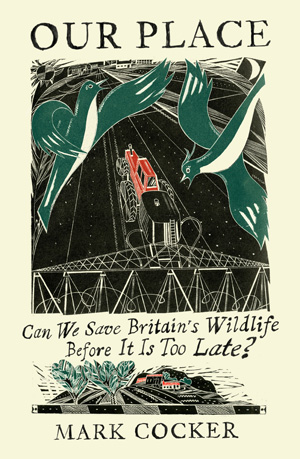
With an exhibition space at Bridport Arts Centre, a charity and a Sunday Times essay competition named after him, British broadcaster, author and naturalist Kenneth Alsop’s impact on conservation and literature is well highlighted. In this year’s Kenneth Alsop Memorial Talk at Bridport Literary Festival James Crowden looks forward to speaking to Mark Cocker.

This year the speaker is Mark Cocker, author of Claxton: Field notes from a small Planet and Crow Country which received excellent reviews from Richard Mabey – ‘Luminously beautiful and dartingly intelligent’ as well as a ‘thumbs up’ from Horatio Clare and Melissa Harrison. Mark Cocker is a bird man and with Richard Mabey he co-produced a learned tome called Birds Britannica. This was  followed by Birds and People which with 600 pages weighs in at almost 3kg. This covers all manner of interactions between people and birds in 82 different countries, even Kazakh eagle hunters. Mark’s other writing includes: A Tiger in the Sand, Birders and the lives of eccentric ornithologists such as Richard Meinertzhagen, a ruthless intelligence officer in East Africa, the Middle East and Spain. Meinertzhagen was supposed to have shot his wife one morning with a revolver on their own rifle range but this was never proven. On a more cheerful note Mark Cocker is not unknown to Guardian readers and has his own Country Diary slot.

But what of Mark Cocker’s latest book?  Our Place – Can we Save Britain’s Wildlife Before it is Too Late? – a radical examination of Britain’s relationship with the land. Mark Cocker is as interested in people as he is in birds and he is not frightened to get his hands dirty digging out old ditches in Norfolk. He dives in the deep end trying to resuscitate five acres of sludgy land near Norwich aptly named Blackwater, half sunken into the ever winding river bed of the Yare. Norfolk: a land of East Enders, East Anglian salt marshes, broads, dykes and washes. A world of reeds, hides and twitchers.

But you would be mistaken if you thought this was a mere nature book, a recitation of duck flights, eels, fishy ways and drainage history. It is in fact a peeling back of the layers of well meaning campaigning and bureaucracy and reserve management. By page six Mark has got into full swing and is questioning why our wildlife is more or less still up a gum tree when so many of us belong to such august tribes and pressure groups as the National Trust and The RSPB. When there are so many competing quangos that harp on about conservation. There are Ramsar sites, SSSI’s AONB’s, SAC’s, SPA’s, Wildlife Trusts, National Parks, Butterfly bodies, even gnats and toads with their own appreciation societies, as well ecology degrees, re-wilding debates, botanical surveys, biodiversity factors, migration coefficients, car park dues and hidden cameras. We all love to belong, to pay our membership dues, to have a voice or at least to feel that we have a voice…

But does it do any good in the end?  Environmental thought and politics have become part of mainstream cultural life in Britain. The wish to protect wildlife is now a central goal for our society but where did these ‘green’ ideas come from? To analyse these august bodies and how they evolved and how they have fared is worthy of analysis, even a PhD. But it is only part of the story. Farming has its own unique ability to either destroy or foster wildlife. Farming techniques and political pressure groups, subsidies and supermarket price structures have all had their impact on the landscape. This is a serious debate about our future as a species and one worth following up.

Mark Cocker also looks at six different locations throughout the country and evaluates the state of wildlife in those parts. As varied as the Flow Country of north of Scotland, The Pennines, Derbyshire, Teesdale, nightingales in Kent, South Holland and the delights of mass produced daffodils near Gedney Fen.

Mark is also a devotee of poetry and philosophers, and quotes Henry Thoreau, some time resident of Concord, Massachusetts and John Fowles, sometime resident of Lyme Regis. He uses this quotes from The Tree. “As long as nature is seen as something outside ourselves, frontiered and foreign, separate, it is lost both to us and in us.”

This is a book that looks to the future as well as exploring the past. It asks searching questions like who owns the land and why? And who benefits from green policies? Above all it attempts to solve a puzzle: why do the British seem to love their countryside more than almost any other nation, yet they have come to live amid one of the most denatured landscapes on Earth? Radical, provocative and original, Our Place is a work of environmental history, personal geographical quest and philosophical inquiry.

What Mark says is at times unsettling but he has an insider’s perspective on the front line of conservation. It concerns us all. If you want to hear him speak about the future of wildlife and also find out more about Octavia Hill’s sister Miranda and her ‘Society for the Diffusion of Beauty’ then why not come along to the Electric Palace.


Harvest Home

As a small boy, my mother took me to evensong at our village church. My father was lead tenor in the choir with a strong voice. During festivals, the choir processed around the church and my father carried the banner, whilst singing. Often he would change to descant as he passed our pew which amused my mother, a ready wit, and she would rib him on our return home.

One of our favourite festivals was harvest, around the end of September or early October on the Sunday nearest the harvest moon and the autumn equinox. Processing around at harvest was difficult as the church was overflowing with bread, small “stooks” of wheat, carrots, parsnips, potatoes and other vegetables arranged around the lectern, the font and every space in the church. At harvest, we sang “We plough the fields and scatter the good seed on the land” and my mother’s favourite “All things bright and beautiful”, among other familiar hymns. Another harvest hymn is “Come ye faithful people come, raise the song of harvest-home”

Harvest Festivals as we now know them have only existed from 1843 when the Rev Robert Hawker in Morwenstow, Cornwall introduced one and they quickly spread. Earlier there had been a festival around the first of August also known as Lammas with bread made from the new wheat crop, but this was lost when King Henry VIII rejected the Catholic Church.

Dorsetshire Folk-Lore by J S Udal provides a quotation from William Barnes published in Hone’s Year Book saying Harvest Home was “formerly celebrated with great mirth but now a declining usage, was a feast given by the farmer at the end of harvest, or when his hay and corn were got in… Some years ago the ‘harvest home’ in Dorset was kept up with good old English hospitality”.

“When the last load was ricked the labourers, male and female…all made a happy groupe, and went with singing and loud-laughing to the harvest-home supper at the farmhouse, where they were expected by the good mistress. The dame and her husband welcomed them to a supper of good wholesome food, a round of beef, and a piece of bacon; and perhaps the host had gone so far as to kill a fowl or two, or stick a turkey, which they had fattened. The plain English fare was eaten from wooden trenchers, by the side of which were put little cups of horn filled with beer or cider”. “With the cloth removed one of the men, stood and grasped his horn of beer to propose the health of the farmer, “Here’s a health unto our miaster – the founder of the feast….”. “After this would follow a course of jokes, anecdotes, and songs in some of which the whole company joined”.

Udal also added his own memory of a West Dorset Harvest Home in which the party went outside after the meal and the men circled a large tree, removed their hats and held them in front of them. They stooped to the ground and chanted “We have ‘en”, the first word commenced in a low tone as they gradually raised themselves up, finally saying “have ‘en” quickly. This was repeated three times when they all shouted “Huzza!”. A similar ceremony is described by Grimm in Teutonic Mythology in which the men in Lower Saxony at the end of the harvest waved hats and beat their scythes three times shouting “wauden” to the god Woden. Udal suggests that the Wessex cry of “We hav’en” might be a survival of an old invocation to the god Woden of their Saxon ancestors.

Thomas Hardy tells us in Far from the Madding Crowd how Sergeant Troy held a harvest home for the workers, although the work was not completed. Eight ricks remained unthatched and a thunderstorm threatened and disaster was only averted by the quick thinking of Gabriel Oak, the sheep farmer and Troy’s wife, Bathsheba.

Forward to the First World War, when a schoolboy organised for several boys and himself from Trowbridge High School, Wiltshire to help the war effort by harvesting on a farm and also have a seaside holiday. He was Dr John (Jack) Pafford, now deceased, who had spent several holidays at Weymouth and so arranged for them to help Farmer Lenthall at Manor Farm, Burton Bradstock.

Some years ago Dr Pafford gave me an article he had written about their experiences, which I have transcribed: The boys were all between 16 and 17 years old and arrived in mid-July, cycling down from Wiltshire, staying for just over 4 weeks. The farm supplied straw for bedding and the boys brought their own blankets, clothes and cutlery, etc. They kept clean by bathing frequently in the sea at Freshwater or West Bay. After two nights in the Manor Farm barn, they moved to Marsh Barn, near West Bay, which was still a barn with a shepherd’s cottage. In rotation, they prepared cold food for breakfast, lunch and supper, with a hot meal as high tea. They harvested fields in Burton, near Marsh Barn and Shipton Gorge which had been ploughed by Government Order to produce cereals, probably winter-sown wheat, barley and then oats. A horse-drawn binder machine reaped, gathered into sheaves and bound them with string. They followed the binder, picking up sheaves and forming them into stooks. The stook was made up of 8 sheaves with heads upward. A threshing machine travelled from farm to farm and when it was arriving at their farm they moved the sheaves into it. They were paid 3d per hour, including Saturday mornings. They left with good feeling on both sides and had all been happy but conscious that there was a war on. Perhaps this is why they did not have a harvest home or supper.

This year, after a hot sunny July with little rain we saw field grass cut by an unusual machine and wrapped in plastic into bales. The field looked as if it was covered in “black puddings”.

Bridport History Society meets on Tuesday 9th October at 2.30 pm in the United Church Main Hall, East Street, Bridport for a talk, after the AGM, about “To Buy a Whole Parish: Rousden and the Peak Family” by Nicky Campbell. All welcome, visitors entrance fee £3.


Cecil Amor, Hon President Bridport History Society.


People in Food – Giuseppe Bosi

As his name suggests, Giuseppe Bosi, owner, with his wife Suzanne, of Gelateria Beppino in Bridport, has roots in Italy. But, he is, in fact, a Londoner, born and bred in Lambeth. Raised in the Italian restaurant trade with his brother, once they left school both boys joined the family firm; a restaurant in Soho, London. There, he stumbled into Suzanne, who was selling theatre tickets on the same street. Working in the busy basement restaurant Giuseppe learnt all aspects of the food business, finally leaving the family’s embrace after twenty-five years, to run a large Italian delicatessen in Putney. Years later, having given all they could to the commute and long working hours, the couple decided to sell their house and move with their teenage daughter, to the town that stuck in their memory, ever since they’d been on holiday there.

Renting a house in Waytown, Giuseppe worked at Elwell Fruit Farm, spending two seasons there. But really, he was biding his time, waiting for the right property to come available for his own enterprise. And finally, it did. Falling in love with the building on South Street in Bridport, Giuseppe and Suzanne completely refurbished the property, converting it from a restaurant to their inviting gelateria, with private living quarters at the back.

Giuseppe makes the gelato, a lighter and creamier tasting Italian version of ice cream, sourcing ingredients with an attention to detail he is proud of. Giuseppe uses local raw milk to make his gelato, which he pasteurizes on site. Local gooseberries are whipped into cheek-popping sorbet, fragrant honey is delivered by beekeepers, still in their suits, straight to the cafe. They go further afield, to Amalfi for their lemons, Piemonte for hazelnuts and Sicily for pistachios. Suzanne makes all the cakes and pastries before the café opens. However, if it’s hazelnut gelato making day Suzanne might be spotted sneaking to the freezer, just for one little spoonful, or maybe just one more after that—it’s her favourite.

Bridport Leisure Centre – Enhancing the community’s quality of life

When I first moved to West Dorset in 1982 as a newly-qualified journalist on the Bridport News, one of the stories that began to gather momentum was the development of Bridport Leisure Centre.

The land at Skilling Hill Road was gifted in that year to Bridport and West Dorset Sports Trust Ltd—a non-profit making charity incorporated in 1975—by the late Tony Palmer, who was head of Palmers Brewery. He went on to grant a 50-year lease to the Trust for the leisure centre buildings and land at a peppercorn rent.

It was the perfect site for expanding sport in the area because it was already home to the town’s rugby, cricket and squash clubs. Its associations with sport went back to the 19th century when a cricket square was laid out on Brewery Fields.

Obtaining planning permission for the site now known as Watton Park, the Trust sold it to a developer in 1984, using the proceeds to build the original leisure centre in 1986. The current centre was created in 1992.

Many local businesses and individuals gifted money or equipment for the buildings. The old cricket pavilion was demolished and the cricket and rugby clubs were provided with a bar and club room in the new building.

In the 1980s, campaigning began in earnest for the town to have its own heated swimming pool. For a community so close to the sea—and an often dangerous sea at that—a heated pool for public use was high on the list of local priorities.

People who learned to swim before there was ever a pool in Bridport will tell you how they were dangled from a harness into the harbour at West Bay. It doesn’t bear thinking about.

The BACit group—many of whom were local mums—were vociferous and successful in their fundraising campaign and did not let up in their efforts. As a result, West Dorset District Council financed the building of a pool at the leisure centre and handed it over to the Trust to run.

In 1993 Bridport Rugby Club completed the construction of the Pavilion attached to the southeastern flank of the sports hall and handed it over to the Trust as part of the centre, reserving the right to use it for the club’s own activities.

In 1995, the Trust was gifted the Hyde Real Tennis Court in Walditch by the late Joseph Gundry.  On 13 June 1998, HRH Prince Edward, Earl of Wessex, formally opened the court, which is now operated by the Hyde Real Tennis Club under licence from the Trust.

The centre now provides a range of recreational facilities and activities for the people of West Dorset, with the overall aim of enhancing the community’s quality of life. Fitness classes, walking netball and football, swimming lessons for hundreds of children, floodlit pitches—the centre is a hive of activity, adding to the health and wellbeing of the local population.

The three major areas of activity for the Trust at Bridport Leisure Centre continue to be the fitness suite and classes, swimming and courses and activities. There are approximately 120 instructor-led sessions per week, with a wide range of activities on offer to people of all ages and abilities.

Swimming pools are popular—as Beaminster residents who have just lost their swimming pool and the people of Chard, who are about to lose theirs, will tell you. But they’re expensive to run.

At Bridport, the ‘dry-side’ element of the Trust’s operation cross-subsidises, to an extent, the ‘wet-side’.

The town council provides the leisure centre with a grant and a management fee continues to be given to the Trust by the district council for the services it provides, as part of the 1992 agreement. But when West Dorset District Council disappears and is absorbed into a new, unitary authority next April, what happens then?

The Trust hopes a long-term resolution can be agreed so that the leisure centre can carry on enhancing the community’s quality of life. It’s in the interests of us all.

Margery Hookings is a former editor of the Bridport and Lyme Regis News. Now a freelance journalist with a weekly column in a national magazine, she became a trustee of Bridport Leisure Centre in 2017.


A swimming pool for Bridport

In 1983 three parents, Jocelyn Pardoe, Lenschen Laffin and Jenny Doy, circulated a petition to find out how many local people wanted an indoor swimming pool.

At that time the nearest public indoor pools were in Dorchester, Weymouth or Yeovil and the current local caravan site pools had yet to be built.

The strength of local opinion was shown clearly as the petition was signed by 5,500 in just two weeks. Bridport had a population of about 8,000 at the time and it was estimated that the catchment for the pool was about 25,000 people.

The petition was presented to Bridport Town Council, then a small committee was formed to raise funds, lobby local councils and keep alive the enthusiasm of local residents. This small group of volunteers gradually expanded as fundraising ideas multiplied but at that stage no one could envisage the ten very busy years to come before the dream would be fulfilled.

It was decided to aim to raise £100,000 as a realistic sum to present to West Dorset District Council in the hope they would allocate the majority of the building costs. As some people in the locality felt that the group, known as BACit, may not achieve that goal, a simple record of all donations over £10 was set up with the promise that all donations would be returned if the pool was not built.

It took ten years for that joint community effort to raise funds and lobby for a 25 by 13-metre pool with additional learner pool.

The target had been to raise £100,000 pounds locally yet by the time the pool was finally built in 1994 an amazing £185,000 had been raised in the community.

The main capital came from West Dorset District Council with a further amount from The Sports Council and local residents Sue and Tony Norman, who were instrumental in a further substantial donation being made. Near the pool entrance is a foundation stone made by Karl Dixon which incorporates the BACit logo. It was provided by committee member Mary Bailey in memory of her father, George Elliott, who did much to promote swimming in the area.

Olympic medal winner Sharron Davies formally opened the pool on 4 September 1994.


UpFront 09/18

Reading Ofcom’s recent, UK Communications Market Report 2018,  isn’t necessarily everyone’s cup of tea. However, it offers some fascinating information. It is now over 20 years since the iPhone was launched by Apple’s Steve Jobs. At the time it was lauded as a ‘game changer’ for the communications industry and since competitors launched and marketed viable alternatives, the use of these little ‘communication devices’ has become ubiquitous. According to the Ofcom report, 78% of UK adults now use a smartphone to connect to the internet and people polled in the research claimed to spend 24 hours a week online—which was more than twice as much as in 2011. Twenty-four hours a week works out at 1,248 hours a year. With an average lifetime now estimated to be around 80 years and deducting, say, the first fourteen years of one’s life for less digitally enhanced growth activity, that adds up to over 82,000 hours staring at a mobile phone screen—over 9 years of one’s life. That may seem like a lot, but anyone studying heavy users’ interaction with their phones might claim the figures should be higher. They might point out that many people, alerted by notifications from their favourite online activity, be it social media or gaming, spend more time interacting with their phones than not. The ‘always connected’ world that people live in now means it’s more likely that heavy users are online for even longer than the Ofcom report suggests. Something that concerns Jenny Radesky, M.D., an assistant professor of developmental behavioural paediatrics at the University of Michigan Medical School. In an article published earlier this year she pointed out that ‘habit-forming design approaches’ used by app, game and social media designers are potentially dangerous to children’s developing brains because they are more susceptible to persuasive design elements such as visual and sound effects, virtual rewards and the gratification of ‘likes’ from peers. One of the greatest worries is users losing the ability to focus. In September, France’s ban on the use of mobile phones in school grounds comes into force. It is part of their ‘detox’ programme for those young people that lawmakers believed were becoming increasingly addicted to their phones. It will be interesting to see if it helps a generation of French people to become more focused than the same generation of British. Perhaps it might result in focus competitions, maybe even a new Olympic sport. Then someone might develop an app so they could play focus games on their phones. Oh dear…

Sunlight is the best Disinfectant

From his days as editor of the BBC’s Question Time to opening up major institutions to very public scrutiny, Simon Ford has been at the forefront of cutting-edge television. He talked to Fergus Byrne about how television programme-making has changed our world, and whether television as we know it and the major institutions involved in it, can survive.


Earlier this year, documentary TV Producer, Simon Ford, brought his third BAFTA home to Broadoak outside Bridport. He first won in 2004 for the undercover investigation The Secret Policeman and next in 2008 with an observational documentary series about life on a London housing estate called The Tower, A Tale of Two Cities. His wife, Ines Cavill, also won a BAFTA for her work on the same series.

This year, Simon was nominated twice in the Factual Series category, for the Bristol-focussed films Drugsland and for BBC1’s portrait of the work of paramedics, Ambulance. It was the latter which triumphed.

Ambulance and 24 Hours in Police Custody are two programmes where Simon currently works as Executive Producer. Because it’s a job that has various different definitions, depending on the genre and what country programmes are made in, it’s useful to get Simon’s explanation of what his role entails. He explained that, in the case of documentary-making, mainly for television in the UK, it’s like being the editor of a newspaper. ‘You select the stories, determine the tone—I call it the voice, the language or grammar of a documentary. Is it polemical, down to Earth, didactic, popular, funny etc?’ Simon often appoints the crew including the Director, researchers, film editors and composer. ‘Documentary making is an incredibly collective exercise and everyone contributes hugely’ he says. However, the buck stops with him and he is often to be found dealing with legal issues and complaints as well as writing the script.

Although he now works freelance, Simon worked at the BBC for many years, initially in news and current affairs, making programmes like Newsnight and Panorama. He was editor of Question Time for a year and ran a series called Rough Justice as well as making many documentary series. Since leaving the BBC he has worked on programmes like Coppers, The Secret History of Our Streets, the film, Being AP, about the champion jockey AP McCoy and has even made some programmes with Jamie Oliver. However, the shows that take most of his time at the moment are Ambulance and 24 Hours in Police Custody. Both of which, he explains, use classic ‘fly on the wall’ techniques, though on a scale that would have been unimaginable just a few years ago.

‘My favourite programmes use observational filming to record ordinary people doing extraordinary things’ he says. ‘They record the reality of our world and give a voice to those who lack power—and challenge the orthodoxies that allow unfairness and justice to persist and threaten us more than ever.’

He has always been drawn to stories about crime and criminal justice ‘as they can demonstrate the best and the worst of us but they also offer cracking yarns.’ They remind him of the type of story which you could imagine in another age, being told around a crackling fire to grip and terrify, but also with a strong moral.

‘Television gives you permission to nose into every corner of other people’s lives’ he says ‘and ask cheeky questions about why and how the world is like it is, without very often getting punched on the nose. It also allows you to tell the stories in compelling ways that engage every sense—the mind, the eye, the ear, the heart. It is capable of being sublimely sophisticated and incredibly direct at the same time and if you are very lucky, by showing people things, it can change the way your audience see their world—and occasionally change it.’

He cites one of the most successful programmes he made as The Secret Policeman, seeing it as a film that not only won awards like the BAFTA but one that also changed Britain. ‘It revealed shocking racism in the police’ he says ‘but after it broadcast, every force in the country changed its policies and recruitment practices—despite some resistant pockets of racism, which we should never be complacent about.’ It meant the police got ahead of so many institutions. ‘For example, I don’t think we would have had the Windrush scandal or the appalling lack of diversity at Oxbridge if similar lessons had been learnt by other public institutions.’

Getting inside the system and opening it up to wider scrutiny has benefits for both the viewers and the entity being filmed. ‘On 24 Hours in Police Custody we have extraordinary unfettered access to police operations’ he explains. ‘We watch everything that happens with hundreds of cameras. We have to persuade the people we are following that we won’t get in their way and we will fairly represent their work.’

This means that Simon and the team have to watch these operations or police interviews live. ‘We have negotiated a situation where we are inside the process, though obviously, we can’t put it on screen until cases have made their way through the criminal justice system, and we’ve made sure we are not revealing anything inappropriate.’

Chief constable of Bedfordshire Police, John Boutcher, is quoted as saying that 24 Hours in Police Custody is a great advert for the police. He points out that the programme shows ‘brilliant’ people doing their very best in difficult circumstances. Simon believes that such unfettered access to a force like this is another way for institutions to police themselves. ‘Sunlight is the best disinfectant’ he says. ‘Wise institutions realise they have a duty to be open and transparent, and if they are doing a good job, the hard work, integrity and excellence of their people will shine through. Of course, if the opposite applies, then that will also be revealed.’

However, despite the refreshing and tantalising thought that television still has the ability to create change, there is now a very large elephant in the room—in the form of social media. Anyone over fifty, who has lived through a time when the term ‘watching too much television’ was one of the major gripes about children, can’t have failed to notice that television simply doesn’t command the same focus from a younger audience today. Which leads to the big question—what is the future of television?

The fact that potential viewers now have many more screens to distract them from the TV has changed how television programmes are made. There now needs to be a serious effort to grasp and hold the audience. ‘Where television used to be something in the background, it is now like going to the cinema’ says Simon. ‘When people are engaged with it, they are intensely engaged with it.’ But that is something that has only been achieved by a change in how television programmes are structured. ‘Everything now has to be highly narrative. So with “Bake offs” and “Love Islands”, they are all so structured in terms of storytelling. If you miss a beat, if you miss that so and so has fallen out with so and so, then you’re not going to understand the next bit.’

This also means that the style of factual series has had to change. ‘24 Hours in Police Custody is Channel 4’s most successful programme’ explained Simon. ‘It was consciously structured like a drama.’ What that means, however, is that anything that is made without that storytelling quality is not going to be watched—a concept that Simon finds worrying, especially when you consider that news programmes are made in more of a magazine-style. According to a recent Ofcom report on news consumption in the UK, TV is still the most-used platform for news by UK adults. However, the internet is the most popular platform among 16-24 year-olds.

So, if the programme style doesn’t draw viewers in, ‘people don’t focus and will go and find their own news’ says Simon. And that, to put it mildly, is a whole herd of elephants doing a tango in the room. Because that begs the question—can television, as we once knew it, survive in a world of content-driven through different platforms?

According to Ofcom’s Communications Market Report 2018, television viewing is down across all age groups under the age of 65 and those aged 55+ accounted for more than half of all viewing in the UK last year. The report also found that programmes attracting audiences greater than 8 million have halved in the past three years.

At the moment, BBC, Channel 4 and ITV audiences are sufficient to be able to justify themselves explained Simon. ‘The old infrastructure still exists and the two (social media and Television) can complement each other, but if there is a shift away from these traditional TV services, the funding model is potentially undermined.’

What if social media companies tried to go into the content business and began to compete with the BBC, ITV, Channel 4 etc for a TV-style viewing audience? Wouldn’t their ability to feed content based on the information they hold about people’s interests mean that they could easily wipe out anyone that doesn’t have that data available to them?

‘The Pollyanna version of that is that because they are data companies and because they’re only after people’s data, they don’t put creativity first’ says Simon. ‘So the creative formula is the wrong way around. If you put creativity first, people will come to it. Then people will find ways of distributing it on different platforms.’ He agrees, however, that this is very much the fingers-crossed scenario. ‘That may be a complacent assumption that everything is all right now and in a couple of years it won’t be.’

The easy answer to the question about the future of television is – we don’t know. Players like Channel 4 have to survive on advertising and programme sales, whereas the BBC at least has the benefit of a licence fee. Simon says that there is always the possibility that huge conglomerates might one day structure an argument that delegitimises the licence fee and if that happened, then the end of the BBC would happen quite quickly. ‘Like any old regime, the collapse is sudden when it happens’ he says. ‘But I think it’s much more likely to be “death by a thousand cuts”. What all broadcasters fear is the inability to pay for the quality.’ And if funding models come under attack and quality is compromised by lack of funds, then perhaps change could be rapid.

There are other factors that might cause problems for the BBC. In recent times it has come under attack for appearing more and more to be simply a voice of the government of the day. ‘The BBC’s problem is that it is highly attuned to the fact that it relies on Government for regulation and money’ he says. ‘So it has a default mechanism of always apologising for itself. It’s almost a “don’t hit me” cringe. In times of difficult politics there is a sense that it finds it hard to just be self-confidently the BBC, because if it is that, there is a fear that the reaction will be that “the BBC is too big for its boots.”’

He points out that every time the government changes, the BBC has to calibrate how it might need to change. ‘The basic principles don’t change’ he says ‘but the BBC feels it has to be responsive.’ He cites all the furore about Brexit and how the BBC took a view post Brexit that “the country has decided” and therefore ‘hasn’t covered the cheating, the Russian money, Cambridge Analytica or any of those things in a way that any journalistic organisation normally would.

‘There’s at least a proper argument that says that they’ve not responded to the journalism that was there to be done about whether or not the vote was legitimate, whether or not people lied, even down to the claims on buses. It wasn’t scrutinised to the same extent. And it’s a fear, I think, of them being seen as a liberal, metropolitan elite, who somehow didn’t get it.’

But is that by choice? ‘I think it’s a very subtle thing. If everyone within the BBC has a fear that they’ll be seen as a liberal, “remaining” platform, then everyone will go the other way. Which is partly why they have given Farage grotesquely too much coverage—partly because it makes it more interesting, but partly because “we don’t get this, we don’t understand why Farage is hitting people’s buttons, so let’s have him on”. And then you build him ever bigger and ever bigger.’

The Ofcom communications report concluded that last year BBC One still had the highest proportion of respondents claiming it was their most important news source. At a platform level, it suggested, measures of quality, accuracy, trustworthiness and impartiality are strongest among readers of magazines and weakest among users of social media. But it goes on to say that people are also not always fully aware of how much time they spend consuming news online as much of this is processed unconsciously when people are exposed to news stories without realising it. Also, smartphones and social media typically mix news with other types of content, it said, which can sometimes lead to people not being aware they are consuming news. These factors, the report concludes, can lead to people underestimating their online news consumption.

As Simon is aware, social media has changed our viewing habits dramatically and thus contributed to a change in the way that television programmes are made. If consumers carry on demanding quality rather than instant gratification, then the current TV model may have a future. Especially if, as Jeremy Corbyn recently suggested, major tech firms were taxed to contribute to the BBC license fee. But if lines between quality and convenience become as blurred as those between trustworthy and non-trustworthy news sources, then it’s hard to say what might grasp an audience in ten or twenty years’ time.


Dom Brown

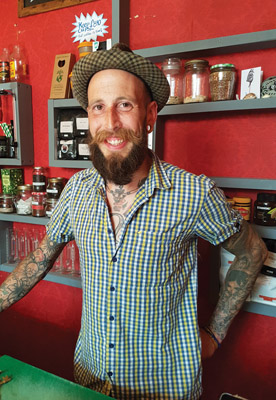
BearKat Café has been at the Lyric Theatre in Bridport for two years now. Set up by Dom Brown, the name comes from 1920s slang for ‘hot fiery broad’. Originally meant for the supper clubs Dom hosts, the name has also been absorbed by the café and his event catering business. Serving up a vegetarian all-day menu which Dom sources and cooks himself from local and, as much as possible, organic ingredients. Those wanting to reduce their food’s carbon footprint would do well to visit this little café, snuck into the entrance of Bridport’s vibrant theatre.

Dom is from an artistic background but found he preferred to explore his artistry through food rather than on paper. However, there are examples of his art also exhibited on the walls of the café, alongside other eclectic hangings, decorations and posters that beguile the eye. Dedicated to learning how to cook, Dom’s kitchen story demonstrates his determination. He was first introduced to the trade at The Bull Hotel in Bridport before moving on to Hix in Lyme Regis. This was followed by a stint in London, after which he moved back to Dorset to learn how to make bread under Aidan Chapman of Phoenix Bakery. With a full set of skills, he then worked for Soulshine Café in Bridport before deciding he wanted to work for himself.

Dom works hard at what he does. He makes everything you see in the café, apart from the bread that he gets from award-winning bakers Wobbly Cottage (as these days he says he’s not enough of an early bird).

When the café closes its doors, Dom puts an emphasis on having fun, he meets with friends, goes down to the beach, lights a fire, cooks up a BBQ, drinks a few beers and enjoys living where he does. Knowing most of his customers by name and with a story behind much of the produce he uses, try asking Dom about his Steaming Bat coffee. You are unlikely to be disappointed

Roy Gregory

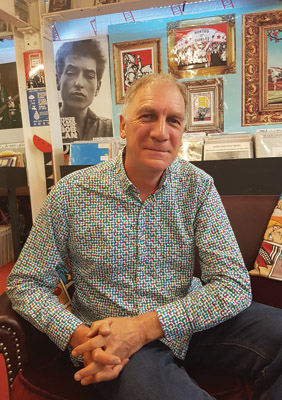
When Roy Gregory of Clocktower Music was a young man in Merseyside, most of his friends were in groups or bands. Unable to sing or play an instrument he consoled himself with buying records. And over the years his collection grew and grew. Until, one day, he decided he needed some space. So he set up a stall in Bridport’s iconic market and started to sell his records. The thing is, although people bought the records, they also brought their old records to him to sell. And so, Roy’s business emerged.

Roy came across Bridport as he was looking to live by the sea. He started in the Isle of Wight and made his way along the coast until he hit the buoyant bustling market town. Sitting in pubs and cafes he chatted with the locals and found no one had a bad word to say about the place, convincing him he had come to the end of his search.

From his market stall, Roy moved a couple of years later to the shop in the centre of Bridport’s St Michael’s Trading Estate. Following the devastating fire in the East Wing of the building earlier this year, Roy is grateful to still be able to trade from the Clocktower in the West Wing.

He is also the founder of Vinyl Saturday, a resounding success which has resulted in Bridport being heralded as one of the hot spots in the country for selling vinyl records. Now his lifelong hobby is his livelihood. The shop embodies the eclectic nature of Bridport, with upgraded Bluetooth vintage radios for sale and an old pinball machine in the corner. Crammed full of records; vintage and current, Roy often plays the music of local up-and-coming artists in the shop, giving his customers new material to marvel over.

Now, an integral part of the community Roy helps organise the Bridport Vintage Market each month. With his two daughters now living locally too, Roy also has his grandchildren at hand, keeping him busy with the next generation of music lovers.