

Monday, December 22, 2025
Home Blog Page 27

Hearts and cards

I suppose it’s mostly to do with my increasing age and senility, but I fear that my life long romantic streak is now becoming dulled by cynicism and an onrushing wave of new technology. Valentine’s Day may be somewhat old fashioned but it does bring a little warmth to the daily grey sludge of wet and windy February. It causes a rush of hearts and cards to break out in gift shops—a rush or perhaps better a rash of pink and red like an outbreak of measles. It’s the month when the price of red roses rises to a Queen’s ransom and a pandemic of cupids infests our supermarket shelves. Come to think of it, cupids are about the least romantic of any creature to represent Valentine. Why on earth should any small fat chubby baby armed with a dangerous weapon make me starry-eyed with love? In these modern days of suspected terrorism and dangerously fake news, I would expect any approaching cherub to be taken out with a killer drone. I shall arm myself with a shotgun as a means of self-preservation. And new technology has helped to squash romance still further. Instead of paying good money and sending a proper card featuring real cardboard in the post (no cupid, please), people nowadays send their Valentine greetings via Facebook or WhatsApp. This is useless as the sender should aim to be anonymous. All kindly and well-intentioned social media such as online Valentine greetings can be traced, hunted or hacked. If not, it’ll end up either deleted as a harmful virus or else dumped into the recipient’s spam folder. Passionate and adoring? I don’t think so…

Long ago I always rather liked Valentine’s Day and the hectic purchasing of cards as I scurried to catch the post in time. Before I had proper real girlfriends, I had a whole host of ‘pretend’ girlfriends. Love was about quantity rather than quality and the more the merrier to brag about in front of one’s mates at school. False girlfriends included the toothy tall girl I had met once on holiday and had kidded myself that she had a crush on me. In reality, she probably didn’t even know my name, but I could still include her in my Valentine card target list. Then there was my cousin Susan who was at least two years older than me and already actually had a boyfriend. I knew this because I once caught both of them secretly kissing behind the kitchen door. But she could still increase the numbers on my Valentine hit list

Then there was the gorgeous small blonde with whom I once had nervously exchanged a smile in the school car park on Parents’ Day. She was the older sister of Johnson from the lower sixth and a bit of an oik. Johnson I mean, not the girl. She was called Amanda and she was going to get my best card because she was HOT. And I had got her address from Johnson so he was alright really. But would she know who the card was from? I needed to include a sort of hint so it was still a secret but that she knew it was from me really. This presented a slight problem. Signing the card as ‘the guy you smiled at next to my parent’s car’ didn’t sound at all romantic. In fact, it would make me sound like a nerd, so perhaps better not to send anything… remain silently romantic in the shadows.

And if I didn’t send a card to her, there was always my sister if I got desperate. That would boost the number of pretend girlfriends up still further. But would my sister like the card with the two hearts floating on a ‘violet sea of love’? Probably not. She certainly wouldn’t like the one with the pink cushion heart and the two cute cuddly kittens. Nobody deserved that one, so I’d send it to mum for a joke. But then I’d sign it so she would know it was a joke and she would have to know it was from me which rather destroyed the whole point.

Over the last several decades, the number of cards I sent (and perhaps more importantly received) has grown considerably less. This is a good thing and is also considerably cheaper for everyone. Last year, I received just the one card. It was a very nice card. It pictured a beautiful painting in red and gold of a couple of pheasants flying round a field. I have no idea who sent it because there is no writing and no clue inside. It was probably from our dog, although my wife might have also had a hand in organising it and sending it. In truth, I think it might have been rather similar to one of the ones I had sent or had received the year before. And that of course is one of the main advantages of sending truly anonymous Valentine cards to people. Not only does it cause confusion and cause the recipient to wonder at the identity of secret romantic admirers, but you can also use them again the following year if you don’t write inside them.

Romantic? Moi? Pass the roses and eat the chocolates!
 

February in the Garden

‘Potato Day’ was on 5th January in Bridport this year; too early for me to even start thinking about planting potatoes—I’m still lifting the remains of the crop I grew in containers last year! Fortunately, there are many more potato selling events coming up this month (see www.potato-days.net) and February somehow seems more appropriate to start acquiring potatoes, to chit, prior to planting once the soil has warmed up a bit.

With all the stuff in the news at the moment, about reducing your meat consumption and eating more veg instead, I’ve been thinking about ways to grow vegetables within my ornamental garden. I have a small vegetable area, it’s too small to be called a ‘garden’ in its own right, but that’s a luxury for a lot of people and there is no practical reason why vegetables cannot be grown in the ‘flower’ garden.

Having said that, there is the practical consideration that you have to be able to tell that what you are harvesting, to eat, is not going to poison you! I reckon that if you have sown the edible crop, amongst your own ornamental plants, then you will know which is which. I was spurred on with this idea when reminded, by a radio programme, that, for at least a century after their original introduction, runner beans were grown for their scarlet flowers, rather than for their edible pods.

Herbs have often been incorporated into flower gardens due, I guess, to the fact that many of them are perennial and are ‘grazed’, rather than dug up completely, so their consumption does not leave gaps in the planting scheme. I am thinking here of plants such as thyme, marjoram, rosemary, lavender and the like. In fact, I have for many years used chives as an edging plant, at the front of a herbaceous border, where their purple, drumstick, flowers are a cheerful addition to their grassy leaves. There are enough of them to ensure that, when I snip off a handful of leaves to cook with, the harvested leaves are not noticeable.

As mentioned previously, growing vegetable in large containers is an easy way to incorporate them into a more formal garden where being somewhat ‘elevated’ excuses any lack of refinement. Succession planting of spinach in a huge, old, galvanised, water tank works well for me. Sowing the spinach in modules, rather then direct sowing in situ, reduces the amount of time that the container is leafless and provides a useful ‘reservoir’ of burgeoning spinach plants waiting to replace the harvested ones.

Spinach, along with any crops which are grown for their leaves, can be gathered by simply removing a few mature leaves from each plant so that, until the plants are completely exhausted, there are no gaps in your planting scheme. I particularly like doing this with lettuces, which make a fine formal edging, or under-planting in rose beds, where the sequential removal of the lower leaves, as they mature, eventually results in ‘standard’ lettuces where the lower stalk is exposed and each mini lettuce ‘tree’ is crowned with a rosette of the newest leaves.

I find the feathery foliage of carrot crops particularly attractive, although they are more tricky to incorporate into the flower garden because they need to be sown where they are going to grow. They require a deeply cultivated soil, preferably stone free, if they are going to produce the best roots to eat. Tall containers are one option, they also lift the carrot crop out of the flight path of their mortal enemy—the ‘carrot root fly’. Another way to foil the root fly is to ‘hide’ the carrots within another crop, preferably one with a strong scent. I’ve not tried it myself, maybe I will this year, but I guess that if carrots were sown amongst an ornamental annual, like English marigolds, then by the time the carrots are ready to be harvested the ‘cover crop’ will be so well established that harvesting the carrots, as required by the kitchen, will barely leave a hole.

Now, as far as February is concerned, some tasks are firmly fixed in the schedule, like doing the second shortening of wisteria shoots (to a few buds), while others are more random and reliant totally upon the state of the season. Even before the onset of global warming, the vagaries of the British climate have always ensured that no two years are the same. The comparative ‘earliness’ or ‘lateness’ of the season will determine much of what can, or cannot, be undertaken now.

With bulbs emerging ‘left, right and centre’, this may be your last chance to add a good layer of humus rich mulch, well rotted horse manure or whatever, to your beds. I always find it hard to get the timing right for this particular task. I don’t like to add a thick layer of organic matter right at the onset of winter where it will then sit, in a saturated mess, on the crowns of slumbering herbaceous perennials. I may be worrying needlessly but I fear that, in the wetness of West Dorset, this soggy carpet of decaying matter could do more harm than good.

Adding your mulch later, just as plants begin to break out of dormancy, means that it will still trap winter rainfall in the soil yet the plants will be active enough to fight off any potential rotting under a blanket of organic matter. Sprinkling a generous quantity of your chosen fertiliser, I still use ‘fish, blood and bone’, as you lightly fork the soil, ensures that the fertiliser is held in the soil as the mulch is applied on top.

Other tasks will become apparent, as you go along mulching, and that’s why it’s a pleasing job to be doing at this time of year. I tend to prune the roses as I go along and also remove old foliage from anything else that is holding onto it from last year—but which doesn’t need it!

Getting a head start with a few propagating tasks, under cover, is always a good idea. Slow growing annuals can be sown, towards the end of the month, if you can provide them with supplementary heat and a light position. Otherwise a timely tidy-up and stock take, in readiness for the main seed sowing, makes sense.

Remember to open up the greenhouse, on sunny days, in order to give your overwintering plants a good airing. If you are of the forgetful persuasion, or just very hectic, then set an alarm or leave yourself a note, stuck to the fridge / TV / bathroom mirror etc., so that it does not get left open on what could well be a frosty night; there’s still a fair few weeks of winter to endure.


Tomorrow’s World

Last November BBC4  showed a 90-minute programme reminiscing about Tomorrow’s World, a programme which ran from 1965 to 2003, describing possible future developments in science and technology. I remember it well and was a great fan. Presenters included Raymond Baxter, an ex-Spitfire pilot, always smartly dressed and Judith Hann, elegant with dark hair, cool and academic and the erudite James Burke. Then gradually came the younger more “with it” set, Howard Stableford, Maggie Philbin, Peter Macann and Michael Rodd. I hope I have not forgotten anyone.

Items Tomorrow’s World introduced to us included the home computer, digital watches, personal stereos and even artificial grass. Also hover-trains, mobile phones, cars without a driver, tidal power, pocket calculators and so on. Many of these are now commonplace, although some have not yet arrived, such as paper clothing. It was a very entertaining programme to me, as I was a technology fan.

I enjoyed the recent programme, but one sudden shock was Judith Hann with white or grey hair, rather than her earlier dark hair. But I have aged too! All the expectation now is that we shall all be driving electric cars, perhaps not driving but being driven by a robot. Even so, I had the pleasure of briefly riding a prototype electric motorcycle about the time Tomorrow’s World was beginning. I was amazed at its acceleration, but unfortunately, the market and certainly the battery was not ready for it. Back before Tomorrow’s World arrived we had the “Sputnik” and I remember checking the newspaper for the times of its orbits and comparing notes with colleagues. I also remember discussing it with the lady who became my mother-in-law and saying we would send men to the Moon in our lifetime, which was met with an incredulous look. She was probably thinking “How has my daughter become involved with this idiot”, but years later admitted that the prediction was accurate.

Looking back, even in my own lifetime of “Yesterday’s World”, I am surprised at the changes. I started trying to collect car number plate details as cars passed along our Wiltshire village road. Cars were so infrequent that I gave up. Aircraft were also few and far between and as children in the playground we would all look up when a plane flew over. Later in the 1940s, we were looking up all the time, at Spitfires and Hurricanes and then gliders with white stripes on fuselage and wings. But looking back, cars were probably eclipsed by horses and carts. They were laden with hay, straw and manure at different times and it was not uncommon to see a cart in a field with a man distributing manure from it, shades of a song by “The Yetties” singing “fling it here, fling it there”. I believe our milkman originally had a horse and trap to deliver the milk. During a visit to my aunt in Edinburgh, we were surprised to be awakened by a horse “clip-clopping” along the city street. When we questioned my aunt she replied very seriously that it would have been St Cuthbert’s horse, which did not answer our query—was it a ghost of St Cuthbert? On further questions, the answer proved to be that it was only the daily milk delivery from St Cuthbert’s Co-operative store. Delivery by horsepower is now so rare that the Wiltshire brewery Wadworth’s of Devizes use shire horses as a marketing ploy to draw a dray around the town, delivering beer to hostelries.

The other common sight on our village road was a herd of cows being driven to and from the communal milking parlour by the farmer on his bicycle. Twice a year the nearest town held a fair selling sheep or cattle, together with a modern amusement fairground. I do not remember whether it was also a hiring fair as described by Thomas Hardy in his The Mayor of Casterbridge.

When I was small my village had no mains water supply, no sewage, no gas and no electricity. No doubt this was true of many Dorset villages also. I can remember when electricity was first brought into our house and I watched the electrician running cables upstairs. At first, we only had electric lights, no power sockets, but it was a great improvement over the “Aladdin’s Lamp” powered by paraffin, or candles. I think “The Wireless” preceded mains electricity at home, as it was battery powered, with a lead acid “accumulator” for the filaments of the valves. Once mains power arrived a “battery eliminator” appeared. Before the electricity had arrived, the church organ was blown by a man “pumping” the bellows in a small room next to the organ. If he drowsed off and had not realised the sermon had finished, the next hymn would commence with an awful disappearing chord, which usually awoke the man from his sleep.

Our drinking water came from a shared well with a windlass and bucket, which I much preferred to tap water when I later tried that. We saved rainwater from the garden shed roof for bath use. At one end of the village, a small stream passed by a cottage and it was alleged that its occupier threw all his dirty water and other items into the stream which then flowed past the other end of the village where perhaps they used it for drinking. Before mains water arrived most households had a small outhouse in the garden which contained a seat enclosing a bucket for one’s relief. At intervals, the householder would empty the bucket into a hole dug in the garden. If houses were in pairs quite often the facility would be shared with side by side holes in the seat. To ensure privacy it was usual to cough politely outside the outhouse to find if it was already in use. These rudimentary toilets were sometimes referred to as “Earth Closets”. However “Earth Closet” was more strictly used for the invention of the Rev Henry Moule of Fordington, Dorchester with his “dry earth system” of sanitation at the time of the cholera epidemic of about 1850. Moule’s invention was a container for dry earth which by operating a lever would deposit some earth over the contents of the bucket. In present day some people have introduced a “composting toilet” which uses earth, wood sawdust, etc., to update Moule’s model.

Some larger houses might have had their own electricity supply from a generator driven by an internal combustion engine, fuelled by paraffin and probably the generator charged batteries for lighting. A local man would be employed to start and switch off the generator at the appropriate time. There might also have been a large water tank in the roof space filled with water by a pump from a well. The same man often operated the pump. The water would not only be used for drinking and bathing but could also flush the toilet into a cesspit in the back garden. This would require emptying at intervals.

Another change over the years is in education. In my day the village had an infant’s school and a “top” school, both clearly labelled C of E and children left when they were 14 years old. The nearby town had a Secondary, later a Grammar School, which took children from all around a wide area. At about 11 years of age, we all sat the Secondary Entrance Examination, which preceded the “Eleven Plus”. The Secondary School charged a fee but awarded a number of “free seats”, based on the pupil’s exam paper and I believe low parental income. Two “free seats” were awarded to our village school in my year and my best friend and I were pleased to receive them. Before the results appeared many of our fellow pupils said: “we do not want to go, we would rather leave and start work”.

At that time many of jobs in the village were “on the land” and my grandfather originally worked on a farm, later becoming a jobbing gardener. He insisted that all his sons should take up apprenticeships. His father, my great grandfather, had farmed in a very small way, on seven acres, with the help of his eldest son.

So that was my “Yesterday’s World” and I think “Today’s World” is generally better. “Tomorrow’s World” remains to be seen, but I am an optimist!

Bridport History Society will meet as usual in the United Church Main Hall, East Street, Bridport on Tuesday 12th February at 2.30pm. All welcome, visitors entrance £3.


Cecil Amor, Hon President, Bridport History Society.


At the Heart of the Community

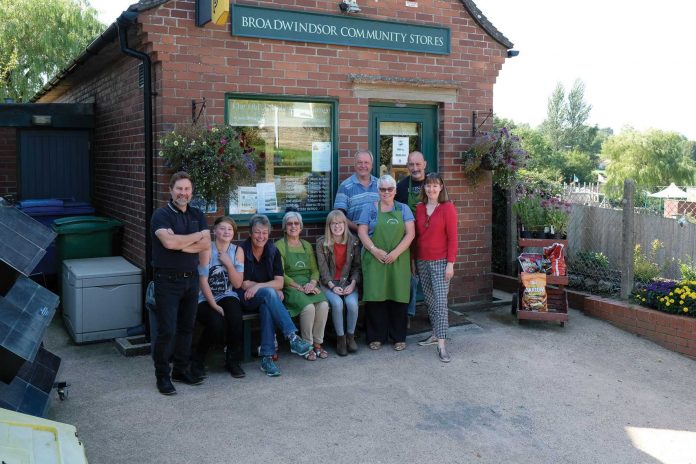
The Plunkett Foundation’s Rural Community Ownership Awards are an annual celebration of the contribution community businesses make to creating resilient, thriving and inclusive rural communities. Broadwindsor Community Stores, which was nominated in the ‘Community Story of the Year’ category, is a past winner of one of these awards. Margery Hookings finds out more about her local shop.


When Broadwindsor’s shop closed suddenly in 2012, closely followed by the pub (thankfully now open again and run by very enthusiastic and community-minded tenants) it had a huge impact on the community and surrounding rural area.

Many people in the village are elderly and don’t drive, the bus service is erratic and virtually non-existent.

Since it opened in 2013, Broadwindsor Community Stores has been the glue that sticks the village and surrounding area together. There are 231 shareholders in this community enterprise. The shop is open seven days a week, all year round. It draws on an army of more than 50 volunteers who help the employed manager and his assistant run the shop.

It’s a vital community facility, owned and run by the village. But, in the few years, the shop has been operating, it’s become much more than that. It’s a social hub, a little shop with a big reputation.

Retired farmer’s wife Jean Frampton, who has lived in the area all her life, says: “I just love my community shop. Nothing is too much trouble. They pack my bag and offer to take it to my car and get me special items if they don’t stock it.”

Grace Dawson is 21 and reading Music at Anglia Ruskin University, Cambridge. She’s been a shop volunteer since 2014 and still helps out during the holidays.

“It brings people together,” she says. “It helps older people especially, some of whom are socially isolated in this rural community.  They can wander down to the shop to buy a newspaper, or maybe a fresh iced bun and a coffee, and have a ‘natter’.

“When the old shop closed and the pub was closed too, the village died.  When the community rallied round and the new shop opened the whole village came alive again.”

Grace recalls how her late grandmother loved the shop. “She could not drive and public transport is not very good here.  However, she could take her time and walk down to the shop, do a bit of essential shopping and meet people.”

When the shop was the target of an attempted burglary last year, the locals took it personally. They were devastated and furious that anyone could target ‘their’ shop. The reaction on the shop’s Facebook page was staggering.

During the two bouts of severe snow last year, the village was cut off completely. Having the shop was a lifeline. During the heatwave, when people were too hot to travel, the shop again proved its worth.

White Lion landlady Vikki Phillips says: “We love the shop because it helps bring the community together.

“You meet all sorts of different people who live in the village and surrounding areas who help run it and shop in it.

“It also plays a large part in promoting and supporting local events and organisations. Our shop is also a lifeline to those who are unable, for whatever reason, to get to the nearest town to pick up prescriptions or groceries or just to have contact with other people for a natter.

“It also supports local businesses by stocking local produce.”

Volunteers have been recruited from all sections of the community, from retired people to students, to people with learning disabilities to those who work part time away from the village but want to be involved in their community.

Susanne Slater, a mother of two, says: “The shop is very special. It’s great for building up kids’ confidence and socialising between children and adults.

“The shop is so good for the village. We need it and all of us have responsibilities to keep the shop going and help each other as a community.”

Volunteer Mollie Peterson, 19, says: “It gets me out and I meet lots of people. I enjoy doing things in and for the community so this works for me.”

Kevin Madder-Smith became shop manager in April 2017. He and his wife had only just moved into the village when he was encouraged to apply for the job.

He says: “I was really worried about taking it on. I felt more than confident carrying out the duties of shop manager but, being new to the village and not knowing anybody, I was really worried as to whether I would be accepted.

“But, more than a year on, I feel fully involved in the community, especially managing the shop which is the hub of the village. In fact, I know people in the village that others who have lived here for many years do not know. Residents who have been here all their lives will sometimes ask me ‘who was that then?’ and I, the newcomer, am able to tell them.”

His experience in the shop gave him the confidence to become even more involved in the village as a parish councillor.

Retired engineer Geoffrey Hutson, who is in his early 80s, has lived in Broadwindsor for three years. He approached Kevin the manager and asked what he could do to help in the shop – but he didn’t want to work on the till. So he comes in at least one morning a week to help unpack the weekly deliveries and restock the shelves.

He says: “I just wanted to contribute something to our community.  It’s such a wonderful community, who wouldn’t want to join and support it in some way?”

Fraser Hughes, a retired marketing executive and a volunteer in the shop, was the first chairman of Broadwindsor and District Community Enterprise. He was instrumental in getting the shop off the ground.

“My first thoughts were the implications of the village not having a shop, and then could we garner enough support to finance the opening of a community one,” he says.

“There were many doubters, but following help from the Plunkett Foundation and visits to other community shops, we put a presentation together that convinced both people in the village and grant aiders that it was a sound proposition.

“After an unsuccessful bid to buy or rent the existing shop—which had closed the year before—we found an ideal, but small, premises.

“Now in our fifth year, we have a steady and profitable business, thanks to a strong committee covering all the essential disciplines for the business, and our loyal customers and volunteers.

“From a personal standpoint, although stressful, time-consuming and, at times, frustrating, I have found it one of the most satisfying achievements of my life.”


The Plunkett Foundation

The Plunkett Foundation’s Rural Community Ownership Awards recognise the efforts of rural communities that have rallied together to save and run vital assets, such as their local shop or village pub.

As well as community pubs and shops from Wales and England, a community-owned farm in Shropshire and a community bakery in Scotland featured amongst the award finalists.

They included Thorncombe Village Shop’s Mary Morris, who was a finalist in the ‘People’s Choice’ category. Mary has been a volunteer at the shop in Dorset for over six years, and has taken on more and more responsibilities. She can be found behind the till, cashing up and is responsible for ordering the fruit and vegetables. Mary started the Tuesday lunch in the café area, which has proved a great success and a scheme to get people talking and meeting in the village. Mary organises volunteers and their availability in the shop every day.

The community shop at Hinton St George, Somerset, was a finalist in the ‘Investing in Local People’ category. The shop provides work experience placements and paid jobs for younger, local residents and opportunities for people to complete their Duke of Edinburgh activities. With around 40 volunteers, who support the running of the shop, they are now in their seventh year and continue to trade as a successful community business.

Churchinford and District Community Store in Somerset was a finalist in the ‘Diversifying to Make a Difference’ category. The store, which has 70 volunteers of all ages, has bought the Post Office and offers an outreach service to those who are more isolated in the community. The store also provides computers, wi-fi and printing.

This year there was a record number of over 50 entries across six categories.

Up Front 02/19

Some time ago I wrote a short article about ways to combat algorithms, treating them as though they were a virus. It was written in the form of a spoof press release about helping people that had been neurologically manipulated by algorithms, and the names of scientists quoted were made up from characters in George Orwell’s 1984. As it happened, the article was too complicated and was consigned to the ‘maybe stick it on a blog one day’ file. The reason for writing it had stemmed from a conversation with a car insurance company where various people within the organisation couldn’t make sense of a quote that their computer had generated. It was totally illogical, and nobody could understand how the quote had been arrived at. However, after much investigation, the final comment was, ‘I’m sorry, but we have to stick to what the computer says.’ As we thunder down the road of leaving more and more important decisions to the power of technology—in systems that use data relying on common denominators and judgements made without any recourse to human intervention, or even investigation—it’s no surprise that some people want to roll back the clock. One example that was confirmed recently is the fact that profiling by social media companies can be done by simply gleaning information about the friends we keep. A study from the University of Adelaide in Australia and the University of Vermont in the US has found that, even where people have deleted their accounts, they can be profiled from the information that can be drawn from their friends’ posts. The researchers analysed the information content of over 30 million Twitter messages using information theory from mathematics and probability to test the predictability of individuals’ behaviour, based on their online posts. They showed that judgement about an individual could be up to 95% accurate based on data from their friends alone. One of the scientists, Dr Lewis Mitchell, likened the process to listening to a phone call but only hearing one of the two people involved—we can still glean a lot of information about the person we can’t hear. If we’re listening to the comments and interests of eight or nine people who are friends of the person we can’t hear, we are likely to learn a great deal about them. We’ve known for some time that internet activity is used to manipulate people, but the telephone analogy is interesting when you consider that telephone tapping is illegal.

People at Work

Recently engaged to the man she moved to Dorset to be with, Charlotte Cattermole has a bigger than normal spring to her step. Establishing Charlotte Grace Pilates soon after she moved to Bridport 18 months ago, Charlotte set about teaching Body Control Pilates. She started with taster classes, which were immediately fully booked, giving her the confidence to offer initially nine, now 15 classes, in venues such as The Tithe Barn in Symondsbury and The Health and Wellbeing Centre in Axminster. She aims to provide comprehensive Pilates classes with a difference. Charlotte’s goal is to help relieve people of pain and teach them to gain control of their bodies, freeing up movement and finding a sense of calm through exercise.
Charlotte has first-hand experience of how Pilates can relieve pain and heal the body. As a child growing up in Suffolk, she competed in gymnastics at national level and then moved into athletics, again competing at a high level. The regime and training took its toll and Charlotte was plagued with injuries. Physiotherapy and Pilates were prescribed to help her. During this time Charlotte learnt a lot about the body, biomechanics and our physical makeup. She furthered her knowledge by doing a sports massage course, duly setting up a massage business. However, her fascination with the human body and its movements was not sated and so she took a leap of faith and enrolled in an intensive Pilates instructor course in London, recommended to her as the best qualification she could gain in the field.
After two years of long-distance dating, Charlotte moved in with Alasdair, who had just opened a new bar in town, the popular The Pursuit of Hoppiness. Together they plan their future and businesses, both bustling with ideas and happiness. As their working lives are so busy, the couple don’t get to spend much time together and so save Sundays for each other and family. But Charlotte also manages to slip into the bar after a day of teaching, to say hello to her fiancé and grab a cheeky glass of prosecco, on her way home.

Snow Patrol

After a seven-year gap since their last studio album, Snow Patrol are about to tour with their new release, Wildness. The band, whose early hits include Run and Chasing Cars are fired up with enthusiasm for a mammoth tour.

Gary Lightbody talked to Fergus Byrne about why the new album is a breakthrough in so many ways.

When Gary Lightbody first formed the band that would later become Snow Patrol, his father wondered why he didn’t get a proper job. He wasn’t the first and probably won’t be the last parent to voice that question. However, he is one of the few that got the opportunity to see their child’s ‘little University band’ achieve real success, and in time, to understand what it was that his son was trying to do.

In a poignant video for the song Soon from their latest album, Wildness—a song about Gary’s father’s Alzheimer’s—we see film of him leaving his home in Bangor in Northern Ireland to get the ferry to Scotland. His father’s voice in the background says: ‘There’s son off to Scotland to make his fortune’. Later, before the first bars of the song’s haunting melody begins, there is a blurry shot of the ferry as it makes its way out to sea. His father muses ‘Here we have the next stage of Snow Patrol’s flight to Scotland’. The underlying pain in his father’s voice and the helpless uncertainty in his words are laced with the suppressed emotion of a parent losing their child. It’s made all the more poignant by the fact that his father would later lose the ability to conjure up and share those memories.

But Gary remembers the day they made the video for the song as ‘up there, at least in the top five days that I’ve ever spent with my Dad’, even though it is a heart-wrenching collage of old family VHS, interspersed with film of Gary and his father watching it together as they also look at old family photographs.

He admits that they were ‘estranged’ through much of his teenage years, simply because their two worlds were so different. ‘I had got into rock n’ roll, and it wasn’t his world, and he didn’t understand it’ says Gary. ‘It was a struggle for him to get his head around what the hell I was doing.’ Especially, he laughs, as for the first ten years there were no hits. But, like many estranged relationships, they managed to rebuild an understanding. Achieving some success, playing in bigger venues and playing at home in Ireland—where his father came to see them—helped heal the father/son fracture.

On the day that they shot the video for the song, they shared what Gary describes as ‘a connection that I never truly had since I was a boy—that feeling of oneness. He became the Lion again—rather than what’s happening now.’ In the lyric, Gary sings about the possibility that one day he will understand that feeling of forgetting. ‘Soon you’ll not remember anything, but then someday neither will I.’ He admits that while writing that lyric he was aware that one day he might fall victim to the same disease himself, but that was more of a side thought. It was more about kinship and understanding. ‘It was more to connect the two of us’ he says, to feel ‘empathy, not just sympathy.’

After forming a band on their first day at The University of Dundee, Gary and his fellow musicians undertook the same torrid journey that thousands of other bands followed. Band members’ left, new ones joined, and some were fired, while throughout their early recordings, the name changed twice. They were signed by a record company and dropped, then later signed by another. Gary remembers one occasion when they arrived for a gig to find there was literally only one person in the audience. For Snow Patrol, like so many others, it took many years before they achieved the industry’s legendary ‘overnight success’. Songs such as Run and Chasing Cars showed a song-writing depth and musical power that began to draw a loyal fan base, eventually seeing the band produce a string of number one albums.

But despite the success and the excitement of touring and playing in front of thousands of appreciative fans, Gary was battling his own demons. He has often admitted he suffered from depression from a young age, and although he says he has never been suicidal or tempted to self-harm, he has put voice to the fact that at times he wondered if it would be better not to be alive. Although that thought is a distance from contemplating suicide, it’s a short road.

However, it is a long way from where he is today. ‘How I feel right now is light years away from how I felt at certain points making the record, or at certain points of my life since my teenage years’ he says. ‘I’ve struggled with it. I know a lot of people do. In teenage years a lot of things are shifting, not just physically but mentally too. We sometimes carry some things that maybe don’t need to be carried. I did a lot of that. I’m not a hoarder for physical things, but I’m a hoarder in my mental life. I will just keep the things that seem to wound me around for ages, like harmful souvenirs. And in the last few years, I have just done my level best to try to remove each one of those things as they come up. With sobriety, I was able to do that pretty successfully. Obviously, it’s an on-going process; you can’t just rub your hands together and say that’s me done now.’

Since the release of Wildness, Gary has talked openly about his struggles with depression and alcoholism. He doesn’t want to be a spokesperson for mental health issues or the many abuses and diversions that exacerbate such problems, but with the release of Wildness, he wants to show that there is a way forward. ‘I see it everywhere, in friends, in family’ he says. ‘Everybody struggles with their mental health in some way.’ He feels he has gained enormously from having changed his lifestyle and taken the opportunity to talk with people about the problems that, as a boy growing up in Ireland, you simply didn’t talk about. ‘Almost the avoidance of it is the problem’ he says. ‘That’s what I’d felt for years, and that’s why I didn’t talk about it until I was forty. I wish I’d done it sooner. It’s liberating.’

That liberation and positivity comes through in the overall feel of Wildness. Gary explained that, though it took a long time to make, it was a labour of love. It’s all about moving forward and the fact that it is possible to pull away from the demons that drive some people to darker places. ‘It’s not a record of sadness, not a record of wallowing, not a record of depression’ he says. ‘It is a record about trying to find a way out of that. It is a joyful record, a hopeful record. It is born maybe of sadness, but it doesn’t linger there, it doesn’t dwell there. It isn’t a record that is immersed in that sort of lowness. There’s so many high parts to it, so many uplifting things in it.’

It is also a record that showcases the power of Snow Patrol’s music, something that is always so apparent in their live shows. On January 27th the band will play at the Bournemouth International Centre. It’s part of what people tend to describe as a ‘gruelling’ tour of travel and performance with little downtime. However, Gary doesn’t see the extended road trip as gruelling as people make out. ‘It can be pretty tough going if you are under the weather’ he says. ‘But if you’re not under the weather it’s a joy. It’s better to be playing most nights. It’s much better. You build up a head of steam; you build up momentum, you’re more comfortable on stage, you get a flow going. There’s dynamite in that. I’m really looking forward to it.’
After the English, the Irish and European legs of the tour they are off to South America, the USA, then the festivals and then Australia and the Far East. The tour takes the band into a series of gigs at the end of next year where they hope to play some special gigs to celebrate their 25th year as a band. Maybe even play some smaller more intimate gigs. In the meantime now is a good time to take the opportunity to see them.


People in Food

The best way to catch John Worswick is as he is emerging from the deck of his yellow boat, pulling himself up the ladder on to the quay in West Bay, clothed in a dry suit, and a sack of freshly gathered hand-dived scallops over his shoulder. Those in the know wait for him, in the hope of buying scallops by the dozen, from the man who only minutes before has been on the seabed. However, they are live, so a certain level of knowledge must be with the purchaser, as the scallops click and pop open and shut in the open net bags.
John has been scallop diving for 20 years now. He goes out in the morning, with his small team in all weathers, searching along the Jurassic Coastline seabed for the fan-shaped shells to harvest. Arriving back in the early afternoon, John unloads their haul to sell to large fishmongers in the area. They clean down the boat, and that’s it for another day.
The sea has provided a living for John for almost all his working life. Before moving to Dorset, he lived in Southend on Sea, where he grew up. Spending a childhood learning to sea fish from his father, they would search the beaches for bait, to save money. During a holiday from his new job in the civil service, John realised he made more money gathering lugworms to sell to tackle shops than at his desk employment. He promptly handed in his notice and continued to gather and sell bait for the next 20 years. It was only when he happened to go scallop diving with a friend shortly after moving to Bridport that John switched his focus.
Entranced by the underwater world, when John goes on holiday he aims for warmer climes but continues to dive, so he can take underwater photos of the sea life he so admires. Next year the Maldives are calling, with John hoping to get some good shots to mount on the walls of his house, alongside other marine holiday snaps. John loves what he does and finds his way of life almost stress-free. In fact, the most stressful time of year, he says, is waiting for his luggage to come through the conveyor belt at the airport on holiday.

January in the Garden

With the excesses of Christmas out of the way, there is a fitting air of sobriety in January which chimes with the bleakness of the winter weather. The shortest day has passed, so lengthening daylight hours provide something positive to hang on to, but it will take a couple of months for the warming effect of the weak winter sun to have much effect. Having said that, on dry, bright, days, it’s a joy to get outside and make the most of anything that is providing interest in the, stripped bare, garden bones.
Snowdrops are the most obvious candidate for blooming during the coldest weather and they are a ‘no-brainer’ in even the smallest garden. Due to the fact that they are a comparatively tiny bulb, liable to become desiccated if lifted and stored for autumn planting, they are usually recommended for planting ‘in the green’. This means that it’s worth making a note now, if you identify areas in your garden which are lacking, in order to seek out snowdrops offered ‘in the green’, in a couple of months time, at the point when they are dying down.
They are easy to send in the post, generally wrapped in damp newspaper, so searching for a nursery online is an option if no local supplier is apparent. It’s important to obtain them from a legitimate grower because there are still some rogues out there who might be tempted to profit from digging them up, from woods and hedgerows, where snowdrops have become naturalised.
In fact, they look their best when growing as huge drifts under woodland trees or shrubs. Flowering very early in the year, dying down before leaves reappear to close the canopy above, means that they can be added to almost any garden as an ‘under storey’ wherever there is bare soil beneath deciduous specimens. When growing them in large drifts, in naturalistic settings, the straightforward Galanthus nivalis, the non-improved species, is the most suitable and cost-effective type to plant.
Once you’ve established a decent population of your own then annual lifting and dividing of the biggest clumps, after they’ve flowered, is the quickest way to increase their number and the area of the drift. They will, naturally, seed themselves around so, even left to their own devices, the area they occupy will increase, slowly, over time.
‘Galanthophiles’, gardeners who collect special forms and varieties of snowdrop, get very excited about tiny differences that occur either naturally, or by deliberate breeding and selection, between different snowdrops. Over the years many named varieties have been selected so a quick search on the ‘www’ will yield plenty for you to choose from if you wish to acquire snowdrops with particular traits, such as larger flowers; broader foliage; degrees of doubleness etc.
I prefer to confine my ‘special’ snowdrops to terracotta pots in order that their special attributes can be more readily appreciated during the relatively fleeting moment that they are in full flower. This also has the advantage that they can be brought indoors, for a day or two, when at their best so that the weather cannot diminish them and their moment of peak perfection does not go unnoticed. The other advantage of growing them in pots is that they can be given extra special treatment, a little extra feeding while in leaf for example, and they are therefore quicker to multiply and increase in size and number. When sufficiently increased I may then liberate them into prime spots in the garden, safe in the knowledge that I still have the ‘insurance policy’, of keeping a number of them safely confined to a pot, just in case they become ‘lost’ in their garden position.
One area where ‘special’ snowdrops may well be most appreciated is underneath those particular shrubs which are grown for their colourful winter stems. Cornus species yield many of these in a range of hues including bright green, vivid yellow, fiery orange and strong red—another search of internet images will quickly identify varieties fitting each of those descriptions. For years I’ve relied on Cornus sanguinea ‘Midwinter Fire’ to provide a really blazing display during the darkest winter months. It’s not as vigorous as the Cornus alba derived varieties which, I think, is an advantage as it’s less likely to get really huge and coarse in a garden situation.
The more vigorous dogwoods are invaluable to provide coloured stems in a mixed hedge, for example, or when used ‘en masse’ in naturalistic planting schemes, especially in boggy pond or stream margins. Once established it is important to cut them down in early spring, either completely or as pollards, in order to get the best stem colour because it’s the newest growth that has the brightest colour. Cutting them back completely, ‘stooling’, every year will weaken them, over time, if they are not also given a mulch, plus feed, during their late spring / summer growing season.
One last thought for January is that, being a ‘slow’ time of year, it’s worth looking back as well as forwards—inspired by the dual-faced god, Janus, from whom this month is traditionally assumed to have been named. One thing that I try to do, although I generally fail to record it properly, is to make a note of plants, or garden ideas, that crop up throughout the year but actually require seeds or plant to be acquired at a later date. One useful aspect of using ‘Instagram’, as a source of gardening inspiration, is that you can save images into a virtual ‘folder’ as an aide memoire.
I am resisting the urge to fill my garden with dahlias, which I’m sure have been on the ascendant due to their Instagram-friendly easiness, but I do save images of plants that have caught my attention and are most easily procured as seed which, by definition, needs to be actioned around now. A quick glance at my ‘App’ yields Dianthus superbus as a plant which caught my attention last year, when it was in flower, but needs to be grown from seed sown in February—hence NOW is the time to do something about obtaining the seed (and I note that ‘Chiltern Seeds’ offer it, along with many other specialities, so I’ll be adding it to my existing order from them).
The thought of compiling, then sending off, seed orders is, I think, a suitably positive note to conclude ‘January in the Garden’ given that it can be a particularly depressing month to cope with…

Vegetables in January

Want to double your productivity this year? The technique of sowing or transplanting a second crop between ones soon to finish increases productivity, especially valuable if you have a small growing area.
For instance last year, leeks sown in April were dibbed in late June between sweetcorn. The soil was bone dry, the leek were well watered in and then looked like they had died, all the leaves flaccid. But a couple of weeks later they were looking perky again, and after we ate sweetcorn in August the leeks grew strongly and now a good size.
This intercropping is so useful for maximising your growing space—summer crops with winter ones jostling for space during the full-on months of midsummer. So in June, we transplanted chard in a bed of March sown lettuce, and in May planted butternut squash against a bed of early potatoes. After delicately digging out the potatoes, and by August the squash covered the area, their main month of growth. You can also plant squash between rows of peas and broad beans, when they are finished in July, the squash soon fill the area.
There is also the practice of catch cropping in the Spring, where you can grow rows of lettuce between newly sown parsnips or carrots. By the time the parsnips are getting going, the lettuce are finished. Sowing parsnips between overwintered purple sprouting or spring cabbage has worked well for us too, especially if you keep the seed rows well watered until germinated.
Another favourite is to transplanting winter salads in the greenhouse between tomatoes in September, then to sow carrots and garlic between the rows of salad in October where the tomatoes were, keeping the precious indoor space busy and productive.
The idea is not new, and many people have been doing it for a long time. You get more for your money by doing it, and it is good for your soil to keep it busy all the time. Did you hear about the man who went to see his doctor complaining that he was having a terrible identity crisis. One moment he thought he was a teepee, the next a wigwam. The doctor said, “You’re too tense”.