
Monday, December 22, 2025
Home Blog Page 25

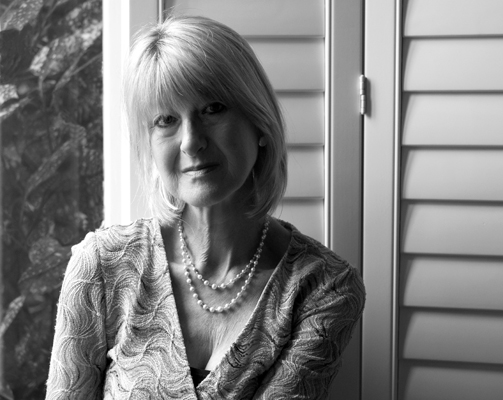
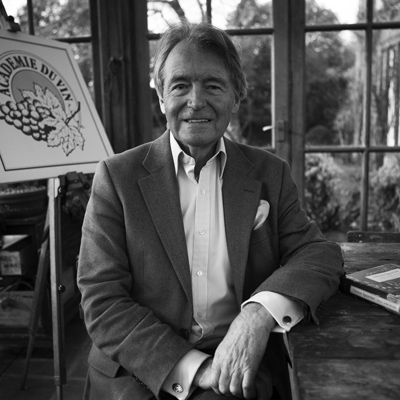
Steven Spurrier

‘I was brought up in Derbyshire where my family have lived for several hundred years. We have been churchwardens of the village church at Marston-on-Dove, where my elder brother still lives, since 1632 without a break. He will be the final churchwarden there.

The Damascene Conversion moment for me was Christmas Eve, 1954, probably my first in long trousers because I’d just started at Rugby public school, dining with my grandfather, parents and brother in the family house. He said, “I think you’re old enough for a glass of port”. A glass was brought, the decanter was pushed in my direction, I poured myself a glass and tasted it, and said “Gosh, Grandpa, what was that?” “Cockburns 1908, my boy”, he said. And that, in all honesty, put me in the wine trade. The bottle of vintage port, with its label, date, and country of origin I could identify with in the same way as my stamp collection, which then became a point of reference in my geography and history lessons at school because I was learning how wine production fitted with those subjects. Later at the LSE, having joined the Wine Society, I was quite clear about wanting to go into the wine trade when I had finished my education.

My father didn’t approve of my ambitions and advised me to use my degree in Economics from the LSE to get a job in the City. In the end, I did a deal with him, saying that if I could get two different job offers in the City, I wouldn’t accept them but it would at least show that my degree had employment potential, and I would still look for a job in the wine trade. He accepted that, although in truth any employer in the City in those days would have offered a job to a young man with an economics degree and a private income. I was on to a winner.

So in 1964, I joined Christopher’s in St James’s, reputedly the oldest wine company in the country. It was definitely the old fashioned wine trade, and I spent a year as a kind of indented slave in the wine cellars but learning the whole time. In ’64 they sent me to Burgundy for a week and Champagne for another week, then in ’65 they sent me abroad (at my own expense) for 6 months in Europe—to Bordeaux, Burgundy, the Rhone Valley, Germany, Oporto—although nothing about Italy. This was pretty much standard practice in the 1960s for a young man wanting to make his career in the wine trade. I had written in advance to all the employers, the great wine houses of the regions I was about to visit, saying that I was looking forward to working for them and learning all I could, but that I was fortunate enough to not need to be paid thanks to my private means. That resulted in a certain amount of preferential treatment towards me compared to the other “stagiaires” (trainees), so that I would get asked to join the wine tastings, and sometimes lunch, with the aristocratic, and slightly snobbish, employers, who possibly saw me as “one of them”. The result was that I learned a massive amount because I saw it from the inside, and through getting to know the members of the great families who had been producing wine for hundreds of years I learned about the history.

Returning to London and the Swinging Sixties, I continued to work in the very active wine trade of those days. Having inherited a substantial sum from the sale of the family sand and gravel business, I bought a property in Provence, a ruin which I intended to restore. I had also met my future wife Bella in ’64, so in 1968 we married, and the same evening took the Golden Arrow train to Paris, and thence to Provence, to make a new life in France restoring the ruined farmhouse. Sadly, we were ripped off right left and centre, and realised by 1970 it wasn’t going to work out. Not wanting to return to England with my tail between my legs, we decided to go to Paris where I could return to the wine trade. On arrival I soon found there wasn’t a wine trade in the same way as England; there were wholesalers, and there were wine shops, but nothing in between, so I decided the best bet was a shop. Passing a boutique de vin in the Madeleine one day, I remarked to my friend that it was my absolute dream of a shop. So we went in, and by good fortune, the lady owner wanted to sell. But not knowing me she was worried that I might destroy her late husband’s reputation as a caviste, and that my poor grasp of French would be a disadvantage. So I agreed to work for her for six months to prove myself, then do a deal if it worked out. We exchanged contracts on April Fool’s Day, and I then put an ad in the Herald Tribune, published in Paris, which ran “Your wine merchant speaks English—call Steven Spurrier. The only English-speaking wine shop in Paris.”  At that time all the British and American banks, and major law firms were represented in Paris, and they were pretty much all in the Madeleine, where I was. So my clientele were already there, and unlike other wine shops, I was choosing and selling my own wines from my knowledge of the vineyards. One of my American clients suggested that I put together a wine course, and I teamed up with American wine writer, Jon Winroth. We took over the premises next to the shop, Jon taught the courses there while I continued to run the shop; Patricia Gallagher became the manager, and L’Acadamie du Vin was born in late ‘72. We were the only game in town, but by forming cooperative business ventures with two or three of the other great wine shops in Paris, between us we were beginning to shake up the whole Paris wine trade. The biggest shake-up however occurred on the 24th May 1976 at a blind tasting L’Acadamie du Vin had organised, by the top French wine experts of the day, comparing some of the up and coming Californian wines to a selection from the finest French chateaux. The tasters had no knowledge of what was in their glasses, with only their palate and experience to judge the wines. To our astonishment, the results of the tasting put the Californian wines, especially the Chardonnays, ahead of the French. The reaction to the results from the French tasters was understandably shock, horror and disbelief. One of the tasters, Aubert de Villaine, called it “un coup dans le derriere pour les vins Francais”, a kick in the backside for French wines. The Californian producer of the winning Chardonnay, when told he’d beaten the French at their own game, said drily, “Not bad for kids from the sticks”. Reporter George Taber from Time Magazine, the only journalist to be present, recorded the event in his book, and the day became known as “The Judgement of Paris”, such was its significance in the years to come.

Ten years later, Bella and I were thinking it was time to come back to England, but I was persuaded to go to New York instead, being advised that having been so successful in Paris I couldn’t help but be even more so in America. As it turned out, it was a complete and utter disaster, nearly the end of our marriage, and mainly due to taking my eye off the ball over my business ventures, financially we were in poor shape. Back in London, I created the wine courses at Christie’s, but by 1989 I sold off everything. My 20-year stint as Steven Spurrier, Marchand de Vin, was over. My debts were greater than the value of my only asset, my London flat, as the guys I’d sold the businesses to failed to pay up.

The years 1990 to 1993 were pretty bleak, but the road back began with the offer of a job with Singapore Airlines as a wine consultant, and then came the offer of a regular column with Decanter magazine. I was becoming much better known as a wine writer, having written 5 successful books on wine, and it became something I loved doing because I was travelling the world with Singapore Airlines, and writing about the wines I was discovering. That put me back in the centre of the wine trade, and I’m still writing my monthly column.

Bella had bought the farm here in Dorset in 1987, and noticing the abundance of chalk under the thin topsoil I took a sample to Michel Bettane, France’s great wine guru. I asked him where he thought it came from, to which he replied “Champagne, of course”. “Actually, Dorset”, I replied. “In that case, you should plant a vineyard”, he said. The idea took a few years to come to fruition, but in 2009 we planted our first vines here at Litton Cheney. There have been some quite good years, some not good, but this last sunny summer has given us our best, by a long chalk.’
April in the Garden

When writing about roses last month I forgot to mention that, even though I tend to leave the final pruning until relatively late, it is good practice to shorten the overall growth before winter. I was reminded of this during all the recent high winds and blustery downpours, during which any non-shortened specimens ran the risk of ‘wind rock’.

This phenomenon was more of a problem when serried ranks of hybrid tea roses were grown, in massed displays, with bare soil all around. If they weren’t cut back, at least partially, before winter then high winds, combined with sodden soils, could lead to the bushes being blown backwards and forwards in the ground. In the worst cases this led to root damage and the resulting risk of plant death or, at least, poor performance.

For the same reason, fast growing, often ‘top heavy’, plants, such as buddleia, should be cut down by two thirds in the autumn and then reduced to practically a stool (the posh term for a stump) at the beginning of the growing season—right about now. Their spring extension growth is so fast and sappy that, if chopped down too early in the season, there is a chance that late frosts wipe out all the newly sprouted shoots. They are so vigorous that it’s better to lose a proportion of new growth, visible now, than to chop them back during the depths of winter. As with so many gardening tasks it’s a question of balance, no two years are the same, and it’s foolish to be a slave to ‘hard and fast’ rules.

We are at the tipping point of the gardening year when it really does feel that winter is being left behind and the re-greening of the countryside gathers momentum. Buds burst from bare stems and spring bulbs double in size and abundance overnight. The first battalion of spring bulbs are going over, to be replaced by blousier, bolder, beauties, such as the taller daffodils and the first of the showier tulips.

Whilst in leaf, before they start to die down, it’s worth feeding the spring bulbs in order to give them a chance to replenish their expended energy and to encourage them to flower again next year. In beds and borders I rely on the trusty application of fish, blood and bone, my ‘go to’ general purpose fertiliser, but in containers, where floral displays have to work really hard, April is the first month in which it’s worth applying a chemical ‘slow release’ fertiliser.

These granular feeds rely on clever science, regulated by soil temperature and moisture, to release a balanced supply of plant food over the growing season. Their expense is best justified in situations where plant growth might otherwise be limited by finite soil volume or an otherwise artificial planting situation.

With rising average temperatures and a diminishing risk of hard frost there’s more opportunity to sow hardy annuals this month than there was last. Also sowing lawns from scratch can take place now, following rigorous seedbed preparation, as long as you can provide some sort of protection from heavy downpours which would otherwise wash the seed and fine tilth away.

Plants which have been wrapped up in fleece, to fend off the worst of the winter cold, can be unwrapped during mild spells.  Keep the fleece close at hand for rapid deployment when frost threatens. Open up cold-frames, greenhouses and conservatories, whenever it is sunny, to encourage ventilation and begin the hardening off process. If you took tender perennial cuttings in the autumn, and they are still in pots or seed-trays, then these should be separated out and potted up as soon as growth resumes.

It’s a good time to plant out containerised trees, shrubs and herbaceous perennials as growth is well underway, which makes establishment easier, and water should be in good supply. You’ll still need to thoroughly water them in, as always, and to keep them well-watered during warm, dry, weather.

This is the optimum time for planting evergreens. Unlike deciduous plants, which shed their leaves and require very little water while denuded, evergreens are always ‘in leaf’ and losing water by transpiration. The danger of planting them in the coldest months of the year is that, if the surface soil becomes frozen, then the water cannot be absorbed because the roots will not have had a chance to extend to a depth below the frozen soil.

Planting at the beginning of the new growing season allows for rapid root growth, assuming you remember to loosen the root-ball when you plant it, which will stand the evergreen in good stead by the time it faces the danger of frozen ground next winter. As usual, it is imperative that it is kept well-watered, after its initial watering in, for at least the whole of its first growing season. Evergreens are very prone to becoming stressed, eventually dying, if at any point they are droughted. They are most at risk during the first summer after planting—hence the need to water them whether you think they need it or not!

Again, with recent high winds in mind, it’s worth remembering that it’s not only blazing sun that dries out the soil and plants. Air flow over leaves massively increases the transpiration rate, the method by which water is lost, and strong winds will dessicate foliage if the plant cannot absorb water from the soil as quickly as it is being lost from the leaves. In serious cases this leads to the effect known as ‘wind burn’ where the foliage becomes shrivelled and blackened, looking like it’s been burned by fire.

A final thought, as I’ve not mentioned them recently, is that increasing average temperatures will lead to an exponential increase in the prevalence of pests, diseases and weed growth. All of these gardening bugbears require ongoing vigilance if they are to be kept in check and not allowed to get out of hand. Whatever method you choose to control them, be it organic or chemical, then the key is to nip any problem in the bud. Gone are the days when gardeners expected to completely eradicate all the gardening ‘nasties’ because that really did require an awful lot of chemical intervention.

Today’s more balanced approach, allowing a degree of ‘live and let live’, leads to a more harmonious, more sympathetic, gardening culture which makes growing plants less of a battlefield, I hope.

UpFront 04/19

I’ve always looked forward to April. There is a general feeling of anticipation and hope—winter is behind us, and we can look forward to growth again. But I’m not sure about this April. We live in such confusion that it’s hard to anticipate the general atmosphere after March 29th. However, my brother reminded me of a story from April 1934 that briefly side-lined that question. It is about an event in my Grandfather’s life. Back in the early thirties, my Grandfather was a local County Councillor during a time when farmers were refusing to pay controversial land annuities that had dated back to the 1800s. When refusing to pay, some farmers had their livestock confiscated to be auctioned off to pay the fine. On this particular day, five head of seized cattle were due to be auctioned to pay the fine levied on a local farmer. However, due to the presence of protesting farmers supporting the man whose animals had been seized, the sale was aborted—there were no bids. With yelps of delight, some of the protesters then broke the cattle out of the pens, and, pursued by the local constabulary, drove them down the side streets of the town. The bemused animals were soon joined by an excited crowd cheering them on. It was all a great laugh until they turned a corner to face a line of police with batons drawn. Even the cattle participated in the ensuing standoff, and, concerned that things might get nasty, the police asked my Grandfather—a man described as a, ‘very influential man in the county’—to calm the crowd. This he did, stressing the fact that the police were, as he put it, ‘the custodians of the public peace, and should not be molested’. The crowd dispersed and no doubt many of them made their way to nearby hostelries to discuss the day’s events, and maybe even the price of cattle. The story might have ended there, except the following week; in a dawn raid that might have looked more at home in an episode of Line of Duty, my Grandfather, along with eight other members of the community, was arrested and thrown in jail for public order offences. The constabulary’s case was eventually thrown out but not before hysterical testimony that included descriptions of the crowd as ‘possessed with hysteria’ and ‘maddened and infuriated’ and even a suggestion that men were ‘frothing at the mouth’. This was, of course, all cobblers, as the barrister for the defence was later to prove. But I couldn’t help thinking that the descriptions might easily have applied to recent activity in Westminster.

Vegetables in April

At last it is time to sow most crops.

April weather is highly changeable in spite of good light levels, and the soil is still cool. All seeds germinate better, stronger and faster when the soil is warm. Try and spot a warm spell coming up on the BBC forecast—it’s so accurate!

Most seed come up better if not sown too deep, lettuce for instance only need a smattering of soil cover, ¼” at most. They appear above ground level in 3-4 days if warm, their first little roots go down quickly too, and so even if the surface looks dry, the soil below should be moist.

This brings us to soil tilth and compost richness in the surface layers of your soil. Germination is definitely quicker if you haven’t dug your compost down out of reach. If you have a layer of really fine rotted compost, like the recycled green waste we use, you can sow into this, rather like sowing in a seed tray, so long as you have worked a fine tilth in the soil layer beneath. The idea of a fine and firm tilth is that seeds won’t drop down through cracks, rather the crumby soil will surround the seed and keep it moist and fed.

We find it easier to sow indoors in modules. Just as with outdoor sowings, make sure the compost is well wet when you sow the seeds and cover lightly. They should not need watering every day, as the first roots go down into the moist compost beneath. Too much water prevents seeds and roots getting air. Composts now on the market without peat are more likely to waterlog.

Tiny seeds like celery and celeriac should be sprinkled on the compost surface. As they take 2-3 weeks to germinate, we put cling film over the top and leave in the airing cupboard for 10 days to get the seed thinking of coming up, and then move to the warm greenhouse.

Mid-month we sow courgettes, squash, basil and sweetcorn in the warmth of the greenhouse, and from the beginning of May our French and runner beans. None of these like being overwatered, especially basil.

And how do you know if the soil is warm enough? Take your trousers down and park yourself on the soil. This is revealing for you, the soil and those around you.


People in Food Richard Balson

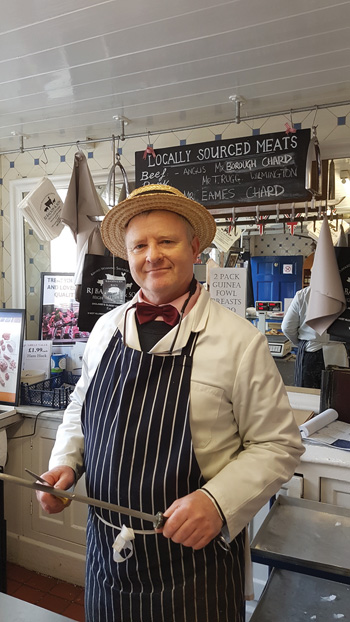
From waking in his bed as a child and hearing the thump thump on the butcher’s block in the shop below to wielding the meat cleaver himself, Richard Balson knew from a young age he would follow his father and grandfather before him and become a butcher. Famously this family butcher, R J Balson and Son in Bridport, has appeared on all manner of media due to their accolade of being Britain’s Oldest Family Business—503 years of trading and counting. But this wasn’t what concerned Richard as he raced through the shop and out to school as a young man. Then, it was sports and carpentry which garnered his interest.

Open at 7am ready for the early customers, of which there are a surprising amount, Richard runs the shop with his French brother-in-law and ex-chef Rudi Boulay. A great supporter of local suppliers, Richard is proud that his local meat can be sourced from field to fork. Richard also specialises in making his own sausages, 20 varieties, many award-winning, and still makes his own faggots. Supplying local restaurants, pubs and hotels, Richard and his team, made up of family members, are a main stop for locals on their shopping round. Friendly, cheeky and all smiles, the shop is often full of chatter as customers share stories and banter with Richard and Rudi. They are proud of their traditional butchers’ premises and the family thrive through hard work and the loyal custom of Bridport’s residents.

When not at the shop, Richard spends time at home with his wife Allison, up the road in Symondsbury. Together they helped build the house they live in, making a building pair to be reckoned with. Richard’s continued love of carpentry and can-do attitude meant he demolished the previous building with his bare hands and a Land Rover. And Allison’s love of power tools continues to come in handy. Organiser of the Symondsbury Fete, Richard loves car boot sales as well as antique and second-hand shops. He is also a keen participant at Beaminster Walking Football; is a member of his local skittles team; part of the Symondsbury Mummers and plays the occasional game of golf. But what really makes Richard most happy is getting out into the garden with his grandchildren, seeing what the vegetable patch has produced for them all, and sitting around a table together to enjoy the results.

People at Work Charles Chesshire

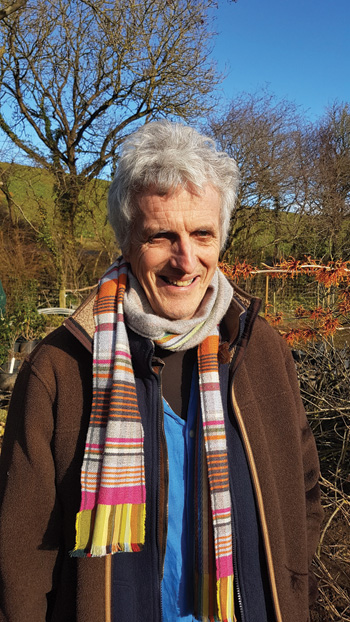
A garden designer, nurseryman and writer, there isn’t much that Charles Chesshire does not know about plants. And he loves to talk about them. Anyone visiting his haven of a nursery, Charles Chesshire Plants & Gardens, situated by the old sheepwash in Symondsbury, can experience his vast knowledge and enthusiasm for plants. Stocking rare and special plants, Charles specialises in but is by no means limited to; Peonies, Clematis, Maples, Hydrangeas and Perennials. Any plant a customer might require which is not in stock is meticulously sourced, and if required, discussed according to habitat and situation.

Growing up on the Welsh Borders, Charles jokes that he has “Camellias in the family”, as his ancestors travelled to China to collect plants, resulting in a Camellia named after them. His career to date is a kaleidoscope of interesting, fabulous and most renowned gardens. He has designed gardens and landscaped for Sheiks’ Palaces in Saudi Arabia, for Billy Joel in Manhattan, various rooftops and terraces across New York, is restoring the Rhododendron garden in Lydney Park and designed Morton Hall gardens, Inkberrow. He has written books, in particular on Clematis and Japanese Gardens and provides consultancy where and when needed. But right now, he has settled in Symondsbury, to be able to just “breathe” plants.

Charles’s main aim for his clients, whether they are a grand estate or someone with a postage stamp back yard, is for them to love and enjoy their garden. He can foresee as soon as he walks into a garden what it could look like, and works with the clients’ wishes and needs to provide them with anything from a hand-sketched drawing to full design and implementation.

On holiday he eschews swimming pools, preferring to trek to wild places to see the plants he admires so much in their natural habitat. Currently researching a book set in China, Charles spends a lot of his time in the evenings reading. Cooking most nights, he puts what he has learnt from his travels into good practice in the pan. Feeling like he belongs here in “Herefordshire-On-Sea”, as he calls the Marshwood Vale area, Charles is making a new pot-shaped niche for himself in Dorset.

Jane Corry

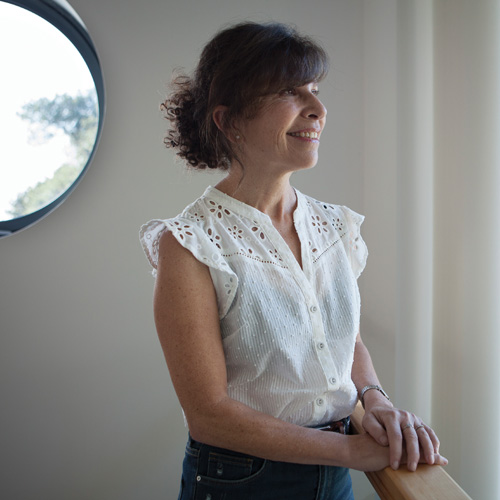
‘I was an only child until I was seven when my sister came along. I read a lot and enjoyed my own company. I wanted to be an author for as long as I can remember and still have scraps of paper on which I’d written little stories in rounded childish writing. My parents didn’t have much money but they loved books. They would read to me every night and I am sure this made a big difference. My mother was a nurse and later an educational welfare officer. My father trained as a draughtsman with De Havilland during the war and then worked in engineering. Our parents worked very hard to give us a good education. My sister and I got places at a well-known London girls’ school called North London Collegiate where the fees were set according to parental income. Otherwise we wouldn’t have been able to go there.

We lived with my grandmother until I was 12 in the suburbs of Harrow. Then we moved to a house around the corner but I still saw her every day. She was a great influence on me. We weren’t allowed to call her granny because it made her feel too old. So, she was ‘Doris’. If I had a teenage argument with my parents, Doris was the first person I went to. I think children can benefit greatly from living with grandparents. I feel so lucky that my only surviving grandparent was so close.

Our parents expected us to have high flying careers. I was hopeless at maths and science. I never considered myself to be bright as the only thing I could do was write stories! I remember going to a careers convention and saying that I wanted to be an author but was advised to do something ‘safer’ like teaching. I walked home in tears. The irony is that later in my life, I did start teaching (in creative writing) and loved it.

I went on to read English at Reading. I was then accepted as a trainee journalist on the Thomson Graduate Scheme. I spent six months in Cardiff where I had my first piece printed in the Western Morning News. It was a review of an art exhibition and I will never forget the excitement of seeing someone on the train to Penarth reading my piece! Then I worked in London on a trade fashion magazine called Drapers Record. Every week, I had to ring round all the big shops and find out what was selling well to write about current trends. I also interviewed fashion celebrities like Zandra Rhodes as well as Gertrude and David Shilling the hat designers. We had a cupboard of clothes left over from photo-shoots and were allowed to borrow them!

But I wanted to write about ordinary life and not just fashion. So I became features editor at Parents magazine (even though I didn’t have children at that point) and then Woman’s Own. One day, my editor sent me to interview a young actress. ‘She’s going to be really famous,’ he told me. I called for her at her London flat and we went out for lunch together. We got on very well and had lots of giggles together. The following month, her new film opened which also starred Michael Caine. Her name was Julie Walters…

Soon afterwards, I had a miscarriage which was deeply distressing. When I got pregnant again, my doctor advised me to have bed rest. So, I handed in my notice at Woman’s Own. After my son William was born, I picked up the phone and spoke to the then features editor on The Sunday Times. I asked why there weren’t any articles on miscarriage and she commissioned me to write one. This led to a long career of writing features about family matters besides two more babies. I worked from home which involved a lot of juggling. When William was small, I took him with me to interview Pam Ayres because I had no one to leave him with. Pam was very understanding and we stayed in touch for several years.

I married young at 22 and have three wonderful children as a result, William, now 35, is a qualified lawyer but gave it up to write novels.  He’s teaching English in Spain at the moment in order to support himself in the meantime. It can take time to get published. The writing gene does seem to run in the family. My youngest son, Giles is a journalist. He writes a music playlist for the i newspaper and also presents and produces on Soho Radio in London. My daughter Lucy is a teacher and very creative.

In 2005 my marriage ended. At the same time, my regular page for a woman’s magazine finished and I needed to find regular income. By chance, I spotted a newspaper ad that said ‘Wanted! Writer in residence for a high-security prison’. It was nearby on the borders of Oxfordshire and Buckinghamshire. I knew of the prison but never expected to go there. I almost didn’t apply because I was scared! But the salary was the exact amount—down to a penny—which I needed, on top of my maintenance, to pay my mortgage. At the interview, I had to meet the ‘residents’ to see how I would react. A big beefy man came up to me with tattoos down his arms and missing front teeth asking what I was doing there. I nervously explained that I was being interviewed as a writer in residence. ‘Hah!,’ he scoffed. ‘I can’t even read let alone write home to the kids.’ Suddenly a light came on in my head. I suggested he could speak it out loud and I’d write it down for him. I was offered the job. Over the next three years, I spent two days a week helping men of varying abilities to write life stories, poems, letters, short stories and even novels. Little did I know this experience was going to change my life and also inspire me to write four novels. I didn’t have an officer with me when I ran workshops or gave one to one feed-back on men’s writing. But I only felt unsafe on two occasions. The first was when a prisoner spat at me. (He later apologised.) And the second was when another ‘stalked’ me in the prison. It’s not considered good manners to ask what people did in prison and usually it’s best not to know because it can change your attitude. But I couldn’t resist looking up his crime on Google. After that, I made sure I was never alone again in his presence. It always took me a while to ‘settle down’ again after my two days a week at the prison. I would also constantly warn my children and their friends against taking drugs or drinking too much because many of ‘my men’ had committed terrible crimes as a result. Besides working at the prison, I also taught at Oxford University. On some days, I went straight from one to the other. I can honestly say that certain prisoners showed just as much talent as the students!

By then, I’d also been published as a romance author. But my prison experience made my writing grow increasingly darker! I began writing a novel about a woman lawyer who, like me, had never been inside jail before. She takes on a murderer’s appeal case and cannot help falling into a relationship with him. I called it My Husband’s Wife and it became a Penguin best-seller in 2016. Since then, Penguin has published Blood Sisters and The Dead Ex which also got into the top ten. My fourth novel I Looked Away comes out this summer.

After my second year at the prison, a friend (Shaun Corry) whom I’d known all my life asked me to marry him. I’d always been drawn to live by the sea. My father’s father had been a sailor and when we came down here, I just fell in love with Sidmouth. But I’d just accepted a contract for a third year at the prison and didn’t want to let them down. A prison officer happened to live in Devon too so I commuted every week in his van.

I feel so lucky to live in such a beautiful part of the world. I became a Royal Literary Fund Fellow at Exeter University where I helped students with the structure of their writing. I also helped to fund Sidmouth Literary Festival four years ago.  The sea really inspires me and I swim for eight months of the year. I am also fortunate because my daughter and her husband have moved here too.  I look after my grandchildren (aged one and three) for two days a week while they work. I consider myself very blessed.’


Into the wide blue yonder

Margery Hookings meets young Bridport man Luke Shirley who leads horse trekking tours of Mongolia

Photograph © Steve Luck Photography (www.steveluckphotography.co.uk)


A lust for life and a quest for adventure have led a young Dorset man to set up an exciting new business.

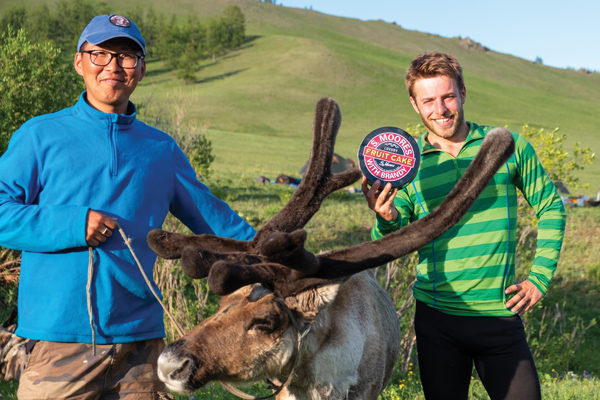
Luke Shirley, 23, is one of the people behind Wide Stride Expeditions, a company specialising in horse trekking tours of Mongolia, that vast country where the word wilderness seems almost an understatement.

‘I’d travelled to 20-plus different countries before visiting Mongolia. Each country had its own experience, but Mongolia blew me away. Nowhere else did I have such an immense feeling of freedom and adventure,” he says.

Luke moved to Bridport as a teenager with his mother, paddle boarder Sally Newman, who was featured in the Marshwood Vale Magazine three years ago. His early years were spent on the Somerset Levels.

‘I was constantly exploring and building dens,’ Luke recalls. ‘I had about four or five dens within 100m of our house right on the levels.’

His memories of Dorset include horse riding with his brother and mother at Golden Cap, an activity he loved.

After leaving The Sir John Colfox School, Bridport, Luke went to Exeter University to study sports science. Considering a military career, he joined the Army Officer training corps and completed his basic training. But the Army life was not for Luke.

‘I learnt a lot of new skills and picked up a few qualifications, but the military wasn’t my true calling,’ he says.

So he went travelling after finishing his studies.

‘I did what came naturally to me, I see how far I can get. I motorbiked the length of Vietnam and then ended up leading a group doing something similar in Laos. I climbed volcanoes in Indonesia and took people on overnight treks in China. I realised everywhere I went I wanted to share my love of adventure with others. I had always dreamt of a life of adventure.’

In the autumn of 2017, Luke went to Mongolia where he met Munkh-Od, an experienced tour guide who had lived and studied in the US and he taught himself English.

Says Luke: ‘He is one of the nicest guys you will ever meet and is such a hard worker—the man doesn’t stop. He cooks, he drives, he guides and he will still sit around the fire with you into the early hours for a chat. If I’m honest, it’s worth going to Mongolia just to meet him.

‘Mongolia is the land of the horse and blue sky. Because of this, it’s the perfect country for horse trekking. Combine the fact that it’s the least densely populated country in the world and the 18th biggest and you have a lot of untouched wilderness to explore.

‘I knew this was a place I wanted to come back to, so when I meet Munkh-Od, who wanted to work for himself and share my enthusiasm for meeting new people and the great outdoors, I knew we would be friends.’

Munkh-Od had been guiding tours in Mongolia for more than five years.

‘He was an outstanding guide, but he wasn’t free to reach his full potential working for other tour operators,’ says Luke.

‘We both wanted to show the world the majesty of Mongolia and share our love of adventure. So we started Wild Stride and ran our first tour in June 2018.

‘Now we are planning on running seven horse trekking tours, a winter ice festival and dog sledding tour in March this year.’

The aim is to run sustainable tours that show off Mongolia’s potential for adventures in a way that supports the local people and environment.

A third of Mongolia’s three million population is still nomadic, a lifestyle so unique in our modern world. Many of the team lead typical nomadic lives for most of the year.

Luke says that climate change and global industrialisation is making life harder for Mongolian herders to survive.

‘Fortunately, tourism is having a really positive impact,’ he says.

‘Many of the people who make up Wild Stride are local to Khovsgol province and we don’t want their way of life to disappear. Some of the skills and knowledge these people possess has been passed down over thousands of generations.

‘By running horse trekking tours in Khovsgol and visiting the Tsaatan people, we provide a way for the younger generations to continue to practice traditional skills and also earn an income that is, unfortunately, becoming essential to nomadic survival.’

The mantra for Wide Stride is ‘take nothing but memories, leave nothing but footprints and kill nothing but time.’

‘We take all of our rubbish with us, none of the wildlife is harmed and we respect the local people’s way of life,’ Luke says.

‘Our tours are designed to help people get in touch with nature, which is why we do our best to run low impact tourism that supports the local wildlife and people. Mongolia is changing but by inviting tourism to experience some of its most beautiful wilderness, we hope to preserve as much as we can.’

The horses roam free for most of the year and can end up getting quite fat on Khovsgol’s bountiful pastures. According to Luke, the exercise on the treks is good for them and keeps them fit and healthy.

‘The reindeer also have it pretty good. The Tsaatan show immense respect to their reindeer, protecting and nurturing their herds. The Nomadic people show an incredible amount of respect to their animals and are extremely forward-thinking in the way they manage the local wildlife.’

Trekkers camp out in tents at night.

‘The camping in Mongolia tends to be quite easy due to the fact it very rarely rains,’ Luke says. ‘Day time temperatures also average around 24°C in the summer. However, the nights are cold.

‘Mongolia is a country on the up and rated as one of the top ten hottest destinations of 2018 by multiple travel magazines and commentators. It’s a destination people don’t really know about yet, a place where you are free to feel wild and a country your friends will definitely want to hear about when you get back.

‘There is nowhere else you can get such an intense feeling of freedom. It’s just you and nature. The riding experience is amazing, with a hugely diverse range of landscapes to explore.’


For more information visit www.wildstride.org

Human Beings not Required

Unexpected machine in the human area

As the song originally gave us about flowers—where have all the people gone?

I used to enjoy chatting with Chris—the guy at the local bank—whenever I wandered in to cash a cheque. However, now he’s gone and been replaced by a squat grey machine with a screen that apparently does the same job. It may read a cheque (not very well) but the machine has absolutely no sense of humour and doesn’t respond whenever I tease it about Chelsea FC losing again. Chris also used to dispense so-called racing tips to me, so I suppose I’ve saved myself some cash because his tips invariably lost. I gather that not only Chris but now the whole branch of the bank will be moving in a few months as part of a ‘central cost-saving exercise’. This means that in future I will have to drive an extra 25 miles whenever I want to cash my measly little cheque for five quid—money that will be lost in my extra mileage and fuel costs.

And what about the ‘staff savings and job cuts’ at the supermarket when I am confronted by a self-checkout machine?  Obviously, it means less people are employed because the machines are doing their jobs, but I miss not being able to have a real human being to talk to. I like the little friendly questions and answers at the check-out such as “…it’s raining—it looks like a busy day for you” or “…only just clocked on”. Yes, I know these are meaningless little snippets of polite conversation, but at least I know I am dealing with real people. If you tried to converse like that with a machine, all you’d get would be “Please place your items on the weighing scale” which doesn’t do much to encourage social banter. Yes, I know I could go through a manned service point and put all my stuff on the moving belt, but have you seen the queues? The reason there are less customers in the self-checkout stations is that we don’t like using them and we’d prefer dealing with a real person. Machines are OK for a few small items—toothpaste, milk, newspaper etc—but have you seriously tried to do a major week’s shop with loads of bottles and washing up liquid and bread and fruit and stuff? Unless it’s just me and I’m being cack-handed, my machine can’t read the bar code or it’s wrongly read the same item twice (so annoying) and the entry needs to be cancelled. You then have to wait for a human assistant which rather defeats the whole aim of staff saving. And then—worst of all—comes the all too loud “Unexpected item in the bagging area”. I try to hide. I feel I’m a criminal and need to be arrested! It’s so embarrassing and it’s totally the machine’s fault. I often swear at it in return but the resulting conversation is entirely one-sided. And which bit is the bagging area anyway? And why is my bag of leeks so unexpected?

Another thing about the voice on self-service machines… she sounds exactly like my dentist, so for me, it’s quite unnerving. Perhaps she really is my dentist. It’s neutral but there’s a hint of steel about it, as in “…now this won’t take long, but I’m afraid it’s going to hurt a bit.”

Why can’t she be more human, more individual and less “supersmarm”? Personally, I’d prefer comments like “Please insert your store card” to sound deep and romantic like a sort of sexy Fenella Fielding. You should be able to choose your type of voice before you start. Customers could select from James Mason, Sharon Stone or Morgan Freeman to offer advice on the bagging area situation.

This is all a part of an ever-increasing trend: to save money by cutting out people and replacing them with machines. By far the most worrying example of this trend is driverless cars. According to the Government, self-driving cars will be on our roads by 2021. But why? Nobody asked me. And nobody’s asked you or anyone else either. It’s apparently just going to happen. The Government says: ‘We’ve already got driverless vacuum cleaners and lawn mowers, so why not cars?’ But they’re missing the point. Unlike hoovering the sitting room or mowing the lawn which are considered chores, I actually enjoy driving. And so do millions of other people. In the USA they’ve tried it out and they’ve discovered that while machines are predictable, humans are unpredictable and behave illogically. No machine will be able to anticipate that the silly driver in front is going to suddenly pull out and turn right without rhyme or reason. It takes another human being driver to always prepare for the unexpected and take avoiding action. 73% of Americans in a recent survey said they would be too fearful to ride in a fully automated vehicle. They’re right to be scared…

Welcome to ‘Humphrey’s Law of Forward Invention’ which states that technology will always advance at its own reckless pace unless stopped by human beings. The reason that we’re going to have driverless cars is because technology says it’s possible—not because we want it or even need it. After driverless cars, what next? I’ll tell you. It’ll be driverless airplanes. Oh, really? Apparently, that’s already happening…

Perhaps we’ll be able to remove the driverless plane crash from the airport bagging area before it’s too late, but I rather doubt it.


Change is coming whether they like it or not

Blizzards, strong winds, drifting snow, bitter cold – that was the story in early March last year when the “Beast from the East” collided with storm Emma bringing extreme weather and disruption to life across large parts of the UK.  Towards the end of June, by contrast, the sun began to shine and daytime temperatures climbed into the thirties and stayed that way across much of the country until August.  Elsewhere across the globe, reports came in of flooding, wildfires, severe tropical storms and unusually high and low temperatures.  Many of these weather extremes can be attributed to climate change and there is considerable concern that the planet is heading for climate catastrophe.  David Attenborough expressed this fear at a climate change conference in Poland:  “If we don’t take action, the collapse of our civilisations and the extinction of much of the natural world is on the horizon.”

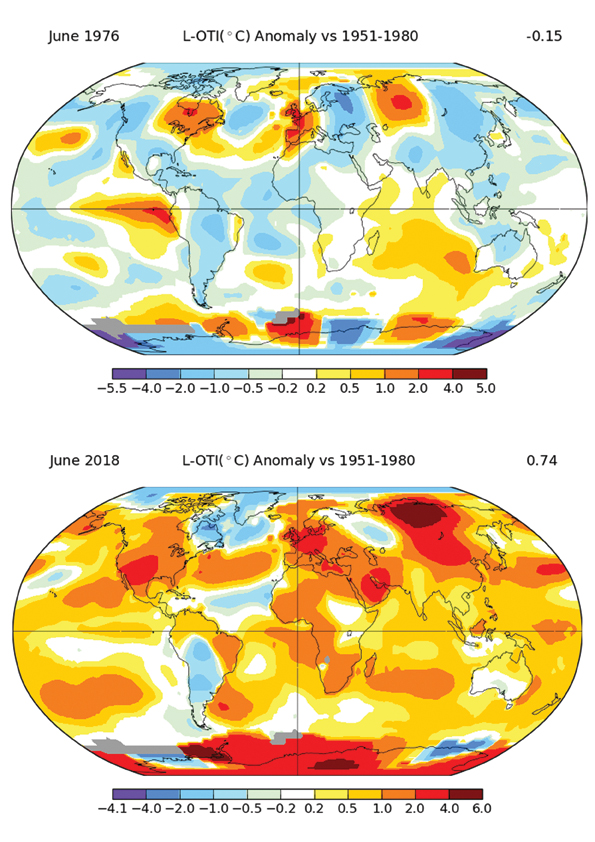
In the UK, it was the long, hot summer, the joint hottest on record, that made people think most about a changing climate.  The weather here is, of course, notoriously fickle and some will remember that in 1976, we experienced a similar long, hot, dry summer, so how can we disentangle normal weather variation from climate change?  One way of looking at this was shown by Simon Lee, a PhD student at the University of Reading, who shared graphs on Twitter of the global temperature anomalies in June 1976 and in June 2018 (see pictures).  These show that in 1976 the UK was one of a few unusually hot spots in an otherwise cooler than average world whereas in 2018 much of the world, including the UK, was hotter than the average.   The 2018 picture shows climate change in action: the planet is warmer making heatwaves more likely.

Careful measurements of the average surface temperature of the planet show that it is currently about 1°C hotter than in pre-industrial times.  This may not seem very much but it is enough to disturb the complex systems that create our weather.  As a result, heatwaves may be more frequent. in summer and, in winter, polar air may be directed southwards bringing abnormal, freezing temperatures.  Also, a warmer atmosphere holds more moisture so that rain and snow may be more severe.  Climate breakdown might be an apt description of these changes.

This global heating is a result of human activity.  The emission of greenhouse gases, particularly carbon dioxide produced by burning fossil fuels such as coal, gas, oil and petrol, traps heat in the atmosphere so the temperature of the world increases.  We have known this for some time and we have also known that the solution is to reduce carbon emissions. Atmospheric levels of carbon dioxide have, however, continued to climb because no government has had the will to introduce the extreme lifestyle changes required to curb emissions.  Some governments, including our own, have even encouraged the continuing extraction of fossil fuels.

It is, therefore, significant that in October 2018, the Intergovernmental Panel on Climate Change (IPCC) issued a report containing a dire warning: we must make urgent and unprecedented changes to the way we live if we are to limit heating to 1.5oC above pre-industrial levels.  To achieve this target, we must reduce net global carbon emissions by 45% by 2030 and to zero by 2050 – fossil fuel use must be drastically reduced by the middle of the 21st century but we must start the reduction now.  Should we fail to achieve this 1.5oC target, the risks of drought, flooding, extreme heat, poverty and displacement of people leading to wars will increase significantly.  The world will no longer be the place we know and love and parts of it will become uninhabitable for humans and the rest of nature.

How do we achieve this reduction in carbon emissions? Voluntary measures such as suggesting people fly or drive less will not work.  The only way this reduction can be achieved is through coordinated government action based on recommendations made in the IPCC report.  These include the planting of more forests and the chemical capture of carbon dioxide to reduce atmospheric levels of carbon dioxide.  There must also be a drastic shift in energy production and in transport away from fossil fuels and this can be driven in part by investment and subsidies directed towards clean technologies.  A carbon tax can also help drive this shift but the tax will need to be high enough to force change, for example by taxing energy companies who burn fossil fuels so that they invest in cleaner technologies.  In the short term, costs to consumers may rise, so politicians would need to keep the public on side, for example, through tax incentives.  If we grasp the opportunity, the scale of change may have the unexpected bonus of allowing us to design more sustainable and equitable societies.

The IPCC report set out very clearly the changes required to avoid damaging global climate change so there was great anticipation when the UN Climate Change Conference convened in Katowice in Poland just before Christmas.  Astonishingly, given the gravity of the situation, the 200 countries represented there failed to agree new ambitious targets for greater reductions in carbon emissions. Four countries (USA, Saudi Arabia, Russia and Kuwait) would not even sign a document welcoming the IPCC report; these countries are of course all oil producers.

It was at this conference that David Attenborough issued his warning about the collapse of civilisations but there was another hugely impressive intervention.  This came from 15-year old activist Greta Thunberg from Sweden.  She had already achieved some notoriety through her weekly climate strikes where she missed one day of school to protest about climate change.  Her actions have stimulated many thousands of young people around the world to do likewise.  Thunberg also spoke in London at the launch of the new grass-roots movement, Extinction Rebellion, which intends to use peaceful protest to force governments to protect the climate.  These new trends offer some hope for the future since it is the young of today that will bear the climate of tomorrow.

Here is part of Greta Thunberg’s speech given at the Katowice conference:

“For 25 years countless people have come to the UN climate conferences begging our world leaders to stop emissions and clearly that has not worked as emissions are continuing to rise. So, I will not beg the world leaders to care for our future, I will instead let them know change is coming whether they like it or not.”

“Since our leaders are behaving like children, we will have to take the responsibility they should have taken long ago. We have to understand what the older generation has dealt to us, what mess they have created that we have to clean up and live with. We have to make our voices heard.”


Philip Strange is Emeritus Professor of Pharmacology at the University of Reading.  He writes about science and about nature with a particular focus on how science fits in to society.  His work may be read at http://philipstrange.wordpress.com/