
Monday, December 22, 2025
Home Blog Page 24

A Songbird makes a Welcome Return to East Devon

The Cirl Bunting is an attractive songbird once found throughout the southern half of the UK. Its numbers declined precipitously in the second half of the 20th century following changes in farming practice and, by the late 1980s, it was confined to coastal farmland in south Devon and might have become nationally extinct. The RSPB recognised the problem and worked with farmers to support the bird resulting in a dramatic increase in its numbers. In a recent expansion of its range the bird has established itself in East Devon at Stantyway Farm near Otterton having been absent for more than 30 years. By Philip Strange


The Cirl Bunting was first reported in the UK by Montagu in the winter of 1800 near Kingsbridge in south Devon. It is roughly sparrow-sized and the male, in particular, is very distinctive with its black and yellow striped head and olive-green breast band. The bird gradually spread across the southern half of the UK, its numbers peaking in the early years of the 20th century. Since then it has declined and by the late 1980s only 118 pairs remained, confined to coastal farmland between Plymouth and Exeter.
With the Cirl Bunting facing national extinction, the RSPB identified changes in farming practice linked to agricultural intensification as responsible for the precipitous decline. In the winter, the bird forages for insects and spilt grain in weedy stubble fields. In the summer, it nests in hedges or scrub and forages on unimproved grassland rich in invertebrates with grasshoppers being important for chicks. With agricultural intensification, there was a shift from spring-sown cereals to autumn sowing so that far fewer arable fields were left as winter stubble; grubbing out of hedges took away nest sites and loss of the hay meadows and increased use of pesticides reduced invertebrate numbers and summer food for the bird.
Once the cause of the decline had been identified, the RSPB worked with farmers in south Devon to support the birds by reinstating some traditional agricultural practices, supported by government agrienvironment schemes. The effect was spectacular and by 2016, numbers of Cirl Buntings had increased to over 1000 pairs. Most of the increase occurred in the bird’s core range but there was some spread along the coast and inland where habitat was suitable. This was a major conservation success, also benefitting other species.
The bird has a reputation for being sedentary and it had been assumed that the estuary of the river Exe would be a barrier to further eastwards expansion of its range. So, it was a surprise when, around the end of 2010, a single Cirl Bunting was seen at Stantyway Farm near Otterton in East Devon followed by several more sightings early in 2011. Since then, the numbers at Stantyway have increased suggesting that the local conditions suit the birds and from 2015 it was clear that a breeding population existed.
Stantyway Farm is owned by Clinton Devon Estates and when the tenant, Mr Williams, retired in 2014, the farm was taken back into Clinton’s own Farm Partnership. Clinton Devon Estates were keen to support Cirl Buntings and other species on their arable farm at Stantyway so they took advice from the RSPB and applied for agrienvironment support. This was awarded in 2016 and supports planting hedges to provide more nest sites, leaving wildlife margins around fields to provide invertebrates as summer food, and planting spring cereal crops that are harvested in the autumn leaving weedy winter stubbles with seed as food. These are all activities shown to be critical in supporting these birds in south Devon. The farm was also put into organic conversion in 2016; organic farming by its nature supports wildlife and increases invertebrates. Cirl Bunting numbers at Stantyway gradually increased across this time.
In 2017, Clinton Estates advertised for a new tenant farmer at Stantyway and Sam Walker was appointed. Although the farm is still mainly arable, Sam keeps 52 cows whose calves are raised and sold on to beef finishers. About a third of the land is now devoted to grass for silage production for winter animal feed. Sam has, however, embraced the existing philosophy of the farm in supporting wildlife: he has maintained the organic status and intends to apply for further agrienvironment support when the current scheme runs out in 2021.
I wanted to see the farm for myself so, on a mild early April day, I went to Stantyway. I left the car on the rough ground across from Stantyway Farmhouse and stood for a few moments enjoying the sunshine. The air was filled with the endlessly inventive song of the skylark and occasionally a buzzard mewed as it circled lazily overhead. Sometimes a low buzz cut through all of this and when I looked, I realised this was from all the insects about.
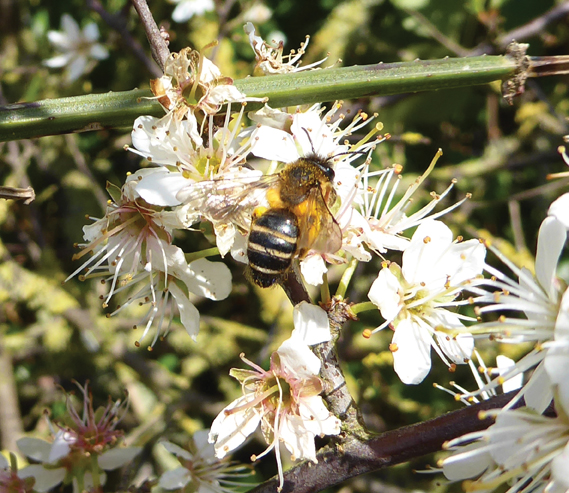
I walked away from the farm along the gentle downhill slope of Stantyway Road with views developing over rolling East Devon countryside on one side and to the hazy mid-blue sea on the other. The lane descended between wide grassy verges backed by luxuriant hedges. Spring flowers grew through the thick grass including stitchwort, celandine, dandelions, violets and white dead nettle. The dominant flowering plant was, however, alexanders, with its fleshy green stems, copious shiny dark green foliage and pale mop head flowers. This was proving very popular with many kinds of fly and a selection of solitary mining bees, some collecting large lumps of white pollen on their back legs.
My walk included a long section of the coast path skirting the edge of Stantyway fields. Thick scrubby hedges, mainly flowering blackthorn, lined the cliff edge along with more alexanders. The occasional hedge break afforded spectacular views along the red cliffs of the Jurassic Coast towards Ladram bay with its crumbling stacks, past the white elegance of Sidmouth and finishing in the chalk of Beer Head. Again, there were many solitary mining bees taking advantage of the flowers. I did not see any Cirl Buntings on my walk but, on two occasions I heard their distinctive, rattling, metallic trill telling me the birds were about.
It’s a beautiful place made all the better by glorious early April weather and I was surprised to see so many insects along the paths. Perhaps this reflects the methods used at Stantyway, showing that productive farming and wildlife can coexist and prosper. Around the farm, each field gate has an information board giving the crop and some other useful information. An Honesty Café has been installed near the farmhouse providing continuous hot water for tea or coffee and homemade cakes that I can strongly recommend. All of this suggests an outward looking, open approach to farming. When I met Sam Walker, the farmer, he explained that, in addition to the provisions of the agrienvironment scheme, he has put skylark plots in cereal fields, created wild bird seed corridors and put up swift boxes to support wildlife. I came away feeling that at Stantyway, Cirl Buntings were getting the best support they could. His methods have already benefitted other farmland birds with numbers of skylarks and reed buntings doubling over the past year and in a further twist to the Cirl Bunting story, some of the birds have now been seen to the east of Sidmouth.
I should like to thank Sam Walker, Doug and Joan Cullen, Kate Ponting and David White for generous help in preparing this article.


Philip Strange is Emeritus Professor of Pharmacology at the University of Reading. He writes about science and about nature with a particular focus on how science fits in to society. His work may be read at http://philipstrange.wordpress.com/

A Nest of Songbirds

Margery Hookings makes some musical connections when she discovers the raucous singing past of her local pub, The White Lion at Broadwindsor.


When folksinger and folklorist Nick Dow visited West Dorset with his wife in the late 1980s, it made a lasting impact.
The couple’s mission was to seek out old Dorset folk songs, following in the footsteps of the great Cecil Sharp and Somerset-based brothers Robert and Henry Hammond, the sons of a clergyman from Priston, near Bath.
Sharp (1859-1924) is considered to be the founding father of the folk-song revival in England in the early 20th century. He gathered thousands of tunes from rural England – including Somerset and Dorset.
Inspired by Sharp, the Hammonds went on long bicycle rides into the Dorset countryside in search of songs, collecting about 600 of them on several expeditions between 1905 and 1908.
Says Dow: ‘It came as some surprise to me, as a fledgling folklorist, to find that no serious research had been made into Dorset folksong survival since 1908.’
And so it was that Dow, who at the time lived in Blackpool, set off with his wife, Mally, armed with a collecting grant and a tape recorder to capture some of these ‘lost’ songs.
I have always been very familiar with the songs and dances that Sharp collected. I went to a tiny primary school in a South Somerset village in the late 1960s. The songs were part and parcel of my family’s life. I thought everyone knew them. I had no idea they had ever been on any endangered list.
My late uncle, Somerset farmer George Withers, was a folk singer. As a child he was immersed in the songs of a time gone by, along with popular music hall numbers of the day, as passed down to him by my grandmother and my grandfather, who were both blessed with good singing voices.
Eddie Upton, who set up Folk South West in 1992, said of George in The Folk Music Journal: ‘He grew up with songs around him. Not only at home, where both his mother and his father sang, but at his uncle’s neighbouring farm, where Jack the carter was a noted singer.
‘His older sisters brought home songs they had learned at school, and George recalled that at a very early age he was hearing songs collected by Cecil Sharp, in several cases from the very singers from whom Sharp had collected. “I can’t remember a time when I didn’t know The Seeds of Love, I rather claimed this for my own.”’
Fittingly, Uncle George’s version of this song was played at his funeral in 2009 and also at that of my own father who, like George, had been a farmer on one of the county council’s smallholdings, which were set up for returning soldiers after the First World War.
Says Upton: ‘The family farm had apple orchards but no cider press, so every year the cider apples were taken to a neighbour’s farm to make cider there. “Cider making involved periods of frenzied activity, and quiet times while the juice is running and you wait for time to screw the press down a bit more. That’s the time when stories are told and songs are sung. I recall Jim and Dad, both old soldiers, singing an old song about an army recruit. It involved some bad language, which impressed me. I was about 12 years old. I only heard it once but remembered it quite well.”’
I include my uncle’s quote about the bawdy song because of what Nick Dow and his wife found on their folk song collecting trek. They amassed some 150 songs, through interviews with people as diverse as a retired ploughman, thatcher and hurdle maker to a hospital porter to an ex-serviceman.
But his real desire was to discover a community where the songs were sung as a matter of course in the local pub, rather than being sung at request into a tape recorder. Cecil Sharp wrote in 1909 that ‘every West Country village holds a veritable nest of songbirds!’.
One only has to chat with people who have lived in these rural areas all their lives to discover a wealth of folk song knowledge.
In 1989, Dow discovered what he describes as ‘the crock of gold at the end of our rainbow’.
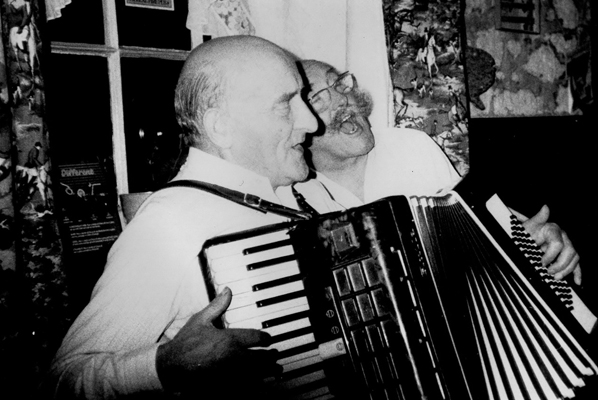
It was the White Lion Inn at Broadwindsor, a village north of Bridport. He was invited to record ‘Flash’ Phelps, who would visit from Chard with his accordion ‘when the spirit moved him and many a lively night was had by all’.
With the famous axion from folklorist and singer A L Loyd ringing in his ears—‘folk music differs from other music as day differs from night, but it’s impossible to tell when day becomes night and night becomes day’—Dow says he held his subjectivity before him ‘like a torch and advanced into academic darkness and the welcoming glow of the White Lion’.
In a piece for Farmers Weekly back in 1985, Dow wrote about his visit to the White Lion: ‘The catholic taste of the singers of ages past is still evident in the repertoire of the assembled singers at The White Lion. Flash would strike up the melody of Putting on the Agony or Home on the Range and that would be followed by a music hall song and maybe Dick Corbett the landlord would sing The Bachelor Song, better known to folklorists as The Foggy Dew.
‘The Old Armchair would put in an appearance, hotly pursued by the Farmer’s Boy and a song from singer Doug Phillips called The Young Countryman Who Kept Company With Me, to the tune of the traditional song The Female Drummer.
‘The ubiquitous Threshing Machine would usher in anything from Charlie is my Darling through to Crystal Chandelier, but might equally be followed by Died for Love or any other song of traditional pedigree.’
Dow says the atmosphere in the White Lion ‘gave lie to academic wrangling, or musical pretensions. The singers gave voice with a wilful celebration of life and living’.
The old songs venerated in folk clubs or condemned to dusty books on library shelves, ‘shook themselves and marched in again proud to be next to their cousins from any number of distant musical mediums, including the hilarity of the music hall, and the unabashed lyrics of the rugby song.’
Would Cecil Sharp have turned in his grave? Dow thinks not.
‘Perhaps the end of the rainbow is not so far from its beginning.’
Musician Simon Emmerson, who lives in the village, is fascinated by the White Lion’s musical history and Dow’s research. He is the founder of folk musical project The Imagined Village, which produces folk music representing modern multiculturalism in the UK. The band features musicians from a wide variety of ethnic and cultural backgrounds.
He and Dow have been in touch.
Says Emmerson: ‘When I moved into Broadwindsor 15 years ago, I had no idea of this connection with folk music. It came as a great surprise when I introduced myself to someone in the pub and he told me that the village has a long tradition with taking people to Sidmouth Folk Festival since its inception.
‘In researching music for my project, The Imagined Village, I found records at Cecil Sharp House of folk collectors coming to the school in the village to record folk dancing. This tradition was still alive and active at the time of Nick’s recordings. Steve Knightley of Show of Hands told me that West Dorset was a fantastic place for folk music.
‘It was an absolute delight to find these past recordings that Nick has. The only missing pieces of the jigsaw is to bring back singing in the local tradition. Wouldn’t it be great if all the pubs in West Dorset were full of the songs they were only 30 years ago?’

• Nick Dow has been singing and collecting traditional folk songs for over forty years. He has gleaned songs from the West Country, and been given songs by the Travelling people with whom he has lived and worked. Nick Dow is trained in the dying art of Gypsy wagon painting, and has worked as a painter for a long list of celebrities including Ronnie Wood of the Rolling Stones.

UpFront 05/19

We never really know what people are thinking. We might believe we do, but in reality, the complexities of the brain and the human ability to distort embellish or even completely invent thoughts and scenarios make it impossible for us to ever categorically know what’s going on in someone’s head. But that doesn’t stop us from passing judgment; both on those we know as well as on complete strangers. I got stuck in a lift once with someone whom I’d seen around for years but had never really met. We were only held there for about ten minutes, but it was enough time for our shared discomfort and concern to break down the usual barriers suffered by the less gregarious. We talked about the fact that we had seen each other around but never really chatted. Within those few minutes, we found that we had a lot in common. We shared a similar sense of humour, world view and even upbringing. By the time we got out of the lift we were giggling about our adventure, and, since we were heading in the same direction, decided to pop into the local pub for a drink. It was then that we discovered one of the reasons we had never spoken. For the previous couple of years, he had made a decision about me based on something he had heard. It transpired that at a company event years before, someone had pointed in my direction and commented on what they believed was my opinion on a recent international crisis. Their judgement couldn’t have been further from the truth, but to my new friend, that accusation had left a lasting impression. For the next couple of years, his attitude to me had been influenced by this throwaway comment. Coincidentally my accuser was in the pub and remembered the occasion. It turned out he had been pointing at someone just beyond me. I had been smeared by mistaken identity. My new friend and I never became great buddies, and a few months later I got a job overseas. In fact, I never saw him again. But that quirk of fate that put us together in a dodgy elevator often haunts me when I find myself about to pass judgment on a person or situation, especially when based on no real knowledge, something perhaps we’re all guilty of. Sadly, we are all human, with all the fallibility that comes with that territory and there will always be occasions where an opinion is blurted out based on nothing other than instinct and unconscious bias. But now and then I find myself benefiting from remembering that scenario and taking a step back before damning my fellow man. I wish I could do it more often.

The Sound of Distant Drums

Margery Hookings has a go at drumming and meets the founder of Organic Rhythm to find out her story

I’m in the parish hall at Ilminster where there’s a drumming session organised by Organic Rhythm. The sound of friendly chatter is soon replaced by the booming sound of about thirty djembe drums all being played in a circle. It’s a very primal noise and deeply satisfying.

For someone who finds it difficult to pat my head and rub my tummy at the same time, I’m finding it quite a challenge. The thing, Organic Rhythm founder Sharon Stone says, is not to think about it too much. So I don’t. And then the magic begins.

According to Wikipedia, the djembe is a rope-tuned, skin-covered goblet drum played with bare hands, originally from West Africa. And according to the Bambara people in Mali, the name of the djembe comes from the saying ‘Anke djé, anke bé’ which translates to ‘everyone gather together in peace’ and defines the drum’s purpose.

Sharon first came across drumming in a Cornish summer camp marquee many years ago. ‘I was immediately drawn to it,’ she tells me after my first hour-long session. ‘I was offered a drum, but declined, feeling a tad apprehensive, and that I wouldn’t know what to do.

‘Instead, I listened and enjoyed the sound of the drums way into the night, coming across the fields to soothe us to sleep in our tents.

‘A few weeks later I spotted an advert for a one-day African drumming course at a local college. I was hooked. The rest is history.’

I booked Organic Rhythm for my village fun day last year, thinking it was time for a change from the standard entertainment. The sound of the drums reverberated through the village street as people of all ages joined in and became one tribe.

Sharon has 150 drums and describes herself as lucky to be making a living the way she does, driving around in her distinctive van with all her drums inside and doing what she loves. ‘More than 20 years ago I realised that when participating in a drumming class I felt relaxed and came away energised and feeling good,’ Sharon says. ‘I started to explore why this could be and came across all sorts of exciting evidence and studies around this.

‘I followed courses with the Therapeutic Drumming Foundation, Health Rhythms, Drum Beat, Drum Circle facilitation training and my thirst for understanding around this took me on travels around the UK, USA, and to West Africa.’

Ten years ago she decided to take the plunge and gave up a steady job to run her fledgeling drumming business. ‘From a stable job in housing and homelessness to being self-employed was a leap of faith. The job became more stressful with increased caseloads and a decrease in resources and cuts in services. I’d started the business two years before on a very part-time basis, but I decided on my 40th birthday to take that leap.’

She says nothing pleases her more than sharing the joy of drumming, whether it be at a village fete like mine or as a corporate team building exercise.

“Gigs” have included drumming with Rick Stein’s management staff team meeting early one morning in Cornwall and the Cheshire International Jamboree last year, where they drummed with up to 600 young people per day during the week. One of the participants was adventurer Bear Grylls.

‘From small groups to over 100 people at a time, everyone gets a drum for a fully interactive participatory experience’ she explains. ‘Our workshops are accessible, inclusive and suitable for all, regardless of age, ability or experience.’

Several years ago, she discovered that a woman who came to her regular drumming class was her first teacher at Hindayes Infant School in Street. ‘So, then I was the teacher, and she was my student,’ Sharon says. ‘We went back to the school together and drummed with all the children there.’

One of her favourite quotes is by psychotherapist R.Freidman in The Healing Power of the Drum: “Drumming in a group has been shown to enhance the alpha brain waves- those associated with euphoria and feeling good.”

Sharon says: ‘We see this in many settings including, rehab facilities, day centres, schools, corporate events, prison, team-building, private parties and many summer events.

‘People report feeling better after drumming, more connected, included, happier, calmer, energised and relaxed. Teams tell us of increased morale, team-bonding, connection and increased productivity.

‘Schools tell us of improved behaviour, particularly when children have participated in several weeks of our drumming intervention, Drumbeat.

‘Teachers have also been surprised when children they’d expect to misbehave, leave the room or become disruptive, have participated and enjoyed the group drumming experience.

‘Drummers in our regular classes tell us that drumming turns a bad day into a good one, they leave the everyday stresses once they start drumming.

‘I love drumming because of all these results. It’s not really about the drumming; it’s about the outcomes. Drumming makes you feel good!’


The Canterbury Tales

Do you listen to The Archers on Radio 4? (“An everyday story of country folk”). We used to listen regularly years ago but now only occasionally. One annual event portrayed by the Archers has been the Christmas pantomime or similar entertainment with its usual problems of non-attendance at rehearsals, scenery not available or falling down, etc. All of this would send the usual producer, Linda Snell, into a tantrum, to accompany her hay fever and sniff.

This year, for Christmas 2018, Linda proposed to portray The Canterbury Tales by Geoffrey Chaucer, written from 1386 and not finished by his death in 1400. As might be expected, most of the prominent of the Archer players were included in this production. I thought the choice of Lillian Bellamy with her naughty laugh was ideal for “The Wife of Bath”, both having many men in their lives.

To refresh my memory of the story I have referred to The Canterbury Tales a Penguin Classic translated into modern English by Nevill Coghill. Chaucer apparently intended to write of some thirty pilgrims who would tell two tales on the way to Canterbury and two more on the return journey. He was unable to complete his task. Chaucer assumed that the pilgrimage would take five days (16 to 20th April) to Canterbury. The story of the pilgrimage commences in Southwark at The Tabard Inn, “a high class hostelry, close beside The Bell”. The Tales begin with The Prologue, an introductory list of the pilgrims going to celebrate the martyr, St Thomas a Becket. We must remember that in 1400 the country was Catholic, before the Reformation, so that we find many more religious titles than are now current.

Chaucer started with a gentle Knight who had fought all over Europe and the Mediterranean. Although he had fine horses he was not gaily dressed, his tunic was stained by marks of his armour. His son was with him, a fine young Squire of about 20 years old who had served abroad with the cavalry and now served his father at table. There was also a Yeoman, dressed in green, carrying his bow and arrows, shield, sword and dirk, he wore a silver St Christopher and a hunting horn hung from his baldrick.

Next was a Prioress known as Madam Eglantyne with a simple, coy smile whose greatest oath was “By St Loy” and sang through her nose as well as speaking daintily in French, “in the English manner”. When eating, her manners were well taught and she was entertaining, pleasant and friendly, but with a stately bearing. She would weep if she saw a mouse caught in a trap. I think the Archers’ Linda Snell would have been well suited to play her character. The Prioress wore her veil and cloak with charm and a rosary, a coral bracelet and a gold brooch engraved Amor vincit omnia. Another Nun, secretary at her cell, was riding with her and also three priests.

I have taken a liberty with Chaucer’s listing in order to have all the priests together, for he makes a “pretty picture” of his priests. Chaucer described a Monk, a manly man able to be an Abbot. His sport was hunting and he owned a number of good horses and his bridle jingled loudly. He also owned greyhounds and his fun was hunting a hare or jumping a fence. His sleeves were trimmed with fine grey fur and his hood was fastened at the chin with a wrought gold pin. His head was bald and shone as did his face as if it had been greased. He liked to eat a fat swan, roasted whole. His boots were supple and his palfrey was brown like a berry.

Then a Friar, a Limiter, was described, that is a begging friar granted a district to beg in so his activity was limited. He was wanton, merry and a very festive fellow, glib with gallant phrase and speech. He fixed up many marriages and was beloved with his County folk and city dames of honour and possession. He claimed that he was well qualified to hear confessions with a special licence from the Pope and provided penances for a  gift and said that instead of weeping and prayer, one should give silver for a poor Friar. The Friar had pins for curls and pocket knives to give to pretty girls. He sang well and played the hurdy-gurdy and knew every tavern, and innkeepers and barmaid, better than lepers, beggars, for they did not fit his dignity. Even if a widow was penniless he still got a farthing from her and he would arbitrate disputes for a fee. His dress was not threadbare, more like a Doctor or a Pope with his cope of double-worsted and he lisped a little to make his English sweeter when he played his harp.

A Summoner, paid to summon sinners to trial before an ecclesiastical court, looked as if his face was on fire with carbuncles, which nothing could cure. His eyes were narrow and he was as hot and lecherous as a sparrow, with black scabby brows and a thin beard. Children were frightened when they saw him. His diet was garlic, onions and leeks and strong red wine. After the latter, he would shout as if crazy, all in Latin but only a few tags which he had mugged up. For a quart of wine he would allow a lad to keep a concubine for a year. If he found some rascal with a maid he would say “do not be afraid of the Archdeacon’s curse, just put some money in my purse”. He knew what all the local lads were doing! On his head, he wore a garland and outside an ale-house he would have a round cake and wield it like a shield, as a joke.

A gentle Pardoner rode with him, who had authority from the Pope to sell pardons and indulgences, he was just back from visiting Rome. His yellow hair was long, spreading over his shoulders. He rode with only a small cap on his head, with a holy relic sewed on it and his wallet on his lap bulged with pardons from Rome. The Pardoner had bulging eyes and a small voice like a  goat but no beard or facial hair. Perhaps he was a gelding or a mare. In his trunk he had a pillowcase which he claimed was Our Lady’s veil and a piece of sailcloth alleged to have been St Peter’s, with a metal cross set with stones. With these relics, he would induce a poor country parson to invest more than his monthly stipend. He read a lesson in Church, or told a story and sang with his honey-tongue so well that he could win silver from the congregation.

I think perhaps we may think better of Henry VIII for ridding the country of so many of the priesthood after reading Chaucer’s description of them. In contrast to the others a Parson to a town was rich in holy thought and work, knowing the Gospel well but poor in his pocket. His parish was wide with houses far apart but he would visit whatever the weather, on foot with just his staff. He would give to the poor, from church offerings or from his own pocket. He was a learned man and taught about Christ and His Twelve Apostles and followed their example.

Chaucer intended to complete his stories in the month of April, but bearing in mind space limitations, I must leave his Prologue at this point, “To be continued in our next” as used to be said!

Bridport History Society meets as usual on Tuesday April 9th at 2.30 pm in the United Church Main Hall, East Street, Bridport, when Dr Diana Trenchard will tell us about a “Convict Museum Ship visits Dorset”. All welcome, visitors entrance fee £3. 

Cecil Amor, Hon President, Bridport History Society.

People in Food – Rich Wright

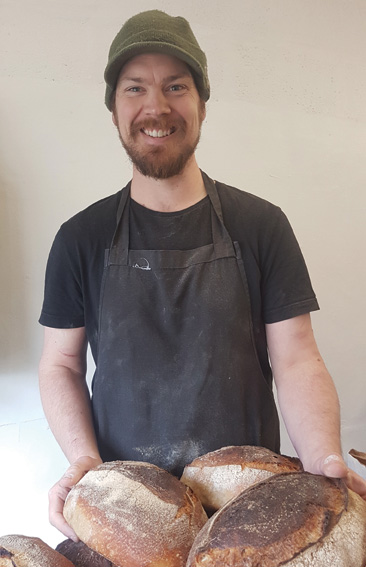
Stumbling out of bed at 3.30 am every morning isn’t everyone’s cup of tea, but as Rich Wright from The Wobbly Cottage points out, “you don’t become a baker if you don’t like early starts”. Mind you, he hasn’t far to go as his artisan micro bakery is in Broadwindsor Craft Centre, only a short distance from the house he shares with his wife Dani and their children. Baking by 4 am, Rich specialises in Sourdough bread, preferring ancient traditions and using local flour to create his crusty masterpieces. He bakes up to 450 loaves a week of the award-winning bread and also makes pastries, sausage rolls, chutneys and jams as well as his much sought-after scotch eggs. Dani is in charge of logistics and deliveries, supplying some of the most renowned pubs and restaurants in the area.

The Wobbly Cottage is named after the cottage the couple first lived in when they moved to Stoke Abbott. It was snugly nestled in the middle of the village, with not a straight wall in sight. It is from here that Rich and Dani started their business, attending food and farmers markets at weekends with their jams, chutneys and freshly baked goods. As the sourdough proved to be the main breadwinner in their business, they realised they needed to expand from their domestic oven set-up. Happily, the unit at Broadwindsor Craft Centre became available at the same time, so the move took place. Now, thanks to crowdfunding, they have a commercial stone-shelf oven which bakes all their beautifully gnarly sourdough loaves and other bakeware.

Having worked before in a windowless basement kitchen during his career as a chef, Rich is unperturbed by the long days. As he says, “now if I want some fresh air all I have to do is walk out the front door for a few minutes. If it’s a long day, then it means we’re busy, which means we’re doing something right.” Rising at such an early hour doesn’t translate into early nights for Rich. He specialises in power naps and can survive on four to five hours sleep a night. Sundays though are reserved for the kids. Then, Rich will cook and concentrate on his family, spending time at the beach together and generally relaxing…ready to start kneading and baking once more. He wouldn’t have it any other way.


Devon & Dorset Detox

Do you feel exhausted and burned out? Do you fail to get a proper night’s sleep? Perhaps you crawl through your day like an eyes wide-shut tortoise?

If so, you’re probably suffering from TATT! Yes, really…

TATT stands for ‘Tired All The Time’—a gloomy dormant condition that almost certainly applies to me and possibly many other people. It’s mostly to do with the end of Winter, particularly as we haul ourselves out of a miserable and wet February and March. Right now, I personally feel like a cold and damp hedgehog trying to slowly unwrap itself from a dank hibernation ball.

Perhaps you also feel like you’ve run out of batteries and you’re in need of a spring break? Well, wait no more. Spring is finally here carrying with it a strong smell of fresh mint, green apples and broccoli all whizzed up in a juicer and served with a crunch of crisp celery in a tall glass of frothy green goo.

Yes, it’s time for a good detox to clear out the system and rinse all those nasty impurities from our mouldy bodies. Just like flushing the pipes in your central heating, you need to wash it all out before you can fill up again. Get Clean! Be Refreshed! Wake Up and Smell the Coffee! Only, no… That’s one thing you can’t have—coffee. Nor tea, nor chocolate, nor anything with caffeine, nor any sort of additive and don’t even think about alcohol. Processed meats and sugary foods are out, and so are foods high in salt, bad fats and artificial ingredients. Well, that’s me straight off the list… that’ll mean no more breakfasts at McDonalds (Sorry, I may be alone but I do so love a Sausage Egg McMuffin!). So, I’ll have to trash the junk stuff and pour myself a nice glass of beetroot, carrot and ginger instead. Or maybe a cup of lemon laced with turmeric? Yum!

Twenty years ago, people used to pay vast sums to vanish off to the Swiss Alps or a 5-star spa hotel up the end of some Norwegian Fjord for a dramatic diet and a detox regime involving a celery stick for lunch and a mug of parsley and spinach juice for supper. The more expensive the retreat, the less you got to eat. And then they would return to their friends one week later positively glowing with joy and health: “…and what’s more we’ve lost weight too!” they would blush with well-polished smiles. Well, of course they lost weight! And so would anyone if all they’d eaten were a couple of blueberries and some kale soup while getting seriously fit cycling hundreds of static miles on a gymnasium bike while being earnestly pampered by people in white coats. But now, you can do all of that and more in the UK!

I’ve just googled ‘Detox West Country’ and there are literally hundreds of places you can retreat to all over Devon and Dorset. And Somerset too, although there don’t appear to be many detox retreats near Bridgwater or Brean. Why is this? Perhaps the further North you go in Somerset, the less the need for local detoxification. It may have something to do with one’s proximity to Bath? No doubt a commercial opportunity beckons!

They can be as small as a spare bedroom or a converted tool-shed or as large as a stately manor, but you’ll find loads of private detox friendly retreats. You can spend a couple of days or a whole fortnight of mild exercise and gentle rinsing out, plus pottery, art, books and talks on “Wellness” (a phrase much quoted on these websites, but nobody seems to know what it means beyond being sort of vaguely healthy). Costs vary according to the facilities and the menu. You can have a few nice glasses of fresh juice and a walk down the garden or you can enter a full-sized gym with delicious meals of spinach and guava and nuts plus a slice of chicken or fish—all magnificently presented and cooked by top nutritional chefs. The choice is yours. This whole “Wellness” thing (that word again) has become a huge leisure industry without me even realising it. It’s obviously time for me to wake up and smell the er… um… Mint?

I’m going to cash in. I’ll put my old exercise bike in our garage plus my dad’s narrow WW2 camp bed on the floor and install a cold-water spa (garden hose) for 100% all natural colonic (or other type of) irrigation. ‘Can’t be too luxurious or my clients will smell a rat. Actually, they may easily spot one as I think I saw a tail behind a pile of wood in the corner. And then I can bring them glasses of foaming green brown mush (rhubarb and loganberry juice with added cumin and lettuce) twice a day. Plus some YouTube clips of ‘Wellness’ advice on their TV. “Kwik Kleen Thru”—your Budget Dorset Detox. A bit like a car wash, I reckon…


‘A Private War’ in Bridport

In February 2019, the family of the much celebrated foreign correspondent and war reporter, Marie Colvin, remembered the seventh anniversary of her death in the knowledge that a US court had just found the Syrian regime of Bashar al-Assad guilty of her murder. Killed in an artillery strike while reporting on what she claimed to be intentional attacks on civilians, Marie Colvin paid the ultimate sacrifice for her belief in the need to tell the world what she claimed the Syrian regime didn’t want the world to know. She died in the same attack as French photographer Rémi Ochlik, in a makeshift ‘media centre’ in the Syrian city of Homs. She had been working with English photographer Paul Conroy who survived the same explosion.

In the days that followed, Paul Conroy suffered excruciating pain from a hole in his leg that he remembered as being big enough to get his hand through. Lacking food, water and medical supplies, he endured another five days of bombardment before escaping the decimated district of Baba Amr on a motorbike through a three-kilometre long tunnel.

Talking later, Paul described how the missiles first took out the room they had been sleeping in, then the front room and then the middle room. He remembered the explosion, the smoke and the deafness from the blast, and later explained that the pattern of the bursts proved there was ‘bracketing’, a military tactic used by artillery units to ensure they hit their target. He recognised the pattern and timing from his own experience in the British Army.

There had been three strikes, and he hoped that might be it. But a fourth rocket impacted right in front of the house. In Under the Wire, he described it as ‘like being hit by a tube train in a dark tunnel’. He lay on the ground next to the bodies of Marie and Rémi for fifteen minutes, while what he believed to be a drone, relayed pictures back to the artillery.

Five days later he was put in a truck along with other injured, and a convoy of about four trucks drove through the front line to reach the tunnel, where the motorbike took him to the end. He had initially refused to get on the bike as there were other injured women and children that he thought should have been brought first, but his rescuers told him he had to go so he could tell the story.

The following year he published his book Under the Wire detailing what became known as ‘Marie Colvin’s last assignment’. Last year it was released as a documentary and this year the story of Marie and Paul’s reporting from Homs has been made into a full-length movie, A Private War, starring Rosamund Pike, Jamie Dornan and Tom Hollander. Based on an article in Vanity Fair by the journalist, Marie Brenner, the film will be screened at this year’s Bridport Film Festival ‘From Page to Screen’ where Paul and journalist and war correspondent, Jon Lee Anderson, will be in conversation afterwards.

The reason that Marie Colvin came to be in the middle of an artillery bombardment in Syria in 2012 is simple—she wanted other people to care about atrocity as much as she did. Brenner’s Vanity Fair article cuts to the bones of what became clear in evidence delivered to the US court that found Assad’s regime guilty: ‘A murderous dictator was bombarding a city that had no food, power or medical supplies. NATO and the United Nations stood by doing nothing.’

Marie was known for her determination to report the real stories of the people caught up in conflicts such as the Syrian civil war. She had reported, with her own brand of outrage, from locations such as East Timor, Libya, Iran, Iraq, Kosovo, Chechnya and Sri Lanka, where she lost the sight of an eye when attacked with a grenade. After that particular attack, she became known for wearing a black patch over the blind eye—a badge of both defiance and honour that no doubt made her a more easily recognisable target. However, and despite suffering enormous emotional trauma after Sri Lanka, she carried on reporting atrocities with the oft-repeated question to anyone who would listen: ‘Why is the world not here?’ For the last seven years, Paul Conroy has made it his business to tell Marie’s story, consistently echoing that question.

Talking to Channel 4’s Krishnan Guru-Murthy earlier this year, Paul made clear his belief that, despite being targeted as journalists by the Assad regime, western governments’ inaction in Syria was also a disgrace. ‘The West behaved abysmally’ he said, claiming that a lot of politicians have blood on their hands. He believed that inaction on the part of western governments to stop Assad’s annihilation of his own people was a grave mistake. ‘Doing nothing,’ he said, ‘cannot be dressed up as political strategy, it is still ‘doing nothing’.

Paul Conroy will be in conversation with Jon Lee Anderson after the screening of ‘A Private War’ at Bridport Arts Centre on Friday April 24 at 8 pm. For tickets telephone 01308 424 204

People at Work – Jason Hill

As Watch Manager of Devon and Somerset Fire and Rescue Service, Jason Hill gives an insight to his job by describing himself with a smile as, “the one with the white helmet, think of Fireman Sam, I get to sit in the front seat!” For nearly a year now, Jason has been running Red Watch at Exeter City Centre Fire Station, a great accolade. Working shifts of two days and two nights before four days off, there is no standard work day for this full-time firefighter.

Jason is always busy. There is kit to clean and examine, and then check again. Every bit of equipment gets inspected twice a day, every day. Fire Safety Inspections need to be carried out at local businesses, as well as Operational Risk Visits at public sites. No matter where they are though, if the alert sounds, the team have to be back in the fire engine and moving down the road within 60 seconds. Some of the most common calls they deal with are supporting other services, such as the Ambulance service or Police. Jason admits ‘the job can be harrowing at times, but saving someone’s life is the most satisfying thing you can do’. And of course, for anyone in charge, there is desk work too. Jason writes the incident report for the call outs and carries the responsibility of ensuring all is in order at the station.

Jason is the son of a fireman, his dad has inspirationally been in the service for 40 years. Jason grew up on a dairy farm in Colyton, but always knew he also wanted to follow in his father’s footsteps, so joined as a retained fireman at Axminster. He has now served 16 years as a fireman, with over 14 years full time. Living in Chardstock with his wife Emily and dog Rudi, the couple are busy renovating a bungalow they bought, which takes up Jason’s time when he’s not on shift. He also finds running therapeutic, something that clears his head, paired with fitness being a part of the job. He still loves the rural countryside and gets involved in the local community as a bell ringer at Chardstock Church. A fan of the Exeter Chiefs, who he tries to see as much as possible, you may also catch Jason on his downtime, with a well-deserved beer in hand, watching Formula One.


Holloways & Hideouts

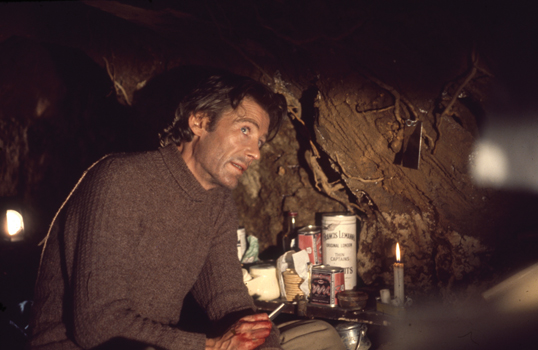
Rogue Male photograph courtesy BBC

Ines Cavill on another Search for Rogue Male


“I chose southern England, with a strong preference for Dorset. It is a remote county, lying as it does between Hampshire, which is becoming an outer suburb, and Devon which is a playground. I knew one part of the county very well indeed……”  Rogue Male by Geoffrey Household, 1939

“A track worn down by the traffic of ages and the fretting of water and in places reduced sixteen or eighteen feet beneath the level of the fields.”  

Holloway by Robert Macfarlane, 2012


It is 80 years since the publication of Geoffrey Household’s enduring thriller Rogue Male. His cult novel perfectly distilled the suspense wrought from a hunter turned prey, inspiring 8 decades of storytellers including Fritz Lang’s 1941 film Man Hunt, David Morrell’s First Blood, Frederick Forsyth’s Day of the Jackal and the 1976 BBC screen adaptation. Peter O’Toole stars in this as Household’s would-be assassin who fails to shoot Hitler, escapes torture by the Gestapo and flees back to the UK pursued by the sinister Major Quive-Smith (played by John Standing). Peter O’Toole said in 2007 that it remained his favourite of all the films he had worked on, and Rogue Male continues to fascinate—Benedict Cumberbatch has most recently secured the rights to the book he describes as one of ‘the most treasured of English novels’ and will produce and star in a new film that’s in development.

Born in 1900, Geoffrey Household was educated in the West Country and Oxford. In his twenties, he worked throughout Europe from Bucharest to Bilbao (from banking to bananas!) and started an early period of literary work in New York including screenwriting for CBS. But by 1933 he was back and broke in England, spending time walking the countryside of Wiltshire and Dorset until international sales work for an ink manufacturer gave him the scope he wanted to travel and write. His first of 36 books, the novel The Third Hour, was published in 1938 but it is the following year’s Rogue Male that would prove to be an instant best seller—it was even issued as a morale-boosting Services and Forces special edition—and his genre-defining masterpiece.

Rogue Male is unforgettable for its pace and plotting but also the tangible descriptions of place that breathe authentic life into the story. As when the hunted hero seeks sanctuary in ‘the green depths of Dorset’ and arrives just after midnight ‘…on the ridge of a half-moon of low rabbit-cropped hills, the horns of which rest upon the sea, enclosing between them a small, lush valley. The outer northern slopes look down upon the Marshwood Vale….’

From here he drops down into the network of holloways—‘these trade-worn cantons of red and green upon the flanks of the hills are very dear to me’ locating a thick hedge accessed from old lanes leading back to the ridge ‘in the heart of this hedge, which I had been seeking all the way from London, the lane reappears. It is not marked on the map. It has not been used, I imagine, for a hundred years’. Inside this ‘double hedge’, guarded by ‘sentinel thorns at the entrance’ he digs out a den and goes to ground until a shocking final confrontation with his hunter, Major Quive-Smith.

These vivid details and tantalising clues have periodically compelled a search for Household’s original hideout. Christoper Roper wrote about one—‘Geoffrey Household’s Lost Lane’—for this magazine in 2003. He was enthralled by Rogue Male’s stunning descriptions of the Marshwood Vale’s secret places when he moved to North Chideock and could recognise the ‘small lush valley’ on his doorstep and the contours of the hero’s hideaway in nearby holloways like Hell Lane, ‘I shared the book with lots of local friends, all were impressed by Household’s meticulous knowledge of topography and one neighbour said the book was so realistic he could picture the Nazis coming over the hill and through his window!’

The nature writers Robert Macfarlane and Roger Deacon continued this quest in the summer of 2005 approaching the distinctive crescent of hills from the south with bill hooks and sleeping bags ready to take shelter for the night deep inside an ancient track like Rogue Male himself. Macfarlane went on to explore the origin and nature of these holloways in the 2012 prose-poem ‘Holloway’ and defined his topographical muse as “A sunken path, a deep and shady lane. A route that centuries of foot-fall, hoof-hit, wheel-roll and rain-run have harrowed into the land”.

Both these explorations concluded that Household might well have disguised the exact location of the runaway’s lair as cunningly as his ingenious protagonist. But there is rumour of another theory that I set out to hear last month with the storyteller Martin Maudsley. We met with George Streatfeild at Denhay Farm to be taken to see the site his father John had believed to be the novel’s central location. George told us about the beginnings of the farm as we followed him out of the farmhouse towards the dairy. “Daddy bought Denhay after he retired from Navy—though he would forever be known locally as ‘the commander’—and back then in the fifties, it was 250acres of bogs, brambles and bunnies”. This was already sounding a lot more like Household’s literary landscape than 21st Century Dorset.

We were approaching the crucial ridge from the North as Rogue Male does when he is heading towards the sea after sleeping in fields around Powerstock via ‘a remnant of the old Roman road from Dorchester to Exeter’ with his rickety tandem bike ‘the beastly Combination’. The field rose steeply up Denhay Hill leaving the cows below, inky rooks wheeling high above, storm-proof primroses at our feet, the remains of an old farm road and derelict cottage to one side and the high line of the promised crescent ahead with sea sparkling beyond. George describes how a network of tracks crisscrossed farms from the coast to the depths of the vale, ‘We’re still finding the beach pebbles that were picked up and dumped by empty carts on the tracks when they were on a return run from the sea…”.

We turn to look back north over the sweep of the vale’s distinctive small fields edged by hearty hedges with occasional handsome oaks, left as George explained for each ‘chain’ of the hedges that were laid in winter when the cows were inside. Towards the top, the soil changes from heavy clay to Bridport Sand, the kind of ground that lends itself to high-sided holloways, and there running down a small valley on a par with Household’s description is the groove of a once substantial track. Had ‘the commander’ come closest to cracking the code of literature’s most tantalising lair? Its previously unkempt double line of overgrowing hedge trees have been cut right back, but it definitely has potential—and still enough cover to shelter us and George’s German wire-haired pointer Brychan from a heavy shower.

Martin collects folklore and says the uncanny qualities of holloways have always generated their own tales—the deep grooves in their sandstone sides were once attributed to scratches by Dorset’s ‘Colepixies’……

Geoffrey Household died in October 1988 aged 87.  His son wanted to scatter his ashes in the holloway that inspired his father’s classic novel, but he too could not be certain of its exact location in that maze of old tracks and chose instead a hill-top view of the Marshwood Vale.

On Wed April 24 Bridport’s Film Festival ‘From Page To Screen’ is showing The BFI’s reissue of the 1976 version of Rogue Male which has been re-mastered from the original 16mm film negatives.
There are just 28 places for this special event. Tickets are £10 from the Bridport Arts Centre Tel. 01308 424 204. Rendezvous 1 pm in car park behind Symondsbury’s Manor Yard to explore the nearby holloways with Martin Maudsley before a ‘secret’ screening.