
Seven months into a bout of Plantar Fasciitis and I have to admit to the occasional sense of humour failure. One foot screams at me to stop using it, and the other complains about having to do all the work. I’m used to aches and pains, but now the aches feel like a fading memory. It’s a little like a metaphor for the world around me. As the human race becomes more tribal and politics more polarised, it’s hard not to feel despair. After thousands of years of developing incredible levels of sophistication: becoming the dominant animal on earth, learning to communicate despite speaking different languages and discovering that the general aches caused by living with empathy and compassion are better than the pain of constant conflict, we appear to be determined to go back into the caves to sharpen our spears. There was a time when great leaders brought people together. Today there seems to be a blind attraction to those who see a good argument, take a side and stir up conflicting viewpoints to make themselves feel important when what we need are leaders who can find middle ground and communicate levels of common purpose. The latest BBC drama, Years and Years, takes a fanciful guess at some of the possible levels of madness that might develop from where we are now. They include a US nuclear attack on China; the fall of the second largest investment bank in America, and an ‘oh so sincere’ UK celebrity turned politician who wows her audience with a magic pen that cuts out all internet signal in the room (yes every dinner table should have one). The show goes on for a few more episodes, so who knows what the outcome might be, but in one striking moment a political activist, returning to the UK after an extended stay overseas, is surprised at how interested people are in a local by-election. ‘Nobody used to care about by-elections’ she says. ‘Yea, we’re all bloody furious now’ replies her sister. When asked what about, she simply replies, ‘Everything!’ Realising that polarisation, tribalism or populism—call it what you want—has no long term benefit for this planet is not rocket science. Some might describe the current world upheaval in political manoeuvring as one of history’s ‘market adjustments’, but that’s no different to closing your eyes, putting your fingers in your ears and shouting ‘blah, blah, blah’ while the world falls apart around you. Polar opposites will only win votes from polar opposites, and that’s a pointless exercise. There, that’s my sense of humour failure done for today—bloody foot…
June in the Garden
June is often the first month of the year when the abundance of plant growth, conspiring with higher temperatures, results in the need for wholesale irrigation, rather than the selective watering of newly planted areas, pots, containers etc., which has been the priority up to now.
Thinking about watering has reminded me that the sales of metaldehyde based slug pellets will be banned, from around now, to allow time to use up old stock before their total ban, on outside applications, in 2020. The reason why this is linked to watering is because the way you water the garden has an effect on controlling the damage done by slugs and snails.
In dry weather slugs and snails are less able to move around, and therefore less able to nibble your precious plants, due to their mobility being based on slime production which relies on moisture being readily available. In hot, dry, spells they are more likely to stay below ground, or in cool hiding places, where they are safe from dehydration.
If you water your garden by spaying a fine spray of water, willy-nilly, over all the plants then you are creating the perfect conditions for these molluscally rascals to emerge and bite chunks out of your tastiest plants. The devastation is compounded if you water in the evening, so that the ground and foliage remains wet all night, just when slugs and snails are most active. Watering very early in the morning is a bit better but only if the water has time to evaporate from the foliage before the sun gets too hot. Wet leaves can become scorched if exposed to strong sunlight.
I don’t think I’ve mentioned it for a while, so this is the perfect opportunity, but incorporating seep hoses (a.k.a. ‘leaky hose’) into beds and borders may be the ideal way to irrigate in the most efficient manner. Seep hoses are easiest to install when creating a new planting scheme, from scratch, because the hose needs to be buried a few centimetres below the soil surface which is easiest before any planting takes place.
It is important to read the specifications, for whichever product you buy, because its porosity will determine the length you will require to ensure even watering over the whole area. If you need to install it in existing borders then it is possible, but more fiddly, as it will need to be buried, at the correct depth, while also weaving it around existing plants without damaging their roots. I pin it down with wire hoops, formed from stiff gardening wire, so that it stays in place even before it is covered over by the soil.
Most, if not all, black rubber seep hoses are made from recycled car tyres (check this is the case before purchase—I’ve only ever used the recycled variety) which is another bonus. Also, in addition to watering the plant roots and not the foliage, the fact that they are buried means that water loss by evaporation from the soil surface is minimised because the water is applied directly to the root zone, below ground, and not all over the plants and border.
They work at low water pressure, seeping over a long period of time, and are therefore well suited to being hooked up to a water computer. If programmed to supply water only during the hours of darkness then water loss by evaporation is reduced even further. When set up properly the soil surface should remain dry, except directly above the buried hose, which inhibits the activity of slugs and snails compared to a soil that is watered from above. Applying an organic mulch over the entire soil surface, including the buried seep hose, reduces water loss, by surface evaporation, even further.
Having had a relatively dry winter, following a hot and dry summer, there is a chance that watering restrictions may be necessary if this summer is also relatively arid. It goes without saying, even in the generally wetter south-west, that installing water butts and other water storage devices is pretty much de rigueur these days. Moving away from some of the most water-dependent plants, those that tend to wilt if not kept damp at the root, is another option. The trend towards ‘Prairie Planting’ consisting of more drought tolerant plant species, originating from grassland areas rather than ‘edge of woodland’ habitats, is a boon to creating planting schemes which are less dependant on good rainfall. They are also, by fortuitous happenstance, more mollusc resistant due to the fact that many ‘Prairie’ mainstays are less palatable to slugs and snails; ornamental grasses being a case in point.
I think of the large ornamental grasses as upright shrubs, in the mixed border situation, as they are similarly solid and act as a foliage foil to the more ephemeral flowering perennials. Miscanthus varieties have not yet reached their full height, they come into their own towards the end of summer, but the ‘Spanish Oat Grass’, Stipa gigantea, is in full bloom around now—although ‘bloom’ is a tricky term when applied to grasses which have more architectural flower spikes rather than ‘blousy’, petal based, inflorescences. I find that S. gigantea is less reliable than the bombproof, larger, Miscanthus sinensis and may be weakened, even killed outright, in severe winters. Having said that, its fountain of ethereal oat-heads, punching through a mixed planting, is so dramatic that it’s worth the risk
To inject extra colour into borders, especially now that the risk of frost is gone, it’s not too late to buy summer bedding and tender perennials as garden-ready plants. If you sowed your own ‘filler’ annuals, in early spring, then these are invaluable for plugging the odd gap, especially where spring bulbs have gone over. Alliums are the main bulbous plant making an impact now, taking over where tulips finished off, but they are notoriously unattractive as potted plants, their leaves tend to shrivel as the flowers come out, so are seldom sold as potted plants for instant effect.
Lilies are much more likely to be offered in garden centres and are a good ‘go to’ for plunging into border gaps. It’s always worth ordering some summer flowering bulbs, at the same time that you order your spring bulbs, to plant in pots and keep in reserve for this very reason. The choice of varieties is far greater, as bulbs, than that offered as ‘instant’ plants in garden centres. Growing your own is less expensive too.
Returning to the subject of watering, I’ll finish off with a reminder to add a feed to the watering can when watering plant displays in pots and containers. Plants which are expected to produce showy blooms, at least if regularly dead-headed, need to be fed artificially in order that they do not become exhausted before the summer is over. Follow the instructions on the packet for whichever fertiliser you prefer, I tend to use a balanced feed that is added to the can at a specified rate, as there is no point in overfeeding them.
At the end of the day, the most likely cause of container plants failing prematurely is a lack of water. Regular watering is vital because it’s very difficult to re-wet compost, once it has completely dried out, and the stress of becoming desiccated will weaken the plants. A weakened plant is more prone to succumbing to pests and diseases so diligent watering, with feeding every week or two, not only fulfils their maximum flowering potential but also saves you time and money in helping them survive with the least need for emergency intervention. Prevention is always better than cure!
Vegetables in June
At last the threat of frost has passed and the longest day of the year comes at the end of the month. With this brings the prospect of summer vegetables like cucumbers, tomatoes, courgettes and peppers. All of which were planted from the beginning of May At Trill. We had a cold start to May, and it is always best to not rush into planting these tender crops too early, otherwise you end up worrying about frosts and having to fleece crops that are already stringed up which can be a bit of a nightmare.
The market garden at Trill is mostly planted up by June, and usually looks its best—before earlier crops start to fade a little, and there is still the vibrancy of late Spring lingering on. It is a time when we start to see some of early crops being replaced by successions of salads, and the salad mix can have a huge variety of leaves, with various lettuce varieties as the summer stalwarts. We especially like Cerbiatta, and you can’t beat Maureen a lovely little gem. One of our favourite leaves at this time of year is agretti which we grow in tunnels for the more tender salad leaves, and outside as a vegetable to blanch. It is an Italian vegetable likened to samphire—with a slightly salty crunchiness. It is notoriously difficult to germinate, and we find it best to save our own seed—leaving a few plants to mature without harvesting them, and simply hanging them up in the polytunnel from October time, where the seed ripens further. We then sow it from January successionally through to April or May.
Other leaves that we are harvesting at the moment include summer purslane and goosefoot (Magentaspreen from Real Seed Catalogue)—we grow these in polytunnels, but they will do fine in a fairly warm dryish summer outside too. Also salad burnet, chervil, amaranth, fenugreek, nasturtiums, peashoots and endive to name a few.
For us June is definitely a time to reflect on all of the planning and work that has gone into the market garden over winter and spring, when we can look at the garden and be proud of how productive and beautiful it is. However, the work certainly doesn’t stop there, and there is plenty to do to keep the weeds down, and ensure beds are constantly being utilised. We aim to have plants in trays ready to be planted when another crop is slowing down and not producing much anymore, this means that there is little bare soil in the summer months. As the early spring crops such as radish, peas and broad beans begin to fade we usually mow them down and cover the beds with black silage plastic to help kill off any weeds and speed up the breaking down process. It usually takes around 3 weeks for the crop residues to break down enough to take off the plastic, rake and plant something new—so its always good to have something ready for planting in place of old crops.
WHAT TO SOW THIS MONTH: purple sprouting broccoli & January King type winter cabbage (early this month), french beans, beetroot, chard, carrots, basil, late cucumbers, kale, fennel, salad leaves—summer purslane, buckshorn plantain, salad burnet, lettuce, chicory (Treviso and Palla Rossa varieties early in the month, other varieties later), endive, mustards and rocket (mesh to keep flea beetle off), goosefoot, anise hyssop, amaranth, orache, nasturtiums.
WHAT TO PLANT THIS MONTH:
OUTSIDE: Dwarf french beans, beetroot, squash and corn (if not already done), lettuce and salads, squash, corn, runner beans, kale, chard,
INSIDE: climbing french beans, cucumbers, basil, salads—goosefoot, summer purslane
OTHER IMPORTANT TASKS THIS MONTH: Still keeping on top of weeds—especially important early on after planting out crops or direct sowing, to minimise competition from weeds, and minimise slug habitat. Undersow squash with a mix of red and white clovers, yellow trefoil, and other cornfield wildflowers—this will help to fix nitrogen, but more importantly cover the soil and provide organic matter and living roots for soil organisms to benefit from.
We are running Salad Growing courses on July 13th and October 19th – see trillfarmgarden.co.uk/courses for further details.
Ann Griffiths

One of the stalwarts of Bridport’s independent shop scene has changed hands. Owner of Bridport Lighting, Ann Griffiths, took over two and a half years ago, buying the shop which has been in South Street for over 30 years. Although keen to keep the feel of the shop and retain the usual offerings for the existing loyal customers, Ann has managed to inject a fresh new selection of modern, fashionable and classic lighting products, attracting an additional surge of local custom. Her attention to detail, ever-changing stock of lights, lightbulbs and furnishings means she is busier than ever.
With a background in banking, Ann is used to customer-facing roles. However, she didn’t know much about lights when she bought the shop. After a six month handover with the former owners, she was then able to take the reins with confidence. Having also completed an interior design course and worked in the design industry for fabric and wallpaper suppliers, Ann was well versed in business know-how. Putting what she knows into practice every day Ann runs every aspect of the shop, opening it, shutting up and then doing the bookkeeping and admin. With two assistants to help during the week in the shop, Ann is also able to scoot off to a couple of trade shows each year as well.
There is a surprising amount of diversity of stock on display. Rope lights dangle down and new wire filament bulbs entice the pavement gazer. There are glass and fabric shades, converted oil lamp chimneys, wall lights and standard lamps, all nestling together. With a dedicated light bulb section, Ann is able to advise, demonstrate and lead the most unfamiliar shopper through the maze of bulb regulations and changes.
After a day’s work Ann might head home, to be found at her desk with a Manzanilla sherry in hand, completing the last of the admin. Or, she may go straight out to the bright lights of one of Bridport’s hostelries. She enjoys living in a town with so much to offer and eats out regularly. At the weekend she takes advantage of her National Trust membership, visiting all the estates and gardens in the area. However, Ann is branching out further afield this summer, on a sailing and cycling holiday in Croatia—a light bulb moment which she is now starting to regret!
Places I Remember – Alan Johnson

Home Secretary is just one of the many cabinet positions Alan Johnson held during his twenty years as an MP, but it could all have been so different if someone hadn’t stolen his guitar.
He talked to Fergus Byrne about his life in music and politics and the career that might have been.
The late Roger Mayne once told me that he felt he had ‘saddled’ himself with Southam Street, the street in North Kensington that he photographed extensively in the late fifties. He wasn’t complaining; just explaining how one can be typecast by the series of photographs. His Southam Street series went on to become iconic in their reflection of life on the rough streets of what is now better known as Notting Hill.
For former MP and Cabinet Minister, Alan Johnson, Southam Street was home. He remembers Roger Mayne’s photographs with a sense of affection and recalls that in one of them he recognised his older sister playing as a child. One of his prized possessions is a letter Roger wrote to him after he mentioned the photographs on BBC Radio 4’s Desert Island Discs.
During twenty years as an MP, eleven years as a Government Minister and five years in various Cabinet positions, Alan never really highlighted his upbringing. He says he only ‘alluded’ to it occasionally, explaining that it was ‘because it sounds as if you’re using it for political advantage. I was very loathed to do that then.’ The details of his extraordinary childhood were eventually put into his first memoir, This Boy, which was published in 2013. He went on to write two more memoirs about his time as a postman as well as his life in politics. Throughout each of the three books, his interest in music runs like a persistent loose thread sitting alongside the story and sometimes feels like a suppressed energy waiting to be let loose. He has recently unleashed that narrative of his dream to be a rock star and his passion for popular music into a new book, In My Life. When featured on Desert Island Discs in 2007, whilst still working as a politician, Kirsty Young mentioned that ‘all politicians like to lay claim to popular culture’ but In My Life shows a knowledge, an understanding and an affection for music that goes far beyond an interest in needing to associate with young, or even not so young voters.
Anyone who has written or related stories and moments from their early lives will know that one of the key benefits, apart from restoring precious memories, is bringing events and even people back to life. In This Boy, Alan Johnson relished the opportunity to give his mother’s life a place in history. At the age of seven, his father had left home one Christmas Eve while his mother was in hospital and didn’t return. Alan, aged just seven and his ten-year-old sister Linda were left to eat the sweets they found hidden in a pillowcase for Christmas before venturing out to see their mother in the hospital. His father appeared briefly again but soon disappeared for good.
Suffering from an unusual heart condition, Alan’s mother Lily died a few years later when he was not yet fourteen. ‘The glorious thing for me is that I was making my mother live again on the page’ he says. ‘And no one knew about my mother. There’s no grave—her ashes were scattered somewhere in Kensal Rise cemetery.’ His sister’s boyfriend at the time paid for a little rose to be planted with a plaque. But they didn’t know it had to be renewed every five years and so it was ripped up. ‘So there’s nothing to mark her life.’ The fact that This Boy has now sold half a million copies gives him some solace. ‘That’s the privilege of it’ he says. ‘My mother lives again, and so many people now have related to her story.’ Her death and the difficult circumstances in which she lived were not unusual. ‘And so many people of that generation, the generation before mine, who went through the war and went through the depression of the 30s, who came from big families, were used to death’ he explained. Two of his mother’s siblings died in infancy, and her mother had borne eleven children. His mother’s siblings died of pneumonia following measles, which Alan says was very common. ‘They were an amazing generation, and my mum was just one representative of them.’
It was his Mums efforts to scrape the money together to take him to see Lonnie Donegan at the Chiswick Empire that sealed his passion and dreams of becoming a musician. ‘As soon as I saw him on the stage with the guitar that was something I wanted to emulate’ he explained. ‘My father was a talented musician, and part of that comes down in my DNA—and of course the generation I come from. I hit my teens just as the Beatles came out and grew up with Rock ‘n’ Roll.’
This was at a time when music was the attraction, not fame. Today, the ubiquitous imagery and access to the lives of those that perform in public is such that the icon is often the attraction, not the talent. Growing up in an era when the BBC was constrained by ‘needle time’ and could only play a small percentage of recorded music, Alan remembered how music was a ‘shared experience’. His were the days of what he describes as, ‘crackly radio Luxemburg or the pirate radio stations’. That’s not to say that he doesn’t appreciate the huge choice available today. ‘It’s great to have more choice’ he explains, but he feels there was a benefit to the limited coverage and unavailability of choice in what you listened to, because ‘you had these enormous shared experiences—millions of people watching and listening to the same programme.’ There is a certain sense that today’s wider choice has had the effect of pushing people into smaller and more disparate groups.
Like his previous books, which were all titled after a Beatles song, In My Life is broken down into year chapters which are all given a title of a song from that year. From the Cole Porter penned True Love which was a hit for Bing Crosby in 1957 to Billy Joel’s Allentown in 1982 there is an enormous breadth of musical history that is not only engrossing but will bring back many memories for those who felt aware that there was a musical soundtrack to their lives. Thankfully it doesn’t read like a history textbook, but as Alan says, ‘rather depressingly what I call my youth is described by others as social history.’
Despite being part of two proper groups and auditioning with a reasonably major band at the time, his efforts to make his living out of music didn’t pan out. His mother had left a surprise legacy after she died which allowed him to buy a guitar, what he described lovingly as ‘a cherry-red Höfner Verithin with Venetian double cutaways, mother-of-pearl inlay on the head and neck, a black scratchboard and a Bigsby tremolo unit.’ Although he claims it was probably through lack of talent, with a growing interest in popular music and the wherewithal to allow people to access it, it’s likely that he could have pursued his dreams and achieved a level of success. But a mixture of bad luck in having all his kit stolen, not once but twice, along with the fact that at a very young age he had three mouths to feed, meant he had to move on—despite the fact that in 1971, having moved to his first proper council house on the Britwell estate in Slough, he remembered how music was as critical to his life ‘as the air in my lungs and the blood in my veins’.
Although the music carried on pulsing through those veins and he carried on writing and playing, his interests, from Johnny Kidd & the Pirates to Bob Dylan, David Bowie, Neil Young, Bruce Springsteen and Elvis Costello grew, and they ramble engagingly across the years covered by the book.
Unlike many who fell under the spell of Bob Dylan’s gravelly protest lyrics, he doesn’t believe that music ever politicised him. He puts that down to a teacher who introduced him to the writings of George Orwell. ‘This was a year after the Cuban missile crisis’ he remembers. ‘We boys were going out into a world dominated by fear.’ He became obsessed with Orwell and had read everything by him by the time he was 20. ‘I’d say a combination of George Orwell and my experiences in the Union politicised me’ he says. In his early 20s, married with three children, Alan’s career path was via the Post Office to the then Union of Post Office Workers, which in time, became the Communication Workers’ Union. He would eventually become General Secretary and go on to join the Labour Government under Tony Blair holding a variety of different Cabinet positions in both Blair’s and Brown’s governments, including Home Secretary, before retiring in 2017.
As it happens, the day we speak is March 29th, the day that Britain was scheduled to leave the EU. So it seems reasonable to ask where he stands on what history will call the Brexit crisis—or perhaps the “first” Brexit Crisis. ‘I would have voted for the deal first time round in December’ he says of the Prime Minister’s withdrawal deal. ‘The wonder to me is that Theresa May can’t sell her own deal. She is so unpersuasive. It actually is a good deal in terms of the withdrawal settlement. Because all the discussion, whether it’s about Common market 2.0, which I support, or whether it’s about the Canada option or whatever, that’s all for the next stage of the future relationship.’
He admits that Theresa May was dealt a lousy hand but says she’s played it very poorly indeed. However, he is just as bemused by his own party. ‘I can’t understand why Labour is against it other than wanting to force a general election’ he says, echoing what many throughout the country have said. ‘Really it should be about country first and not your political interests.’ He also believes history could have been written differently if the Prime Minister had been a tad more careful in how she addressed her fellow members of parliament after yet another defeat to her proposal. What he called the ‘naughty naughty’ speech blaming MPs for not supporting her probably didn’t help. ‘My sense was that she could have got more Labour people to vote for it if she hadn’t made that extraordinary speech. She castigated the very people she had to persuade just as they were starting to come over. People like Lisa Nandy and Caroline Flint had already been voting for it. She shot herself in both feet… which means there’ll be an extension of article 50 and we’ll see what happens then.’ However, as we have all learned, a week, no a day in politics is a very long time, and between March 29th and the time people read this just about anything could have happened.
Ros Nelmes
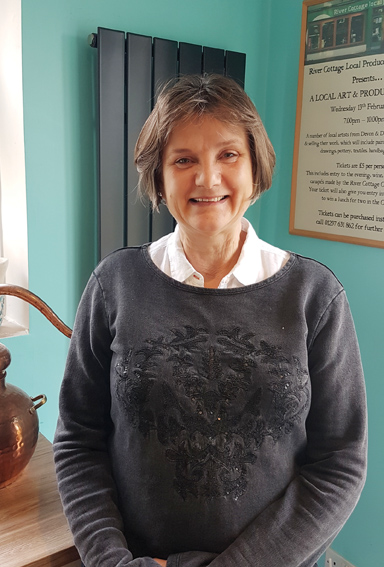
Chiropractor by day, gin maker by night, Ros Nelmes started Fordington Gin with her husband Colin, distilling batches of gin on their kitchen table top. She was inspired by a Conker gin tasting she attended in Bridport a few years ago and decided to give it a go herself. Fordington Gin is named after the area they live in, just outside Dorchester and is the result of many a tasting party with friends. The outcome is a smooth, delicious gin with flavours of star anise, lemon balm, mint, wormwood, juniper and coriander.
Working three days a week in Blandford as a Chiropractor; Ros’s career for over 20 years now, she has four days a week to work on the gin business. She comes up with the magic – the making of the gin, marketing, sales and admin. Colin runs the logistics, delivering gin round the county, to pubs, bars, farm shops, wine shops, independent delis and restaurants. As an Animal Chiropractor he is on the road anyway, so his role in the business ties in nicely. Ros is the face of Fordington Gin, also doing talks, birthday parties, tea parties with a twist, charity events, food fairs and fetes too.
In addition to the standard Fordington gin there is also Gurt Lush, a new gin they have brought out. At 50% ABV proof it’s not for the faint-hearted, but Ros confirms it is a complete triumph and something everyone who enjoys gin should try. Now with a dedicated converted stable found at the bottom of their garden, Ros has a purpose-built gin-making emporium. She can now produce even more batches of her tipple, as she tries to meet the growing demand. Local, award-winning producers are also using her gin. MaBolton, producer of allergy-friendly artisan baked goods, preserves and syrups uses Fordington Gin to make her Marma’gin marmalade. And gelato makers Baboo have made a Fordington Sorbet.
A stickler for making everything from scratch, Ros likes to know what she is eating, and cooks pretty much every night, usually with a gin and tonic in hand. Her chickens in the garden cluck away as she busies herself, preparing the evening’s meal, catching up on emails and tinkering around with syrups, concocting new flavour combinations for even more gin tastings. Lucky friends!
May in the Garden
If you are not a seriously committed, plant obsessed, sort of gardener then May may be the first month that your garden actually gets any proper attention. Everything is in growth, most plants have produced new leaves or top growth, and there are generally enough warm, dry, days that you are likely to be tempted outdoors. The older I’ve got the more I’ve become a ‘fair weather’ gardener myself; double-digging, in freezing winter weather, loses its appeal once the bloom of youth has well and truly worn off.
One thing I’ve never been very keen on is the noise of powered garden machinery. Even the most basic garden tends to include an area of lawn unless it is so small that it is paved from fence to fence, and regular mowing is one gardening task that really is worth pursuing with religious fervour. Improvements in cordless technology mean that an electric lawnmower, without the danger of a trailing electric flex, is a real alternative to a petrol powered machine. Even if it weren’t for the perceived benefits of switching from fossil fuel to battery power, I’d still consider cordless machinery for the reduction in noise pollution alone.
Large lawns are still best served by petrol driven mowers, although I’m sure big, cordless, lawnmowers will become available / affordable in time. For example, petrol powered chainsaws are still the preferred option, for most gardeners, due to the limitations of price and performance of the, relatively new, cordless versions, but this will shift in time.
The best cordless chainsaws, from the leading manufacturers, are, I’m assured by those better acquainted with them than myself, just as competent as comparative petrol models. As with all new technology, until the economies of scale come into play, its relative extra expense will move closer to parity as the market ‘matures’ – it was always thus.
Back to more horticultural matters; it should soon be safe to plant out tender bedding plants once they have grown to a suitable size in frost-free conditions. It is still possible to have overnight frosts in May, even in the comparatively balmy south-west, so keep an eye on the weather forecast and have some horticultural fleece handy, to throw over any dubiously hardy plants, if temperatures take a tumble.
It’s very tempting to impulse buy packs of bedding plants when visiting garden centres, or on a trip to the supermarket, but it’s worth remembering that these may have been kept in protected conditions, up until being sold so they will benefit from a period of acclimatisation before being planted out. If they are very small plants then it might even be worth potting them into a pot the next size up, using fresh potting compost, and growing them on a bit, under glass or on a windowsill, before their final planting out.
Shrubs which flowered in the spring should be pruned, once their flowers have faded, using the ‘one in three’ method. This refers to the aim to remove one-third of the main stems of a mature shrub, every year, in order to maintain a good balance between vigour and flowering potential. Early flowering shrubs produce their blooms on shoots that grew in the previous year and it is these youngest shoots that have the best flowering potential.
This means that when pruning them it is the oldest one-third of shoots that should be cut out, after the initial removal of any damaged, weak or diseased material. Cut them right down to the ground, or as near to the base of the shrub that you can, so that new shoots arise from the base and not halfway up the plant. There is nothing worse, in my opinion than cutting the ends off old stems leaving unnatural, ugly, truncated limbs which then respond by producing a thicket of new growth at eye level. The aim, when tackling anything in the garden, is to achieve the desired result, managing nature, in such a way that your intervention is undetectable. I’ve said it before and I’ll say it again; ‘ars est celare artem’.
If you’ve not done it already, I often fail to get mine installed in time, insert pea-sticks around floppy herbaceous plants early in the month because soon they’ll be too big to get the sticks in without damaging the plants. I love pea-sticks for their near invisibility which is a huge bonus compared with the completely unnatural appearance of those dreaded, green ‘plasticoated’, metal staking products which link together on a hook and eye principle. Pea-sticks can be woven together using their natural form which supports herbaceous perennials in a twiggy embrace. Those ugly metal stakes, especially when dressed up in a lurid green never seen in nature, tend to cause the herbaceous stems to appear trussed up, down below, yet dangerously unsupported up above.
As mentioned last month, but now even more likely to become a problem, pests are responding to warming temperatures by multiplying exponentially. I am glad to report that, compared to when I was training in horticulture thirty years ago, it is now the exception, rather than the rule, to reach for a chemical control when pests threaten damage. I can’t remember the last time I used a pesticide in the garden, with the exception of vine weevil killer in potted specimens, and this is mostly due to experience having taught me that pest damage is rarely so serious that it warrants chemical warfare. There are some pests which do require constant vigilance, lily beetle being a case in point, and if these seriously bother you then the ultimate solution is to plant something else which isn’t susceptible to that pest; sometimes life is too short to fight battles which you are never going to win—however unfair that may seem!
The good thing about May is that it is such a blooming marvellous month for floral exuberance, it’s no coincidence that the legendary ‘Chelsea Flower Show’ is held at this point of the year. Any gardening shortcoming is soon overshadowed by another tribe of plants hitting their stride. There is colour, striking foliage and intoxicating scent at every turn. With any luck, the threat of dangerously hot weather, with possible drought, has yet to occur so, with the exception of plants in containers which require regular watering, the garden as a whole is largely self-sustaining. If your own garden is just crazy paving, nothing wrong with that, it’s a great time to get out and about in other people’s gardens, so you get all of the ‘gain’ with none of the ‘pain’.
Vegetables in May by Ashley Wheeler

May marks a real change in the vegetable garden. Towards the end of the month we can be fairly certain of no frosts, so fleece can be taken off the spring plantings and rolled up for next year. It is a month that more tender plants go in the ground, with the likes of courgettes, squash and corn going outside, and tomatoes, peppers and aubergines being planted under glass or in polytunnels. It is not too late to sow squash, corn and courgettes either, so don’t worry if you haven’t yet done that.
At Trill Farm Garden we are lucky enough to have polytunnels, and we use these mainly for salad and hardy herbs over winter, and then change over to sugarsnap peas, tomatoes, french beans, cucumbers, peppers, a few other salady bits and some plants for seed saving from the end of April onwards. So this month sees a real change in the tunnels as well as outside. We also use the tunnels to extend the season a little, for example by planting garlic, spring onions and sugarsnaps in the autumn we can harvest them earlier than the outdoor grown crops, making the hungry gap slightly shorter. If you have fairly free draining soil you can do this outside too with the use of fleece or cloches to protect the autumn plantings more from the winter weather.
When you are planting new crops in the ground, whether it is in polytunnels or outside it is always a good idea to think about how to maintain good soil health. Rather than using the conventional approach of removing the old crops and double digging, why not consider cutting the old crops down at the soil surface, leaving the roots underground so as to maintain the biological activity in the soil. You can them pull out any perennial weeds and mulch the bed with a couple of inches of compost before planting a new crop. This approach not only saves your back, but also preserves and improves biological activity in the soil. It is always best to try and minimise soil disturbance as much as possible as it will damage any myccorhizal and other biological activity under the ground. This soil life helps plants to access a wide area and range of nutrients as well as water.
WHAT TO SOW THIS MONTH: Courgettes, french beans, squash (early in the month), chard, beetroot, lettuce, winter brassicas, spring onions, swede (end of the month), carrots (or leave until June to avoid the first carrot root fly), parsnips, radish, forcing chicory,
WHAT TO PLANT THIS MONTH:
OUTSIDE: Courgettes, french beans, beetroot
INSIDE: Tomatoes, cucumbers, peppers, chillies, aubergines, basil, summer purslane
OTHER IMPORTANT TASKS THIS MONTH: Keep on top of weeds – keep hoeing whenever you get the chance and whenever the weather allows it (ideally on a sunny breezy day). Try to hoe before you even see the weeds germinating – it is much quicker and easier and will knock the weeds back as they are germinating under the soil surface. We usually hoe about a week after planting a bed.
Along the Road to Canterbury
Last month I related the description by Chaucer of some of the pilgrims starting along the Canterbury road. Now I propose to look at the remaining pilgrims, the laity. They might possibly be described as ordinary people, from middle class to working class, in today’s parlance. Chaucer writes as if he was one of the group and so could describe his companions.
So we start with a Merchant with a forked beard, a Flemish beaver hat and daintily buckled boots. He discussed his increasing capital, how he was expert in exchanges and administration of loans, bargains and negotiation, and the need for sea-police between Harwich and Holland, which sounds very modern. But no one knew he was in debt. He was an excellent fellow, all the same.
There was an Oxford Cleric, still a student, who had studied logic long ago. His horse was thin and so was he and his overcoat was threadbare. He preferred books rather than clothes and had not found preferment in the church and was too unworldly to look for other work. Although he was a philosopher he could not turn base metal into gold and if friends gave him money he would spend it on more books and pray for them. He said little but was pleased to learn and to teach.
Another, a Serjeant at Law used to meet his clients discreetly at the entrance of St Pauls. He had often acted as a Justice of Assize and was knowledgeable about the law, without question. But for this journey, he had left his robes and wore a homely partly coloured coat tied by a silken pin-striped belt. He was accompanied by a Franklin, that is a freeholder of land, but not of noble birth. His beard was white and he had a high colour and lived for pleasure and entertaining with a well-stocked larder and cellar. He was well thought of as Justice at Sessions and had often been Member for the Shire and carefully checked audits as Sheriff. On his girdle hung a dagger and silk purse in white.
A Haberdasher, a Dyer, a Carpenter, a Weaver and a Carpet-maker all wearing the livery of their impressive guilds also travelled with the party. They all looked trim and their clothes would pass for new and their knives made with pure silver, displayed on their girdles and pouches. They each appeared to be a worthy burgess, wise enough to be an alderman. Their wives believed they should be called “Madam” and carried their mantles like a queen when going to church.
An excellent Cook in the party could tell London ale by flavour, as well as cooking, all one could ask for. But Chaucer thought it a pity that the Cook had an ulcer on his knee.
Riding a farmer’s horse as well as he could was a Skipper from Dartmouth who owned a barge named The Maudelayne. He wore a woollen knee length gown with a dagger on a lanyard around his neck and down under his arm, and he was suntanned brown. The Skipper was an excellent seaman, but had little conscience, drinking wine at Bordeaux while the traders’ backs were turned and if he took enemies prisoners he made them walk the plank.
Along the road it was clear that the Doctor could talk well on medicine, surgery and astronomy, drawing horoscopes for his patients, then prescribing drugs. He was careful with his own diet and wore blood-red garments, slashed with bluish grey, lined with taffeta. However, he was tight with money and loved gold, which is said to stimulate the heart.
The Wife of Bath was deaf but was skilled with cloth better than the French. She was haughty and no one dared to reach the altar steps before her. Her kerchiefs were the finest, especially those she wore on her head on Sunday, her hose were of the best scarlet, gartered tight and her shoes were soft and new. Her handsome face was bold and red. She had married five husbands, apart from other company in youth! She was widely travelled and would wander. She had gap-teeth which she said suited her as a mark of Venus. Laughing and talking about love, she rode easily on an ambling horse. Her wimple was topped with a hat as broad as a shield and her large hips were hidden by her flowing gown.
There was a Ploughman, the Parson’s brother, honest and hard working, whether carting a load of manure, thrashing corn or digging a ditch. He would help the poor for the love of God. He paid all his tithes promptly and wore a tabard smock whilst riding a mare.
Another man entirely was a Miller, a stout man of sixteen stone who could win the prize at any wrestling match. His red beard was spade shaped and his nose had a hair tufted wart and wide black nostrils. He had a large mouth and he told “pub” stories, usually filthy. A blue hood topped his white coat and at his side hung a sword and buckler. His favourite instrument, the bagpipes, he played as they left the town.
From the Inns of Court came the Manciple a man very careful with his money who watched the market closely. He had over thirty masters in the College full of legal knowledge, but none could match him financially.
The Reeve could match the Manciple, but in his care of his master’s estate, when he presented his annual accounts better than any auditor. He knew the yield from the land and animals and was feared by all the employees. He had a lovely dwelling, shaded by trees and had become rich, but would give his lord loans or gifts to ingratiate himself. He rode a dapple grey stallion-cob at a slow trot at the rear of the party, wearing a bluish shade, overlong overcoat, tucked under his belt and a rusty blade slung at his side.
The final member was their Host at the tavern. He welcomed them to the Tabard and gave them a fine supper and strong wine. A striking man, well built, merry and proposed that each should tell two stories towards Canterbury and two more on the return journey, to while away the time. He would judge the best story and the teller would have a free meal on their return to Southwark, paid for by all the pilgrims. This was agreed and the Host said he would ride with them and they set off next morning at slightly more than a walking pace.
Then began the stories, some of which are quite long and so I can only provide a flavour of them. The first was the Knight’s Tale which is long and intricate with allusions to early Greeks. This was followed by the Miller’s Tale, humorous, but perhaps too rude for a family publication. Several of the stories have similar crude material. Perhaps in Chaucer’s time attitudes were different. However the Reeve’s Prologue spoke out against the Miller, but was interrupted by the Host and told to stop preaching. The Reeve continued with a story of a miller who tricked two young customers, who eventually “turned the tables” by ending up in bed with the miller’s wife and daughter.
The Cook started by laughing at the Miller in the Reeve’s story but was told by the Host to get on with his story. The Cook, Roger, replied referring to the Host as Harry Bailey and proceeded with his tale of a no good apprentice, but this story was not completed by Chaucer.
Chaucer parodies himself by writing in the Man of Law’s tale who said “Chaucer, clumsy as he is at times, in metre and the cunning use of rhymes” and then requested by the Host to tell a tale, he commenced “Sir Topaz” and was stopped by the Host for his “doggerel rhyme” and commanded to try prose. Chaucer then commenced “Melibee” but ends it abruptly.
You will recall that we were told originally that there were around thirty pilgrims, to each tell one tale on the way to Canterbury and another on the return, but I have only found twenty three in total, including Chaucer’s. Because of their length and complexity I have not been able to even precis them all, so all I can suggest is that if you “have the stomach for it” you apply to your local library, or book shop for a copy. Perhaps they keep it on the top shelf! Just to give a final flavour of it, our west country woman, the Wife of Bath, implied that each of her five husbands and those outside wedlock all agreed that she “was good in bed”.
Next meeting of Bridport History Society will be in Bridport United Church Main Hall, East Street at 2.30 pm on May14th when Stuart Morris will talk about “Weymouth Piers and Pavilions”. All welcome, visitors entrance fee £3.
Cecil Amor, Hon President, Bridport History Society.
Arts and Crafts
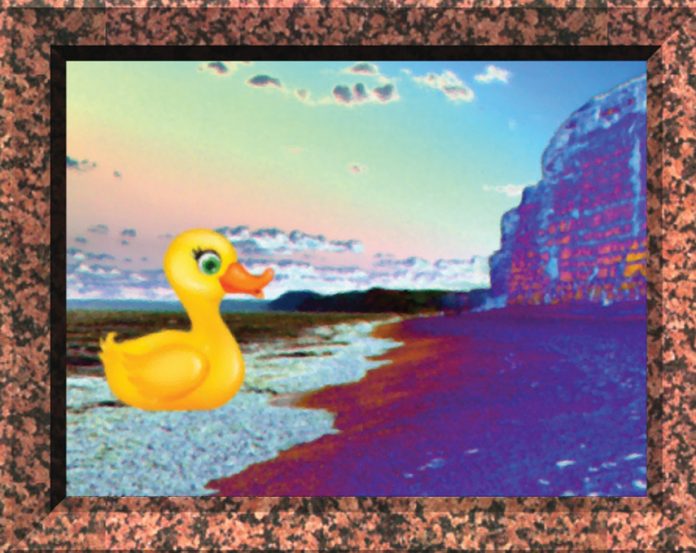
Some of my best friends are artists. Or rather… some of my best friends are really good artists who can draw and doodle at the drop of a #4 Red Sable brush. Some of them are also pro artists and even exhibit and regularly sell their own paintings. I wish…The only time I sold a work of art was by accident when I painted a portrait of my sister which made her look like a long-nosed dinosaur with huge scary eyes and hair covered in pink custard. Very ‘Jackson Pollock’ I thought, although my sister was not impressed. A graphics illustrator from Leeds bought it for twenty quid and used it as inspiration for his next horror cartoon magazine. If you turn to page 12 of “Shazzam Monster Animator Monthly (January 2014)” you will see why my sister was so upset. Apologies for scaring the living daylights out of any of your children.
When proper artists paint a watercolour of—say—the River Axe at sunset, it looks great. It looks like it’s supposed to look—i.e. a river, a rowing boat, reed beds, a bird or two and a beautiful evening sky. My attempt at the same scene resembles a splodge of blue and orange with blurry black bits (supposed to be ducks) and in place of a boat, there’s something that looks very like a dead vulture poking out of the water. My arty endeavours over the years leave quite a bit to be desired and rather more to be imagined, but I keep trying.
I used to be part of an art class run by one of my good friends (she’s a seriously good artist and can even tell you the exact shade of yellow of the inside of a daffodil—Cadmium Yellow Pigment 37, in case you were wondering). I kept going for years without ever achieving even a minor masterpiece but, as she told me, “I must keep experimenting”. One of my so-called experiments was an oil painting of Sutton Bingham reservoir. It wasn’t too bad but I got bored with it one rainy afternoon and in a mood of complete frustration I added a German submarine to the foreground which failed to improve it. Probably the only reason I kept going to art was because I was the only man in her art class. It was much more interesting to sit and experiment with pencils and brushes when surrounded by attractive ladies.
To be a good artist, it helps if you’re a little weird. Picasso carried a real gun around and if you asked him about his art, he’d pull it out and threaten to shoot you. Salvador Dali kept a pet ocelot and stole the pens of all fans who asked him for autographs, while Michelangelo may have painted the Sistine Chapel, but he was a right stinker… he never bathed and only rarely changed his clothes. Despite a lifetime of painting ballet dancers and young ladies combing their hair, Edgar Degas was a dedicated misogynist who hated all women. He preferred racehorses apparently. Perhaps I’d be a better artist if I too cultivated a few weird behaviours like wearing a pair of underpants on my head or walking a live lobster around Bridport.
Degas once famously said: “Painting is easy when you don’t know how, but very difficult when you do.” This is SO true and it partly explains why my ten-year-old granddaughter is so much better at painting than I am. She looks at something and simply draws it. Voilà! Poetry on a page…
On the other hand, I first have to choose the medium: watercolour or acrylics? Today, it’ll be acrylics because water colours are too difficult since you can’t erase a brush stroke if you don’t like what you’ve done. Next, what type of paper? This means going through all my pads of paper—white, grey, dark red or buff yellow paper, or maybe acrylic canvas board? Some of them I’ve never ever used, but I like to have them there just in case. It’s strangely comforting. Then I can start to get ready. Firstly, I remove last week’s brushes from the cold cup of coffee, rinse them thoroughly and then dry them for no particular reason particularly as I’m about to wet them again. Repeat this rinsing and drying routine. Then I sit down, pour a fresh coffee (because the last one had traces of Burnt Sienna in it) and spend ten minutes contemplating. This is a very important moment artistically. I have to allow time to relax and let the image of what I intend to try and paint sink inside my brain… Deep breathing to help bring on the “inner me” etc. Then I remove an orange from the ‘Still Life Arrangement’ and eat it.
Finally, I draw a couple of lines (horizon or something) and then dabble a few round blobs of green paint to give the impression of some grapes. Then I make them too big and turn them into apples. My still life of ‘an orange with a bunch of grapes’ looks OK but it’s somehow missing something important. Ah yes… the orange. That’s why I lack the patience to ever become a great artist. I’m sure you get the picture. Or rather, in this case, you don’t.