Monday, December 22, 2025
Home Blog Page 22

Vegetables in July

July is a time of abundance. We are harvesting cucumbers, tomatoes, French beans, padron peppers and courgettes along with all of the hardier spring sown crops like beetroot, chard, spring onions, kale and the like, as well as lots of salad and herbs. If you want to continue this abundance through the autumn it is an important time to get sowing to replace some of the spring crops.
One of the crops that we sow a lot of at the very beginning of July is chicory. We grow a huge variety, some of our favourites including Treviso “Sel Svelta”, Palla Rossa “Giusto” and “Marzatica”, Castelfranco and Leonardo. The palla rossa and treviso types can be sown a bit earlier (in May and June), whilst most varieties do well from sowing at the very end of June or first week in July. If they are sown too early they tend to bolt, and if sown too late they do not have time to form a proper solid head. Chicory is a great autumn leaf, as it doesn’t suffer from mildew like lettuce does with the cooler nights and damper air of autumn. When the chicory forms dense heads, the inner leaves have a bitter sweetness, which can be balanced with a good dressing—more lemon juice than normal and maybe a little more honey. They are also great when braised or roasted.
We plant chicory in beds that have either had peas, peashoots and broad beans in them, or in beds that have had shallots—these are harvested just before the chicory is ready to plant. We sow chicory seed into module trays, aiming for one seed per cell and plant them out about a month after sowing. Chicory seems to grow pretty easily, providing it has enough water—mulching heavily with compost will help to retain moisture in the soil. We then start harvesting the heads from October (from the July sowings).
We also start sowing a few more of the other autumn leaves for salad through July, such as some of the mustards—Purple Frills, Red Mizuna, Golden Frills along with Rocket, Winter Purslane and Leaf Radish. Flea beetle are still about so it is important to keep the brassica salads covered with a fine mesh (0.6mm holes).
July is a great time to sow fennel—it is less likely to bolt from July sowings, compared to earlier sowings. You can either sow direct or sow into modules. It doesn’t like to be transplanted too much, so try to minimise the shock by getting them into the ground as soon as possible from the modules, and do not let the roots start to fill up the modules too much. Let’s hope for a sunny, warm July!

WHAT TO SOW THIS MONTH: Chicory (see varieties above), endive, summer purslane, winter purslane, mustards, rocket, land cress, chard, beetroot, lettuce, kohl rabi, fennel, broad beans (for tips in salads) & peashoots (at the end of the month), carrots, dill, coriander

WHAT TO PLANT THIS MONTH:
OUTSIDE: fennel, beetroot, lettuce, chard, kale, salad leaves – amaranth, orache, anise hyssop, buckshorn plantain, salad burnet, chervil, endive
INSIDE: summer purslane, late french beans, late cucumbers, basil,

OTHER IMPORTANT TASKS THIS MONTH:
Try to clear beds where crop harvests are coming to the end such as broad beans, peas, spring onions, lettuce and shallots, so that you can put in newly sown crops straight away. We either flail mow old crops and cover with thick silage plastic for 2-3 weeks or remove the crops by cutting them off at ground level and then hoeing the bed before planting.

We are running Salad Growing courses on July 13th and October 19th.
See trillfarmgarden.co.uk/courses for further details.

Andrew Dickson

‘I grew up in Richmond, near London, in a loving musical family. My parents and one sister played fiddles, the others piano and flute, and there was always music, especially at Christmas. I started ukulele at 11 and guitar at 12, which became my main instrument. Aged 13 I did a term at the Spanish Guitar Centre in Leicester Square learning Classical; it took them that long to realize I was doing it all by ear, so that was the end of my formal training. I think I’ve gained most of my musical skills through friends and osmosis.
When I started writing my own tunes, they became more interesting to me than the pop music of the day, though I loved Joan Baez, and Skiffle. I judged music by its drivability, meaning that if I enjoyed driving to it, loud, which I did a lot of, it was good. My Great Aunt Marjorie had published several books “demythetising” music, making it more accessible for children. She wrote songs and invented the Tonic Solfa family with Father Doh and Mother Soh, predating my similar quest to erode the inherent elitism in most music. I trained to teach at Coventry College of Education in the 60s when Folk Clubs became very popular, and because I could play more than three chords people decided I was a beatnik and a great guitarist. I found a teriffic singer, Jenny, and we spent two happy college years playing the Midlands Clubs as ‘Andrew and Jenny’. I learnt how to show off and sang the rude and funny songs while she did the beautiful ones.
When I left college I found that everyone in the audience at my local Twickenham Folk Club could play at least as well as me. I learned to play the piano, and then worked in a Special School for Maladjusted Teenagers (as they were then called) for two years, which was great—child led education as it should be—then I got into Theatre in Education. My friend Sue Birtwistle and I started the first TIE Company in Scotland working in Edinburgh schools through the Royal Lyceum Theatre, promoting the use of Drama as a teaching method. As writer/actor/teachers we devised programmes on a variety of subjects which we took into schools as Characters and then involved the children in the action. They weren’t consciously performing, but becoming involved and thus learning about the topic by Doing rather than Reading about it. After two years of much pioneering fun I did another two at the Cockpit Theatre in London making TIE programmes with many city schools.
Having worked in Edinburgh, I got to work for many of the companies I admired from the Festival, fringe companies such as the People Show, Joint Stock and Theatre Machine. From the Three B’s in Bridlington to the Peoples Palace in Borneo I worked as actor, musician, composer, director and writer for many including The Crucible Sheffield, The Liverpool Everyman, Nottingham Playhouse, Oxford Playhouse, two years touring with the Royal Shakespeare Company, two years as Artistic Director of the Young National Trust Theatre and seven Edinburgh Festivals. I did seventeen shows with the great poet Adrian Mitchell, including three of the Greek Myths (40 songs) in Japanese in a huge tent in a Tokyo park for Japanese children. Adrian also wrote The Wild Animal Song Contest for Ken Livingstone’s Year of Peace when he was leader of the GLC, which we toured round London parks in a double-decker. The whole side of the bus came down to form a stage, and we ended up in the Children’s Field at Glastonbury competing with U2 in the next field—hard work but very exciting.
Working in the world of theatre I bumped into film director Mike Leigh. I had written music for the Crucible’s 10th anniversary, a production of Caucasian Chalk Circle by Brecht, in which Mike’s best friend was playing the lead. He asked me to do the music for his film Meantime, and that was the start of a relationship in which I did a further five of his films. It was the hardest work I’ve ever done yet the most rewarding. Mike supervised virtually every demi-semi quaver, but it was great having that much collaboration. I would start by writing tunes to a rough first edit of the film, from which Mike would select one out of ten. I would then do ten variations on that tune, and he would select one of them. I then had to choose a small ensemble to record, often using harp, viola and double bass. Unlike the current trend in film to employ wall-of-sound/end-to-end noise, thus negating the audience’s need or opportunity to use any imagination, Mike and I both love, and use a lot of, silence. The positioning of the music is painstakingly chosen and though I have worked with Directors who leave me completely alone, I much prefer collaboration.
In between Mike’s films, which were generally about two years in preparation, I was able to do community projects, like a play called The Symondsbury Marys, which was a secular nativity play in the Tithe Barn at Symondsbury. I first came to Dorset to work with Anne Jellicoe in Community theatre, on Howard Barker’s play The Poor Man’s Friend, in 1981. It had political overtones and I always prefer working on theatre with a purpose, fun and relevance being my main priorities. It was about a boy who was hung for setting fire to hemp in Bridport’s main industry of the time, ropemaking for the hangman’s noose—otherwise known as the “the Bridport Dagger”, or “the poor man’s friend”. It was a huge, wonderful surprise for me working with a cast of 120, writing harmonies for that number of people, and seeing the joy they discovered in performing. Only recently have people become aware of the fact, now that TV has discovered it, that singing in choirs is good for the soul and can significantly help with loneliness, stress, self-confidence and Dementia. The play came at the beginning of a whole movement of Community Theatre, in which I continued to be involved, with Entertaining Strangers by David Edgar in Dorchester, and then five others, one in Burton Bradstock. Then in 2016 I wrote the music for The Tempest of Lyme at the Marine Theatre, an adaptation linking Shakespeare’s Tempest to the history of Lyme Regis directed by Clemmie Reynolds. I’m working with her again in London on a project based on Theodora of Byzantium, an amazing woman who lived in the year 500AD in Constantinople, who started life as a child prostitute, and ended up, by marrying the Emperor of Constantinople, the most powerful woman in the Roman world, changing many laws which discriminated against women at the time.
I’ve had amazing luck throughout my working life, often due to the people and places I’ve encountered. I’ve been commissioned to write several pieces of musical theatre, one for the Somerset and Dorset Theatre Company run by Kate Geraghty called Feed the Birds, and more recently Flea, a Ukulele Opera based on a Flea Circus, with a 22 piece ukulele chorus, a band, and a cast of a hundred plus. It was all sung, and performed here in Bridport at the Palace. I strongly believe that simple instruments like the ukulele, harmonica and autoharp—all producing instant results—should be taught at an early age, instead of more traditional and challenging ones like violin and clarinet, which can wait. I have a huge collection of instruments from around the world which I am happy to share with anyone who is interested, and one day hope to initiate a ‘Music Hub’ in which to house them where all can come and play. At the moment I’m lucky enough to be writing music for my daughter Kitti’s wedding. And, alongside various awards, my greatest achievements in life are my three wonderful children, Jim, Kit and Micky.
I began teaching guitar when I was 15, and have continued with many other instruments ever since. I discovered early on that ‘Tone Deafness is as rare as Genius’ and that, if you’ve got a heartbeat and a vague sense of pitch, then you are musical. Which means everybody. It’s a natural human condition, and not the preserve of a talented elite. Music, along with the other crucial Arts subjects, has been far too marginalised by recent governments and it is high time that music was a priority for all teachers in training. I’d simply love others to share in the great discovery of enabling their fellow human beings to access their innate musicality and their own singing voice, which, in a merry way, has been one of my main motives in life.’

People at Work

Joel Seward’s Dad saw an advert in the paper for an office and yard assistant at Westcrete, the local firm in Axminster where he used to pick up all the landscaping materials to transform his garden in Smallridge. Knowing the family firm to be friendly and informative, he urged Joel to apply for the job. Successful in his application, he started at Westcrete in 2010. And for the last 5 years, Joel has been the General Assistant Manager; a job he loves.
Waking at 6.30am every morning to take his beloved rescue dog Rex out for a long walk in an effort to tire him out, Joel is at his desk by 8 am coffee in hand ready for whatever the day ahead brings. The firm supplies landscaping and building materials, as well as a range of aggregates and also deliver ready-mix concrete. Joel serves the customers that start to come through the door as soon as it opens, the trade customers tend to come in early so it’s full on from the start.
With a background studying business studies and marketing Joel also looks after the website, marketing and any promotions the company is running. He performs stock checks, is the customer service department and updates social media. Learning from the owner Mike Thoennissen, Joel has a good grip on the products offered and how the business works but says there is always more to learn. One new introduction to the business Joel is particularly proud of is their photo competition. The best photograph of a garden completed by one of their landscape gardener customers is voted on, with the winner gracing the cover of Westcrete’s price list for the year, often resulting in new business enquiries.
Lunch sees Joel out walking Rex, along the river next to the office. And as soon as work is over Joel is off home to change into his running gear. A member of Axe Valley Runners, Joel’s health has been transformed since he joined a year ago, alongside taking on Rex at the same time. Now he takes Rex on a run with him most nights covering up to 50 miles a week. So, with the running combined with playing for Seaton Cricket Club, that’s summer sorted for Joel this year.

Layers of Life – Dave White

Painter Dave White is to select the artists for the Painting & Drawing category of the 2019 Marshwood Arts Awards. He talked to Fergus Byrne about some of the opportunities that helped him to become a successful artist.

It was only on the last day of his degree course at the Liverpool John Moores University that Dave White discovered whose workspace he had inhabited for the previous three years. As he packed up his paints and brushes, a cleaner explained that, thirty-odd years before, the space had been occupied by a mouthy young teddy boy called John Lennon. Big boots to fill—in some ways—but then Lennon had famously quit what was then Liverpool College of Art to go on to a different career.

Dave White, on the other hand, never really lifted his head from the canvas. He won an arts competition; was chosen to join the prestigious Northern Graduates exhibition at the Royal College of Art, and, following that, found himself exhibiting alongside David Hockney and Picasso at Sotheby’s. His rise was meteoric and mind-spinning. He worked hard and went on to be feted as “the new Andy Warhol”—a badge that at times has been as much a burden as an honour.

But these early breaks are part of the reason that Dave is so enthusiastic about Arts Awards. ‘It’s amazing how a little thing can spur you on’ he says. He remembers the evening he sat in a room with others who had been nominated as the best new talent in visual arts when the painter Adrian Henri announced his name as winner. ‘I nearly spilt my drink’ he laughs. ‘I was sitting next to Norman Wisdom. It was bizarre.’ But it gave him an early break. ‘And for some people, that’s exactly what you need. It gives people confidence and a wonderful opportunity for people to see what you do.’ He echoes the sentiment offered by many of those who have selected work for the biannual Marshwood Arts Awards in the past. ‘At the end of the day every artist is on a journey, and it’s nice to be acknowledged.’

For Dave White, that journey began as a child. ‘Ever since I was a little boy, I’ve always made images of things I was into’ he says. ‘Things I was obsessively into. It’s almost as if anything that captured my imagination, that floated my boat, I would go away and make an image of it.’ Even in school, all other classes were just treading water until it was time to paint and draw. Sitting in school, he just knew that ‘all the other lessons were not where you want to be’.

Although accepted for a place in Glasgow School of Art he had already come under the influence of well-known local painters such as Rodney Dickson, Dick Young and of course Adrian Henri. ‘These guys were much older than me, but they took me under their wing’ he recalls. Consequently, he couldn’t see a reason to go and study anywhere outside of Liverpool. His father was a butcher who had hoped his son might take over the family business, but not only had art derailed that ambition, Dave had also decided to become vegetarian. However, he credits his Dad with passing on his talent and imagination. ‘His window was his outlet and his creativity’ he says of his late father. Designing the layout of his shop window was something he took time and effort to get right. ‘He was also a jazz drummer, but he would go in at five in the morning to do his window. It was immaculate. He was the best in his trade.’

Taking that creativity to another level, Dave’s connection was with paint. As he puts it, ‘there were no ifs or buts’. When he discovered oil, he says, ‘It communicated viscerally my ideas. Oil paint can be a tricky beast for some people, but I never found that. I connected with it immediately.’ His feting as the new Andy Warhol came after a collaboration with Nike and Brand Jordan where he pioneered ‘sneaker art’. Always a huge fan of sneakers he understood what he called ‘trainer culture’ and produced a series of paintings inspired by pop art. Those paintings and the sneaker line were a huge success. After his collaboration with Nike and Jordan, he was commissioned by Coca Cola to produce a painting for Jay-Z’s new design for Cherry Coke. Consequently, the ‘Andy Warhol’ and ‘pop art’ labels were applied perhaps too liberally, and though he found that period of his career ‘an incredible journey’ he says it doesn’t define him.
About twelve years ago he began working on animal portraits again. Variously described as “vibrant and rich, engaging and bold” as well as “filled with expression, emotion and dynamism” this work captures a depth not seen in most animal imagery. It was born of a love of animals and a reaction to his shock at the many endangered species around us. He points out how we take for granted the fact that tigers, rhinos, elephants etc. are endangered. ‘But what people don’t think about are animals like chimpanzees, parrots or sea-lions.’

Some of his fondest childhood memories are visits to Chester Zoo, where the introduction to a three-dimensional perspective of animals still influences how he paints. ‘When you look at a rhinoceros, or you look at a giraffe’ he says, ‘your brain has got it imprinted that that’s what it looks like. But when you see them move…’ That movement and the layers of life within his subject are what he strives to get into his paintings. His focus is on getting a connection with his subject. He has what he admits is ‘an obsession’ with great apes and talks about the need to make eye contact. ‘Once you’ve got that eye-contact there’s something much more going on there.’

In 2014, following on from exhibitions depicting tigers, sea turtles, orangutans and various other animals, a show of work in London and Los Angeles focused on Great White sharks. His explosive use of paint highlighted their movement and dynamism, making the vast creatures as intimidating on canvas as they might be in the ocean. However, his goal was to show their fragility and beauty as well as their power.
Last year he created a hand-painted Rhino for the conservation charity Tusk. It was installed for a month outside Ralph Lauren in Bond Street and later auctioned to raise money for the charity. It was yet another turn on his journey, which to him felt somewhat surreal. He got to meet the charity’s royal patron HRH The Duke of Cambridge and hang out with Ronnie Wood, Gavin Turk and Harland Miller. ‘I felt a bit out of my weight grade, but it made a ton of money for the charity’ he says with an endearing humility.

He is looking forward to seeing the wide range of work that is submitted to the Marshwood Arts Awards this year. ‘The things I respond to most are instantaneous’ he says. ‘To be a good judge, you have to be quite eclectic. I would be looking for quality, individualism, a uniqueness and a spark—something that shows passion, integrity and honesty—people who enjoy what they do and love what they do. That’s what I respond to.’ Understanding the solitary nature of painting and the angst that many artists suffer he cites the later work of Picasso as an inspiration. ‘That freedom, that not caring and just making an image from your soul’ he says, is something he aspires to and profoundly affects his response to art.

There are many striking things about Dave White. His office is a shrine to Star Wars characters, video games, technology and sneakers. His look is a myriad of tattoos, chunky rings, deep brown eyes and infectious energy. And his canvases carry broad, confident, animated brush strokes illustrating his need to give life to what are instinctive reactions to the world around him. But the most striking thing is his enthusiasm for his craft and his wonder at what can be achieved. ‘My work’ he says, ‘if I really had to define it, is about that wonder of being a little boy and seeing something for the first time.’ He believes in his need to keep developing, keep refining and ‘never losing the love’ for his craft, but most of all ‘never not learning and never not pushing forward.’

Dave White will be selecting work for the Painting and Drawing category of the 2019 Marshwood Arts Awards.

For information or to enter work for consideration for the 2019 Marshwood Arts Awards visit www.marshwoodawards.com

For more information about Dave White,
visit www.davewhiteart.com.

People in Food

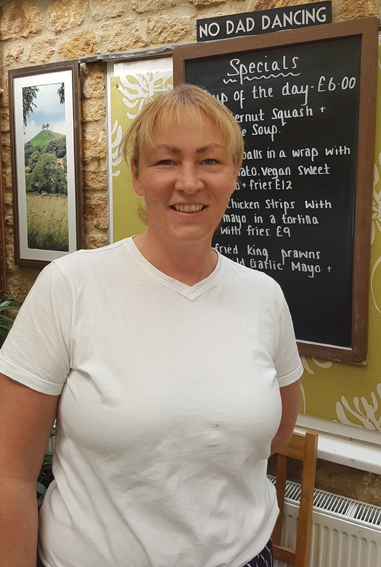
Fancy a pint by a tuneful stream on a stretch of grass opposite a thatched pub, oozing rural charm? This might be just the spot for you. Landlady Marie Childs runs The Fox Inn in Corscombe with her husband Shane. This is their seventh year running and living at the pub, in the village where Shane grew up. Marie works in the kitchen alongside Aleisa the head chef. Shane man’s Front of House with bar manager Sophie. A local’s drinking haven, the pub also is renowned for its food and finds itself of many people’s dining destination wish lists. With an inglenook fire to snuggle up next to or a light conservatory to dine in, this is a traditional Dorset pub, with wafts of ingrained wood smoke and something delicious from the kitchen, drawing in those who step through the door.
Marie’s childhood was spent growing up in a pub. She has worked in all manners of hospitality and even car sales, but the lure of the pub drew her back to run her own. Her passion for food nudged her towards the kitchen, while she was looking for a sous chef decided she would fill the role herself. A few NVQs in catering later and she was qualified to help Aleisa on a day to day basis. They have a weekly changing specials menu and a seasonal dining menu that changes quarterly, as well as the staples like fish and chips, burgers and steaks. Marie’s favourite day is when they plan the menu talking recipes and food. She has an extensive cookery book collection which she often refers to and peruses for pleasure in the little spare time she has.
Also taking up some of Marie’s attention are her two dogs and horses. She rides each morning, something she’s done since she was 9 years old. It sets her up for her day of split shifts in the kitchen. As well as cooking for the pub Marie also prepares meals for Shane and her two sons. One is grown up and “part-moved out” and the other is thirteen and still at home. But each Monday there is always an extended family meal where everyone gathers at the table, usually with hot buffet style food that Marie has made. She prefers food which can be grazed on, amongst chatter and catching up, just the way it should be.

Monumenta Britannica

John Aubrey, the 17th century Wiltshire antiquarian wrote about the monuments of Britain, under this title. However, this article is about monumental inscriptions in the churchyards of parts of West Dorset. The Somerset and Dorset Family History Society decided in about 1996 that it should record the inscriptions of gravestones, possibly inspired by our President Sir Mervyn Medlycott who single-handed recorded several churchyards in his area.
I was a member of the West Dorset Group and we were led by our Chairman, Harold Faulkner, who with his wife Pat requested permission from various parish ministers and churchwardens to carry out the work and then drew up plans of the particular churchyard. Finally Pat typed up the results. Not all parishes agreed as they did not want the lichen disturbed, or other wildlife. We agreed to carry out the work with the minimum disturbance and not of course on Sundays or other church occasions. Naturally, we required good weather.
My initiation was at St Swithuns, Allington, Bridport and had not realised how much time was required. So my only memory from that occasion was of several graves of Doctors, explained by the earlier local hospital in Allington.
Broadwindsor is memorable for our work being delayed by a visit from a group of Morris Dancers nearby, which we all enjoyed. As we commenced our task we noticed a small cremation tablet inscribed “In loving memory of R.C. (Dick) Day died 14 Feb 1989 aged 82” and then a local man passing through the churchyard asked what we were doing. One of our members asked if he knew Dick Day and he replied “his finger is buried there, look in the book My Story by Leonard Studley. Leonard, a retired farmer, attended our monthly meetings in Beaminster, always wearing an immaculate bow tie. He told us that Day had been baptised Reginald but known to his friends as “Dodger”. He had been working on a farm machine pulping mangolds for cattle feed when it jammed and Dodger attempted to clear the jam with his fingers, just as another lad turned the handle, chopping off a finger near the middle joint. A local doctor soon attended to Dodgers hand. However, a local elderly lady said that unless the finger was buried in consecrated ground the stump would never heal. The lady was respected in the village, always wearing black and performed the “last rites on people—to lie ‘um out”. So they returned to the farmyard and found the grisly finger among the mangold pulp and buried it with a matchbox for a coffin, under a yew tree in the churchyard. The “cure” was effective and the stump healed. Dodger frequently said, “I want to be buried under the yew, with my finger” and when he eventually died his ashes were scattered under the tree. But Leonard said that no one asked him and the tablet is on the opposite side of the tree, from the finger. However, we found it a peaceful spot.
Some headstones were already illegible and eroded, so the work entailed washing the inscription with clean water and then reading it as accurately as possible. It was best to work in pairs, one reading and the other recording and checking. Good sunlight, from the side, provided the best contrast, but alternatively, a mirror could be used to reflect the light. If this was not possible a torch was used from the side, with stone and reader covered in a ground sheet to shade other light. So should you be walking past a church and see a huddled form against a headstone, do not be alarmed, it may be someone discovering their family history. Frequently another eye at a different angle could see what the close observer missed. When our leader, Harold, walked round to check progress if we said we could not read a word he would say “It’s as plain as the nose on your face” and he was always able to read that particular word.
We were generally a happy bunch and often found inscriptions amusing. In Beaminster churchyard we found an inscription referring to an actor who died after a fall. Someone suggested “from the stage” and I think this proved to be so. It was a hot day and our erstwhile Chairman, Ray Paul, was noted wearing a hat with a bright white handkerchief on the back of his neck, “Foreign Legion” style, which caused a giggle. Occasionally we had to restrain some of our members from extreme actions, such as using bleach or “Brillo” on the stones. Our friend and recent Chairman, Brian, was prevented from bringing his wire brush, or chisel. He was once found standing on top of a table tomb, brushing ferociously with a yard brush.
In the summer of 1997, we embarked on the parish church of St Mary, Bridport, in South Street, assisted by some members of Bridport History Society.
I purchased a copy of the records subsequently so that I can quote in detail, where there are items of special interest. For example, a medium size table tomb records members of the Downe family, possibly the originators of Downe Street. Another records two William Balston’s. There are two large table tombs to members of the Gundry family and some smaller graves, names needing no explanation in Bridport. Some of the tombs and headstones bear engravings and embellishments of flowers, ivy leaves, angels, scrolls, trumpets, willows, hourglasses, shells and a skull.
Other recorded names also relate to the towns staple industry of rope, nets and twine, including Whetham, Tucker, Hounsell, Seymour and Ewens.
Another large decorated table tomb records the death of Nicholas Bools and family, including two daughters, one the wife of John Thoyts, Lieutenant Colonel of the Royal Horse Guard Blues. Bools had been one of the early shipbuilders at Bridport Harbour.
Inside the church, there are many monuments. A large brass plate records two Professors of Music named Hayes, related to two Rev Broadley’s, one Rector of Bridport, the other Vicar of Bradpole and Rural Dean. There was a photograph of Albert Stone, who was organist from 1888 and a plaque records that the first organ was built in 1815, rebuilt in 1884 and restored in 1984/1988. An illuminated script with the church history listed the Rectors of the Parish from Peter de Colyngton 1317 to John West Gann 1987. A brass plaque refers to an historic time in the national history, “in memory of Edward Coker, Gent, Second son of Capt. Robert Coker of Mapowder, slayne at the Bull Inn, Bridport An Do 1685 by one Venner who was an officer under the late Duke of Monmouth in that rebellion”. Another brass plaque shows the coat of arms of the ship H.M.S. Bridport together with its White Ensign.
A marble monument relates to Charlotte Carpenter, died 1816, only child of the late Rev Edward Roberts. Also of Henry Roberts, eldest son of Thomas and Charlotte Carpenter aged about 14 years, a midshipman on board H.M.S Scout, sloop of war which foundered at sea in November 1801 on the banks of Newfoundland on her voyage to Halifax in Nova Scotia when all hands perished.
The Ringing Chamber and Bell Tower has a photograph of the Ringing Guild Members in 1897 and details of the bells being recast variously in 1843, 1887, 1897, 1924.
Two particular monuments in Bridport require special mention and are well known. The Town War Memorial faces South Street and is the object of annual commemoration and needs no further detailing as it may be clearly examined. The other is the monument to Giles Lawrence Roberts, M.D.F.R.C.A. who died Sept.16th 1834 aged 69 years, just inside the wall behind the war memorial. It is a tall obelisk topped by a large sphere and standing on five steps. Also recorded is Joseph son of Rich & Mary Roberts, died Dec. 29 1769 and John their son who died in infancy and finally Phoebe wife of Giles died Jan 5th 1810 aged 56 and also their daughter Phoebe who died in infancy. The obelisk carries crests and globes and references to “The Good Samariton”. He was well known in Bridport and further afield for producing an ointment termed “The Poor Man’s Friend” and for pills for various conditions. It has been said that he often did not charge poor people for medication and he is now remembered by a small close off South Street bearing his name. His shop is now the Heart Foundation charity shop almost opposite the Town Hall.
Unfortunately, due to family illness, I was unable to continue with the project and it was finalised by Marilyn Sealy who brought it to a successful conclusion.
Finally, the completed typed scripts were printed and bound by the Somerset and Dorset Family History Society and copies distributed to the relevant church, museum, etc., and may be sold to any interested individuals.
John Betjeman penned a poem about Dorset Churchyards (which I have savagely abbreviated) :
“Rime Intrinsica, Fontmell Magna, Sturminster Newton and Melbury Bubb, —-
While Tranter Reuben, T.S. Eliot, H.G. Wells and Edith Sitwell lie in Melstock Churchyard now. —-
While Tranter Reuben, Mary Borden, Brian Howard and Harold Acton lie in Melstock Churchyard now. —-
While Tranter Reuben, Gordon Selfridge, Edna Best and Thomas Hardy lie in Melstock Churchyard
now”. Read it in full if you can!
The next meeting of Bridport History Society is not in a churchyard, but in the United Church Main Hall at 2.30 pm on Tuesday, June 11th for a Summer Special from Bruce Upton and Jane Ferentzi-Sheppard, “Pubs, Drinking, Poverty” : surviving life in Bridport in the 1800s’. All welcome, visitor entrance £3.

Cecil Amor, Hon President, Bridport History Society.

Feathered Friends

I think it happens when we all get a bit older, but I find I’ve now become much more of a wildlife fan. Being officially ‘retired’, it’s probably got more to do with me having spare time on my hands and watching too much David Attenborough on TV. Not that you can ever have ‘too much’ of Saint David, as he seems to be one of the few sane people left on our polystyrene polluted planet. When it comes to elections of various kinds, I’d much rather put an ‘X’ against Sir David’s name on my ballot paper. If he’d care to stand somewhere, I’d go and vote for him so he could then sort out Westminster by covering Big Ben with a gigantic pile of discarded plastic bags topped with albatross poo. He’d also save the country by feeding the soggy mess called Brexit to a troop of hungry polar bears, although they might end up with chronic indigestion.
I don’t know about you, but I find that—as I get older—everything around me is rushing past at ever increasing speed. This is why I now like gardening. Way back when I didn’t have the patience to wait six weeks for my runner beans or sweet-peas to grow. A month was an eternity, let alone six weeks! But now that I’m slowing down a bit, all my plants seem to be springing out of the ground like Jacks-in-the-box and it’s increasingly difficult to catch them before they bolt away. It’s a sort of race between me, the plants and the slugs, which is in itself an exciting and fun activity.
Along with gardening has come a sudden interest in birds—the feathered variety. I’m not yet a proper ‘Bird Watcher’ (I’m only a Bird Gazer Third Class), but I now almost know the difference between a siskin and a serin (not as easy as you think) and I can even recognise individual wood pigeons and blackbirds from their calls. I still get a bit bemused by buntings (so many of them) and I’m befuddled by the myriad tribes of finches, but I know enough to get through the majority of bird questions at our local village quiz night.
With the onrush of beginners’ enthusiasm, my wife and I have now joined the RSPB and we’ve erected a forest of bird feeders near to the kitchen window. Instead of my usual semi-dormant morning inertia at the breakfast table, I can now be spotted next to the coffee machine, squinting at the sky as I eagerly scan the fat balls for a chaffinch. Or is that a red start? Quick—get the bird book! One of my first purchases was a nice pair of binoculars—an essential piece of kit even for amateur bird gazers like me…
I thought this new hobby would be easy and relatively cheap, but that’s not quite true. Although the birds themselves don’t cost anything, their food does and I must have spent the equivalent of several Spanish family beach holidays on everything from sunflower seeds and hearts to pink and grey suet pellets, mealworms and suet blocks (with added insect extract for extra protein). And there’s no such thing as simple birdseed. Birdseed comes prepacked as ‘Feeder mix’, ‘Table mix extra’, ‘Blue Tit mix’ (which seems to attract every bird EXCEPT blue-tits) and my least favourite—‘No Mess mix’. This latter is misnamed as it produces much more mess than the others, but at least your garden gets cultivated with hundreds of beautiful wildflowers from the seeds that fall to the ground. And then there’s the tiny black nyjer seeds which get everywhere—on the floor, under the coffee machine, in your hair and in your breakfast cereal bowl etc. Nyjer seed is supposed to attract goldfinches and the like, but a huge magpie removed the container from its hook the other day and dropped the whole thing on the ground where it promptly broke. The bird then proceeded to gobble it all up beakful by greedy beakful. Of course, this was on purpose. Magpies are very clever but they’re also selfish and brutish and mean.
I call this the Bird Feeder Paradox… the greater the joy, the greater the problem. You start by putting out all your bird food and for about five days it’s a wonderful success. You get every sort of small bird such as robins and tits and finches all feeding near your window. And then the starlings arrive like badly behaved noisy teenagers to drive all your pretty little birdies away. Two days later, the really big bullies arrive the crows, rooks and magpies. They proceed to trash the entire place and break or steal the feeders and scare everything away. Your only solution is to remove all the food and put the feeders into the garage for safe keeping till the following winter. This rather removes the object of bird watching.
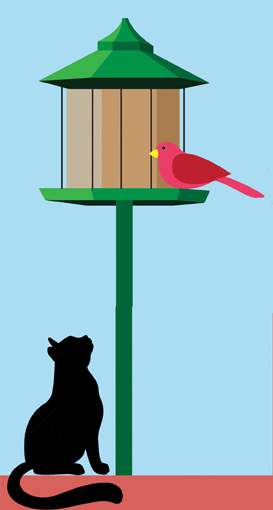
Living on the Jurassic Coast, I suppose I could always hang out a dead sheep or something similar and wait for a passing Pterodactyl to swoop down on my garden like a huge dark Jabberwocky. That would clear out the magpies. And all the seagulls. And probably the horribly noisy children from number 14. And their cats… definitely their cats.

D Day Remembered

It was seventy-five years ago when I, as a ten-year-old child, woke up one morning to the persistent drone of an armada of aircraft flying overhead. I got out of bed and went to the kitchen to hear BBC announcer John Snagge telling the world that “under the command of General Eisenhower allied naval forces supported by strong air forces began to land armies this morning on the Northern coast of France”. Outside in the morning air, the sky seemed black, horizon to horizon, with literally hundreds of gliders being towed to war by Douglas skywagon aircraft. The roads, which had recently been crowded with miles of parked up convoys of U.S. Army vehicles, had emptied under the direction of white-helmeted military police as they made their way for embarkation at the port of Weymouth. After the busy activity of recent weeks and the passing of the last aircraft of the aerial invasion a noticeable silence fell over the land, interrupted only by the occasional jeep speeding important messages from one point to another.
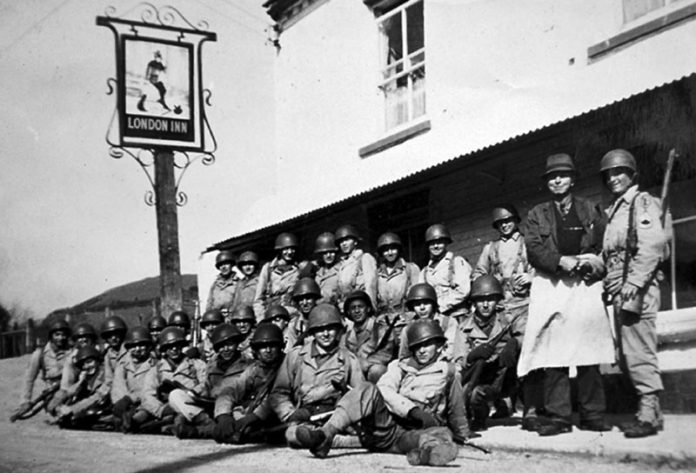
For the previous nine months, we had been under the friendly occupation of the U.S First Infantry, “The Big Red One”. They had arrived already battle-hardened from combat in North Africa and Italy. Being shipped back to England they were anticipating a return to the United States only to find it had been decided that with their already notable battle experience they had been selected for the vanguard of the intended invasion of Europe. Even commander General Bradley admitted that the decision to involve the 1st Division in a third amphibious landing caused him concern. Their arrival in Liverpool had been shown on the newsreels at the Regent cinema in Lyme but our first sighting of them was outside our granny’s bungalow outside Rousdon where both my brother and I had been evacuated. Playing in the road, where traffic was very sparse due to the war, we heard the sound of a convoy of heavy trucks labouring up Bosshill from the Axe Valley we saw them appear over the crest and down towards us. As they drew close a head thrust out of the window and, giving a ‘wild rebel yell—ephwaah!’ threw a hand full of stuff at us. The next truck did the same, and the next, suddenly we realised that the ground around us was being covered with packs of chewing gum and chocolate bars. We were being liberated!
A new commandment was issued by our headmaster, Mr Freeman at our school in Uplyme, “Thou shalt not ask Got Any Gum Chum!” The infestation of US Army encampments by children pestering for goodies became something of a concern to both British and US Army authorities, but their generosity otherwise seemed boundless. “Two Hundred Gate Crashers at Yeovil Party”, reported one headline in the Pulmans Weekly News. Strangely, wartime regulations stated that the US Army had to obtain permission from the British Ministry of Food to use American ingredients in any food used for party fare for British children.
Headquartered at Parnham House near Beaminster the 16th Infantry Regiment of “The Big Red One” were accommodated in tented and Quonset hut encampments, and civilian billets in Bridport, Lyme Regis, Abbotsbury, Litten Cheney and marshalling areas in Long Bredy. During those nine months of build-up we had soldiers tramping along our roads, playing war games in our fields, rumbling around with their half-track vehicles and strange amphibious vehicles, leaving a litter of unwanted food from their small boxes of personal ‘K’ field rations for us kids to scavenge,-packs of shortcake biscuits, small bars of chocolate, tinned spam, small tin of Nescafe, and a pack of five Lucky Strike cigarettes cast away by non-smokers.
As D-day approached restrictions on civilian movement were applied. Magistrate’s courts became busy with prosecuting people for not carrying their identity cards and young women from upcountry were gathered up in surprising numbers. If you were under sixteen years of age you were free of restrictions so free to roam. We would cycle down the back way from Uplyme to Lyme Regis where an American Cannon Company had secretly parked ranks of jeeps already with small howitzers attached read for the ‘Off’. Suddenly convoys started gathering along roadsides parking bumper to bumper. The DUKW’s of the Amphibious Truck Company departed their base in Beaminster, passing the neighbouring hostel of Woman’s Land Army girls and a few breaking hearts, no doubt.
I was a member of Uplyme church choir and remember sunrays glinting on the brass buttons and badges worn by the many GI’s who attended in the congregation at that time. Another chorister of that time, from Symonsbury church, a soldier from New York State, Pfc. Andrew Mapes of the First Infantry was shipped across to Omaha beach on D Day. Today there is a brass plaque in the choir stalls to commemorate his name. He fell among the dead and wounded on D-day.
It is not too hard to imagine the dangers the man wearing the red cross on his helmet had to face when he heard the frantic cry “Medic….hey medic, up here!” As one said “There are few things worse than being a rifleman in the infantry, but being a medic is one of them. When the shooting is heavy the GI can press himself deeper into the ground and doesn’t need to go out into the open on a mission of mercy”. It was one of those medics, an army surgeon of the 16th Infantry Regiment who was to leave his new bride in Lyme Regis. They had married just prior to the invasion. Captain Apanasewicz had been badly hit and wounded himself but insisted on crawling to other soldiers around him on Omaha Beach, injecting them with morphine. He was evacuated back to England but died shortly after. He was posthumously awarded the Silver Star and is buried in the American cemetery in Cambridge. Mrs Apansewicz lived a widow until her death in 2005.
Another remarkable hero was Sergeant Philip Streczyk who fought in five major battles with the Big Red One in WW2. He was awarded the Silver Star four times, one during the landings in Tunisia and another in the invasion of Sicily. During the invasion of D-day, he was in command of a 31-man assault team. Upon landing on Omaha Beach they were greeted with a scene of carnage as bodies were lying everywhere having been cut down by heavy machine gun fire from a pillbox atop of the cliff. At the rear of the beach, a gulley through the foot of the cliff giving a route off the beach was blocked off by a barrier of barbed wire. Sergeant Streczyk lost seven men crossing the sands only to find his remaining team trapped along with other teams of the Regiment who had landed alongside. The only way to break out of the trap was for one man, or several, to risk their lives by crawling forward with little more than wire cutters or Bangalore torpedos – 20-pound tubes packed with explosives-and exposing themselves to enemy fire while they attempted to cut their way through the tangle of wire, and they knew that German tanks could be on their way. Two men tried it but were cut down. Sergeant Streczyk picked up the cutters and took over. With practically every German weapon within range zeroing upon him he dashed to the wire, snipped a way through and waved his troops through. For clearing that route as a way off that deadly beach he was personally awarded the Distinguished Service Cross by General Eisenhower and the British Military Cross by General Montgomery.
Regimental Commander General Ed Wozenski said of Streczyk “He was one of my platoon sergeants. I think he is the greatest unsung hero of World War 2. To the best of my knowledge, he was the first on the beach and it was the path that he took which I picked up. The rest of our battalion followed, and then, later on, I think almost the whole of the remaining corps went up that same path.”
His team, now able to climb through the gap and up to the top of the cliffs then positioned themselves behind the pillbox for an attack. They overcame the Germans inside with the help of Sergeant Streczk’s knowledge of Polish. For like many of the defenders of those Normandy beaches they had been dragooned into service with the Wehrmacht during the invasion of their countries earlier in the war. The sergeant managed to talk them into a bloodless surrender.
As a bridgehead was gradually secured over the following days ships to-and fro’d across to the invasion beaches, some carrying army nurses, some probably from the 400 bed US Army hospital in Axminster, others returning to the UK with German prisoners of war. One Canadian reporter enquired of an incoming POW, what he thought of England, the German shouted back “Three years ago Adolph Hitler told us we would be coming to England. Well,” holding his crossed wrists in the air in a mock gesture of captivity, “here we are!”
So, at this time of commemoration of D-Day, a very respectful salute to all those young GI’s who came to help us ‘Limeys’ out during those uncertain times, and which, at great cost to them, led us to Victory.

Publishing across the Generations

Along with many business models, the book publishing industry has seen a dramatic overhaul in recent years. With the introduction of laptops, tablets and mobile devices, the way we read and the methods in which we access our reading material has changed. And where once there were dozens of publishers and agents working to help new writers reach a traditional hardback and paperback audience, today there are a handful of major publishers whose businesses appear to be driven more by marketing than literary aspiration. So what is a new writer to do when their work doesn’t fit into the business model that requires a ready-made Instagram or YouTube following to get them a book deal?
Self-publishing is one option. It has become very sophisticated over recent years and there are many companies offering routes to becoming a published author. But it can be a lonely and often depressing experience for those that have spent years working alone with a keyboard. And that can be daunting.
Bridport based Siobhan Harrison is one of many local writers who have experienced the knockbacks from publishers who ‘don’t want to take a chance’ on a new author. So, with encouragement from those who had read it, she decided to self-publish her first novel Carnaval under the pen name S A Finlay and followed that by producing an audiobook for the title.
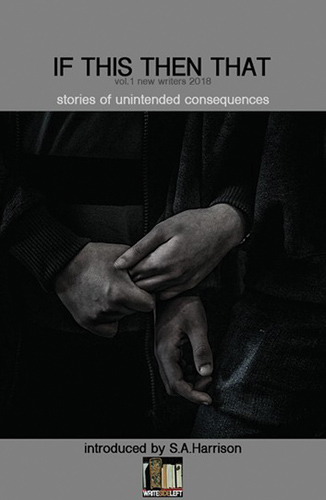
It was a huge learning curve. However, having learnt the basics of the publishing industry from first principles, type-setting, design, ISBNS, formatting print and ebooks, commissioning and producing an audiobook and making all her errors publishing her own novel, she decided she didn’t want the whole process to be just a vanity project. So she then put all that experience into publishing a second novel by another local writer Bardy Thomas. She followed that by commissioning and publishing her first Anthology If This Then That and followed it up with her first non-fiction book by locally based photographer and writer Robert Golden. At which point she decided to join the Independent Publishers Guild.
Siobhan brings more than a writer’s creativity to her business. She named her company WriteSideLeft because she is irritated by the ‘compartmentalisation’ of thinking and lifestyle associated with whether someone is ‘in the “creative world” or not’. Her day job uses a financial qualification whilst her publishing and writing are creative. ‘In real life, you need to use all of them to operate’ she says.
WriteSideLeft explores a theme of intergenerational issues, and she is determined to mix the age range, especially in her anthologies. ‘I really love the idea of introducing new young writers’ she says. ‘Their writing is raw. I don’t interfere with that. You get the odd young writer hitting the big time, but I think it’s tougher for them to know which—always online alleyway—to turn down. Their experiences, thoughts and interactions are Insta- fragmented—disorientated.’
Siobhan’s authors range from a remarkably talented seventeen-year-old student from The Sir John Colfox School to seasoned writers with a wealth of life experience. ‘I like the idea of a conversation between the older generation and the younger generation’ she says, ‘#baby boomers versus (and with) #snowflakes—in fact, that’s what literature is—a conversation down the ages.’
This year Siobhan is working on two anthologies: one on the theme of Asylum and the other on the theme of Christmas. ‘I am looking for stories and poetry on the theme of “asylum”’ in terms of human connectedness’ she says ‘whether that’s on the private stage—tucked up with your smartphone or a cup of coffee—or at large, publicly or politically. Asylum actually means “inviolable”. I’d like a mad bad and dangerous to read Brexit one—we must all have stories to spin about that. I like irony and dark humour and satire. That’s my thing.’ Her interest in satire and comedy she says is because ‘it’s the only response when you have a bunch of cartoon characters running America, the UK, Russia etc. So what is the response to that for our time?’
Although writing a cyberpunk novel herself at the moment, she thinks there is a lot of ‘better talent than me’ out there. ‘I don’t have any vanity or ego when it comes to me and writing. Which makes me a solid editor or gatepost—I’m just a gatepost. My original aim was two books a year, and if I consider anything I write to be good enough I’ll do that as well.’
For more information about current and future books visit www.writesideleft.com.

The Family Tree

A large group of us is sitting around a big table at Marsh Barn, on the outskirts of West Bay towards Burton Bradstock.
I’ve been here before, to learn about family history with local expert Jane Ferentzi-Sheppard. I’ve done a couple of sessions but haven’t really had the time to get stuck into it yet. Never mind about procrastination, as anyone who has ever looked into their family’s history will tell you, it’s research that can be the thief of time.
But, oh the rewards. Not in monetary terms, of course, but in the satisfaction of fleshing out the family bones – although there is always the possibility of a skeleton or two in the cupboard.
I’m here today to find out more about DNA and how modern science can help in the quest to delve deeper into the shelves of family history.
A DNA test can show to whom you are related – providing they have also had a test done – and also give you a clue about your own ethnicity.
Author and lecturer Debbie Kennett, in an interview for the society’s magazine, The Greenwood Tree, firmly believes in the benefits of DNA testing to the family historian.
“I think you should make use of all available records. DNA is a resource in the same way as parish records, census returns, public archives etc.
“You would not ignore any single one of those when doing your research and DNA should be seen in exactly the same way.”
The biggest company by far offering DNA tests is Ancestry, with some 14 million kits sold.
“But you do need a subscription to access the full family trees of your matches, which is a drawback. They offer the best tools for the beginner and you’ll get more UK matches here than anywhere else,” Debbie says.
There are three different types of DNA test available: autosomal, which measures DNA from both paternal and maternal lines, yDNA which tests the paternal line only and mtDNA which shows only the maternal line.
Kate Boyle, who is giving today’s talk, took a DNA test with Ancestry, as it has the largest database. She thought that maybe DNA results would find a link to a distant brick wall or throw something up unexpected.
She found evidence pointing to South Africa and a possible family indiscretion, which she is looking at ways to find out more.
She is glad she has had her DNA tested as it has confirmed much of what she already knew of her family tree. But she urges caution to anyone considering taking a test: accept the possibility you could be in for a shock. Hidden issues such as adoption or illegitimacy could be uncovered and could potentially cause family upset.
Another issue to consider is privacy. Debbie Kennett, in her interview with The Greenwood Tree, believes such concerns are overrated. She says raw DNA data is not particularly revealing and is stored separately from contact details. Your DNA can be used only for the purposes you specify and you have to opt-in to share your data with third parties.
My husband, mother and I have all recently had our DNA tested through Ancestry.
You have to dribble your saliva into a small tube, mix it with some magic solution, seal it and then send it off to a laboratory in Ireland where it is tested.
My husband’s results came back quite quickly to reveal he was a quarter Scottish or Irish, which was something of a surprise for him. Apparently, there is also a tiny bit of Norwegian in him (Viking perhaps?). When he has the time, he is going to investigate more to see if he can find where that ethnicity might have come from.
The DNA test showed my mother’s heritage to be predominantly English, with a small amount of unknown Swedish thrown in for good measure. Online, she’s now been able to see people to whom she knows she is related, along with at least one other she did not know existed.
And my results?
I have long suspected that my paternal Grigg grandmother had some kind of exotic blood. My brother-in-law insists that the surname Grigg is a corruption of ‘Greek’, which fills me with great excitement as I always feel very at home in Greece. I had a fanciful thought that the Griggs could be Romanies, with their brown eyes and sallow skin, but my mother’s research into that side of the family places them firmly in a small village in south Somerset in the late 1600s, either farming or running pubs.
But my results haven’t been returned, as I had to do the test again. I think there was probably too much bubble in my spit, which is a bit disappointing as I was hoping to sit down with my mother and compare results.
Still, when the DNA results finally come back, maybe I will know for sure. Or maybe not.

For more information about the Somerset & Dorset Family History Society,
visit sdfhs.org


Why research your family history?
‘As you get older you suddenly want to find out more about your roots and now it’s so much easier,’ says Jane Ferentzi-Sheppard, who runs family history courses locally.
‘Attitudes to family history have changed so much over the years. When I started in the 1980s, family historians were seen very much as trainspotters, just collecting names. But now they have been become accepted in the outside world, especially the academic world, as they are now looking at the bigger picture.
‘When you research your own history, you become the expert on your family. And it opens people’s horizons to look at the social history. Who were these people and what were they doing?’
A conversation with fellow students yielded the following comments:
‘It’s definitely a drug though. You get hooked. You can spend hours and hours on it.’
‘It’s about chasing family stories to identify those that are true.’
‘Look at the demographic here today, it’s slightly on the older side. We all wish we’d done it earlier and asked the older members of the family more.’
Says family historian Kate Boyle: ‘I remember my mum saying I had no sense of family when I was younger and not interested in my older relatives. And now look at me!’

It’s all in the genes
Paul Radford, editor of The Greenwood Tree, explains the basic science behind DNA, in the latest issue of the quarterly magazine of the Somerset & Dorset Family History Society: “Your body is made up of cells, each containing 23 pairs of chromosomes for a total of 46. The chromosomes contain the specific information that makes your body unique, from the colour of your eyes to the shape of your nose and everything else.
“In 22 each of the 23 pairs there will be one chromosome inherited from your father and one from your mother. In 23 of those, they will look the same but the 23rd pair determines your sex.
“You inherit a Y chromosome automatically from your mother but from your father, it could be a Y or an X. If it’s a Y, you will be male, if X, you will be female.”