
Sunday, December 21, 2025
Home Blog Page 20

Natural Response – Tania Kovats

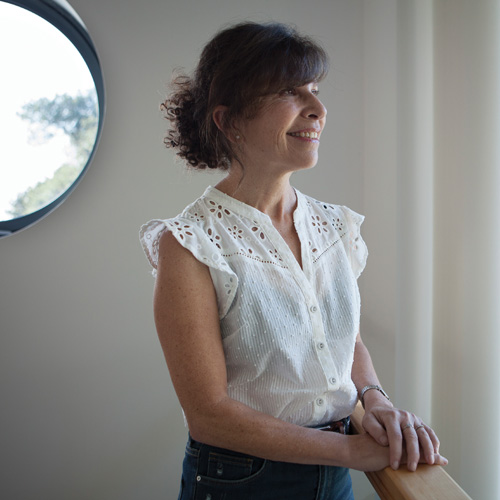
Driven to explore our relationship with environment and landscape Tania Kovats has travelled the globe working on incredible sculptural installations. She talked to Fergus Byrne about her love of sculpture and a career that nearly didn’t happen.

She is selecting sculpture for the 2019 Marshwood Arts Awards.

In an essay about the artist Tania Kovats, writer Philip Hoare describes her work as re-animating “the myths and realities of landscape in her imagination and ours.” He sees her “continually building and rebuilding it like a brick wall in her head.” It’s a description I’m reminded of as she talks about her motivation and the response to the environment which inspires her to create extraordinary sculptural pieces. The motivation is something she has never been able to pin down, but the response is constant. ‘I’m just very driven with what I do’ she says. ‘I just don’t think I could do anything else; it’s what I was made for.’ She describes it as like an engine that’s always on. ‘There’s always another work that needs to be made.’

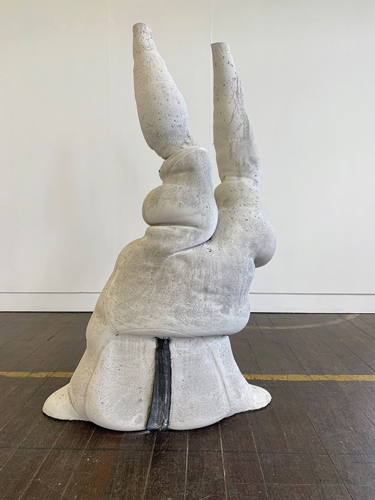
The need to dissect, explore, investigate and interrogate the landscape, indeed the environment around her, is physical. She loves the tactile nature of sculpture. Her current exhibition ‘Divers’ at Berwick Visual Arts in Berwick-upon-Tweed involved filling wetsuits with concrete, and after setting, peeling off the rubber remains of the suits. The result is extraordinary, but she recalls the process as a ‘real wrestle’, although conversely, she also found it ‘a deeply erotic experience’. Despite casting in concrete, her current material of interest is water, and the ‘Divers’ are inverted as if they are diving through the floor—a probe ‘testing human limits’.

Moving to live by a mill in Devon has had an influence on her work. She began to concentrate on water as her source of inspiration and material. She visited the Arctic which had a ‘massive impact’ helping her to see how places she had visited previously—jungle and desert—interconnected with the Arctic and with each other. ‘Water is the connecting element’ she says, realising that all the landscape works she had done before were made by water. ‘Water is the sculptor.’ From glaciers making valleys to rivers making a gorge, she sees water as a ‘dynamic force’.

Looking back on earlier work, even TREE, a commission from the Natural History Museum to celebrate the bicentenary of Charles Darwin, looks like water. The final result is the shape of a tree embedded into the roof of the Natural History Museum. ‘It looks like a delta’ she says. ‘The tree is a big straw sucking up fluid.’

Water might be a fitting symbol of the ebb and flow of her creative journey to date. Her deep affinity with sculpture got off to a shaky start at the Royal College of Art where she felt ‘the place was sort of haunted by people chiselling on stone and macho bronze casting.’ She knew that wasn’t what she wanted and battled with the traditional interpretation of the word ‘sculpture’. However, a spell in Rome on a scholarship changed her view. Spending time immersed in the relationship between sculpture and architecture, the city and the body helped her realise she didn’t have to be scared of ‘the S word’ anymore. ‘It is who I am, it is what I do’ she says. ‘Sculpture is the most incredible thing ever.’

But things might have been very different. Told by a tutor at the Royal College of Art that she probably wouldn’t have an exhibition until she was in her forties and more likely would give up, get married and have children, was a shocking and potentially deflating experience. However, she dispatched that prophesy to its rightful place by winning the Barclays Young Artist Award in 1991. She remembers attending the opening night at the Serpentine Gallery where she was the only woman exhibiting alongside people like Peter Doig and Douglas Gordon. Each selected artist was given a cheque, and she recalls feeling ‘cross’ when all the names were read out, and hers wasn’t. Deflated and angry, her mood suddenly changed on hearing that there was one more announcement—the overall winner was Tania Kovats. ‘I was so excited’ she recalls.

It was one of the turning points in her career. One that helped her to understand the need to become visible and the value of initiatives like Arts Awards. ‘You have to seek it out’ she says of success and recognition. ‘Becoming visible is so important. They call it an artwork and some of that work happens in the studio with just you and the object, but so much of it happens beyond that. Engaging with the world, being present, making the work present, that’s all part of the artwork.’ She agrees that for many artists being brave and promoting their work can be an uncomfortable experience but explains: ‘You have to balance that introverted process with putting yourself out there.’

Tania Kovats ran the MA Drawing at University of the Arts London until 2018 when she was appointed Professor of Drawing at Bath Spa University. She has work in collections including Arts Council Collection, UK, the British Council Collection, the Contemporary Arts Society, London and the Victoria & Albert Museum and is represented by the Pippy Houldsworth Gallery, London.

Tania will be choosing sculptors to exhibit alongside her at the Marshwood Arts Awards 2019 in November. For information or to submit work for consideration visit www.marshwoodawards.com

 

People in Food – Chris Onions

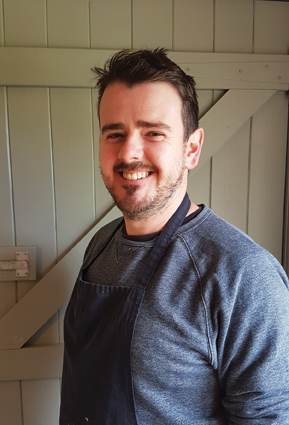
What a wonderful name to have as a chef; Chris Onions. Chris’s surname is something he proudly celebrates, with an onion featuring in the logo of The Old Dairy Kitchen, part of Trill Farm. The business was set up by Chris five years ago, based in the eponymously named Old Dairy, part of the collective of independent, organic and sustainably run enterprises operating at the 300-acre farm just outside Axminster.
A large kitchen greets visitors, with wooden tables adorned with wildflowers, welcoming diners and course attendees alike. Large Kilner jars bursting with a rainbow of preserved produce divide the dining and kitchen area. Chris is an advocate of using everything he can from as local a source as possible. Vegetables are grown a few meters away by the organic fruit and vegetable business, the meat from neighbouring pastures. Opening the doors for lunch twice a week and catering for the events that take place on the farm, this chef is always busy. Chris also runs courses, sharing the information he has gleaned over the years, as well as his highly anticipated monthly feasts, celebrating the abundant seasonal produce available.
Chris grew up in Scotland on the island of Islay. He knew from a young age that he wanted to go into the catering business. He travelled to Australia, learning all he could, his path then diverting him to Scandinavia to cook at a project offering care and training for a variety of disadvantaged groups as part of a Care Farm Cooperative. Some years later the opportunity arose to come to River Cottage HQ with a sea urchin diver, who Chris had befriended. Chris’s cooking path now steered him south, so energised was he by what he had seen at River Cottage, determinedly seeking and finding a job there, integrating himself as part of the team. He lived on Trill Farm, so when the opportunity to run his own business there arose, he jumped at it.
Always finding new ways to preserve and serve his food, Chris is passionate about what he does. This summer he anticipates evenings by the beach catching fish, going for walks, picking what’s available and getting stuck into the vegetable garden himself. But most of all, he’s eagerly awaiting the arrival of his baby with partner Anna, due to emerge into a world of natural eating and sustainable nourishment this Autumn.

Packing for a Summer Holiday 2019

Off on your summer hols this year? Lucky you! But don’t pack too much stuff, particularly as airlines charge us increasing amounts for every bag carried in the hold. Here’s my lateral packing list to confuse you as to what to take…
Passport / visas etc:
I’m assuming that you’re off on holiday before the End of the World (otherwise known as Brexit—the No Deal Option) currently scheduled for Halloween October 31st. If so, just take your passport and all the usual essential identity stuff (out of date parking voucher from Crewkerne, Lidl Welcome Card, urine sample etc) to prove that you are whom you say you are.
Of course, if you’re travelling post-Brexit, then all bets are off. Nobody knows what you’ll need. It all depends upon the type of Brexit. You might need a European Visa, a copy of your birth certificate or even a mouth swab or a print-out of your DNA records… In the old days, a well-placed banknote used to work wonders as a bribe, but be warned that this can also send you to jail which would rather put a dampener on your holiday plans. Anyway, travelling after November 1st means you can’t be on a real summer holiday, so this magazine article doesn’t apply to you. If in doubt, scan your passport and send it as an email to your mobile phone. That way you’ve always got a copy. Unless you lose your phone…
Your phone
See above – your most important travel accessory and space saver. It’s a currency converter, multilingual phrasebook, Sat Nav, tourist map, music player and camera all in one. It’s a wonder to me how we ever got anywhere or did anything without one. Use your mobile for all of these things and more, but never actually use it as a phone. You may want to speak to your darling kids and grandchildren and send them WhatsApp photos of the beautiful view from your hotel window but please don’t. Unbeknown to you, they were there last year. Besides, they don’t really want to know where you are. It might also make them jealous and increase family disharmony. You will then return to the UK to find that local Italo-Turkish telecoms have added a couple of hundred quid to your phone account for unannounced data roaming charges. Welcome home!
Digital extras
Don’t forget your chargers, headphones, power bank, spare USB cables, adapters and voltage converters. You’ll also have to allow an extra three kilos for all this wiring—much more if you’re also taking your laptop and your tablet and Kindle etc—but then I’d question why you’re going on holiday at all, if you can’t take even a tiny break from all your emails and wall-to-wall watching of Netflix and BBC iPlayer.
Drugs
I suppose it’s obvious but the older one gets, the more packets of pills and potions we have to take with us. Add another two kilos. Given my advancing years, I am now a travelling pharmacy. I feel like I could probably set up a dispensing service for half the guests in my Spanish hotel.
Sunglasses
Why do I always lose my dark glasses? Take spare sunglasses because you’re bound to lose your best ones over the side of a boat or sat upon during a beach party rave. And if you don’t have spare ones, you’ll go and buy another pair at your beach boutique. I just know you will. And they’ll look like expensive ‘Dita Mach-Six’ or Prada (‘great value bargain, monsieur’) but in fact, they’re an equally expensive North Korean copy. Not Gucci but Gwachi. Correct logo, but I’m afraid you’ve been done…
Art
Every year I take a sketchpad and paints because I’m sure I’ll want to try a bit of holiday painting. And every year, the same art set comes back unused in my suitcase. Why do I do this? Do I have a secret longing to be a Monet or Manet? Obviously not. Why don’t I just accept the fact that I can’t draw and have another holiday tequila instead?
Clothes
Take the absolute minimum. This is a holiday, not a fashion show. However, it’s a wonderful opportunity to clear out your clothes cupboard, so pack a little special something to wear for that anniversary dinner or the inevitable Caribbean theme dress evening. You know that frightful orange and bright green beach shirt you were once given as a birthday present by a colour-blind old friend and have never actually worn? Finally—here’s its chance! And that slinky all-too-revealing dress with the violet watermelon design that you bought in Majorca after too many glasses of Pinot Grigio? You know—the one that you’ll never ever wear because it’s so obviously NOT you? Yes—put it in your suitcase now. If you’re going to embarrass yourself, do it this once in a far-off place where nobody will know who you are. Wear it and be the talk of a strange town for a night. What a way to go in a blaze of fake satin glory! Just make sure you leave it hanging on the back of your hotel room door when you leave. That way you’ve saved enough room in your suitcase to buy another embarrassingly bad taste article of clothing which you can wear the following summer.

The Folly Mill Lane Firebrand

This is a story of 1833 Bridport. Arson had taken place but the punishment meted out to the perpetrator was much more extreme than would be considered now. It is a true story of earlier life with disastrous consequences and is not for the faint-hearted.
In 1832 Bridport had suffered a number of fires, thought to be arson. Then in early 1833 there was another which destroyed eight properties in Irish Lane (now King Street) adjacent to Folly Mill Lane. Some were thatched houses and about thirty people had to vacate their beds and homes. There had been an attempt to set fire there only two or three weeks earlier. The properties would have been adjacent to the present East Street car park near Folly Mill Lane.
The late Basil Short gave a lecture in the Unitarian Chapel in 1993 and much of this detail is drawn from his notes held in the Bridport Museum Local History Centre. Basil Short was formerly the Unitarian Minister in Bridport and an extra-mural local history lecturer of Bristol University.
The main victim was John Follett, a flax comber, with his combing shop in Irish Lane close to his house. His garden adjoined that of the Wilkins family with their house forty yards towards Folly Mill. Thomas Wilkins was a carpenter with a sideline of twine spinning, with rates of 19s 6d in 1826, the same as Dr Giles Roberts, so not desperately poor. His eldest son, Sylvester Symes Wilkins aged 15 years was a shoemaker and had been a choir boy in St Mary’s Church and attended Sunday School there. In December 1832 he received a prize for good reading and conduct. So why did Sylvester, a “good boy” reasonably educated, from a comfortable home, become involved in arson.
The fire commenced just after 10pm on Monday 25th February 1833 and shortly after the fire bell rang and there were cries of “fire”. It was a dark, wet night and the boys had run away.
John Follett said he had previously found his flax on fire and he had seen three boys, whom he identified, in his garden several times. On his oath and others, three boys were committed to prison by a warrant dated 5th March 1833, by Joseph Gundry, esq., Justice of the Borough of Bridport. The Prison Book records that 15-year-old Sylvester Wilkins (Prison no. 325) was 5ft 5ins. tall, David Fudge Curme, a 17-year-old printer (no. 326) was 5ft 2 ins., both admitted on 5th March 1833. John Middleton (no. 334) a 17-year-old shoemaker, also 5ft 2 ins., was brought to prison on 9th March. Wilkins was described as having brown hair, grey eyes, of sallow complexion with dimpled chin and pock-marked face and with a scar on his left hand, near his thumb. But he must have been thin and underweight, as will appear later.
There were two judges at the trial, the Hon Sir James Allan and Hon Sir Joseph Littledale of the Westminster Courts. David Curme admitted his guilt, but offered King’s Evidence against Wilkins saying “Last Michaelmas Fair Wilkins said it would make a good fire and asked for help….but they would not….weeks later in the “Antelope” he asked again. We bought 1/2d of tobacco and Middleton lit a pipe”. However, Middleton denied responsibility on the occasion of the fire. Curme also said “Sylvester pulled off some thatch and put some oiled paper in the hole….he called me and took a match from his pocket and lighted it at the pipe which I had in my hand. He then set light to the oiled paper. We then came away….then heard the fire bell ringing and he could not help laughing”.
Sylvester Wilkins admitted firing Mr Follett’s house but did not know why. On the subject of numerous earlier fires in the town, he knew of them, but was not responsible for them.
At the Lent Assizes on 9th March 1833 the Jury found Wilkins guilty of arson but recommended mercy. However, the Judge ignored this plea, being keen to set an example by capital punishment.
Following the trial Sylvester wrote several letters from prison, we are told “in a good hand”, wishing his parents well, with prayers and so on. He asked for Andrew Symes Partridge, David Hodder, George Clapp, William Hallett, David Lang and James Foss Woodward to be his bearers. One assumes these were young men of about his age, perhaps fellow choirboys. He also asked for his co-defendants to attend his funeral.
Wilkins was executed at noon on Saturday 30th March 1833 at Dorchester Gaol. The executioner attached lead “mercy weights” to his legs to hasten his end as otherwise, his lightness might have prolonged his hold on life. This was common with underweight victims. Some time ago Bridport Museum had a representation of Wilkins on display but this has now been placed in the store.
A contemporary local diarist, Maria Carter, of West Street, Bridport wrote on Sunday 31st March “Rev Broadley 15th chap. of Corinthians 33rd verse. A very good sermon respecting the boy that was hung yesterday”. Surprisingly she does not mention the fires or the subsequent funeral.
Basil Short recorded that the funeral was on Good Friday at St Mary’s Church, Bridport, a grand affair with the streets lined with townspeople. 2,000 people filed past the body as it returned to Bridport. The Burials Register for St Mary’s, record no 668 show Sylvester Wilkins, buried on 5th April, aged 15 years, service conducted by Rev Robert Broadley.
Neither of Sylvester’s friends, David Curme or John Middleton appear in the 1841 or 1851 Census Record Indexes, so they had probably left the area. The Wilkins family continued to live in Bridport, Thomas Wilkins was still a carpenter, aged 65 in 1851. His wife Ann was a dressmaker, aged 63 and Augustus a tailor of 27. Hezekiah was living in Bradpole aged 24. John Follett was living in Bothenhampton in 1851, still a comber.
Basil Short suggested that Silvestor Wilkins may have “got into bad company”, perhaps easily led and obviously fascinated by fire. It is surprising that such a quiet boy, given a prize for good conduct only a year before should end in this way. It was also suggested that no one expected such a youngster to hang.
So far we have not mentioned the “Bridport Dagger” but surely the hempen noose, made in Bridport, must have been used by the hangman.
Nowadays we might expect processions, protests outside the then gaol and marches in opposition to the extreme sentence. We live in a peaceful area and trust that the horrific acts we see on TV cease and do not reach here.
Bridport History Society does not meet in August. We look forward to seeing you in September.

Cecil Amor, Hon President, Bridport History Society.

The Day the Earth Moved

Nearly 180 years ago, about three miles west of Lyme Regis, a huge chunk of the East Devon coast split off to form a plateau separated from the mainland by a deep, dry ravine. This was the largest movement of land ever experienced in this part of the country; it remodelled the coast and created a unique new environment. The plateau, now called Goat Island, and the ravine are still unique and when I walked there in late June, pink and purple orchids flowered across the grassy surface of the plateau whereas the ravine was populated by a tangled jungle of trees and other vegetation.

In the early 19th century, the land behind the cliffs in this part of East Devon was dominated by farming. Between the cliffs and the sea, there was an area of land, the undercliff, formed by subsidence that supported fertile market gardens and orchards with some pasture for animals. Cottages had also been built here for farm labourers who walked up and down the steep cliff path to the farmhouse a short distance inland. The latter part of 1839 had seen unprecedented rain and as Christmas approached, there had been ominous signs of instability in the cliffs with deep fissures opening on the cliff tops and settlement cracks appearing in cottages built on the undercliff.
One of the farm labourers who lived in the cottages with his family was William Critchard. At about 1am on Christmas Day 1839, Critchard and his wife returned to their cottage having been generously entertained along with other labourers’ families by their master at his farmhouse. Their Christmas Eve gathering had included the West Country custom of burning the ashen faggot (a large ash log) accompanied by the drinking of copious amounts of cider. On their way back to the cottage, the couple noticed that part of the cliff path had dropped about a foot since the morning and new cracks had appeared in the cottage walls. Still merry after their evening’s entertainment, they retired to bed unconcerned. At 4 am, however, they were awoken by a “wonderful crack” and by 5am they rose to find deep fissures appearing in the garden. They realised that something major was happening and set off up the cliff path, now almost impassable owing to subsidence, to spread the alarm.
Movement in the cliffs continued over the next 24 hours and as the day dawned on December 26th it revealed a landscape changed almost beyond recognition. Contemporary drawings show that a massive section of cliffs, about three-quarters of a mile long and estimated as 8 million tons of rock, had moved seawards by several hundred feet creating a dry ravine, the Great Chasm, in its wake. The plateau of land that had moved was bounded by cliffs 150 feet high and came to be called Goat Island. The ravine held a gothic landscape of lumps and bumps, peaks and troughs, vividly expressing the power of the convulsion that had occurred.
The cliffs in this part of Dorset and Devon are notoriously mobile, but the events of Christmas 1839 represented the greatest ever movement of land in the area. At the time there was much speculation as to the cause of the landslip: might it have been the result of an earthquake or a volcano, was it the work of rabbits, or could it have been a punishment from God? By chance, two of the most eminent geologists of the time, William Buckland and William Conybeare, were staying nearby and could interpret the events; Buckland’s wife Mary made invaluable drawings of the changed landscape. Buckland and Conybeare concluded that the excessive rain had saturated the permeable layers of chalk and greensand that constituted the upper part of the cliffs. Beneath these layers was an impermeable layer of clay and the chalk/greensand, saturated and very heavy, moved forward on the impermeable clay leading to the landslip.
The new landscape became a tourist attraction. Queen Victoria arrived on the Royal Yacht to view the scene and others took to paddle steamers to gaze in wonder while specially composed music, the Landslip Quadrille, was played. Bizarrely, fields of corn and turnips growing on cliff top land had moved intact with Goat Island and were ceremonially harvested the following August by local village maidens dressed as attendants of Ceres, the Roman Goddess of the Harvest.
But what of Goat Island nowadays? It’s only accessible on foot but the walk along the coast path is worth the effort. I set off from Axmouth on a misty but mild morning in late June to make the steep climb across the golf course and on to the cliff top. I followed narrow lanes with high banks and skirted cornfield edges to reach the coast path. Cliff edge scrub obscured the sea most of the time but occasional breaks revealed Beer Head lurking mysteriously in the mist.
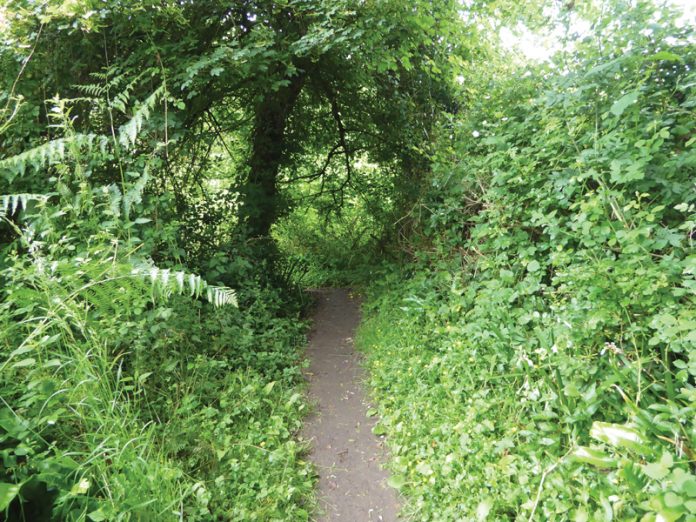
About two miles into the walk, with my attention captured by the many flowers lining the path, I was jolted from my reverie as the path twisted and dropped down steeply into dense vegetation. It continued to descend with the occasional squirm to the right or left before bottoming out. About me now was a disorienting, tangled jungle of trees, shrubs and ferns with brambles and creepers dangling downwards to catch the unwary. Dampness hung in the air and only brief vestiges of light filtered through the canopy. This is the undercliff near the edge of the Great Chasm, no longer an open ravine but taken over by nature in the intervening 180 years.
Quite soon the track reared upwards again climbing steeply towards the light past a cushiony chalk hillside with a scattering of wildflowers. In time, the path levelled out to a long, lush grassy meadow sloping gently towards sheer cliffs above the undercliff and the sea; this is Goat Island. Woven within the grass were the frilly flowers of eyebright, many yellow dandelion-like flowers of catsear, patches of yellow rattle and wild thyme and two blue spikes of viper’s bugloss. It was, however, the orchids that surprised me with their number and variety: pyramidal orchids with their intensely pink, three-lobed petals overlapping like ornate roof tiles and common spotted orchids with their cylinders of lilac-pink flowers carrying magenta hieroglyphics. I searched for bee orchids and found only two spikes, each bearing several flowers. With their mauve propeller-like sepals and their large central petal complete with furry edges and yellow horseshoe patterns on a maroon background, these flowers are one of nature’s marvellous mimics said to resemble bumblebees. Butterflies, especially marbled whites completed the scene. Goat Island nowadays is a beautiful, unusual place, an oasis of calm where noise means bird song. It is also a managed landscape, a cooperation between nature and humans, as every year the grass is mown to encourage flowers and to prevent scrub taking back the land.
Goat Island is also a place of history and I stood there for some time, trying to imagine the scene 180 years ago when the land beneath my feet moved and the lives of the people living there were changed forever.

Philip Strange is Emeritus Professor of Pharmacology at the University of Reading. He writes about science and about nature with a particular focus on how science fits into society. His work may be read at http://philipstrange.wordpress.com/

UpFront 08/19

As the clock ticked ever closer to midday on Tuesday, July 23rd—one of the hottest days of the year so far—it was hard to concentrate on a daily routine due to the imminent election of the next Prime Minister. Amongst those who felt that bending or avoiding the truth isn’t a talent to smirk about, there was an unease that was gradually escalating to a feeling of impending doom. Whilst amongst those who believed bluff, bluster and big promises was a recipe for political stability within their own party, there was a sense of excitement. So with a small desk fan pushing warm air around the room, I decided to take an early lunch and watch the parade of commentators and pundits trying to muster some enthusiasm for the moment ahead. The clock ticked some more, and I promptly fell asleep. When my snoring eventually woke me, Boris Johnson had been voted in as head of the Conservative Party and therefore the next Prime Minister. So along with the other more than 99% who didn’t vote, I went back at work. Coincidentally one of the first things I read was a recently published report called Understanding our Political Nature: How to put knowledge and reason at the heart of political decision-making. It was produced for the Joint Research Centre in Brussels by sixty experts from across the globe who worked in the fields of behavioural and social sciences as well as the humanities. The opening sentence suggested that humans do not always think rationally and that it is problematic to base politics on the assumption that they do. The report went on to highlight things that many people have been concerned about for some time, such as the view that facts don’t tend to change people’s minds because they don’t want to hear things that challenge their beliefs, especially from an opposing political platform. Or that we are increasingly exposed to misinformation and that constant lying doesn’t mean that we always eventually believe the lies; it means we stop believing in anything. The consequence is that we find it difficult to make decisions. After months on the roller-coaster of British politics, I imagine I’m not the only one who fell asleep at the decisive moment this week. Many people are simply beaten into submission and want it all to be over. Whilst some hope Boris can pull a rabbit out of a hat, many others feel like rabbits in the headlight of an out of control bicycle, driven by what one wag described as ‘a mayonnaise covered potato dipped into a bucket of straw.’ We stand in the middle of the road, fingers crossed; eyes tightly shut, hoping that what we can’t see can’t hurt us.

Paul Lashmar

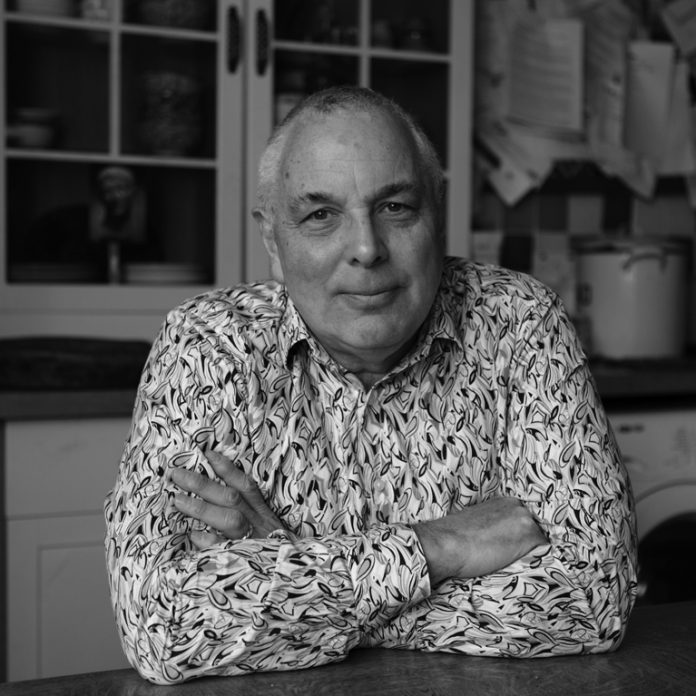
‘I was born in Rainham, Essex, in a rented 2-up 2-down cottage with the spider-infested toilet out the back and a tin bath in front of the fire on a Friday evening. My mother was second-generation Irish whose family came to Dagenham because that was where the work was. My mother and father met while they were both in the RAF just after the war; he came from Bournemouth, and the name Lashmar is English despite how it sounds. My first memory is that of seeing a red sky from my cot because from where we lived near the Ford factory you could see the glow of the pig iron being tipped at night from the foundry. My father was a “tongsman”, an incredibly hot and dangerous job, but he earned good money.
Mine wasn’t a great childhood. My mother had miscarriages and mental health problems and was often away for weeks. This led to a split with my father, and sadly he committed suicide when I was 8. I often lived with my grandparents in Dagenham, who like the rest of my family, worked at Fords. My mother remarried but I didn’t really get on with my stepfather until decades later. My ‘Nan’ worked in the canteen and was a shop steward, but she was a wily person and suggested that I could sign up with a false name, lie about my age and get casual work. So aged 13 (and again a year later) I became a kitchen porter during the summer holidays, earning £25 a week which was good money in 1968. The high point of that job was being commended by the directors of Fords for the quality of my crinkle cut chips.
My mother sent me to a Catholic school in Chingford called St Egberts, which exposed me to people who didn’t come from Dagenham, for example refugee classmates who’d come out of Czechoslovakia in ’56. We were a peculiar class because we didn’t play football, we would stand round and argue about things, which with hindsight was formative, and this was also the period when the “hippieness” starts to creep in. So I shifted from being quite conservative to enjoying counterculture zeitgeist, reading Oz magazine and discovering a love for music, which is something which has lasted all my life. I got in terrible trouble for hitch-hiking down to the Bath Festival at Shepton Mallet in 1970 to see Led Zeppelin et al. I’d asked my mother to write school a note to cover for me, which she did, but not grasping the point, told them I was at a pop festival. But Led Zeppelin’s 3-hour set was worth the bother.
When St Egberts closed down I went to technical college in Redbridge for three years, where I was social secretary. It was quite hippy, we had sit-ins, and I hung out a lot with bands, and despite having a fairly amazing social life managed to get an Ordinary National Diploma in the Sciences. Coming from the kind of background I did, I knew I had to get out of Dagenham, but how? I’ve always understood how hard it is for people from an economically deprived background to make a success of their lives, compared to those who have cultural or economic capital. Today when I teach, I go to even greater lengths for students without those advantages, to try and give them confidence which is all-important. I think it was an easier time for us back then, because we all had low expectations which were easily met, but now everyone has high expectations which are constantly being deflated, not least because of Brexit.
In ’72 I then fell into a job at a record company, working out how many vinyl ‘45’ records to press each day, like Rod Stewart, Slade and the Stylistics. Later I moved over to being a warehouse supervisor, still only aged 19. By that time I’d been to the Bath Festival, the Isle of Wight Festival, Hyde Park to see the Rolling Stones and Blind Faith, was around people with whom I could talk about the music of John Coltrane, Miles Davis, and Pharoah Sanders, and was listening to rock, blues and jazz, funk, everything that came my way, because we had no barriers. It was a fantastic period for music. In May 1975 I went on a trip with a flamenco playing mate to Spain, and meeting some other people crossed to Morocco in a classic hippy road trip in a rough old Transit with no windscreen, over the Atlas Mountains to Fez and Marrakesh. I was meeting people who’d had the benefit of university education, who knew about philosophies like existentialism and looking back I realise I’ve always been interested in the power of ideas that can change the world. I decided it was time to get myself better educated if I could.
Reading Time Out, I saw an advert for a course called Diploma in Communication and Design at North East London Polytechnic. The tutors there were full of radical ideas, such as making art and design more accessible to people from working-class backgrounds, and I’m still in touch with two of them. I had three years of extraordinary education there. One of my tutors became a mentor for me, a role which helped me no end having lost my father because it meant someone older than me took me seriously, which more than anything gave me confidence. Mentoring is something I’ve tried to do all my working life. As a side-line to the course, I helped one of the tutors as a researcher in his work as an investigative journalist, putting together a story about the Cold War which was published in the Observer. Jack Crossley, the news editor there, a tough old Fleet Street hand, was impressed with our work, and thanks to a recommendation from my course tutor, offered me a job as a researcher. Working for him meant I needed to learn how to write, and Jack seemed to like what I did, often asking me to rewrite the copy that other Oxbridge educated reporters wrote. When Jack left, the next news editor was Robin Lustig, who hired an investigative reporter from the Guardian called David Leigh, an extraordinary character, and suggested I work with him. David and I just clicked and thirty-seven years later we still do. Leigh and Lashmar we were the investigative team at the Observer, up against the other Sunday papers such as the Sunday Times who had much larger resources. We considered our task was to beat them every week, getting the stories they didn’t. We did Mark Thatcher in Oman, MI5 vetting at the BBC, several investigations into police corruption, Stalker, Spycatcher, Clive Ponting, the Belgrano, and many, many more. I learnt that as a journalist if you take on the government you don’t do so lightly, but in those days we were a gung-ho, fearless lot. Many of the people we went after were very rich, very powerful and had the best lawyers, and we had to out-think them. After I and many others left the Observer due to owner Tiny Rowlands’ interference, I went to work at World in Action on TV. There were some very exciting times, some too exciting, following stories on police collusion with organised criminals, being rammed by their cars, and travelling to Brazil to cover how street children were being murdered like vermin, following the death wagon to get footage as they went round in the mornings collecting bodies. That was a pretty hairy time, but perhaps my best story was investigating the Royal Family’s ability to negotiate how little tax they paid, a privilege which changed after we wrote about it.
Anna and I got together, in late ’93, married in ’94, our son Ben arrived in ’95, then Arthur in ’97. I wanted to make sure I was going to be a good father for them. The world of journalism was full of tough individuals and you had to be tough too, there was no paternity leave, the birth of one’s children was seen as somewhat incidental. I didn’t want to belong to that club. From 1998-2001 I was at the Independent and we lived in Crouch End. Having sworn that we were Londoners, Anna and I changed our minds and explored the idea of living in Dorset. What clinched it for Bridport was hearing the live music coming out of the Hope and Anchor as we crossed the car park. We subsequently went there on a regular basis, and through extraordinary landlady, Val Crabb got to know many Bridport characters. Anna returned to teaching and I was offered a job on the MA Broadcast Journalism course at Falmouth. Then 9-11 happened, and the Independent on Sunday asked me to cover it as I was the only journalist they could use who knew about terrorism, spies, etc. So I was able to do that, largely still able to remain in Bridport and teach at Falmouth.
In 2011 as three of the family were commuting daily to Thomas Hardye School in Dorchester we moved there. I also needed better access to London as I’d been taken on at Brunel University as a research academic and still teaching. I soon realised that to progress I would need a PhD, which took 3 years of hard slog because I got no time off to fit in the study, but I achieved it in 2015. In 2017, through the grapevine, I heard there was a job going at City University, which was considered the top journalism course. I got the job. If Dorset is my spiritual home, City feels like I got lucky at work. There are 500 students, 27 staff and 60+ visiting lecturers. Two months ago I was made Reader. And now from being Deputy Head, I’ve been asked to be Head of Department, starting in August. For a boy from Dagenham, it’s been a long but never dull journey.’

August in the Garden

Gardens have a memory. What is happening in your garden, on any particular day, is not just a reflection of the prevailing conditions but also of factors that have influenced it over the whole time it has been in existence. The factors affecting plant growth / survival are cumulative and can either be very subtle, acting over a long time, or, such as in the case of catastrophic weather events, very dramatic and immediately obvious.
There are certain things that are performing much better this year than I can ever remember them doing previously; Acanthus mollis (bear’s breeches) being a case in point. Originally mine were planted right up against the house which, being poorly built after Victorian subscription, has no damp course or ‘real’ foundations. Acanthus is so massively rooted that it was in danger of coming up through the floorboards on the inside of the house! That was almost twenty years ago—I dug it up and moved it, to a restricted position on the road side of the curtilage, and it has been there, totally uncared for, ever since.
It is in poor soil, exposed to winter cold, but, importantly, it gets a total baking in the summer sun plus extra root warmth due to the brick retaining wall which absorbs heat during the day and releases it over night—just like a storage heater. Over the years its flowering has been fairly ‘up and down’. Last year, during what was a relatively hot and dry summer, it flowered ‘OK’—nothing special. This year it’s flowering its socks off, one of the best displays it has ever produced.
This is not because of the recent warm weather, it is the cumulative effect of the weather and cultural factors that have acted on it over the last two decades that it’s been under my care. The heat last summer was the biggest factor in determining that it should be putting on a ‘career best’ performance now. I expect that next year, having partially exhausted itself, it will not flower so well—whatever happens in the intervening period. Knowing that it comes from places with relatively poor soils influences my decision in what to do next. If I tried to feed it, by adding a fertiliser for example, to address the ‘exhaustion’ I know that it would react, being a bit of an opportunist, by producing lots of extra leafy growth. This would actually reduce its flowering potential for next year.
A more ‘greedy’ perennial plant, lilies grown in borders for example, need copious feeding after flowering, while still leafy, in order to build up the flowering potential for next year. If I treated my floriferous herbaceous perennials, in the same way that I treat the tough old ‘bears breeches’, then they’d never flower again and might actually fade away. It’s all about ‘horses for courses’—and understanding what you are dealing with.
The point of this is that gardening is a long-term pursuit, the horticultural equivalent of ‘spinning plates’! I often bang on about certain gardening tasks, like watering / feeding plants that are confined to pots and containers, because they really do need to be done, in a timely fashion, or else the plants will soon die and any long-term, cumulative, factors become completely irrelevant.
The whole “Right Plant, Right Place” philosophy is perhaps the most important horticultural maxim that anyone attempting to garden should try to master. The late, and great, Beth Chatto was the greatest exponent of this approach to gardening and her writings on the subject cannot be bettered. Planting the right plant, for the conditions that you are expecting it to thrive in, is the best route to allow it to gain maximum benefit from it’s place in your garden. Getting that bit right really takes the pressure off you, as custodian, in every cultural intervention that you will do over the whole lifespan of that plant and, by extension, over the whole life of your garden.
The fact that my Acanthus is flowering so well right now, and not coming up through the floorboards of my front room, is because I was able to recognise that its thug-like roots are best contained within retaining walls. Its origins in hot, baked, climates mean that repositioning to a south-facing position gives it the best chance to fulfil its maximum flowering potential whenever it can respond to a favourably hot summer. This may be an extreme example but I’m trying to explain that if you get these things right in the first place then it makes your life so much easier for the long haul.
On a more general note; shrubs flower best on wood which has been ‘ripened’ by the sun the previous year, so they may, like my thuggish Acanthus, show the effects of the previous year’s conditions rather than the current ones. On the other hand, shrubs which flower after the longest day tend to flower on shoots grown that year so they will be less affected by what took place the previous year and will reflect their current growing conditions more religiously—I think I may quit there because I’m managing to confuse myself…
Containers may well have to be watered and fed this month to keep bedding plants and annuals flowering for as long as possible. Unless you added a slow release fertiliser to the compost, when you planted them up, there is a good chance that the containers will have had all their nutrients exhausted by now. When watering towards the end of the growing season use a ‘high in potash’ feed, such as tomato feed, as this is biased towards flower and fruit formation rather than excessive leafy growth; the last thing we need right now is more soft, green, growth.
This is the best time to plant bulbs which flower in the spring. It may seem very early, and a bit depressing to have to consider the end of summer just as things have started to hot up, but it really is best to get them in as soon as possible. Tulips are the exception to the ‘plant now’ rule, due to cultural reasons (‘Tulip Fire’) but if you order them now at least you get first pick of the crop as the most popular / newest varieties (for me it’s always ‘Abu Hassan’) sell out quickly.
The horticultural reason, for getting hold of spring bulbs now, is to reduce the time between the bulbs being harvested by the grower before getting re-established in your own garden / pots. Although they are happy to become ‘comatose’, once harvested, all the time that they are out of the soil, even if stored correctly, they are deteriorating. The smaller the bulb the more prone they are to dessication between lifting and replanting—this is the major factor behind tiny bulbs, such as snowdrops, generally being recommended for planting ‘in the green’.

Vegetables in the Garden

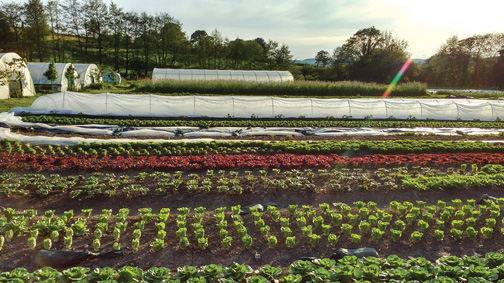
August—the time of plenty (sometimes even too much if good organisation and planning hasn’t been taken into account). Successional sowings are the key to managing outputs from the vegetable garden, but also to ensure the highest quality of produce is maintained throughout the summer. By staggering sowings you can avoid having too much of one thing at one time. It also ensures a consistent supply of produce from the garden through the summer months rather than being in an all or nothing situation. Lettuce and other salad leaves are a classic example of this, where it will run to seed relatively quickly during summer, so sowing every few weeks will ensure a steady supply. We sow six lots of lettuce between the middle of February and the end of June which gives us harvests from early April until sometime in October normally. Sowing in mid-February, mid-March, end of April, mid-May, early mid-June and then finally at the end of June ensures that as one planting begins to go to seed the next succession is planted and ready to harvest. We stagger radish sowings about every two weeks from early March until mid-May which means that we have a continual supply during the spring and early summer, whilst spring onions are sown from mid-January to mid-April to provide bunches until July (when they tend to get rust where we are). We also successionally sow peas, beetroot, fennel, chard, coriander and dill amongst other things—all for the same reasons—to ensure a consistent supply.
One new crop that we have tried this year is Aztec broccoli (also called Huauzontle—literally meaning hairy amaranth and part of the Chenopod family—amaranth, beets, chard and fat hen). It is as easy to grow as fat hen and very productive. We sowed two batches—in the middle of March and end of April, sowing around 3 seeds per module of a plant tray, then planting out at around 30cm along the row, with rows spaced about 60cm apart. We started harvesting from early July. You can simply snap off the top 3-6 inches of flowering stem, and it just keeps sending out sideshoots and can be harvested until around mid-October. As the nights start to cool the leaves start turning red too. It can be blanched like any green and has a very spinachy taste to it. We will certainly be growing more next year, and thanks to the Real Seed Catalogue for continuing to provide us with exciting new things to try.

WHAT TO SOW THIS MONTH: endive, winter purslane, salad mustards (best sown direct) such as Golden Streaks, Purple Frills, rocket, land cress, chard, leaf radish, texsel greens, lettuce, fennel (early in the month), broad beans (for tips in salads) & peashoots, autumn radish and turnips, Chinese cabbage and pak choi (early in the month), parsley (for overwintering in polytunnel/glasshouse), corn salad & spring onions & spring cabbage (all late in month for overwintering)

WHAT TO PLANT THIS MONTH:
OUTSIDE: fennel, beetroot, lettuce, chard, kohl rabi, chicory, salad leaves: buckshorn plantain, salad burnet, chervil, endive, turnips and winter radish (sown direct), pak choi and chinese cabbage
INSIDE: summer purslane, goosefoot

OTHER IMPORTANT TASKS THIS MONTH:
Keeping on top of taking old crops out and planting with new crops is still important throughout August. There is still plenty of time to get late crops in the ground, and as we roll into September it can almost be like a second spring (with the benefit of already warm soil)
Generally it is a time to harvest—keeping on top of harvesting courgettes and beans will keep them going and mean that they don’t get too big or too stringy.

Corrie Van Rijn

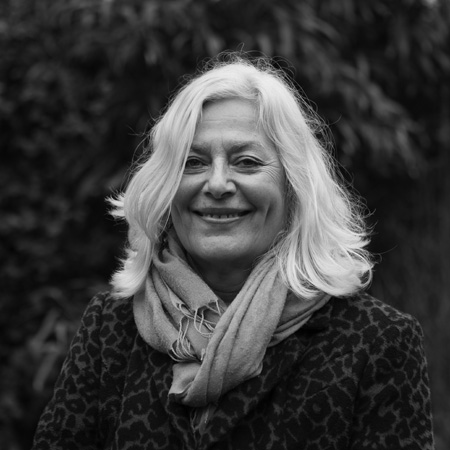
‘I was born in a small fishing town called Katwijk aan Zee in the Netherlands. My family was very religious; there was church twice on Sundays and prayers before and after every meal. The town itself was quite conservative, and my family fitted the community. I was number 6 of 7 children, and despite the emphasis on religion, it was a lively household, full of music. My 5 brothers all played an instrument, and I loved to sing. I have very happy memories of that time, and I still do singing and voice workshops. In my early life, my father captained a barge carrying freight along the many Dutch waterways, and if I was lucky I went along too for short trips, which I loved. Later he started a business supplying the large fishing fleet in our town with tackle such as nets, chains, etc., which was a great success. Things definitely looked up from then, my eldest brother joining the business. For my parents it was a big improvement in their circumstances, having come from very humble backgrounds. When I was only 2 my mother was diagnosed with cancer through which she lost her voice, which was devastating so that looking after all us children was extremely difficult. My eldest sister played a major part in managing the family, and my mother lived until I was 13. As I grew up, for some reason I was attracted to the weird and wonderful, and couldn’t wait to leave the constraints of family life.
We lived in a street which was owned by the air force, housing families from various different countries. There was a Spanish family next door, who had dug a hole in the floor to grow a palm tree in their living room and had pictures of bullfights on the walls, all of which was completely outlandish to my innocent eyes. Also at secondary school, I was mixing with people from all kinds of backgrounds, discovering the diversity I had been craving. And of course it was the sixties, there were hippies, and I just loved all that stuff; but I was the only one of my family that embraced the counter-culture of the time, which made me the black sheep.
When my father remarried I left home and got a job in the town, then moved to Leiden, a larger university city, and ended up in a squat there, in a street of condemned grand houses lining the canal, full of artists and musicians. It was very bohemian and psychedelic, but I moved out of that to be with a boyfriend and get a bit more on the straight and narrow. I had an aunty who was a very good dressmaker, who had been teaching me to make dolls’ clothes from the age of about 4. My parents bought me my first sewing machine when I was 10, so I was making things for myself from a very early age. I knew a lot of local musicians, and I began making clothes for them, revelling in the glam rock style of those days. I also became quite entrepreneurial, successfully selling a lot of clothes at that time.
Having turned out so different from my family, I had a strong sense of needing to belong somewhere. At first, I felt I belonged to the community in the squat, but when I began work in a nursing home I felt I fitted in there. They accepted me for who I was, and I felt valued. I did some training and began to help with creative and fun activities with the patients. Once a year they would hire a big boat, park it close by on the Rhine, and then with all the patients, including some of the quite infirm elderly folk in their hospital beds, go on a 2-week cruise all the way down the Rhine, having huge amounts of fun. They all loved it, and so did I. It was my first foreign trip.
I then worked at a number of creative jobs in Leiden, some with local kids from deprived areas, and later for the educational department of The Museum of Anthropology, working to pay the bills as I always have done. In my early twenties, I met a guy, an artist, and we had a son. After a lot of training, I was teaching handicrafts to young children whilst bringing up my son. That was also a period when I started to take an interest in Satipatthana Meditation, going to workshops with John Garrie Roshi. After I was divorced, it was at one of these workshops that I met Alan, and at the age of 28, having come for a long weekend, I moved to the UK and stayed.
We lived in a small village in Oxfordshire, quite a big change for me after Leiden. Everything seemed so tiny and rural and with the old pubs, it seemed like the middle ages. So I was in Oxford a lot, and got into Aikido, and trained in Shiatsu. I was still making clothes for people and using textiles as a medium for other creative projects. Then Alan and I went to live on a country estate in Brightwell Baldwin, in the servants’ quarters of a crumbling mansion. Alan had a workshop there, enabling him to develop his furniture making skills. We lived there for 3 years and then were offered this place in Askerswell, which has been our home since 1986. My son went to school in Holland, came here for vacations, and now lives in Amsterdam. He’s in the music industry, has two lovely children, and we see a lot of each other, either in Amsterdam or here in England.
Here in Dorset, I did a 2-year City and Guilds course in Fashion at Exeter College, then a year’s teacher training, during which I was teaching at the A Level Art and Fashion course. I also got involved with the drama department of Exeter University, making costumes for shows including a Japanese Noh production. After that, I decided to do a degree in Textile and Fashion Design, in Bristol, as a mature student. While I was there I made friends with a film director and worked on several productions here in Dorset, some Thomas Hardy-related productions, and a series called Harbour Lights. I worked with a German film company FFP Media on costumes, later sourcing extras and English actors for small roles. That was an incredibly busy time for both Alan and I, because we were producing work for Dorset Art Weeks right from the beginning. One visitor to our DAW show, Deirdre McSharry, was curating a 50th Anniversary exhibition at the American Museum in Bath, to which I was invited to contribute with my textiles. It was a lovely exhibition lasting 6 months, and my part in it was a Shaker-inspired collection. Deidre was very well connected, which led to some really good publicity for me, and I enjoyed 5 to 10 years of success with my work. Alan and I did many shows together, often opening our whole house to show our work together in joint exhibitions.
After 2007 the recession began to bite, making buyers more hesitant about parting with their money for what both Alan and I were offering. Dorset Art Weeks had become bigger and more expensive to participate in, and some of the local artists in our area moved on, making us feel a little more isolated, although I had one particularly loyal client who continued to buy my work, and who must have bought nearly a hundred outfits over the years. Since I first was interested in it, I continued to practice the Meditation and Yoga. In my late forties, I decided to train as a Yoga teacher which I did over a period of 4 – 5 years. I started to teach from the beginning of the course, which one is encouraged to do anyway to get teaching experience. I now teach here in the village hall, as well as Bradpole and South Perrott, and there will be a Summer Yoga programme in the Bull Hotel in Bridport, in July and August, for beginners and experienced yogis, where people can work with a different teacher each week. So the creative side of things has taken a bit of a back seat but has never really disappeared. Throughout my life, from when my parents first encouraged it, my life’s main interests have been creativity, music, and physical activities such as gymnastics and athletics when I was younger, and now Yoga.
I love world cinema, I was on the committee of Bridport Film Society for 5 years, and I love travelling, my particular favourites being India, Morocco and the Middle East. Japan was a big trip for me too, and I love going to places where I can discover textile processes. I prefer independent travel, opening up to expansion, so that it becomes an adventure, you meet the local people, and possibilities open up, connections are made.’