
Sunday, December 21, 2025
Home Blog Page 17

More Grist for the Mill

In October we looked at the rivers of Dorset, now let us look at some of the mills using the river water for hundreds of years. By the time of the Domesday Book there were many mills throughout the country, generally grinding corn, the grist, into flour. At that time there were 372 mills recorded in Dorset and this number increased over the years, but the number reduced to about 130 some 20 years ago, with only about 9 in satisfactory order and only one being commercial.

In the Industrial Revolution many flour mills were converted into mills to produce cloth from wool. Many were Fulling Mills used to manipulate the cloth in a bath of Fuller’s Earth, producing a heavier fabric. Others were used to spin flax for sailcloth. Watermills were used for power for many years, until steam engines arrived and then electrical power took over.

Lyme Regis and Uplyme together are believed to have had a total of 7 mills at one time. One was recorded in the Domesday Book and another was built in about 1340. Lyme Regis Town Mill was owned by a miller until the Borough took it over. A Town Mill Trust recently took over and it has been renovated and once more grinds corn, since around the year 2000, partly for the heritage and tourist industry.

Sylvia Creed in Dorset’s Western Vale tells us that before 1860 the Moore family commenced milling and baking at Stoke Mill in Whitchurch Canonicorum, not with local wheat but bought from Bridport merchants. They ceased milling about 80 years ago and the water wheel was sold for scrap and the mill became a farm house. However the Moore family has continued baking biscuits in Morcombelake and Bradpole. At Charmouth the Old Mill was still working to produce flour by Henry Smith, the miller at the time of Jane Austen’s visit, c.1803.

On the River Axe, Mosterton Mill was working until at least 1880. Beaminster had several mills on the various streams rising north of the town. Marie Eedle in a History of Beaminster writes that the Bishop of Salisbury held Beaminster at Domesday, including a mill and two sub-tenants each having a mill. There were still three corn mills in the later medieval period, one at Hams, another off East Street and Beaminster Mill. Buckham Mill was occupied by Charles Podger in the late 1600s, probably supplied by the River Axe. Another at the top of Fleet Street formerly owned by Henry Willmott was taken over by the Read family in 1806. An anomaly occurred in 1868 when Whatley Mill which had been producing sail-cloth, twine and thread was converted to flour milling. As a rule flour came first. The Wheadon family were wool-staplers and cloth-makers in East Street up to 1811 and Thomas Hine a broadcloth maker at Fore Place, The Square in 1807. In 1830 three mills on the Brit in Beaminster were used to spin flax for sail-cloth yarn. By 1842 Eedle says the cloth industry was virtually over  in Beaminster. Two of the Beaminster mills were used for paper making in the18th century, one at Fleet Street and the other referred to as in East Street was probably near Prout Bridge. In 1851 Robert Bugler commenced making agricultural equipment using a sawmill on the Brit in North Street.  Parnham had an ancient grist mill on the Brit.

Stoke Abbott had a mill, strangely called “Horsemill”, possibly supplied by Stoke Water.

Clenham  Mill at Netherbury was working until at least 1880 according to Eedle. Carrying on down the Brit we find Slape Mill. South and East we come to Mangerton Mill on the Mangerton River both grinding grist and working on flax. Nearby is Milton Mill. On the Asker we find Loders which formerly had two mills, one for corn and the Old Mill in New Street Lane was a bolling mill for hemp.

Bridport vies with Beaminster for its complexity. Near Happy Island on the Asker was a Tucking Mill used to “full” cloth but it ceased to operate in the 1840s and now little is left. The Simene was formerly known as the Mill Stream and possibly supplied the foundry on West Road. In Allington can be found North Mills with the former Allington Corn Mills on the Brit converted to flax spinning in 1806 and upstream can be found Pymore Mill for corn and bolling, converted to flax spinning about the same time. In West Street next to The Court is West Mill, on the Brit. It was very early and in the 1860s was used for grist and bolling. Its wheel was removed in favour of a Water turbine in 1886. The mill has since been converted to an attractive residence. Along East Street, just over the roundabout towards Dorchester can be seen a Mill House and an Old Mill House, on the north side. However East Mill, on the Asker producing flour in 1902 is now hardly evident. To the south is Folly Mill Lane on which stood Folly Mill, earlier known as Killings Mill, for grist until conversion in the late 1800s.

There is said to have been a Walditch Mill, or Asker Mill opposite East Mill, behind the present garage and workshops on the Walditch Stream which was used for flax spinning. Half way down South Street a small road leads east to South Mill. Further south behind Palmers Brewery is a large water wheel which has supplied the brewery with pumped spring water. Finally between there and West Bay once stood Port Mill, for hemp bolling using cam driven hammers, but now only a few foundation stones survive. Most water wheels in Bridport were made in the town.

Going east to Burton Bradstock Richard Roberts erected a mill in 1778 for spinning wool on the site of an older mill. In the early 1880s a second mill was built in Grove Road for flax working.

Further east and north we find Toller Porcorum (a reference to the pigs which once lived there) which had Old/Toller Mill for grist and corn until c.1900 on the River Hooke, leading to the River Frome. Going south to Abbotsbury we find the Old Mill with three millers in the 1901 census.

Early water wheels were undershot, the water running under the wheel. The breastshot wheel  has water meeting the wheel halfway down and the overshot where the water feeds over the top. The best millstones were French burrstones but millstone grit has been used for animal feed.

Thomas Hardy in The Trumpet Major describes life in a mill, with the gentle noise of the wheels and cogs, sometimes all night and the mist of superfine flour pervading the whole building.

There is an old song about a mill and stream, my wife reminded me, probably from Old Time Music Halls, sung by a sweet soprano or an alcohol infused tenor which is:

“There’s an old mill by the stream, Nellie Dean, Where we used to sit and dream, Nellie Dean,  And the waters as they flow, Seem to murmur sweet and low, You are my heart’s desire, I love you Nellie Dean”.

Thanks are due to Bridport Museum Service and several members of Bridport History Society for help with information used.

Bridport History Society meets on Tuesday 12th November at 2.30 pm in the Main Hall Bridport United Church when we are pleased to welcome Carlos Guarita to tell us about “Potts, another Bridport photographer”. All welcome, visitors fee £3


Cecil Amor, Hon President, Bridport History Society.
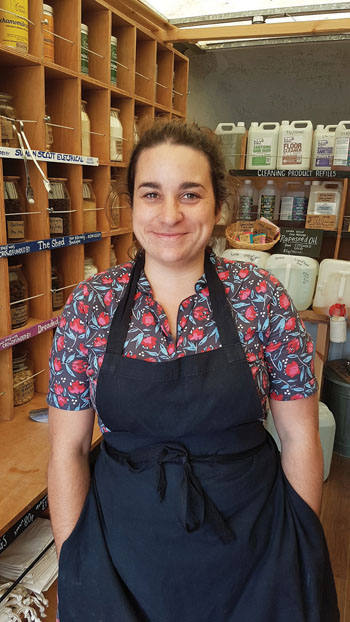
People in Food – Kate Robertson

From gluten-free organic flour to beetroot and parsnip crisps, ginger biological washing up liquid to organic olive oil, chocolate and salted vanoffee cashews to recycled loo roll, bamboo toothbrushes to chia seeds, Kate Robertson of The Green Weigh sells it all. Neatly stowed away on shelves from floor to ceiling Gertie, The Green Weigh’s van stocks an impressive array of organic, biological, sustainable and vegan products, which customers can come to purchase at the various locations she stops at during the week. Set up by Kate, alongside her fellow directors Alex Green and Libby Rogers, together they have created Dorset’s first mobile zero waste shop.

They describe themselves as “a group of mums on a mission to help reduce plastic pollution”. Kate and Ally were at Baby Yoga together in Bridport, where they discussed a zero waste shop Alex had seen on holiday in Totnes. Realising there was nothing like that locally, Kate encouraged Alex to start planning their own shop, with Libby also being brought on board. Every Wednesday after school the mums with their children would gather at Kate’s house developing their business plan. And after an extremely successful crowdfunding campaign, backed by local businesses, they were able to launch in 2017.

The Green Weigh project takes up most of Kate’s time. When she’s not planning or working on the back end of things she is busy being a mum to three girls. Growing up in Redcar near Middlesbrough, Kate married her teenage sweetheart and juggled moving to the Isle of Wight whilst pregnant, giving birth early, just three days after arriving. Her now ex-husband is a musician and composer, which complemented Kate’s artistic talents. She studied Photography and Video at Lincoln University, then later whilst the family were living in Buckfastleigh she snuck in an Integrated Crafts Degree with travelling around Europe, performing Neuro Operas. Still carrying out freelance video commissions, her CV boasts being shortlisted at the Saint-Petersburg International Film Festival and winning film for Best Artistic Merit at Plymouth Film Festival, amongst other awards.

Now living in Bridport, Kate enjoys working the odd shift at The Red Brick café. She squeezes every moment of time out of her day, spending evenings at her computer typing out neurospecialist transcripts. Trying to make a difference, she is certainly making a positive impact with The Green Weigh.

Dancing in the Community

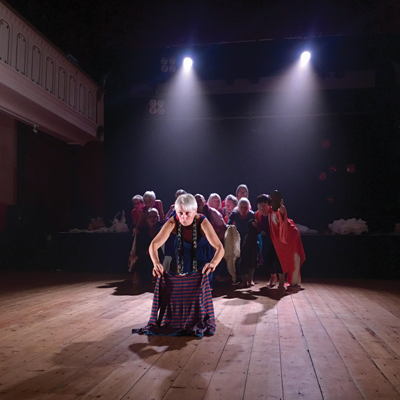
Anna Golding went from being a landscape architect to a community dance teacher. Margery Hookings meets her to find out more. Photographs by Pete Millson


The joy of dance is everywhere.Whether you’re glued to Strictly, learning to tango at your local community centre or just throwing shapes on the dance floor to a bit of soul, the feeling that dance gives you is empowering, infectious and takes you to a place outside the run-of-the-mil norm.

It’s never been more popular.

Dance is artistic expression, a release valve, and as good as any sport to keep you fit. And most of all, it’s fun.

I have to confess I once tried an adult ballet class as a precursor to writing about it. A group of my friends loved it, still love it, but I couldn’t take to it, largely because ballet was so alien to me. I grew up thinking only posh girls did ballet and just didn’t get it. And I still don’t.

Dancing around the kitchen to the latest tunes on BBC 6 Music, though, or to 1970s disco and funk, well, that’s another matter. It’s a bit like stream of consciousness writing. You just do what comes naturally, instinctively. There are no rules.

So I have to admit to being a little hesitant about meeting Anna Golding, a dancer and choreographer from Bridport who is involved in a number of groups locally.

I was put on to her by a mutual acquaintance, Tessa Slimon, who is a member of her Over 50s dance class in Charmouth.

‘You really ought to do a piece on her for the Marshwood Vale Magazine. She’s really good. It’s such a lovely class.’

I wasn’t able to attend a class but arranged to meet Anna for coffee in Gelateria Beppino in Bridport. I knew Anna Golding’s name from her choreography of Flea!, the weird, wacky and brilliant piece of community musical theatre performed at the Electric Palace in Bridport in 2017. It was written by award-winning composer Andrew Dickson and directed by the Lyric’s Nikki McCretton from an original idea by Sally Vaughan.

Arriving at the café, I felt rather embarrassed when I realised I’d turned up with only about 60p in cash. Anyone who’s bought a coffee lately will tell you that’s not even enough to buy the milk.

But Anna instantly put me at ease by diving for her purse straight away. It was ridiculous, really. Why would I have been nervous? I was the one interviewing her. (Maybe it’s because there are too many people on the local arts scene who can be sniffy and aloof from ordinary people and real life. That’s why I like Colmer’s Hill artist Marion Taylor, because she’s not like that. But that’s another story.)

Straight away, I liked Anna Golding. Here was a woman with no airs or graces, no self-importance, whose two great loves are dance and people.

Working in the community through dance, with all sorts of people, is what Anna excels at. Our mutual acquaintance, Tessa, says: ‘She is a very inspiring dance teacher and always encourages her pupils.

‘Anna’s dance class helps me physically and mentally—the dance sequences we learn exercise my memory and coordination. We are able to use our imagination sometimes and create dances pieces ourselves.

‘The music which Anna chooses is very eclectic and varied. And she is incredibly sensitive to everyone’s different needs in the class.’

Tessa asked a few friends what words they would use to describe their dance class: laughter, fun, friendship, creativity, expression. Of Anna, they said: welcoming, encouraging, mindful of older dancers who are less flexible and, lastly, a beautiful dancer.

Anna spent her early life in Durham with a father who was a playwright and a mother who was a painter and community activist. She left to study landscape architecture in Leeds in the late eighties and, after a period working for the council in Huddersfield followed by a short life in Greece teaching English as a foreign language, decided that she needed to find a new path.

‘I had always loved theatre and dance but up until this point hadn’t pursued them seriously, having been encouraged to follow a more secure path, but now it felt like the time had come to jump into the unknown,’ she says.

While deciding, Anna enjoyed the vibrant jazz scene of Leeds and got to know dancers there who were studying nearby at the Northern School of Contemporary Dance.

‘I was persuaded to audition and was thrilled to be offered a supported place to train professionally,’ she said.

What was it about dance that excited her?

‘A button switched on in my head and my whole body came alive with the music, pushing my body to fly and fall in ways I had never thought possible. Almost by chance I had found something which felt completely natural, a passion which has stayed with me since then.’

From Leeds, Anna moved to London where she worked in a variety of fields including as a dancer and a teacher, arts journalist and museum educator, all of which ran alongside a new life raising her own family.

In 2005, she moved from London to Dorset where her family settled into a new rhythm in Bridport.


‘I first came to Dorset when I was 14 and was reading Hardy’s Far From The Madding Crowd at school,’ she says. ‘We were staying near Coryates, not far from the house that features in the Julie Christie film. I came to Bridport a couple of times and loved it.

‘My husband Spike’s family lived in Southbourne so we used to come to Dorset a lot. We went camping in the Purbecks and started to explore West Dorset.’

After moving to Bridport, Anna worked for Take Art in Somerset for six years on various dance and health projects across the county, developing a particular interest in the mature dancer and in inclusive dance.

Since 2010, she has worked as an independent dance artist more locally establishing projects such as Grace + Growl, No Limits Bridport, The Shoe Chorus and, most recently, Fingerprint Dance, a community interest company building on these existing projects and developing new dance opportunities for all ages and abilities in West Dorset.

In 2011, Anna worked with Activate Performing Arts on a Cultural Olympiad project called A Dance A Day which offered dance opportunities to people over 50 in Dorset. She worked with a group at The Marine Theatre in Lyme Regis to create a piece of contemporary dance which was performed on Weymouth Esplanade as part of the opening celebrations for the Olympic Games in 2012.

After this project, the group were keen to continue dancing with Anna and have been doing so ever since. They are now based in Charmouth Village Hall. The classes are a mixture of contemporary and creative dance, are open to all adults with or without dance experience and take place on Thursday mornings in term time.

What is it about dance that brings people together? Why does dance work so well for community projects?

Ann says: ‘We move for pleasure, often in response to rhythm, way before we can crawl or walk.

‘Small children, so at ease in their bodies, physically respond to the world around them by exploring human contact, gravity, their environment, something which they share with dancers the world over.

‘Over time, the instinct to move to a stimulus, normally music, can be dulled down by the pressures of modern life and the joy of dancing becomes confined to kitchen dance floors on a Friday night. What a community dance class offers is very simple, the chance to come back to this way of connecting body and mind, enjoy a freedom in movement with each other—and have fun while you’re doing it!’

  • For more details about Anna’s classes, call her on 07958045672 or email her at goldinganna@gmail.com


American Imports

As the UK slowly wriggles away from Europe, it’s time to consider new trading opportunities as we turn and look westwards across the Atlantic. Last month I wrote about some nice European things that we’ll be leaving behind, so this month I’m writing about a few of the positive benefits in having the USA as a potential trading partner. Please note, this does not include unwelcome items such as chlorinated chicken, force-fed religion or yet more American TV (we get quite enough of that already). And you’ll be relieved to know I’m not suggesting we import any member of the Trump family! Having lived in Los Angeles for seven years before I moved to Dorset, here’s my top ten list of things the USA does particularly well.

1)  Fridges & Ice: American kitchens tend to be larger (they’ve got more space than we have), so their fridges are massively wonderful. Everything goes in them—including stuff that doesn’t really need to be there at all such as jam (sorry jelly), pet food, eggs, milk and bread, medicines and mouthwash and plasters, plus half a ton of yoghurts and ten school lunches. Many Americans think they must always be ready for Armageddon, so their fridges are packed with every consumable item and quite a few non-consumables such as batteries. Yes, batteries in a fridge—don’t ask me why. And most of them also have ice machines. Just insert your glass and plop, plop, thump—it’s full of ice cubes. Heaven! Yes, you can get US style fridges in the UK but you need a second mortgage to buy them. I’m not sure all this power consumption is actually better (and it’s certainly not better for the environment) but it’s definitely bigger. That’s America for you—it’s just bigger. But not necessarily better…

2)  Longer shopping hours: In the UK, the shopping world (except for supermarkets) comes to a stop at about 6pm. In the States I could buy a shirt or a car and have my teeth fixed up to about 9pm. Of course, in Las Vegas everything’s open 24/7, but that’s because nobody has time to sleep.

3)  Soft drinks: Why is it that in a British pub, a diet coke costs virtually the same as a glass of wine or a beer? In the USA, soft drinks are always roughly half the cost of their alcoholic equivalent which reflects the true price if you buy them in a shop. And in so many restaurants, you get free refills too! And then there’s root beer and grape soda—great fizzy drinks that are so common in the USA but so hard to find over here…

4)  Hot dogs: We used to have these in the UK, but they seem to have vanished. I really love a genuine wiener hot dog with bright green relish in a long bun. Currently I put a Tesco frankfurter into a roll but it’s not the same. Perhaps I’ll be able to import them direct from the USA in a post-Brexit world…

5)  Good Mexican food: I know, I know… we’ve got Wahaca and other chains like Chiquito which are certainly better than what we used to get in the UK. But where can you find essential Mexican goodies like frijoles charros or hot tamales? And I’m not talking ‘Taco Bell’ here…

6)  American Sports: I love my UK footie and cricket and rugby, but American Football and Baseball are pretty cool too. And Ice Hockey is amazing on TV (that’s if you can follow it because the little black puck thing whizzes by so fast). The only bits I can occasionally catch here are at 3am on channel something or other when I am asleep. Probably the best thing about sporting USA are college sports. The city comes to a standstill when Oregon plays Ohio State—fan mania and hysteria but at a grassroots level! In the UK, college sport means the Oxford vs Cambridge boat race (daftly elitist) or University Challenge on TV and, no matter what you may say, a college quiz is not as exciting as a 40 yard touch-down!

7)  Pickup trucks:  So useful—just a covered cab and an open space behind to carry everything. Put anything in it—your furniture, a couple of trees, dogs, comfy chair, grandparents, whatever… a bit like an American fridge.

8)  Mountains in general: Ben Nevis is just over four thousand measly feet high. This is merely a gentle hill compared to the USA which has nearly 200 mountains at over 12,000 feet. It might be difficult to import them directly as they wouldn’t fit easily onto a pick-up truck but I told you earlier that American things tend to be bigger than ours.

9)  Genuine friendliness towards complete strangers: Hard to beat. Over here we tend to wait until we’ve been officially introduced or at least shaken hands. In the USA, generous hospitality is a nice habit. Perhaps we could import it to here.

10)  Cheap gasoline: Yes, UK petrol is nearly double the money. But UK walkers and bicyclists beware. There’s almost no provision for cycle lanes in most American cities and when I lived in L.A., we had few pavements (sorry sidewalks). Walking is something you do to take exercise like at the gym. Going for a walk gets funny looks. You are not expected to go anywhere unless you go by car.

And there are other negatives I wouldn’t want to import like American chocolate (much too sickly sweet), the lack of bookshops (Americans don’t read as much as we do) plus widespread obesity (although the UK is catching up fast). And there’s nothing like the NHS over there – I’d have to take out a bank loan to get US health insurance now. Yes, there are some things we wouldn’t want to get from the USA. Getting shot is another…

Philiy Page

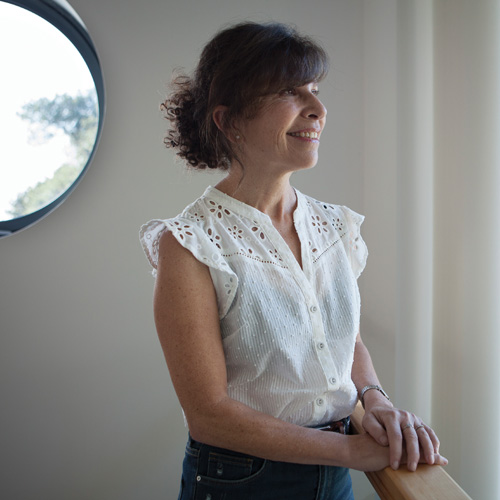
‘I was born in Redhill, Surrey, near where we lived in a village called Dormansland. My father left us when I was four, when my brother was still a babe in arms. My Mum was Catholic, and was thrown out of the church because of the divorce. From that age my brother and I didn’t see my father.
My mother’s family history was complex. She was a war baby, born at the end of WW2; her mother enjoyed a party, and her father, we think, was an American air force pilot from Boston. My Grandma then married an Irish Catholic from County Cork called Jack when my mum was about three, my mother never knowing that Jack was not her real father until she was dying. Grandma’s family were proper EastEnders, who worked in a tobacco factory in Clerkenwell, but she didn’t enjoy that life, and fought hard to change it. Her father was forward-thinking, ensuring that all his daughters had a good education, which enabled my Grandma to train to become a sugar sculptor, and end up making cakes for the Royal Family. Because she eventually enjoyed a completely different life from her brothers and sisters, she fought to enable my mum to better hers.
After the divorce Mum’s understanding boss let her continue working in a bookshop taking me with her. She then worked at the GLC under Ken Livingston; I remember licking endless envelopes and stamps in the evenings for her. Eventually Mum ended up selling scripts for the BBC, and language teaching in the holidays. We had several foreign students live with us. Through a charity called Gingerbread, mum met a new man, Ron. He encouraged her to set up her own business as a literary agent.
Ron had three children of his own, and was from the East End too. He had been in the Merchant Navy, drove a Hackney cab, and then bought a double glazing business in the ‘80s, which made him a millionaire. Our fortunes changed dramatically, but on their honeymoon Mum found a breast lump, and within a year and a half she was dead. Before her death, Ron adopted us, to get parental rights, and I remember going to court aged eight, having to explain what I thought was happening. When Mum died he pretty much had a breakdown. Aged ten I was getting us up in the mornings, him to work, us to school, and doing the washing and ironing. I took over Mum’s role until Ron hired an American nanny to look after us.
After the death of my Mum, Ron decided he wanted a new life and sold everything, including my Mum’s house. He moved to Tenerife, and my brother and I were sent to boarding school. He was keen for us to make our own way in the world and never gave us pocket money or handouts.
My boarding school was a stage school. Thandie Newton was my prefect. I’d already done lots of performances as a youngster, but had I known I was going to be sent away, I would have done a rubbish audition! I got in and was there from the age of 11 until 15, at which time my step-dad met another woman, Carole, and remarried. She was from Sheffield, and they decided to relocate there from Tenerife, including me. I didn’t even know where Sheffield was. They pulled me out of school in the middle of my GCSE’s, and off we went to Sheffield.
I attended a girls’ high school where they put me back a year initially. Then Ron and Carole wanted to go back to Tenerife because of the recession. I refused to go, determined to finish my GCSE’s. I stayed with a girl from school from 16 to17, and eventually went to live with my English teacher’s friend, Howard, in a warm and vibrant household. My first boyfriend Liam’s parents pretty much adopted me. They were left-wing, cultured people, a complete contrast to Ron’s conservative East End background. Liam’s father started teaching me photography; I loved it and took night classes completing an A level photography in a year getting a grade A. I took art classes too and met Karen from San Francisco, becoming became great friends with her and other artists. San Francisco became my second home, and I would visit twice a year.
Although I was getting some work published, photography wasn’t making me a living, but my American friends persuaded me it was possible to earn good money as a creative. I got serious and went to Manchester Met University studying photography. It was really good but in common with many creative courses taught very little about the business skills you needed to actually make a living. At my final meeting I was told I was the most likely to succeed, as I understood how business worked. Years of watching my Grandmother, Mum, Ron, and all of my siblings create their own work had obviously rubbed off on me.
Then Howard, from Sheffield, sent me a cutting, which said the BBC were making a programme he thought might interest me. We both applied, and I was sent as their photographer. The programme was called Castaway 2000. At Christmas time 1999, thirty-six of us including eight children, were driven in a coach through blizzards to begin a year of living in an experimental community on the Hebridean island of Taransay. Castaway was a life-changing, career-changing experience, launching mine, and Ben Fogle’s careers. I’m still in touch with the Castaways today.
I moved straight to London from the isolated life on Taransay, which felt a bit like time-travel. That experience had me shooting for publications like Marie-Claire and the Guardian. I was determined to make it as a photographer, but it was tough and competitive. I waited tables at night to make ends meet, then I read about a post-grad course in photojournalism at what was the London College of Printing, and applied at the last minute. At the end of year show all the top newspaper editors turned up, and we all got work. I then worked as a photojournalist for the Sunday Times, the Guardian, and others, but with the pressure of constantly hustling for work, I found myself burned out. I had friends who as war correspondents lived crazy lives in incredibly dangerous situations, one of whom, Tim Hetherington, was sadly killed. I found myself at a crossroads, where I could either go off and do that kind of work, or change direction completely. I decided to retrain at Goldsmiths, as a secondary teacher. I taught in some difficult South-East London schools, where the poor kids faced so many challenges all they really wanted was breakfast and a sleep rather than learning.
When I got together with my future husband Paul, who lived in Dorset at the time, I decided to move to Beaminster from London. It was a shock, and I left to travel around the world alone for seven months. On that trip I decided to go back to media as the school situation was dire. Returning to Bridport, I got a paid internship with a TV company in Bath, and re-trained as a camerawoman and programme developer. Then I was put in touch with Eric Harwood who ran a TV production company in London and lived in Charmouth. I worked with him for three years, filming Julia Bradbury’s walking programmes. I was offered work on Ben Wheatley’s second feature film Kill List, and worked in films for the next seven years, ending up as his production manager. I also worked on Far From the Madding Crowd, filmed here in Dorset.
After that film, I was approached by the British Council and asked if I would train creative start-ups internationally, due to my side work at Universities. Feature films were an 18-hour, six days a week job and I didn’t want to burn out again. I had had a wide range of freelance experiences, and, going right back to childhood, my family were serial entrepreneurs. I used all of that as inspiration to train creatives globally, helping put their ideas into business practice.
Time and time again I would find that the women in the groups lacked the confidence needed to succeed. To fill that gap in 2014 I started Creative Women International, connecting the women I had trained in those international groups through a social network. Two years ago I was invited to become a Fellow of the RSA for the work that I do with Creative Women International, and I also worked as a Fellow of Entrepreneurship for the University of Bristol. I reduced my work when I had my son Huxley, and I’m now delivering training programmes, and host a weekly podcast encouraging women to start their own businesses. Often what holds people back is lack of confidence, which is a large part of the subject of my book The Business of Creativity, published this year.’

Marshwood Arts Awards 2019

November in the Garden

November is one of those months when gardening activity is largely dictated by the whims of the weather and, of all the months, November is perhaps the most variable. In a ‘normal’ year it is the final chance for those activities which depend on the last vestiges of warmth and active root growth—such as moving trees, shrubs, herbaceous perennials and the like. It is also the first chance to start those tasks which rely on the lack of plant growth and the onset of winter dormancy; pruning of roses, planting bare root stock, digging fallow soil.
Rose pruning is something which, as far as I am concerned, can wait a while longer as roses will only just be ‘slowing down’ and there is the whole winter still ahead of us. On tall specimens, especially those in exposed positions, it is a good idea to reduce the growth by about half to lessen the likelihood of ‘wind rock’ in autumnal gales. They can get their full prune towards the end of winter.
A mild November will allow the herbaceous perennials to gently collapse and die down with fitful flowering, from the stalwart late summer bloomers, continuing right up to the first frosts. A more severe month, with hard frosts, will finish off the borders practically overnight and then you may have to act swiftly to deal with dubiously hardy plants, such as dahlias and cannas, if you have them in your garden.
It’s always been traditional to wait until dahlia foliage is blackened by frost before lifting and storing the tubers in a frost-free place until next spring. The hassle of having to perform this operation, not to mention the need to find somewhere to store them (centrally heated houses are not conducive to successful overwintering), must have played a part in their fall from popularity in the first place. They are so ubiquitous these days that I wonder how many are kept from year to year, as they were in the past, and how many are simply purchased anew each spring and treated as disposable?
If left in situ they may survive in a mild winter but, especially in this wetter part of the country, they are apt to rot even if they survive the cold. The other problem with leaving them in garden soil is that they are bedevilled by those little black slugs which live under the soil surface; ‘Keeled Slugs’, I seem to remember from my old ‘Pest and Disease’ lectures! They gnaw away at the tubers in the damp soil and then nibble off every shoot just as they begin to grow again in the spring. Even a heavy mulching, which guards against a degree of frost, is no protection against soil borne pests and diseases.
Other tender plants should be under cover with some frost protection by now. There are many borderline hardy salvias to choose from which respond really well to being lifted and brought under cover until the spring. I have a really ancient specimen of ‘Amistad’ which suffers the indignity of being chopped back, dug up and re potted each autumn but which bounces back every spring to make an even bigger plant than the previous year. Just keeping them dry and under glass is enough for many of the woodier specimens but supplementary heating is advisable for any really tender ones.
If you can run power to your greenhouse then a simple electric greenhouse heater, with a ‘frost-guard’ setting, should protect your plants even when temperatures remain low for a prolonged period. Paraffin heaters are a bit more temperamental and they have the side effect of producing water vapour plus carbon dioxide which can be a problem in a confined space.
Back outside; now’s the time to plant tulips if you’ve been holding off, quite sensibly, to reduce the threat of ‘tulip fire’ (a nasty disease which is less prevalent in tulips planted late—after all the other spring flowering bulbs). I don’t find that many of the ‘fancy’ tulip varieties are reliably perennial. Planting them as deep as possible certainly helps, some of this may be due to the fact that shallow plantings are prone to predation by rodents, but if you want guaranteed displays then planting fresh, new, stock each year is recommended. Having said that, I often find that the old ‘Darwin’ type hybrids, generally in rather brash red and yellow hues, form permanent populations in many established gardens—whether you want them to or not.
Now that herbaceous plants are dying down and deciduous trees / shrubs are dropping their leaves, it is the evergreens which come into their own. Evergreen specimens are often referred to as the ‘bones’ of the garden, on which the summer ‘flesh’ is draped. As such they should not dominate but work best as structural elements or as solid backdrops.
Box edging, topiary balls and clipped yew hedges are standard, classic, examples of evergreens being used to anchor the more transient garden constituents. Without evergreens the garden would be a pretty desolate place from this month right up until growth starts again in the spring—still a long way off.
Another major, evergreen, component of the garden which acts as a calming foil, to the more flamboyant performers, is the lawn. Fallen leaves are best raked up whenever weather conditions allow, a leaf blower makes this task easier if you have lots of trees, or acres of lawn. If the leaves are not too thick or wet, and the grass is still growing, then using a lawnmower, assuming it has a collection box, to pick them up kills two birds with one stone. Leaves have less nitrogen in them to speed up decomposition, compared to green material, so composting them separately is advisable if you have the room to make dedicated ‘leaf-mould bins’. I tend to sprinkle a little ‘fish, blood and bone’ fertiliser onto each new layer in order to give the agents of decomposition a little helping hand—it can’t do any harm.

Vegetables in November

November is a time to start taking stock of the year gone by and think about how to make changes to the year ahead. It is also a time when the majority of crops have been harvested, and most winter storage crops have been brought in to keep us going through to spring. One of the best crops to store over winter are drying beans. There is a huge diversity of beans that can be grown to dry, many of which are dual purpose, so can be eaten fresh or dried. One of our favourites to grow is the Gigantes bean which grows and looks much like a runner bean, but the beans within the pod bulk up and resemble butter beans. They come from the mountainous regions of Northern Greece and so grow well in our cool damp climate! In terms of growing, treat them just the same as runner beans—sowing at the end of April inside and planting out mid-May, or sowing direct outdoors around mid-late May. The plants can be grown up wigwams or strings, spaced around 30cm away from each other.
The other perhaps more familiar drying bean to try if you haven’t tried growing them before is the borlotti bean. We grow the variety Lamon which seems to be particularly productive. We grow them in a similar way to the Gigantes, but space them a little closer at around 20cm apart. Other interesting varieties to try include Bridgwater, Pea beans and Bird’s egg No. 3. Good places to buy bean seed are from Real Seeds and check out the huge variety from Beans & Herbs.
The nicest way to eat many of these drying beans is to get them when they are semi-dry (when the beans inside have swelled up and the pods start to change colour a little). Eating them this way means they are lovely and creamy. If you are drying them, leave them on the plants for as long as possible before the weather turns too wet and miserable, then harvest them and bring them inside to a warm dry place to dry further. If the pods are fairly wet when harvested it is usually best to pod them as soon as possible and dry them out of the pods. To use them through the winter just soak the beans overnight and then boil for 30-40 minutes until tender, or add to stews. If you are growing the drying beans from the french bean family (Phaseolus) they can also be resown the following year and come true to type, which is an added bonus. This will even work if you grow a few varieties nearby to one another. This won’t work if you try to save Gigantes beans and you have runner beans growing nearby as they cross-pollinate, so you may come out with something unexpected if you try sowing them, but could be worth a try still if it’s just for yourself!

WHAT TO SOW THIS MONTH: Not a lot! We have made all of our sowings by now, and will start tentatively with a few sowings again in January, but nothing else before then.

WHAT TO PLANT THIS MONTH:

OUTSIDE: Garlic (if not planted already)

INSIDE: peashoots, sugarsnap and early pea varieties, spring onions, broad beans, garlic (for extra early garlic)

OTHER IMPORTANT TASKS THIS MONTH: If the weather dries, continue preparing beds for the winter by mulching with compost. Don’t be tempted to tidy up too much, as old crops and flowers act as a habitat for many beneficial insects. Start going through your winter job list – whether its cleaning glasshouses or polytunnels, tidying up your propagating area, cleaning and oiling your tools or even looking through seed catalogues for a bit of inspiration for next year!

Matt Kingston

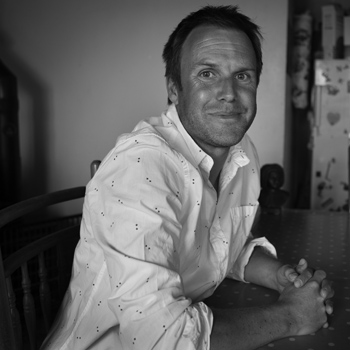
‘I grew up in Cheltenham, the fourth of five children. The musical side of my family comes from my mother’s parents; my grandfather was a music teacher, composer, violinist, organist and conductor whose name was Eric Coleridge, so I use the name Matthew Coleridge when I compose, as a tribute to him. My parents weren’t musical at all so it skipped a generation, but all five of us children learned instruments. I don’t remember a time when music wasn’t part of my life. I remember dancing to Dire Straits and Queen on Top of the Pops when I was four, whilst Iron Maiden and Van Halen were blasting out of my teenage brothers’ bedroom.
I joined the local church choir, St Mary’s, Charlton Kings, where my grandfather had been choirmaster, when I was six. I was very much aware of his musical achievements, although he died when I was only two so I never knew him. Singing in that choir was completely magical for me, and I became just immersed in wonderful music from the likes of Bach, Tallis and Stanford from that early age. As well as singing, I was encouraged to compose, conduct, and (as soon as my feet could reach the pedals) to play the organ.
During school holidays, we’d occasionally go and sing at Llandaff Cathedral, and I also sang at the Royal Albert Hall alongside a few thousand other choristers. Most importantly, I learned to listen acutely, to respond to what I was hearing, and that ‘musical ear’ I developed as a boy has served me well over the years.
I loved junior school, and then went to a very good grammar school where I was very much bottom of the pile. Most of my contemporaries were working towards Oxford or Cambridge, to become doctors or work at GCHQ; I preferred messing around in the music department. There was a large portrait of Gustav Holst, one of my musical heroes, who had attended the school 100 years earlier. A friend and I discovered a dusty cupboard full of old synthesisers, mixing desks and reel-to-reel tape decks, and set up a recording studio when we should have been studying. The head of music was my choirmaster from St Mary’s, and very much a mentor to me. Just as I was starting A-levels, he had a devastating bike accident. We were left with a succession of supply teachers and I lost interest, scraping a D at A-level music.
After school I met Jaz Coleman, the lead singer from punk band Killing Joke. Jaz had been taught to play the violin by my grandfather, and later became Composer-in-Residence at the Prague Philharmonic. He offered me a job as his assistant on a project to write and arrange a score for a hugely successful Czech folk band, Čechomor, who wanted an orchestrated version of their album. I learned quickly how to transcribe orchestral scores by ear, often working late in to the night to get instrumental parts ready for the next day’s recording sessions. It was an incredibly tough but very rewarding time. I was on a family holiday in Prague last summer, and was delighted to hear Čechomor’s music being played in the gents’ loos in a restaurant I was eating at!
It also helped me realise that I wanted to write my own music, not to transcribe other peoples, so I started to think about ways in which I could earn a living from my music. I’d played trumpet from an early age and grew up playing in brass bands, so I thought I’d try my hand at composing and arranging for brass ensembles. I found a gap in the market selling brass quintet arrangements—on eBay of all places!—and soon had my own website up and running, selling print-it-yourself brass sheet music. Within a couple of years I had customers all over the world, including far-flung places such as the Faroe Islands, Muscat and Guam, and was just about able to earn a living from it. These days I mostly write for beginner groups – young players who have only been learning for a year or two. My brass music has been performed everywhere from Premiership Rugby grounds and cross-channel ferries to medieval cathedrals and US military bases.
My family used to come and camp at Eype three times a year since before I was born, so Bridport always felt like a second home. I had a lot of friends here too, so in my mid-twenties I decided I’d like to move here permanently, renting a flat in Beaminster which my sister and I shared. I met my wife Ellen at Bridport farmer’s market where she was selling her family’s cheese. I remember going for a walk along the Monarch’s Way many years ago, spotting an isolated cottage and thinking it would be a lovely place to live one day. It was quite a surprise when Ellen invited me back to her place, which turned out to be the very same cottage! Her family have lived at Denhay since the 1950s, and it’s a wonderful place for us to live and bring up our family.
Ellen sang in Broadoak Choir, and I was soon invited to join. I hadn’t sung much since leaving school, but soon found myself falling in love with choral music all over again. The choir had a plan to perform Fauré’s Requiem, and a conversation in the pub after choir practice ended with me volunteering to conduct it. That led to me being asked to conduct the New Elizabethan Singers in Bridport, for a performance of Vaughan Williams Sea Symphony. I’d never conducted an orchestra until the afternoon of the concert, and the score was so huge my music stand collapsed under the weight of it, but it was a great success.
At Broadoak we sing a lot of music composed by our ‘choir herd’, Chris Reynolds. Chris’s passion for choral composing encouraged me to get back in to it, and one afternoon I sat down and wrote a short choral piece. I sent it to a friend who sings in the choir at St George’s Chapel, Windsor Castle, and before I knew it he’d recorded it with his a cappella group, for a Christmas CD for BBC Music Magazine.
Our son was born in 2014. I was keen for Sebastian to be his middle name (like Bach) but we couldn’t think of a first name, so it got upgraded. I took a bit of time off work, and as he was a good sleeper I found myself spending quite long spells at the piano writing music. Almost by accident, I managed to write about 20 minutes of a large choral work, which would become a Requiem.
Rather sheepishly, I got a small group of singers together at Eype Church to give it a spin. They really took to it, so I knuckled down and finished writing the work, setting myself a deadline by booking St Mary’s Church in Bridport for the first performance. It was a sell-out success, and people started asking me for a CD. We decided to crowdfund a professional recording, spending a day in London with an amazing choir. They turned up, sight-read it to an incredibly high standard, and produced a recording of which I’m extremely proud. And we were hugely lucky to get Guy Johnston, one of the country’s top cellists, to play the solo cello part. He invited me to the Royal Academy of Music to play it through with him; I never thought I’d accompany a BBC Young Musician winner when I stopped piano lessons after Grade 6. Then, last year I was asked to lead a workshop on my Requiem at Buckfast Abbey. 140 singers spent the day learning the piece, followed by a concert performance in the evening. It was quite an overwhelming experience, hearing my music reverberating around such a beautiful building. And next year I’m taking the Requiem ‘on tour’, with workshops and performances around the country, including Exeter and Portsmouth Cathedrals, as well as dates in Bristol, London, Cambridge, Oxfordshire and Worcestershire. It’s a slightly intimidating prospect, but it’s going to be incredible working with so many singers, in the acoustics of some of the country’s most wonderful churches.
Our children, Sebastian and Bea, are five and three. They fill me with constant joy and pride. I’m fortunate to spend most of my time working at home, so I’m a big part of their daily routine. Like me at his age, Sebastian is nature-obsessed. He has a huge encyclopaedia of animals which he’s pretty much memorised, and seeing his love for the natural world is an absolute joy. Bea seems more creative, loves painting, dancing, singing; whatever their passions are, if they’re lucky enough to follow them in life that will be enough for me.’

Beth Bright

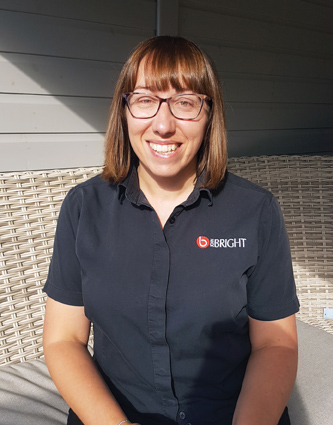
Beth Bright’s parents, John and Bridget set up the company John Bright Fencing when she was born. Hoping for a better future John left his job in a meat factory behind and started working outdoors, gardening for others and doing some fencing work. Now, John Bright Fencing is the go to place for Bridport’s fencing, timber and general agricultural needs. Situated in Salway Ash the store has everything from shooting gear to railway sleepers, garden furniture to pet supplies and poultry houses to sheds which are so sophisticated they look like a second home. This is Beth’s world, one she grew up in, and one she now runs, alongside her parents.
Living next door to the shop site means Beth doesn’t have far to travel. Her parents are also neighbours so the close family unit are united in more ways than work. With seven dogs between them, there’s usually one or two in the back office area, keeping their owners company. In charge of all the purchasing required, Beth does anything that needs doing in the office when she gets in. Emails with order enquiries are answered and stock takes are carried out. And the business is a family affair in more ways than one, with a set of brothers working for the Bright’s as well as a father and son. One loyal member of staff has been with them for 27 out of the 37 years they have been running.
Outside of work, Beth loves animal husbandry, in particular attending to her herd of Texel sheep. With fields in Salway Ash and Pilsdon Pen she transfers the sheep between the two depending on the time of year. Beth also has turkeys that she rears for the Christmas market and some pigs. Her husband, Jim Cook, has a farm with cattle he tends to in Ryall, so conversation round the dinner table often turns to farming related subjects. It was at a talk about sheep worming at Highlands End where the two met, they are now celebrating their seventh year of marriage. Today they are still attending meetings together such as the South West Simmental Club Committee meeting, squeezing in some time to spend in each other’s company in their busy lives. As Beth is also on the Cattistock Hunt Skittles team, a committee member for Dorset Young Farmers 200 Club and Church Warden at Dottery Church, that’s not such an easy task.