Sunday, December 21, 2025
Home Blog Page 14

People in Food and Drink – Jamie Smith

Jamie Smith spent his weekends with his grandparents in Chideock. He always found the village a great place to be. Little did he know, years later he would come to live there and be part of the heart and soul of the village, as landlord of The George Inn. Cutting his teeth in the catering business he did his work experience at The Green Yard café in Bridport and worked there full time when he left school. Growing increasingly enamoured with the food industry he then moved on to work for Highlands End before taking up work at The George Inn.

Jamie learnt the ropes and was living above the pub when the opportunity arose to take it on. As the son of an amateur musician who gigged around the Bridport pubs, Jamie was always taken with the idea of becoming a pub landlord, as he had watched through child’s eyes the one person in the pub everyone wanted to be friends with. Years later, the notion still appealed and so Jamie became one of the youngest Palmer’s landlords, running the 160 seater pub since 2015. He has put in the graft ensuring the pub thrives with both local and visiting custom. However, he admits he has no idea how he ran the pub on his own for three years since his girlfriend, Amy Day, has started helping him. With her own full-time job, Amy also looks after her daughter and helps him run the pub, often working late into the evening.

Tackling the summer trade with food freshly cooked to order is no mean feat, something he manages to deliver with his loyal ‘Team George’. Jamie doesn’t get much time away but does let off steam on the football pitch in Charmouth and at skittles once a week. Still passionate about being a landlord, Jamie is continuing to explore the pub’s potential and further knitting himself into the fabric of the community he has come to love and know so well.

People at Work – Claire Wrixton

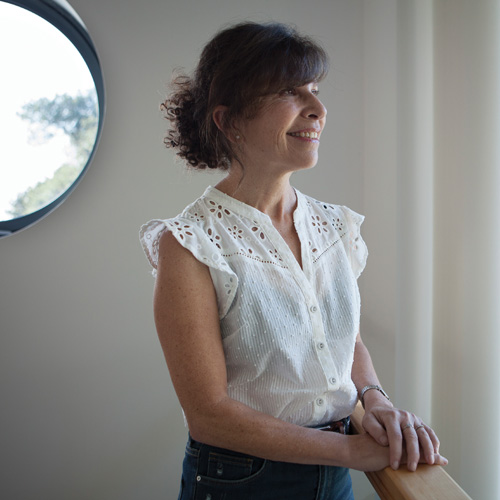
Nestled at the bottom of Colmer’s Hill is the charming Symondsbury Estate Manor Yard, where visitors can eat and shop for local wares. The newest shop on the block is Wrixton-Smyth Creations, owned by Claire Wrixton, local jewellery designer. Long acquainted with the view of Colmer’s Hill, she grew up in a house adjacent to the iconic silhouette, with its crown of pine trees. Each day she would gaze out of her bedroom window at the view which would emerge in her GCSE art coursework and beyond, materialising in her jewellery and even forming her logo.

Effectively self-taught, Claire explored different materials but felt the relatively new material, silver clay, was the best match. Motherhood, with two small children to look after, enabled Claire to focus on her jewellery making during nap times and stolen moments in the evenings. She started to sell at craft fairs and listed her items on Etsy, finding a welcome audience and loyal following. Once her youngest had started school, she recognised the moment as ‘now or never’ and opened her shop in November 2019. Her jewellery is also stocked by National Trust Dorset, Bridport Museum and Collate in Axminster.

Wrixton-Smyth Creations started mainly with jewellery inspired by the Jurassic coast. Creating ammonites with minute detailing into earrings, rings and necklaces, encased in boxes with the name, age and location where the fossil was found, forged Claire’s reputation. She then branched out into a Dorset Countryside collection, using sycamore seeds, acorns, leaves and ferns, collected during walks with her children. Alongside, on display are other items using her developed traditional skills as a silversmith and now goldsmith. Simple studs to mosaic and middle-eastern inspired designs, there also features a series of necklaces with a Colmer’s Hill pendant, naturally.

Soon to be moving her family back to the house she grew up in, Claire anticipates recreating her childhood with her children. Splashing in the stream, smelling the hay in the summer, sitting on a golden bale together, watching the sun go down behind her favourite view.

Pampered and Spoiled

After all that loud and frantic festive activity throughout December and ongoing parties in January, I expect you’ve been longing for a good rest. A bit of peace and quiet to allow the body and soul to recuperate. Some of you, of course, may have been doing a spot of physical mending like a dry alcohol-free January, or a low carb month or even a wild attempt at daily jogging or weekly visits to the gym. I know of one person who tried to go Vegan for 2020 in the hope it might benefit the planet as well as herself, but she didn’t seem to last beyond the first week of January without succumbing to a bacon sandwich. A friend of ours in Cornwall told everybody he’d made a New Year’s Resolution to swim for one minute in the sea every morning, but this didn’t get much further than January 2nd. These are all punishments—self-inflicted penalties as part of a personal guilt trip because you woke up with a double hangover after too much gin, prosecco and Old Peculiar (often in the same glass) from the night before. Anybody who makes extravagant promises when they’re feeling like complete rubbish is bound to fail. Surely there’s a better chance of success if you think about reward rather than reprimand—a carrot is more effective than a stick.

If you’ve been particularly good, you should claim a prize. Here are a few ideas:

Physical Pampering: Treat yourself to a trip to a local spa and enjoy a bit of aromatherapy or a soothing massage. If that’s a bit expensive, then make an appointment with your favourite hairdresser and get a completely new look. I’m also told the latest thing for girls is to visit a Nail Bar—apparently, there are loads of them springing up all over the south-west. Boys could try a visit to a Turkish Barber, another newly fashionable bonus to many local high streets where you can get shaved, oiled, smothered with hot towels, have your nostrils waxed and all of those fine hairs you never knew you had burnt off. It may not cure your hangover, but your face will have so much happening to it, you’ll forget you ever had one.

Lunch: Invite someone special to lunch. And your lunch guest will be… yourself! Yes, just you. Have a good old-fashioned prawn cocktail or a home-made steak and kidney pie without any need to have a meaningless chat with anyone else. You can even take a book if you like. There’s no one with you to get annoyed and tell you to put it away.

Learn how to bake things: You might have been inspired by Great British Bake-Offs on TV (or not) and of course you can cook a meal—even bacon, fried egg, frozen peas and oven chips? OK, but have you ever baked a cake or a loaf of bread? It really can be quite fun. This task usually requires reading a recipe book (Boys please note—you’re actually allowed to do this. It’s not cheating like reading a microwave instruction book before you take it out of the box and turn it on!) And you will glow with pride like a warm oven when you’ve succeeded. This is one of the few prizes you can actually eat.

Mental Pampering: when you were much younger did you ever put your favourite rock band on the turntable, turn up your HiFi really loud, put on your stereo headphones and blast your brain for ten minutes with Jimi Hendrix or the Rolling Stones? When was the last time you did this, I wonder? Time to re-live your disco days and your misspent youth perhaps?

Tech Burning: This is the opposite approach… you need to unplug your phone, turn off the radio and TV and walk to the bottom of the garden. Wear earplugs for a better and completely silent effect. The idea is to divorce yourself from every outside interference that’s happening in your life. After 5 minutes of hush, you may start to hear the grass growing and your heart thumping. After about 15 minutes of total silence, you will find yourself drifting into a meditative state. Try to stay awake, particularly as I’m just reminding you that your nephew and his young and awfully noisy family are coming to tea and you still have to go shopping for ginger biscuits and butter. And don’t forget you need a half bottle of sherry for your aged Aunt who’s coming for lunch tomorrow. Sorry to wake you from your quiet contemplation, but it’s February and it’s time to take the dog out.

Murmurations and Memories

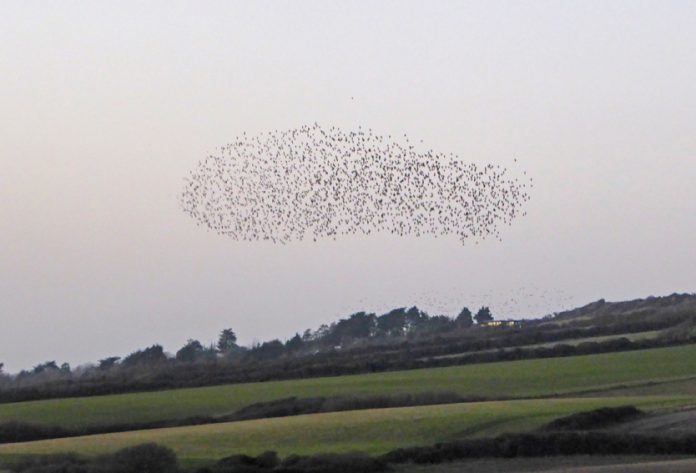
It was the video that clinched it!  I’d read the reports of starlings gathering in their thousands at sunset over Chesil Beach but when I saw the video of their murmuration and the liquid patterns they carve in the sky, I knew I had to go to see for myself. So, on the first clear, dry day we set off for West Bexington on the West Dorset coast near where the starlings had been spotted.

West Bexington lies between low coastal hills and Chesil Beach and when we arrived that mid December afternoon, the village felt very quiet. The sun hung low in the pale western sky, its bright yellow disc casting a shimmering, silvery mirror across the water and a warm light across coastal fields. We parked in the beach car park and set off across the shingle, the pea-sized pebbles making for hard going as usual. The sea was calm with just a light swell and waves that barely left a thin white line along the vast sweep of shingle. I had thought there might be more people about to watch the birds but, apart from a few fishermen, their faces turned fixedly towards the sea, we were alone on the beach. The skeletal remnants of beach plants that flourish here in warmer months added to the sense of isolation.

For a short time, we stood by the extensive beds of pale reeds that line the back of the beach. The feathery stems fidgeted and rustled as a light breeze passed and we heard the occasional squawk from birds deep in the reeds but invisible to us. A skein of geese passed eastwards to disappear behind the coastal hills honking loudly as they went and the pale moon appeared above the ridge.

Then we noticed another figure labouring across the shingle, swathed in warm shawls and a woolly hat. She approached us and asked if we had come to watch the starling murmuration. We had of course. She told us that she had seen them perform near here on the two previous afternoons before roosting and this was about the right time. We stood, the three of us now, looking, watching, scanning the sky for perhaps ten minutes, but nothing happened. We discussed the vagaries of watching wildlife and we got colder and colder. The sun, a fiery orange ball by now, approached the horizon and spread its warm glow across the shingle.  The moon, nearly full and not to be outdone, rose steadily above the hills.

We were on the point of giving up when the first group of starlings appeared in the sky above the coastal hills to the west. At first, they were just a mobile black smudge but soon they began to move about in the pale sky sculpting smooth shapes and occasionally disappearing from view over the dark land. Quite suddenly they were joined by more …… and more……. and more birds, as though some signal had been sent and soon a huge cloud of thousands of birds was moving backwards and forwards forming massive, mobile, liquid shapes that twisted, thickened, thinned and sometimes split apart before merging again. The mass of birds, the murmuration, seemed to have a life of its own, as though it was some kind of sky-bound superorganism squirming about. This was one of the most impressive natural events I have ever experienced, forever engrained in my memory. It lifted our spirits eliciting spontaneous exclamations of surprise and delight.

By now the sun was setting and the light was fading.  Suddenly, and without warning, the birds dropped down to roost across the coastal scrub to the west below Othona like a sheet floating to the ground; it was as if another signal had been sent that only the birds understood. With so many starlings, there must have been an impressive noise from their wings when flying and from their chattering when on the ground. I lost all sense of time while the birds were performing their murmuration but when I checked my watch the whole event had lasted only ten minutes and coincided roughly with the setting of the sun.

We marvel at their behaviour but starlings don’t create these pulsating patterns in the sky for our benefit. So, why do they do it? Security is thought to be one reason. Predator birds are always on the lookout for food and as the light fades, individual starlings become more vulnerable. They cannot see the predators well in the fading light but flying as part of large swirling mass of birds provides safety in numbers. Predators find it difficult to focus on single starlings in a moving murmuration so the chance of attack for individual birds will be lower. Starlings are also gregarious and are thought to gather in large numbers as a prelude to roosting close together both to keep warm overnight and to exchange information about good feeding areas. It is tempting after having watched a murmuration to suggest that the birds are also expressing some kind of joy of life.

And yet, starlings are not universally loved. Some people view them as noisy, thuggish and dirty creatures: bird-feeder bullies that soil urban spaces where they roost and have a negative effect on arable farming. Should you take the time to look at a starling, though, you will see a beautiful bird with glossy black plumage enhanced by flashes of iridescent purple or green. Their dark plumage is decorated with startling white spangles in the winter so that, as the poet Mary Oliver says, they have “stars in their black feathers”.

But whether you love them or hate them, starlings in the UK are in trouble. Since the mid-1970s, there has been a 66% drop in their numbers, the starling has been red-listed and is of high conservation concern. The reasons for this decline are poorly understood but are thought to be linked to changes in farming practice. The use of pesticides and synthetic fertilisers and the loss of flower-rich hay meadows have severely reduced numbers of invertebrates such as earthworms and leather jackets that starlings depend on for food. Starlings are dying of starvation and other farmland birds such as tree sparrows, yellowhammers and turtle doves have also been badly affected. Agriculture needs to adjust to make space for wildlife in order to halt this downward spiral before we lose these birds altogether and murmurations become no more than memories.

For some brief videos of this murmuration have a look at my YouTube channel: Philip Strange Science and Nature.


Ki Aikido – Natural Energy

Sensei Eileen Honeybun has been teaching a Japanese Aikido form in the village of Winsham for 28 years. Fergus Byrne has been to meet her.

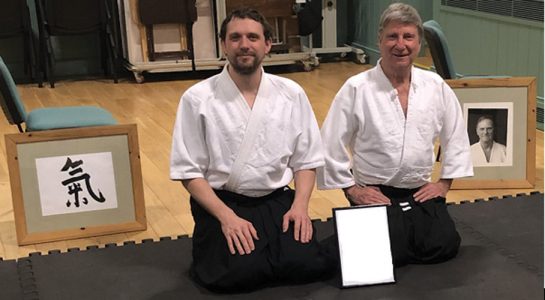
In the Jubilee Hall in Winsham in South Somerset, with its impressive high ceiling, oak floor and beautiful wooden ceiling arch, Sensei Eileen Honeybun stands about four feet apart from one of her students, Jacco Toornent. They each hold one end of what in Aikido terms is known as a ‘Jo’; a wooden stick that looks not unlike a short curtain pole. With a movement not immediately apparent to the naked eye, Sensei Eileen uses the ‘Jo’ as a conduit to deliver enough energy to make Jacco tumble to the floor. He rolls elegantly across the specially designed rubber matting and springs to his feet. It’s a dramatic moment that is hard to comprehend. I can’t help but blurt out ‘What just happened?’ Eileen and Jacco smile. After so many years practising the Japanese art of Ki Aikido they know that an explanation, though perhaps simple to them, may be incomprehensible to those of us with little knowledge of their art.

Sensei Eileen has been teaching Aikido at the Jubilee Hall in Winsham for 28 years. Before that she had a class in Chard and prior to that practised in Seaton. Although elegance and grace go hand in hand with its highly choreographed and stylish movement—using the natural energy in our bodies—Aikido was the furthest thing from Eileen’s mind when she was growing up. She was born with back problems that were further exacerbated by an accident on a trampoline when she was thirteen.

‘It turns out that I was born with a problem with my spine’ she explains. ‘So I hated sports. My Grandad used to carry me to school because it hurt my legs so much to walk.’ After she ‘jack-knifed’ on the trampoline things got progressively worse and by the time she was a young mother an orthopaedic surgeon told her the most energetic thing she would ever do would be to read a book. When she asked the surgeon, who would look after her children, he simply answered, ‘Not you’.

At the suggestion of her sister’s husband she began learning about Kiatsu which is the healing art that goes with Aikido. As even that required a certain amount of physical input she hated it at first, but in time, expanding to Aikido practise, she began to see extraordinary changes. ‘It’ll all based on circular movements’ she explained ‘very beautiful, almost like dancing.’ After a while her back pain eased and bit by bit, thanks to Kiatzu from her head of the Federation, as well as practise, she says she is now totally pain free. ‘Best of all, I am also free of the fear of hurting my back’ she says. ‘That had ruled me for years.’

Designed around simple principles that use the power of the mind along with the body’s natural energy, or ‘Ki’ which literally means ‘Life Force’, Aikido originated from the ancient Japanese art of Aikijutsu. Aikido however is known as a softer less aggressive form which doesn’t encourage striking an opponent; instead blending with their movements to dissipate an attack. In the art of Ki Aikido there is no aggression, tension or competition. Classes are suitable for all levels of fitness and may be practised equally by men and women of any size, age or ability. According to the Ki Aikado Federation, the purpose of the practise is to learn to co-ordinate mind and body through enjoyable exercise.

Jacco Toornent, one of Eileen’s students has just passed his second Dan grading. He spoke about the ‘Ki’ element of their form. ‘I think the best way of explaining the Ki side of things is where a person is tense and the opposite force is tense – then you create a fight. With Aikido you don’t want to fight. What you want is that energy to move on. So what you do is you blend in, and by blending in, the person can’t resist it.’

Although the form practised with Sensei Eileen is softer now, even than when she first began, Jacco’s background in the Royal Dutch KCT Special Forces has seen him in what he described as some tricky situations. ‘It’s saved my life really’ he says, speaking of his earlier Aikido training. ‘In the forces you do tend to have to defend yourself. I’ve had a fair few close calls and being able to defend myself did save my life.’

However both Jacco and Sensei Eileen are keen to point out that Ki Aikido is not necessarily a martial art.

It’s hard to describe it properly explains Eileen. ‘People ask is it a martial art and no it’s not, it’s a Japanese art. They want to know is it self-defence and no we certainly don’t advertise it as self-defence. And yet it’s the greatest self-defence you can have – defence against the self. Eileen says it breaks down all your old habits and bad attitudes. She confided that she had always been a worrier. ‘I would worry about everything and anything endlessly until I practised this’ she said. ‘When you get to what’s known as green belt you’re doing your second test, which is the worry test. You learn not to react to something that hasn’t happened yet. So bit by bit I’ve now learned not to worry. Strangely it took me a very long time to learn to pass my second test, because that was my problem. Now it’s very rare I even catch myself beginning to worry.’

Being rural, Winsham Aikido Club is small which allows more time for individual training. Members work in pairs. ‘It’s not a competition’ she says ‘two people are working together to perfect an exercise. You’re both trying to help each other get it right. You’re testing the exercise rather than testing each other.’

The club has recently enjoyed a double celebration. Jacco passed his second Dan grading at the December Christmas course, held in the Headquarters of the Ki Federation of Great Britain in Mark, Somerset. And another club member, John Speirs, after 20 years of practice, was awarded 6th Dan by the Federation’s President, Sensei Margaret Williams.

Sensei Eileen said, ‘I’m immensely proud of them both; their grades are well deserved and concludes a great year for our Club’.

Classes for juniors (age 12+) and adults are held in the Jubilee Hall, Winsham every Monday 18:30 – 20:30 and Thursday 19:30 – 21:30.

For further information contact Eileen on 01297 34255 and for further information about Ki Aikido visit the federation’s website at www.kifederationofgreatbritain.co.uk

A History of Science in 20 Objects

At the end of last year the Institution of Engineering and Technology published an article with this title in its publication Engineering and Technology. The article was written by Mary Cruse who has just published a new book An Illustrated History of Science: From Agriculture to Artificial Intelligence. This is obviously a large brief and she has included 20 illustrations to make it an enjoyable read. I can only copy her list for you, with some of my own comments.

I searched my bookcase for a slim item and blew the dust off Inventors and Inventions by Brooke Bond Oxo Ltd., introduced in 1975. Once upon a time small boys used to collect cigarette cards. When medical opinion decided that small boys should not be introduced to smoking the cards stopped. Tea manufacturers saw an opening and placed similar cards in tea packets. In 1975 we would swop the tea cards until we had a complete set, of 50 cards. Brooke Bond sold an album to mount the cards in for 8p, complete with descriptive text and additional illustrations. It had an introduction from Raymond Baxter of Tomorrow’s World, then on TV, and covered 50 inventors and inventions.

1: The first object chosen by Mary Cruse is a Sumerian sickle dating back to 3,000 BC when nomadic tribes in Mesopotamia had begun to settle and agriculture commenced. The sickle was probably used for agriculture, food gathering and also for making things. Mary Cruse points out that such inventions gave mankind more time to think and explore. I would suggest an alternative in Europe:  the Neolithic flint hand axe used to cut down trees to clear ground for agriculture in the Stone Age.

2: The second choice is an Egyptian Papyrus of 1,600 BC, which is a medical textbook for diagnosis and surgery, describing 48 types of trauma and analysis avoiding superstition and magic, with evidence and scientific thought.

3: Then comes Euclid’s “Elements” of 300 BC in ancient Greece, concerning geometry and mathematical theories with logic, forming the foundation of mathematics and science.

4: Jumping to 1439 AD Johannes Gutenberg’s printing press using movable type and promoted science in Europe.

5: Coming in at No. 5, “pop pickers”, as someone used to say, was the Medieval Islamic Astrolobe of 1480 from Syria or Egypt used to measure the altitude of objects for surveyors, geographers and astronomers.

6: For 1610 it had to be Galileo with his telescope eventually of 30x magnification and with which he discovered the moons of Jupiter and the phases of Venus.

7: By 1665 the compound microscope had spread throughout Europe and Hooke was able to write his text “Micrographia” with intricate engravings of a fly’s wing, hairs on an ant’s body and a flea among many items.

8: In 1781 James Watt’s steam engine, patented in 1769, was beginning to be installed in factories across Britain and aiding the Industrial Revolution.

9: Edward Jenner, a physician, noted that milkmaids exposed to cowpox were immune to smallpox. He commenced injecting children with a little liquid from cowpox pustules and they did not become infected. This was the first scientific approach to vaccination in c.1796.

10: In 1831 Michael Faraday constructed the world’s first electric generator, proving the principle of electromagnetic induction. It was too inefficient for practical use, but it paved the way for electric power.

11: Charles Darwin set off in 1831 for his five year voyage to South America. Stopping at the Galapagos Islands he observed finches bills varied in size and shape from island to island from which he deduced that they were adapted for different environments. He published his On the Origin of Species in 1859 and the theory of evolution was created.

12: Also in 1859 John Tyndall demonstrated the way in which different gases vary in their ability to absorb radiant heat. He discovered that ozone and ethene absorb more radiant heat than water vapour so that even small traces of these gases may cause excess heat to be retained.

13: 1859 must have been a vintage year as William Rontgen also discovered X-rays whilst passing electric rays through an induction coil inside a glass tube and noted nearby photographic plates were glowing.

14: Something which radically changed the world occurred in 1896 when Guglielmo Marconi was developing radio, or wireless, transmission and in 1897 made contact across sea. Soon messages across the Atlantic became common and also contact with shipping. His work made possible television.

15: In 1928 Professor Alexander Fleming returned to his laboratory to find his petri dishes had been contaminated and bacteria had been absorbed by penicillin mould. He saw this could be an antibacterial material, but was unable to purify it. In 1940 two other scientists were able to refine penicillin into drug form and millions of lives have been saved by its use.                                              At this point my suggestion would be Radar which helped win the “Battle of Britain” and is now widespread.

16: In 1942 film star Hedy Lamarr was also an inventor and with composer George Antheil developed a system of preventing the jamming of torpedo signals and sending them off-course. Their frequency hopping technique allowed switching between different radio frequencies but was not immediately accepted until the Cuban Crisis and later GPS development.

17: Rosalind Franklin, a British crystallographer, produced a diffraction image in 1952 by firing X-rays at a sample which enabled its atomic structure to be deduced. In 1953 Watson and Crick solved the structure of DNA, partly due to her photograph.

18: The Saturn V rocket was first launched in 1967, 64 years after the Wright brothers’ first flight. It launched 13 missions including the Apollo 11 when men first set foot on the Moon.

19: Around 1971 Intel engineers were tasked with producing a powerful calculator, a distraction from their main area of memory chips. They produced four chips including a central processor to perform different functions. This was the first general purpose computer chip, known as the 4004.

20: The Large Hadron Collider at Cern is the most powerful particle accelerator in the world. In 2010 it discovered the Higgs boson, an elusive particle. It continues to investigate fundamental phenomena.

No doubt many readers may disagree with the list produced by Mary Cruse, and have their own proposals, but it gives us a basis for discussion. For example, I would include petrol and diesel engines and motor vehicles, cars, lorries, busses, etc., most of which seem to have originated in Germany, from 1876 to 1893, by Otto, Daimler, Benz and Diesel. Also the Jet Engine and then Concord.

Mary Cruse, in summing up Watt’s Steam Engine of 1781, says that the Industrial Revolution did not come without a cost, for example climate change and environment problems. Also after Tyndall’s Radiant Heat experiments of 1859 she states that we now know greenhouse gases are a cause of catastrophic global warming. This makes us think of 16 years old Greta Thurnberg who has been very forcibly bringing the problem to our attention.

In the Middle Ages trees were cut down for shipbuilding, “Hearts of Oak” as the song goes, possibly not in a sustainable way. I have seen for myself steel production, with furnaces belching out smoke of colours from black to orange/red and containing particles. Does anyone remember London “Smog”, when all houses used coal fires, plus vehicle fumes. I can recall travelling to London by the Great Western Railway, then coal/steam powered when almost everyone smoked cigarettes, to return home to be greeted by “We can tell where you have been, from the smell of your clothes”. I also suggested internal combustion engines as an addition to Mary Cruse’s list, but these are polluters in road transport, trains and ships.

We can only hope that the governments of the world can agree on how best to eliminate the problems we have created over so many years.

The world is a better place through many of the inventions described by Mary Cruse. I am grateful to Mary Cruse for her list and also to Brooke Bond for their tea cards of 1975.

Bridport History Society meets on Tuesday 11th February at 2.30 pm in the United Church Main Hall, East Street, Bridport for an interesting talk from Nick Speakman “D-Day Spearhead Brigade: Hampshires, Dorsets & Devons 6 June 1944”. All welcome, visitors entry £4.


Cecil Amor, Hon. President, Bridport History Society

February in the Garden

Early last month I was in the border cutting down a Molinia, this grass species is less stiffly-sturdy than it’s cousin the Miscanthus, and among the masses of cut stems, at ground level, I found eleven (yes, 11 ) bright red lily beetles. It was during a period of warmth, following an extended period of cold and wet, so these devastatingly attractive little beasts were already active when I disturbed them.

This observation got me thinking. Lily beetles have become so entrenched in UK gardens that growing lilies, in mixed plantings, has become almost impossible, without constant vigilance, since pesticide use is generally eschewed these days. I have, previously, got quite used to finding the overwintering adults amongst the general debris, and the old lily stems, but finding such a concentrated number, so early in the year, in a completely different plant species was a surprise.

The moral of this story is that I’m now beginning to wonder whether I need to rethink my gardening practices which I’ve evolved over a lifetime of gardening. I have written before about how I tend to leave most of my major border tidying and cutting down until just before plants are breaking dormancy. My thinking behind this has been that I don’t like to spend the whole winter looking at borders completely flat and denuded of plant interest (save for evergreens and the bare stems of deciduous trees and shrubs).

Many herbaceous perennials and grasses have beautiful structures, in muted shades of brown and straw, which provide interest, a food source for birds and small animals and, on occasion, look startling when bejewelled by a decent hoar frost. I had convinced myself that this was a good enough excuse to leave them standing for as long as possible. My recent revelation, that they may be harbouring scores, possibly hundreds, of voracious pests, such as the infamous lily beetle, has somewhat changed the way I see things now.

In the past, the generally accepted wisdom was that herbaceous plants were cut to the ground as soon as they began to die down. The reason for this ‘scorched earth’ approach was to leave pests and diseases nowhere to hide, during the dormant season, and to ‘let the frosts’ get to the soil where it is able to perform some sort of purging effect on pests and diseases.

I’m not sure that I’m quite ready to return to completely bare beds, fom late autumn until the following spring, but I think I’ll be a little quicker to remove the collapsing grasses and twiggier herbaceous specimens in future. With that in mind, February is a good time to clear the borders, whenever soil conditions are not too wet or frosty, so that emerging spring bulbs and early flowering perennials are given the best stage on which to perform.

As far as performing is concerned, snowdrops have been providing early cheerfulness since before Christmas, if you have a few of the early flowering varieties, but they will soon be petering out (make a note to lift and divide them soon, ‘in the green’, if you want to expand your drifts). I’ve always had a soft-spot for the ‘Spring Snowflake’ (Leucojum vernum) which flowers later than Galanthus nivalis and is generally beefier, leafier and sturdier. It’s one of those useful bulbs which can stand a little more shade than most and seems to go from strength to strength, once established, if just left alone, in a quiet corner, to get on with life.

If the weather has allowed you to clear your borders then adding an organic mulch, gently forking out your footprints as you go, is a very pleasing way to leave them looking properly smart and ready for the growing season ahead.

My method here remains the same as it ever has; I remove emerging weeds (they will germinate during any warm spell); generally fork over the bare soil and lift it to reduce compaction; sprinkle on a few handfuls of ‘fish, blood and bone’ (old-fashioned, I know); cover this with a couple of inches of humus-rich, organic, mulch. I favour commercially produced, usually bagged, mulch because it should be sterile and weed free so that I know that it will be suppressing weed growth and not introducing new, unwanted, seeds which will only add to my future workload.

Other tasks will become apparent as you go along and, for me, rose pruning is one of them; I tend to grow roses in mixed borders rather than in splendid isolation. Every time I write about rose pruning I try to make it as brief and non-scary as possible, without success! I think the truth is that you get a feel for it the more you do it. It’s practically impossible to kill a healthy rose by pruning it, so I’d recommend simply tackling it without fear of the consequences.

The general aim is to cut out any dead bits, any flowered bits, any weak bits and any congested bits. As long as you leave some buds, preferably ‘outward facing’, and make clean cuts just above a visible bud (the little bumps which are not thorns), then you can’t go far wrong. Being bold is always preferable to being timid—an established rose always responds to hard pruning by fighting back with vigorous new shoots. Forking in a proprietary rose fertiliser, just as dormancy is breaking, is a good idea especially with freshly establishing plants.

An example of horticultural ‘fine tuning’, which tends to become apparent as soon as you clear your borders, is removing the old leaves from those early flowering plants which would otherwise have their fresh new blooms diminished by emerging through tatty old leaves.

Oriental hellebores will already be in flower and they really benefit from having their old leaves removed for practical as well as aesthetic reasons. Epimediums also have persistent leaves which can completely overshadow the dainty flowers if not removed now. Pulmonarias should have shed their foliage but some varieties, with tough, large, leaves are improved by being completely cleaned up to show off their emerging blooms.

In the greenhouse keep sowing seeds, which have arrived from your seed ordering, if you can provide the supplementary heat which they may require. Repot cuttings of tender perennials which have been overwintering, but only if they need it, using marginally bigger pots or else they’ll rot off. Keep everything just ‘ticking over’ as there’s still at least a couple of months of potential frostiness ahead. Remember that plants tend to dislike any sort of root disturbance if the conditions are  not right for active growth. If in doubt leave them until there’s a warm spell with good light conditions.

Before I sign off, there is one task which is pretty universally suggested for completion during February : shortening the flowering stems of wisterias to ‘a few buds’. You’ll need a nice, dry day to do this as you’ll not want to be up a ladder, against a wall, in wet and windy weather! The shoots which you need to shorten are the ones which you should have cut back, by about two thirds, last summer. Reducing each one to three or four flowering buds (they should be fattening up by now) maximises the potential size of the great dangly blooms, the whole point of a wisteria, and keeps this unruly plant nicely under control and pinned to its supporting wires / framework / pergola.

If you don’t have a wisteria then you can ignore the last paragraph and save yourself a few hours of jeopardy up a ladder—lucky you…

Vegetables in February

It’s all kicking off again! Well…just about. We will begin to sow our first seeds this month, starting off with peppers, tomatoes, beetroot, lettuce and other salad leaves (like broad beans for tips, mustards, kales, chervil), shallots, spring onions and spring cabbage. However, we have heated benches to help maintain the right sorts of temperature for seed germination for these crops, so if you don’t have anything like this don’t be tempted to start sowing too early. Sometimes the weather at this time of year can charm us into being a bit overexcited, but be cautious—it does not pay to sow things too early. Light levels are still low, and seedlings can grow very leggy and weak. It is generally better to wait a few weeks and start sowing in March for a lot of things. Even waiting a few weeks to sow tomatoes may mean the first harvest are just a couple of days later, and the effort to keep the seedlings healthy and strong through February is not always worth it.

Almost all of the crops that we grow we sow into module trays first (the only crops that we sow direct into the soil are carrots, parsnips, radish and a few mustard salads). We fill the trays up with organic seed compost, making sure that it is well pushed down into each module (especially around the edges). We then press down with our fingers (or a special tool that does all the modules at once) to make a little impression in each module into which we sow the seed. Many of the crops that we grow we sow multiple seeds per module so that we can plant out a clump of plants at a time. We do not thin these out, but each seedling pushes the others out of the way a little and creates its own space to grow. The result is a mini bunch that can be harvested in one go and saves time thinning plants. It also means that the beds can be hoed a lot more thoroughly as we set out the plants at even distances allowing the hoe to pass between them rather than having a dense line of plants. This works well with beetroot & chard, peas (all 2-3 seeds per module), spring onions (10 seeds per module), shallots and many of the different salad leaves (3-5 seeds per module). We sow just one seed per module for cabbages, broccoli, kale and most other brassicas, lettuce (as pills), chicory and endive. Lettuce seeds that are not in pills (a clay coating around the seed) are sown in an open tray and pricked out once the two seed leaves (cotyledons) appear, we also do this with tomatoes and peppers.

After sowing the seeds into trays we usually lightly cover them with vermiculite which helps to maintain more constant moisture levels and temperature. We then place the seed trays in a tray of water, so that they are watered from below. This ensures that all of the compost is moist and well-watered, and takes away any chance of washing the seeds away from watering overhead. The only seeds we don’t do this with are larger seeds like beans, peas, cucumbers and squash which can rot if they get too wet. Lastly, we put the soaked seed trays onto the heat benches and cover them with polystyrene sheets. This again maintains more constant levels of humidity and temperature. We look under the polystyrene twice a day, and at the first signs of germination we take it off (take it off after 3 or so days for seeds from the umbellifer family—parsley, chervil, dill, fennel, as they need more light to germinate). We then take the trays off the heated benches to harden them off a little and make space for new sowings. The plants are ideally planted out once the first lot of true leaves have come up. All of our early plantings outdoors (which start around the end of March) are covered in horticultural fleece to keep them protected from the wind and cold until around May.

WHAT TO SOW THIS MONTH: If you have a heated propagator in a naturally well-lit place: peppers, tomatoes, lettuce, beetroot, shallots, spring onions, spring cabbage, salad leaves (see above). If you do not have a heated propagator, best leave sowing until March.

WHAT TO PLANT THIS MONTH:

OUTSIDE: Wait until next month!

INSIDE: Most of the indoor space should have been planted up with overwintering leaves, herbs, and early crops like spring onions, early garlic and peas.

OTHER IMPORTANT TASKS THIS MONTH: If the weather dries, continue preparing beds for the spring by mulching with compost. Wash any polytunnel or glasshouse to make sure maximum levels of light are getting through to the crops. Try to finish off that winter job list, so that you are fully prepared for the onslaught of spring!

Where the Dipping is Ripping

At the November meeting of Bridport History Society our new committee member, Carlos Guarita, introduced his latest book entitled Where the Dipping is Ripping. We were shown slides of many of the photographs from the book, which features images produced by Joseph Robert Potts taken before and after the First World War.

Potts was born in Felton, Northumberland in 1885. He came to Dorset and was living in Weymouth in 1911, working as a photographer. In the same year he married Harriet Mary Wills at St John’s Church, Portland and by 1912 he was working as a photographer for Shepard Photographers in East Street, Bridport. Shepard died in 1912 and Potts joined another of Shepard’s employees, Clarence H. Austin, as “Austin and Potts”. Unfortunately, Austin died in 1913 and Potts carried on alone.

When war came in 1914 Potts enlisted in the army and was sent to India as a Private in the Dorchester Regiment. He photographed his colleagues and the local sights. He transferred to the Royal Air Force in 1918 and was discharged in 1919. He returned to Bridport, working from 45 East Street, from Mrs Shepard’s Studio.

Carlos, himself a professional photographer, has published Potts’ photographs together for the first time and provided an analysis of them. I have seen previously in various books of our locality one or two of the images, but Potts was not acknowledged. The front cover of the book shows a young couple sitting on the front at West Bay, Bridport. The title “Where the dipping…” has been taken from another of Potts pictures, this time of Burton Bradstock. The Chesil Beach at Abbotsbury features with a beaching of the “Dorothea” in 1914 and another of May 1923, a barque, or ketch, the “Alioth”, stranded on the beach at West Bay which was wrecked later in the day. Potts photographs cover Burton Bradstock and Eype with several photographs of each and also of West Bay. The photographs show how the beach and cliffs have changed since the 1920s.

I was personally intrigued by Potts time in India from 1914, as my father was also sent there in 1918 and the troop, complete with “topees” (sun helmets) look just the same as in our family album. I think both men were stationed at Dagshai too.

Pictures of the funeral of “Lawrence of Arabia” at Moreton, Dorset in 1935 show Winston Churchill as one of the mourners.

Among the early photographs of town and village events, an unusual set include flooding at Diment Square, Bridport in 1913. The book has raised several thoughts in my mind. The flooding at Diment Square was not alone in Bridport, which had many floods in earlier years and also the more recent floods in the north of England, last autumn. Some of these were so bad that people may not be able to return to their homes. This also makes one think of global warming and are the floods of the last few years an indication of this, or is it because appropriate steps have not been taken to prevent flooding?

The photographs of the two beached ships, the “Dorothea” and the “Alioth”, also bring to mind the perils of shipwreck. Some years ago Bridport History Society had a talk by Gordon Le Pard on the subject of shipwrecks in Lyme Bay. Gordon told us that over 1,500 shipwreck sites have been identified for “The Maritime Archaeological Sites in Dorset”. The earliest wreck dated from around 1500 AD, in Studland Bay, and was possibly Spanish.  The “Earl of Abergavenny” was wrecked in 1805 including a reputed chest of £30,000 worth of silver. It was eventually salvaged using a diving bell from Weymouth Harbour by divers who concluded that construction flaws caused its sudden sinking.  In 1879 the “US Constitution” was swept into Swanage Bay, but towed off by steam tugs and was returned to Boston, USA where it is on view.

Last autumn we experienced some unusual seas on the south coast, described by one Coast Guard as the waves turning like the water in a washing machine. Unfortunately, a young man and his mother were walking on the shore, close to the waters’ edge at Burton Bradstock and they were both swept in by the waves. The mother managed to get out of the water, but her son was drowned.

We are also regularly warned about the danger of cliff falls and that we should keep a safe distance from cliffs, and not to climb for fossils, but wait until they have fallen from the cliff onto the shore.

One of Thomas Hardy’s Wessex Tales is Fellow Townsmen which features Bridport (as Port-Bredy) and harbour, with mentions of a Black-Bull Hotel and St Mary’s church. The two main male characters are Mr Barnet and Mr Downe, old friends. Barnet was well off, his father having sold his flax merchant’s business, whilst Downe was a struggling solicitor. They were both married, Downe with a loving wife and children, but Barnet had married “above him” and his wife was distant.

Downe suggested that his wife might visit Mrs Barnet and perhaps female company might settle her mood. This was agreed and Mrs Barnet took Mrs Downe for a drive to the harbour the next day. The weather was fine and the ladies decided to take a boat trip round the cliff. Unfortunately there was a sudden change of the wind and the boat threw both ladies into the sea. Mrs Barnet was recovered and Barnet took her home and with his attention she recovered. Mrs Downe was drowned and later Barnet suggested to the grieving Downe that perhaps he should engage a young woman with whom they were both acquainted, as a governess for his three children. Meanwhile Barnet’s wife had left him to go to a relative in London and sometime later she died there.

Downe decided to marry the governess, Lucy Savile, which was a blow to Barnet who had hoped to woo her, now that he was free. Barnet proceeded to sell his houses, etc., and left Port-Bredy for over 21 years. On his return he was told that Downe had died seven years earlier, his children married and Lucy living alone. Barnet immediately visited Lucy and asked her to marry him, but she declined. Barnet left apparently for good. Lucy changed her mind and after a few days went to the Black-Bull, but found Barnet had left without leaving a forwarding address. So Hardy ended his story, with no happy ending.

Potts excellent photographs show how apparently benign our sea can be, but we must always take care. Overall it is a most interesting book.

Carlos and I agreed in November it is too cold for “Dipping”.


Bridport History Society will open its New Year on Tuesday 14th January at 2.30 pm in the United Church Main Hall, Bridport East Street when Richard Sims will talk about “Coker Canvas and Bridport”, including Bridport sailcloth industry. All welcome, visitors entrance fee £4.

Happy New Year to all from Cecil Amor, Hon. President, Bridport History Society

Up Front 01/20

This is our 250th issue. Now, who saw that coming? I certainly didn’t—at least not nearly 20 years ago when my wife and I would lay out pages of this magazine on our living room floor, trying to decide what should go where. Recently, we have been producing a second version each month. It’s called Marshwood+ and is the online extended issue where we include items that we couldn’t fit into the print issue. Despite expanding the workload, it has been a fascinating experience and has allowed us to remember and reproduce articles from past issues. Last month we highlighted Chard resident Charlie Holbrow from our cover ten years ago. Charlie started working as a farm labourer at 13 and followed that by working as a miner at 15—his story left us wondering how on earth he had survived such an extreme life. Less than a year after our feature, the Daily Mail ran a story about how Charlie had died after waiting five hours to be seen at a local hospital. In this month’s Marshwood+ we will take a look back at the cover features of Beresford Pealing and Nonie Dwyer. We also look back on stories about the Dillington photographers inspired by the late Ron Frampton, and catch up on articles such as one from Persephone Arbour who talked about her enjoyment of humour. ‘Humour derives from the human condition’ she wrote. She pointed out that it is born from ‘our pomposity, our wiles, our unintentional stupidity’ and our behaviour. It was a good description and with continuing uncertainty in every corner of the world, we could do worse than to hold on to humour whenever we have the chance. Looking back on these past issues makes the change on this month’s front cover all the more interesting. We now bring our cover subjects to readers in both colour and black and white. It’s one of many changes over the years as we’ve grown. But the one thing that hasn’t changed is the focus on being a resource for the wider local community. We’ve expanded from our original 24 pages. Today in any given issue we help promote hundreds of local clubs, events, charities and businesses; not to mention the dozens of people whose stories have fascinated us and enhanced our understanding of this part of the world. Looking back each month hasn’t left us dwelling in the past, it has helped us to look forward with renewed enthusiasm for our community and celebrate the cohesion that we know can exist.